
Solar battery storage installation Kenya organisations are evaluating should start with a defined duty. A battery may bridge short interruptions, support selected loads during a longer outage, store daytime solar energy for later use, manage a planned demand period or coordinate with a generator. Each duty changes the required power, usable energy, controls, location and lifecycle assumptions.
This procurement guide helps commercial, industrial and institutional buyers prepare a responsible brief. It complements ZES information on generator and backup power. ZES can review an enquiry, but system suitability, licensed arrangements, equipment availability and site-specific safety provisions must be confirmed before a quotation becomes an executable scope.
The parent solar installation services Kenya guide covers the whole project pathway; this article keeps its focus on storage duty, safety, controls and lifecycle responsibilities alongside the relevant backup-power interfaces.
Define the duty for solar battery storage installation Kenya
Write one primary use case and rank any secondary uses. For backup, identify the event being covered and the loads that must continue. For solar-energy shifting, record when excess generation is expected and when stored energy is required. For generator coordination, state whether storage should bridge starting time, reduce light-load running or serve another approved function.
Describe the operating day, not just the monthly bill. Include opening hours, shifts, weekends, seasonal activity and planned expansion. Record whether the site has grid supply, solar PV, a generator, uninterruptible power supplies or another source. The design must explain how storage interacts with each source in normal, outage and maintenance states.
Agree what the battery is not expected to do. It may not support every air conditioner, lift, heater, motor or production line. A clear exclusion protects the design from an undefined “whole building backup” expectation and supports an intentional critical-load board or load-shedding plan.
Separate power, energy and operating duration
Power describes how much demand the system must serve at one moment; energy describes how long it can serve that demand. Both matter. A small load for many hours and a large motor start for a few seconds create different design requirements. Prepare a circuit-level schedule instead of multiplying a rough building total by a desired number of hours.
For each critical load, record normal demand, starting or surge behaviour where relevant, operating pattern, priority and acceptable interruption. Identify loads that can be sequenced or disabled when storage reaches an approved reserve. The responsible designer should account for conversion losses, environmental conditions, ageing assumptions and equipment limits without presenting nameplate capacity as fully usable energy.
Ask the proposal to state the calculation boundary and assumptions. A duration estimate is not a guarantee because real loads, temperature, battery condition and control behaviour vary. Monitoring after commissioning should compare actual demand with the approved schedule and trigger review if operations change.
Choose an architecture that fits existing power systems
The site survey should map incoming supply, solar inverters, main distribution, generator and transfer controls, existing UPS systems, earthing, protection and metering. A battery can be connected through different architectures; selection should follow the approved operating modes, compatibility and maintainability rather than a fashionable diagram.
Prepare a single-line diagram showing sources, isolation, protection, connection points and critical-load separation. Document what occurs during grid loss, grid return, generator start failure, battery reserve, inverter fault and planned bypass. Confirm whether the design can restart safely after a complete shutdown and which actions require authorised technical support.
Existing equipment warranties and control ownership should be reviewed. An integration that works electrically may still create unsupported configurations or conflicting remote-control rights. The quotation should list approved communication interfaces, licences or subscriptions, account ownership and what remains functional without internet connectivity.
Assess the battery location and safety interfaces
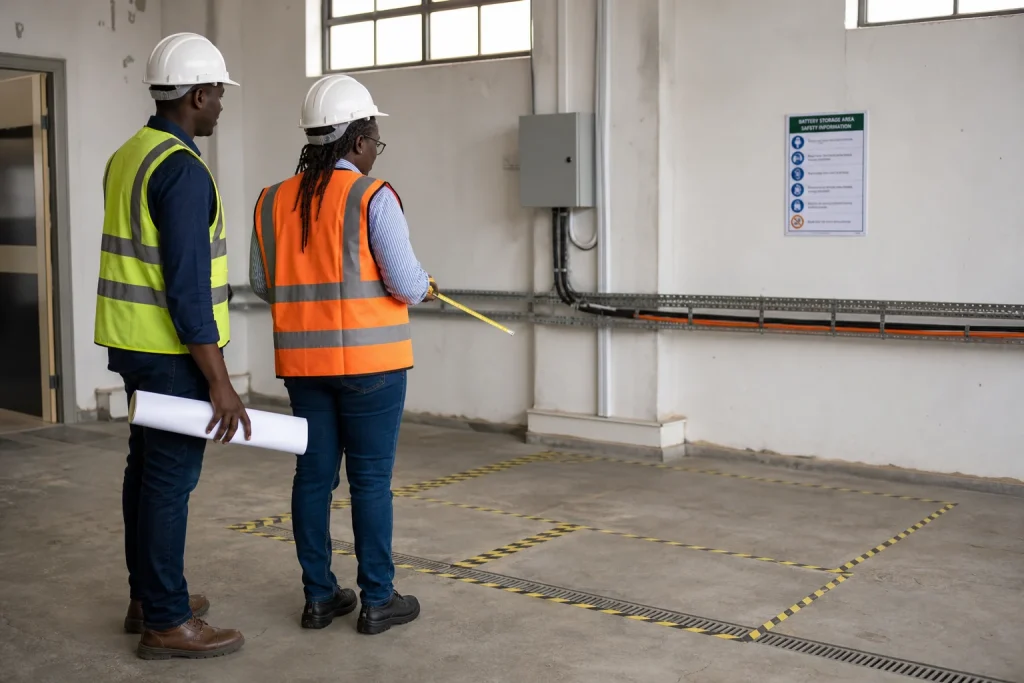
Location selection should consider equipment instructions, environmental limits, access control, ventilation or cooling needs, water exposure, dust, corrosive conditions, impact risk, cable distance and maintenance clearance. Do not assume that an unused cupboard, roof corner or generator room is suitable. Record normal and extreme site conditions before specifying equipment.
The project team should coordinate detection, warning, emergency isolation, firefighting strategy, evacuation, signage and response information with competent safety and building professionals. Requirements vary by technology, size, configuration and location. Generic internet diagrams should not replace manufacturer information and the approved site design.
Plan delivery and replacement routes. Battery modules and enclosures may be difficult to move through narrow doors or stairs, and future replacement must not depend on unsafe dismantling. Protect the area from unauthorised access while preserving access for inspection and emergency response.
Compare equipment through lifecycle evidence
A comparable schedule should state the proposed battery technology, rated and usable energy, power capability, operating limits, enclosure rating, controls, communications and required environmental conditions. Ask who issues each warranty, what conditions apply, how usage is recorded and what local or regional support process is available. Do not infer a warranty from a brand name alone.
Review expected duty against permitted cycling, reserve and temperature assumptions. If future expansion is proposed, ask how modules, controls, protection and physical space will be managed and whether mixed-age equipment is supported. “Expandable” should be demonstrated by documented limits and procedures.
Include maintenance, software, replacement and disposal responsibilities in the financial comparison. A lower purchase price may exclude controls, safe housing, commissioning, monitoring, subscriptions or end-of-life handling. This article does not provide prices, savings percentages or payback claims because those require a site-specific and time-sensitive assessment.
Control installation, commissioning and handover
Before mobilisation, agree equipment storage, delivery routes, work zones, isolations and the sequence for connecting existing sources. Verify drawings and settings against supplied equipment. Cable identification, torque records where required, protection settings, communications and emergency controls should be inspected through the approved quality process.
Commissioning should test safe normal operation and approved failure modes. Possible scenarios include grid loss and restoration, reaching battery reserve, generator availability, communications loss, alarm reporting, emergency isolation and recovery from bypass. Testing must be planned so it does not create an uncontrolled outage or unsafe condition.
Handover should include updated diagrams, equipment and serial schedules, test records, settings backups, user roles, monitoring access, warranty documents, maintenance instructions and an outstanding-items register. Train nominated operators to recognise normal status and alarms, but reserve regulated intervention for appropriately authorised people.
Confirm licensing and responsible end-of-life arrangements
The EPRA business-process page lists solar PV contractor, solar PV worker and electrical licensing processes. The EPRA renewable-energy page links to renewable-sector information and registers. Project-specific licensed solar PV contractor, solar worker and electrical arrangements must be confirmed in the written quotation before regulated work begins. ZES is not described here as holding an unverified solar licence.
Storage procurement also needs an end-of-life route. NEMA’s e-waste guidance addresses identification, collection, sorting, recycling and disposal of electrical and electronic waste. Kenya’s extended producer responsibility regulations include batteries and accumulators among covered products. Ask the supplier to state take-back, transport and responsible disposal arrangements rather than leaving expired batteries to the facility.
Coverage across Kenya’s 47 counties
Baringo, Bomet, Bungoma, Busia, Elgeyo-Marakwet, Embu, Garissa, Homa Bay, Isiolo, Kajiado, Kakamega, Kericho, Kiambu, Kilifi, Kirinyaga, Kisii, Kisumu, Kitui, Kwale, Laikipia, Lamu, Machakos, Makueni, Mandera, Marsabit, Meru, Migori, Mombasa, Murang’a, Nairobi City, Nakuru, Nandi, Narok, Nyamira, Nyandarua, Nyeri, Samburu, Siaya, Taita-Taveta, Tana River, Tharaka-Nithi, Trans Nzoia, Turkana, Uasin Gishu, Vihiga, Wajir and West Pokot.
ZES can consider enquiries across Kenya subject to scope, logistics, site access, responsible licensed arrangements, equipment availability and scheduling. This does not imply a ZES office, installer, battery stock, completed storage project or immediate availability in every county.
Frequently asked questions
How many batteries does a business need?
A count cannot be chosen responsibly without the critical-load power, operating duration, reserve policy, architecture, environmental conditions and equipment limits. Begin with the duty and measured load schedule.
Can battery storage power an entire building?
It can only serve loads within the approved power, energy and protection design. Many projects separate essential circuits and manage discretionary loads to achieve a practical, controlled outcome.
Does a solar battery work during a grid outage automatically?
Not every configuration does. Outage behaviour depends on inverter capability, isolation, controls, critical-load wiring and approved settings. It must be designed and tested rather than assumed.
Can existing solar panels be connected to a new battery?
Possibly, after checking the installed architecture, inverter compatibility, protection, warranties, controls and available documentation. A survey should determine whether modification or a separate arrangement is appropriate.
Who is responsible for old batteries?
The procurement scope should name the supplier, owner and approved waste or take-back route responsibilities. End-of-life handling should follow current Kenyan environmental requirements and must not be improvised after failure.
To define critical loads, location constraints and integration responsibilities, request a ZES site survey or share the storage enquiry with ZES. A written response should confirm capability, responsible licensed arrangements and the information needed before quotation.