
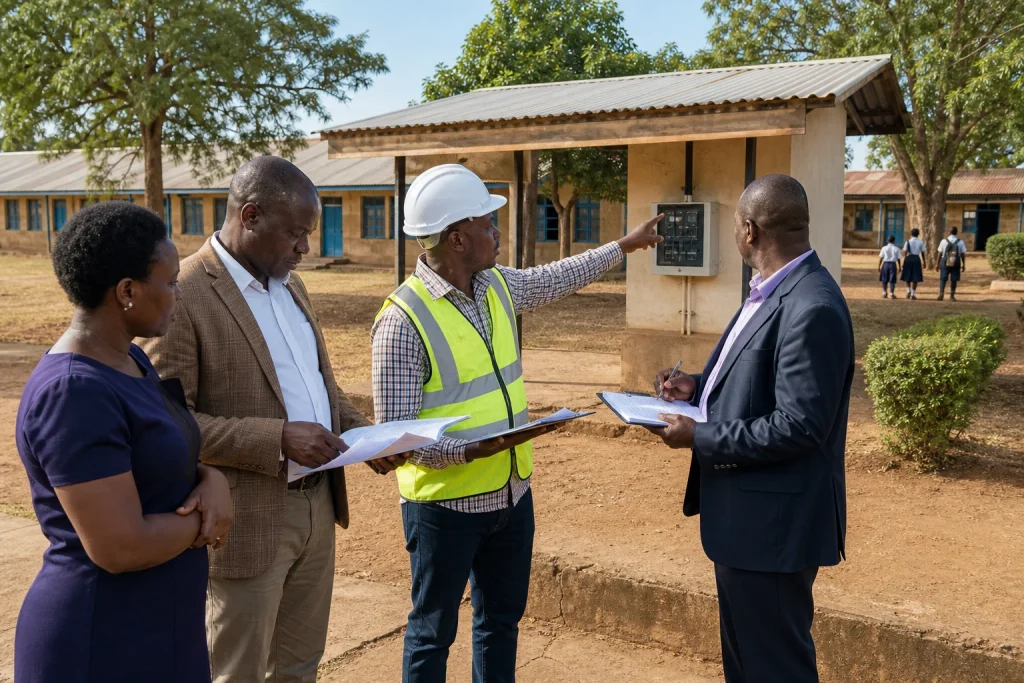
Solar installation for schools Kenya education leaders plan should support a defined learning and operational need while protecting pupils, staff and school assets. A day school, boarding school, college and training centre have different operating hours and electrical priorities. The first task is therefore to map the school day, not to select a standard package from enrolment numbers alone.
This guide helps boards, proprietors, principals, bursars, facilities teams and project committees prepare a clear solar enquiry. It relates to ZES information on generator and backup power. ZES can consider the requirement, but the written quotation must confirm capability, responsible licensed arrangements, equipment availability and project-specific safeguards.
The main solar installation services Kenya guide sets the general procurement boundary; this school-specific brief adds safeguarding, learning schedules, boarding loads and campus continuity considerations.
Set the purpose of solar installation for schools Kenya
List the service the project should improve. The objective may be to serve daytime teaching and administration loads, support selected boarding functions, improve continuity for communications, coordinate with an existing generator or provide electricity at a site with limited supply. Rank these outcomes so the design does not become an unpriced wish list.
Document term dates, weekday and weekend use, holidays, examination periods and community use of facilities. Boarding operations may continue when classrooms are closed. A vocational workshop or laboratory may create short, high loads, while offices and computer rooms may follow different schedules. Record planned buildings and changes in enrolment or equipment.
Identify who approves educational, financial, safeguarding and technical decisions. The school should know whether the board, proprietor, sponsor, public authority, landlord, donor or another party must approve the roof, procurement, asset ownership or maintenance arrangement. Those responsibilities should be resolved before ordering equipment.
Build a school load and priority schedule
Collect electricity bills and inspect the distribution boards. Prepare a room-by-room or function-by-function inventory covering administration, classrooms, computer labs, communications, lighting, security, kitchens, refrigeration, water pumping, dormitories, laboratories and workshops where present. Verify equipment ratings and operating times rather than using broad estimates.
Separate normal solar-offset loads from continuity loads. A grid-connected photovoltaic system does not automatically power circuits during an outage. If continuity is required, name the essential services, acceptable interruption and required operating period. This allows batteries, generators, uninterruptible power supplies and controlled load shedding to be considered responsibly.
Priorities should reflect safety and education, not convenience alone. Emergency arrangements, fire and security systems, communications, health-related equipment and water services may require input from the relevant responsible professionals. The solar designer should not independently redefine the school’s emergency plan.
Survey roofs, grounds and student-access risks
A school roof survey should record condition, structure, drainage, skylights, vents, lightning-protection interfaces, shade, access and planned repairs. Appropriate structural and building professionals should confirm suitability. Installing on a deteriorated roof can transfer a maintenance problem into a more complex and unsafe asset.
Ground or parking-area options require review of play areas, sports routes, vehicle movement, drainage, fencing, underground services and supervision. Equipment, ladders, isolators and cable routes should not be accessible to pupils or create climbing opportunities. Locate displays and learning features where they can be used without exposing students to electrical equipment.
Plan delivery, lifting and contractor movement around the school calendar. Separate work areas from pupils and staff, use authorised access routes and control tools and materials. A holiday window may reduce exposure but does not remove safeguarding, security or safe-work responsibilities.
Coordinate solar, storage, grid and generator roles
Document the incoming supply, metering, main switchboards, earthing, existing generators, transfer switches, UPS equipment and known electrical defects. Confirm drawings against the installed site. The proposal should include a preliminary single-line diagram showing the connection point, protection, isolation, monitoring and any essential-load arrangement.
If storage is considered, define its duty through the critical-load schedule and operating duration. Boarding lighting, communications or a water pump create different power and energy needs. Battery location must address environmental limits, access control, emergency planning, maintenance and eventual replacement; an unused store beside classrooms is not automatically suitable.
Generator coordination should cover starting, transfer, loading, fuel responsibility, maintenance and safe bypass. Solar and battery controls should not create an undocumented operating sequence. The design must state what happens during grid loss, low battery, generator failure and restoration.
Prepare a transparent school procurement brief
Give bidders the same school information: load inventory, bills, operating calendar, site plan, roof information, electrical arrangement, safeguarding rules, approval structure and desired programme. Ask each bidder to state assumptions, exclusions and information still needed. Compare proposals by outcome and completeness, not by panel count or headline price.
Request equipment and warranty schedules, preliminary drawings, installation method, monitoring, training, testing, maintenance and handover records. State who owns accounts, data, subscriptions, passwords and warranty claims. If donor or sponsor reporting is required, define the evidence without creating a second technical acceptance process.
The Ministry of Energy and Petroleum’s KOSAP newsletter describes stand-alone solar systems for public facilities, including secondary schools, as part of that specific national programme. This precedent does not make another school eligible for funding or promise a ZES role. Each institution still needs its own approvals, scope and procurement route.
Confirm licensing, standards and grid dependencies
The EPRA business-process page lists solar PV contractor, solar PV worker and electrical licensing processes. EPRA’s renewable-energy page links to regulatory information and registers. Project-specific licensed solar PV contractor, solar worker and electrical arrangements must be confirmed in the written quotation before regulated work begins. This draft does not describe ZES as EPRA-licensed or approved.
If a school is considering export, review the current Energy (Net-Metering) Regulations, 2024 and applicable utility requirements. Do not budget an export credit, approval or timetable as guaranteed. A proposal should identify who handles applications and what happens if the arrangement is unavailable.
Equipment selection and installation should follow applicable Kenyan requirements and approved manufacturer information. The quotation should name the standards and responsible parties used for the actual design rather than making a blanket “certified system” claim.
Control installation and school reopening
Prepare a work plan covering contractor induction, safeguarding, access, deliveries, work-zone separation, roof access, isolations, noise, dust, temporary outages and daily close-out. Keep emergency routes and school security arrangements operational. If work spans a term boundary, define how unfinished areas are secured before pupils return.
Commissioning should verify approved electrical functions, protection, isolation, labels, monitoring and any backup modes. Testing that affects supply must be agreed with school management. Record defects and outstanding items rather than accepting a partial demonstration as final completion.
Handover should include updated diagrams, equipment schedules, tests, warranty documents, monitoring access, maintenance instructions and safe-escalation contacts. Train nominated staff to observe status and report alarms, but do not encourage teachers, caretakers or students to open equipment or undertake regulated work.
Plan maintenance, learning use and end of life
Set an inspection and maintenance approach that reflects roof access, dust, vegetation, security and manufacturer requirements. Assign a budget and an internal asset owner. Record system changes and preserve configuration and monitoring credentials when school staff or service providers change.
Solar monitoring can support energy education, but public displays should use safe, privacy-conscious data and must not provide control access. Classroom learning activities should remain separate from live electrical equipment. A supervised explanation of generation data is safer than physical access to arrays, inverters or batteries.
Include replacement and disposal planning. NEMA’s e-waste guidance provides a framework for identifying, collecting, recycling and disposing of electrical and electronic waste. Ask suppliers to explain take-back and end-of-life arrangements for inverters, batteries and other covered equipment.
Coverage across Kenya’s 47 counties
Baringo, Bomet, Bungoma, Busia, Elgeyo-Marakwet, Embu, Garissa, Homa Bay, Isiolo, Kajiado, Kakamega, Kericho, Kiambu, Kilifi, Kirinyaga, Kisii, Kisumu, Kitui, Kwale, Laikipia, Lamu, Machakos, Makueni, Mandera, Marsabit, Meru, Migori, Mombasa, Murang’a, Nairobi City, Nakuru, Nandi, Narok, Nyamira, Nyandarua, Nyeri, Samburu, Siaya, Taita-Taveta, Tana River, Tharaka-Nithi, Trans Nzoia, Turkana, Uasin Gishu, Vihiga, Wajir and West Pokot.
ZES can consider enquiries across Kenya subject to scope, logistics, site access, responsible licensed arrangements, equipment availability and scheduling. This does not imply a ZES office, installer, stock, completed school-solar project or immediate availability in every county.
Frequently asked questions
Can one solar package suit every school?
No. Day or boarding operation, loads, roof condition, supply, continuity needs, budget, approvals and maintenance capacity vary. Each project needs a site-specific brief and design.
Will solar keep computer labs running during an outage?
Only if the approved system includes suitable outage operation, critical-load wiring and any required storage or backup. Standard grid-connected solar should not be assumed to provide backup.
When is the safest time to install?
A holiday may reduce interaction with pupils, but safe timing depends on access, weather, examinations, boarding use, security and electrical shutdowns. The school and contractor should agree a controlled programme.
Can students use the system as a learning resource?
Yes, through supervised access to suitable generation information and curriculum activities. Students should not access live equipment, roofs, batteries, isolators or control accounts.
What should a school send with a quotation request?
Provide bills, term and boarding schedules, a load inventory, roof and site information, generator details, planned expansion, approval contacts, safeguarding rules and the desired completion window.
For a school-specific assessment, book a ZES site survey, submit a quotation request or contact ZES. The written response should confirm scope, capability and responsible licensed arrangements before regulated solar work begins.