
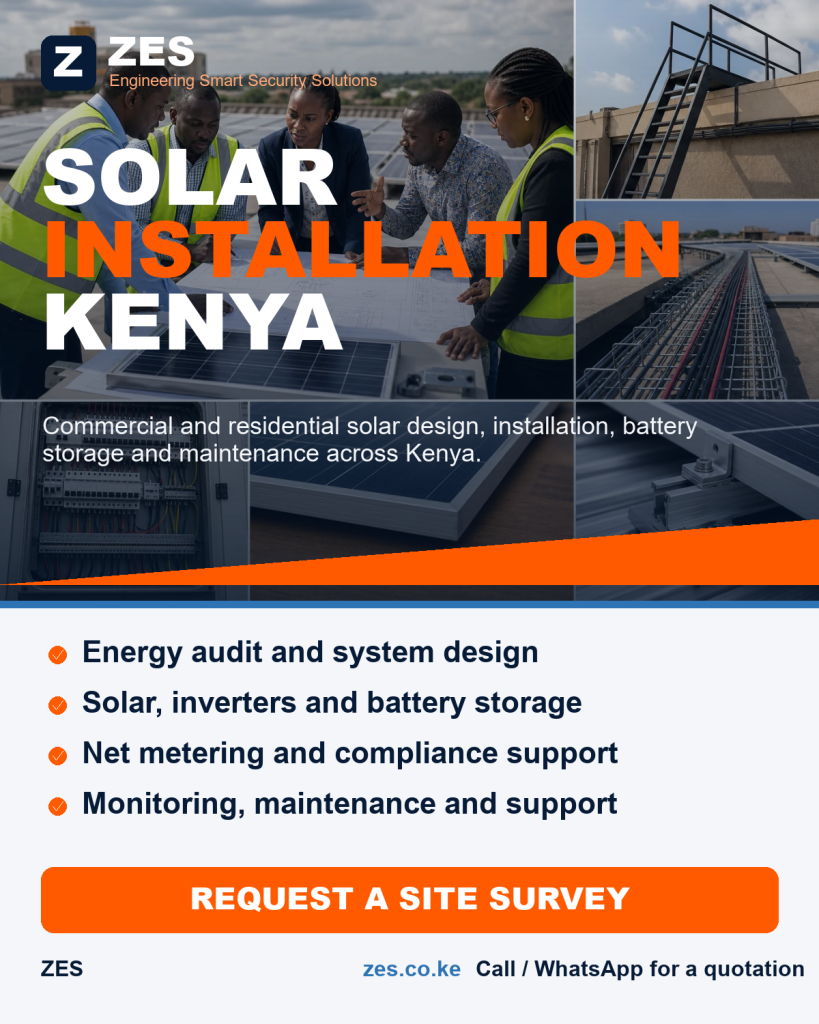
Solar installation in Kenya has moved from a niche backup option to a mainstream business decision. Electricity costs, reliability concerns, falling equipment prices and a growing push for cleaner energy have made solar attractive to factories, hotels, schools, hospitals, offices, farms, petrol stations and homeowners.
But solar is also a market where poor design and cheap installation cause lasting disappointment. Systems that are undersized, badly mounted, poorly protected or installed without a proper load assessment often fail to deliver the savings their owners expected.
This guide explains how solar works in the Kenyan context, what a proper system includes, how to assess your site, what affects cost, how net metering and compliance work, and how to choose an installer who will still be there when something needs attention.
It is written for decision-makers who want a system that performs, not just a quotation with a low headline price.
Why Solar Demand Is Rising in Kenya
Several forces have combined to make solar one of the fastest-growing categories of energy investment in Kenya.
Electricity costs. For commercial and industrial consumers, electricity is a significant operating expense. Solar reduces the amount of power purchased during daylight hours, which is when many businesses operate most heavily.
Reliability. Grid interruptions disrupt production, damage equipment and reduce revenue. Solar combined with battery storage can keep critical loads running.
Falling equipment prices. The cost of solar panels, inverters and batteries has fallen substantially over the past decade, improving payback periods.
Net metering. Kenya Power's net-metering programme allows eligible consumers to export excess solar generation to the grid and receive credit. This improves the economics of well-sized commercial systems.
Sustainability and reporting. Corporates, hotels and exporters increasingly need to demonstrate environmental performance to clients, investors and partners.
Energy independence. Businesses that generate their own power are less exposed to tariff changes and supply interruptions.
The result is strong demand across sectors — and a crowded market of installers with very different levels of competence.
In practical terms, Kenyan solar projects range from small residential systems of a few kilowatts to commercial installations of tens or hundreds of kilowatts, and industrial sites that generate a substantial share of their own power. The design principles are the same at every scale: understand the load, assess the site, size the equipment correctly, protect it properly, commission it carefully and monitor it continuously. What changes is the engineering depth, the compliance requirements and the financial stakes. A home system installed badly is an inconvenience; a factory system installed badly can stop production.
Types of Solar Systems
Understanding the main system types helps you choose the right approach.
Grid-Tied Solar
A grid-tied system generates power during the day and uses the grid as a backup when solar is insufficient. It does not provide backup during outages unless it includes batteries or a hybrid inverter with backup capability. Grid-tied systems are efficient and cost-effective where reliability is not the main concern.
Off-Grid Solar
An off-grid system operates independently of the grid, using batteries to store energy for night and cloudy periods. It suits remote sites, farms, lodges and locations where connecting to the grid is expensive or impossible. Off-grid systems require careful sizing because there is no grid to fall back on.
Hybrid Solar
A hybrid system combines solar, batteries and the grid. It can reduce consumption, provide backup during outages and manage when power is drawn from the grid, the panels or the battery. Hybrid systems are increasingly the default choice for commercial and residential users in Kenya because they address both cost and reliability.
Solar Water Heating
Solar thermal systems heat water directly, reducing the electricity or gas used for water heating. They are common in homes, hotels, hospitals and institutions.
Solar Carports and Ground-Mounted Systems
Solar can be mounted on carports, ground structures or dedicated frames where roof space is limited. These are common for commercial sites with large parking areas or open land.
Solar for Specific Applications
Solar is also used for street lighting, boreholes and pumps, telecom sites, CCTV and remote monitoring, and refrigeration. Each application has its own design considerations.
Core Components of a Solar System
A professional quotation should account for every element, not just panels and an inverter.
Solar panels. The panels convert sunlight into electricity. Key factors are wattage, efficiency, temperature performance, warranty and physical size.
Inverter. The inverter converts direct current from the panels into alternating current for your equipment. Inverter choice affects efficiency, backup capability and monitoring.
Batteries. Batteries store energy for night or outages. Lithium iron phosphate (LiFePO4) batteries are increasingly preferred for their cycle life and safety, though lead-acid remains in use for some applications.
Mounting structure. Roof mounts, ground mounts or carports must be engineered for wind load, roof condition and waterproofing. Poor mounting is a common cause of leaks and failures.
DC and AC cabling. Correct cable sizing, UV-resistant materials and proper routing matter for safety and performance.
Protection. DC isolators, surge protection, circuit breakers, earthing and lightning protection are essential in Kenya's environment.
Monitoring. Remote monitoring shows generation, consumption, battery state and faults, so problems are detected early.
Metering and integration. Where net metering is used, proper metering and interconnection are required.
Labels and documentation. A well-installed system is documented, labelled and safe to maintain.
Site Assessment and System Design
Solar design starts with the site and the load, not the panel catalogue. A proper assessment covers:
Load audit. What equipment runs, when, and how much power it draws. A load audit identifies the real consumption profile and the loads that matter most.
Generation potential. Roof orientation, tilt, shading and available area determine how much solar can be generated.
Roof condition and structure. The roof must be strong enough, in good condition and suitable for mounting without leaks or damage.
Backup requirements. Which loads must run during an outage, and for how long? This determines battery size and inverter capability.
Future expansion. Space, inverter capacity and cabling should allow growth.
Grid connection. Whether net metering is possible, what the connection requires and how the system will interact with the grid.
Safety and protection. Earthing, lightning protection, surge protection and fire safety.
Monitoring and access. How the system will be monitored and who will respond to faults.
A written design with a load calculation, generation estimate, equipment schedule, single-line diagram and expected performance is the mark of a professional installer. If a quotation arrives with no assessment, treat it with caution.
The Solar Installation Process
A well-run project follows a clear sequence.
1. Consultation and site survey. Understand objectives, walk the site and collect the data needed for design.
2. Load audit and design. Calculate consumption, size the system, select equipment and estimate generation.
3. Quotation and agreement. Provide an itemised quotation with scope, responsibilities and timelines.
4. Compliance and approvals. Where required, handle net metering, licensing and utility approvals.
5. Installation. Mount the structure, install panels, run cabling, install inverters, batteries and protection.
6. Testing and commissioning. Test every string, every circuit and every safety device, and verify performance.
7. Monitoring setup. Configure monitoring and confirm data is visible.
8. Training and handover. Explain the system, its limits, its maintenance needs and what to do in a fault.
9. Support and maintenance. Provide a support path and a maintenance schedule.
Skipping the load audit or the commissioning is where most problems begin. A system that looks fine on the roof but is undersized, badly wired or unsafe will disappoint its owner.
Net Metering and Compliance in Kenya
Kenya Power's net-metering programme allows eligible customers to export excess solar energy to the grid. This can improve the economics of commercial systems, but it requires proper application and compliance.
Key considerations include:
- Eligibility and application requirements
- Metering arrangements
- Safety and interconnection standards
- Approval timelines
- Limits on export capacity
- Ongoing reporting requirements
Solar installations must also comply with electrical safety standards and, depending on scale, may require approvals from relevant authorities. A professional installer will guide you through the process and provide the documentation required.
Be cautious of providers who promise net metering without explaining the application process, eligibility or timelines. It is a regulated programme, not an automatic feature.
Battery Storage
Batteries change what a solar system can do. They store surplus generation for use at night or during outages and allow a system to support critical loads when the grid fails.
Key decisions include:
Battery chemistry. Lithium iron phosphate is increasingly preferred for safety, cycle life and depth of discharge. Lead-acid is cheaper upfront but requires more maintenance and replacement over time.
Capacity. Sized to the loads you want to support and the duration required.
Inverter compatibility. Not all batteries work with all inverters.
Backup vs. self-consumption. Some systems use batteries mainly to shift solar energy to evening use; others use them mainly for backup.
Safety. Location, ventilation, temperature and fire safety matter.
Warranty and support. Battery warranties vary widely, and support matters when a battery fails.
Battery sizing is often where buyers are most vulnerable to poor advice. An undersized battery will not carry the loads during an outage, while an oversized one adds unnecessary cost.
Maintenance and Monitoring
Solar systems are low-maintenance but not maintenance-free. Common issues include dirty panels, loose connections, failed inverters, battery degradation, shading from new structures or vegetation, and tripped protection devices.
A maintenance arrangement typically includes:
- Cleaning panels where dust or dirt reduces output
- Checking mounting and roof integrity
- Inspecting cabling, connections and protection
- Reviewing inverter and battery performance
- Checking monitoring data for anomalies
- Testing safety devices
- Reviewing battery health and capacity
- Updating firmware where appropriate
- Documenting performance over time
Remote monitoring is valuable because it identifies problems early. A system that silently underperforms for months can lose far more value than the cost of a maintenance visit.
What Affects Solar Installation Cost in Kenya
Buyers often ask for a price per kilowatt before describing the site. That is not how a reliable quotation works. Cost depends on:
System size. The capacity you need, based on consumption and objectives.
System type. Grid-tied, hybrid and off-grid systems have different costs.
Battery storage. Batteries can be a significant share of the total cost.
Panel and inverter quality. Brand, efficiency and warranty affect price.
Mounting. Roof, ground or carport mounting, and any structural work required.
Cabling and protection. Distance, safety devices and earthing.
Site access and installation difficulty. Height, roof type and logistics.
Compliance and approvals. Net metering and licensing costs where applicable.
Monitoring and support. Remote monitoring and maintenance arrangements.
Financing. Interest or fees if the system is financed.
A good quotation itemises these elements and states expected generation and payback assumptions. Be cautious of a very low price per kilowatt: it usually means smaller or lower-quality equipment, missing protection, or no real design.
Financing a Solar System
Solar is a capital investment, and many organisations need a way to fund it. Common approaches include:
Direct purchase. The organisation buys the system and owns the savings.
Asset finance. A lender finances the system, and the savings help service the payment.
Power purchase agreements. A third party owns the system and sells power to the customer, reducing upfront capital.
Leasing. A structured lease spreads the cost over time.
Each has different tax, accounting and risk implications. The right choice depends on the organisation's cash flow, balance sheet and appetite for ownership. A good installer will explain the options honestly rather than pushing the one that suits them best.
How to Choose a Solar Installer in Kenya
Use this checklist.
1. Do they do a site survey and load audit? Without these, the system is guesswork.
2. Do they provide a written design? Load calculation, generation estimate, equipment schedule and single-line diagram.
3. Is the quotation itemised? Panels, inverter, batteries, mounting, cabling, protection, labour and commissioning.
4. Do they explain net metering and compliance? Including eligibility, process and timelines.
5. Do they address safety? Earthing, lightning protection, surge protection and fire safety.
6. Do they explain battery sizing and trade-offs? Backup duration, chemistry and warranty.
7. Can they support and maintain the system? Ask about response times and monitoring.
8. Do they have relevant experience? Ask for comparable installations in your sector.
9. Are they transparent about limitations? Good providers explain what solar will and will not do.
10. Do they provide documentation and training? You should understand your system and its limits.
Common Mistakes Buyers Make
Buying on price per kilowatt alone. Low prices often hide undersized or low-quality equipment.
No load audit. Systems sized on guesswork rarely deliver the expected savings.
Ignoring roof condition. Solar mounted on a weak or leaking roof creates bigger problems.
Undersized batteries. Backup that cannot carry the intended loads is a common disappointment.
No protection. Surge, earthing and lightning protection are essential in Kenya.
Skipping commissioning. Unverified systems can underperform silently.
No monitoring. Problems go unnoticed for months.
No maintenance. Dust, loose connections and battery degradation reduce output.
Unrealistic payback expectations. Savings depend on consumption patterns and tariffs.
No documentation. Without a single-line diagram and equipment records, future maintenance becomes difficult.
Solar by Sector
Factories: large daytime loads, often combined with battery storage and energy management.
Hotels: high consumption for water heating, cooling and lighting; solar thermal plus PV.
Schools: daytime loads, with solar providing predictable savings and reliability.
Hospitals: critical loads requiring backup and careful design.
Offices: daytime consumption, increasingly combined with hybrid systems for backup.
Farms and agribusiness: irrigation pumps, cold storage and remote sites.
Petrol stations: canopies, pumps, lighting and payment systems, often with backup.
Homes: hybrid systems for savings and backup, plus solar water heating.
Retail: refrigeration and lighting, where reliability protects stock.
Understanding Your Electricity Bill and Consumption
Most solar decisions start with a bill, but a bill alone does not tell you how to design a system. It tells you how much you paid, not when you used the power.
A useful solar assessment looks at three things.
Total consumption over time. Monthly or, better, interval data shows how much energy the site uses and how it varies by month and season.
The shape of consumption. A business that runs heavy loads during daylight hours has a very different solar opportunity from one that operates mainly at night. Shifting some loads to daylight can improve solar economics significantly.
The tariff structure. Demand charges, time-of-use rates and fixed charges all affect savings. Solar reduces energy charges, but it does not remove fixed or demand charges unless those are managed separately.
This is why a load audit matters. It separates the theoretical saving from the achievable saving, and it prevents the common mistake of buying a system that generates power when the site cannot use it.
Solar System Sizing: A Practical Walkthrough
Sizing is where good and bad proposals diverge most sharply. A responsible process looks like this.
Step one: establish the load. List the major equipment and its power draw, then estimate how many hours each runs. For commercial sites, interval meter data is far better than estimates.
Step two: decide the objective. Are you reducing daytime consumption, providing backup, or both? The objective determines whether batteries are needed and how large they should be.
Step three: assess generation. Roof area, orientation, tilt and shading determine how much solar can be installed and how much it will generate. A site with a shaded or small roof may support less than the load requires.
Step four: size the inverter. The inverter should handle the array and the loads, with headroom for expansion. Undersized inverters clip generation; oversized ones add cost.
Step five: size the battery. Battery capacity should be based on the loads you want to support and the duration required, not on a round number.
Step six: check the economics. Estimate generation, savings and payback under realistic assumptions. Be sceptical of payback claims that ignore tariffs, degradation or maintenance.
Step seven: plan for growth. Leave room for additional panels, batteries or loads.
A proposal that skips these steps is a product sale, not a design.
Roof, Ground and Carport Mounting
Mounting is often treated as an afterthought, yet it determines whether a system lasts.
Roof mounting is the most common approach. It requires a roof in good condition, adequate structure and careful waterproofing. Penetrations must be sealed properly, and the mounting must be engineered for wind loads.
Ground mounting suits sites with available land. It allows better orientation and easier maintenance, but requires foundations, security and cable routing.
Carport mounting uses parking areas to generate power while providing shade. It is attractive for commercial sites with limited roof space and large parking areas.
Elevated structures can be used where roof or ground space is restricted, but structural engineering is essential.
In every case, the mounting must be corrosion-resistant, properly earthed and designed for the site's wind and environmental conditions. A poorly mounted system is a safety risk and a maintenance headache.
Solar Water Heating
Not all solar is photovoltaic. Solar water heating uses thermal collectors to heat water directly, reducing the electricity or gas used for water heating.
It is particularly relevant for hotels, hospitals, schools, staff quarters and homes, where hot water demand is significant and predictable. Solar thermal systems are generally simpler and cheaper per unit of energy saved than PV for water heating, but they require storage tanks, plumbing and freeze or overheating protection.
A combined approach — solar thermal for hot water and PV for electricity — often delivers the best overall return for sites with high hot water demand.
Common Myths About Solar in Kenya
"Solar means no more electricity bills." Solar reduces consumption charges but rarely eliminates fixed charges, demand charges or night-time consumption. The saving depends on the design and the load profile.
"A bigger system is always better." Oversizing wastes capital, especially where the site cannot use the generation or export it.
"Any installer can do it." Solar involves electrical safety, structural mounting, protection and compliance. Poor installation is dangerous and expensive to fix.
"Batteries last forever." Batteries degrade with cycling and age. Their replacement should be budgeted.
"Solar works perfectly during outages without batteries." Grid-tied systems without batteries shut down during outages for safety.
"Cheap panels are just as good." Panel quality, warranty and degradation rates vary significantly.
"Net metering is automatic." It is a regulated programme with application and approval requirements.
"Maintenance is unnecessary." Dust, loose connections and failing components reduce output over time.
Solar and Energy Management: Beyond Generation
Solar is most valuable when it is treated as part of a wider energy strategy rather than a standalone gadget.
Measure first. Metering and monitoring show where energy is actually used. Many organisations discover that cooling, water heating, compressed air or lighting dominate consumption, and that efficiency measures reduce the solar capacity required.
Shift loads to daylight. Where tariffs and operations allow, moving flexible loads — such as water pumping, charging or some production processes — into daylight hours increases the share of solar energy used on site.
Manage demand. Reducing peak demand can lower demand charges, which solar alone does not address.
Combine with efficient equipment. LED lighting, efficient motors, variable speed drives and improved insulation reduce the load that solar must support.
Plan for storage. Batteries are most valuable where they protect critical loads or shift solar energy into expensive evening periods.
An installer who understands energy management will often propose a smaller, better-performing system than one who simply sells panels. That is a good sign, not a reason to worry.
A Final Pre-Purchase Checklist
Before approving a solar quotation, confirm the following. Make sure a site survey and load audit have been completed. Check that the design includes a load calculation, generation estimate, equipment schedule and single-line diagram. Confirm that the quotation is itemised by panels, inverter, batteries, mounting, cabling, protection, labour and commissioning. Ask about expected generation and the assumptions behind any savings or payback figures. Confirm the net-metering process, eligibility and timeline if it is part of the proposal. Ask how the system behaves during an outage. Confirm the battery sizing basis and warranty. Check the earthing, surge and lightning protection. Ask how monitoring works and who responds to faults. Confirm the maintenance arrangement, documentation and training. Finally, compare at least three quotations against the same design brief.
A provider who welcomes these questions is usually the one worth choosing.
Frequently Asked Questions
How much does solar installation cost in Kenya?
Cost depends on system size, type, battery storage, equipment quality, mounting, cabling, protection, compliance and installation difficulty. Request an itemised quotation after a site survey and load audit.
How much solar do I need?
The right size depends on your consumption, the loads you want to support and whether you need backup. A load audit and design determine the correct capacity. Guessing from a monthly bill alone is not reliable.
Does solar work during a power outage?
Only if the system includes batteries and a suitable inverter. A standard grid-tied system shuts down during an outage for safety reasons.
What is net metering?
Kenya Power's net-metering programme allows eligible customers to export excess solar generation to the grid and receive credit. It requires application, approval and compliance with interconnection standards.
How long do solar panels last?
Quality panels typically carry performance warranties of 25 years or more, though actual output declines gradually over time. Inverters and batteries have shorter lives and should be budgeted for.
Do I need batteries?
Not necessarily. Batteries are needed for backup or for shifting solar energy to evening use. A grid-tied system without batteries can still reduce daytime consumption.
Can solar reduce my electricity bill significantly?
It can, depending on consumption patterns, tariffs and system size. Savings are highest where consumption coincides with solar generation, such as daytime industrial or office loads.
What maintenance does a solar system need?
Cleaning, inspection of mounting and cabling, checking protection devices, reviewing inverter and battery performance, and monitoring output. Remote monitoring helps detect problems early.
Is solar safe?
Yes, when designed and installed correctly. Safety depends on proper earthing, surge and lightning protection, correct cable sizing, fire safety and qualified installation.
Can I expand my solar system later?
Often yes, if the design allows for it. Inverter capacity, roof space, cabling and battery capacity should be planned with growth in mind.
Conclusion
Solar installation in Kenya is a long-term investment that rewards good design and punishes shortcuts. The difference between a system that saves money for years and one that disappoints is not the brand on the panel — it is the load audit, the system sizing, the mounting, the protection, the commissioning, the monitoring and the support that follows.
If you are planning a solar project, start with your consumption and your objectives. Then insist on a site survey, a load audit, a written design, an itemised quotation, a clear compliance path and a maintenance plan.
ZES designs, installs, commissions, monitors and maintains solar and energy systems for businesses, institutions and homes across Kenya. If you would like a practical assessment of your site and a clear, itemised quotation, start with a site survey.