
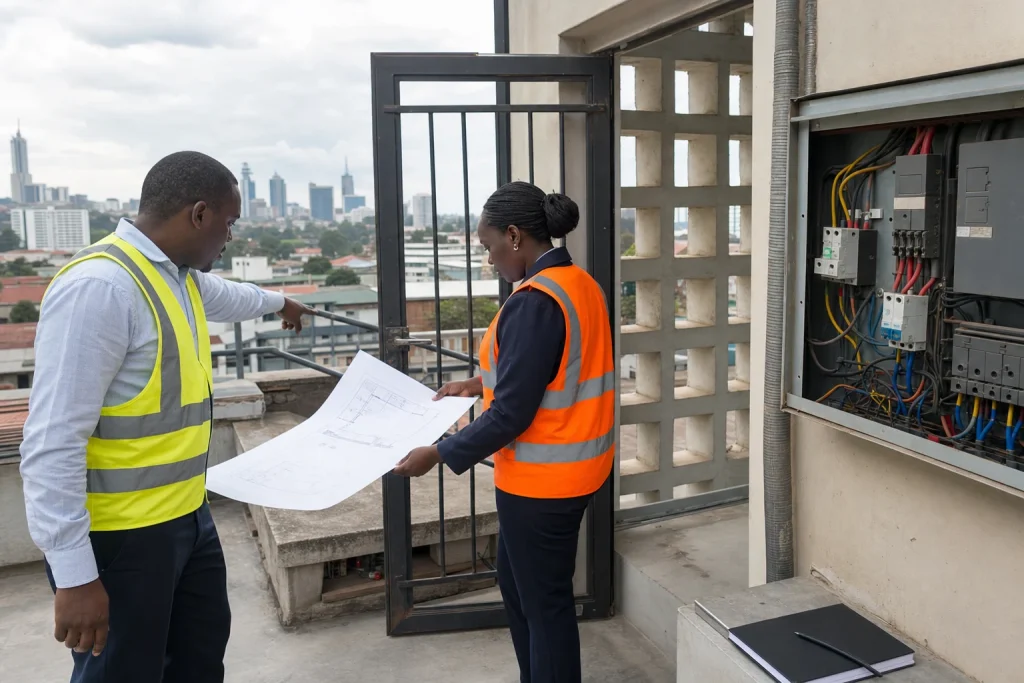
Solar power system installation Nairobi planning should respond to the real property rather than a standard equipment bundle. A multi-tenant office, workshop, clinic, school, hotel, shop and warehouse can have similar monthly bills but very different daytime loads, outage consequences, roof access and electrical infrastructure. The initial brief must explain which operating problem the system should solve and which site conditions will control design and installation.
Zama Engineering Systems (ZES) can review a preliminary Nairobi enquiry and identify information needed for a scoped assessment. Before regulated work begins, the written quotation must confirm the project-specific licensed solar PV contractor, solar worker and electrical arrangements. No licence, stock, brand relationship, completed project, output, saving, response time or approval should be inferred from this planning guide.
The national solar installation services Kenya guide explains the overall procurement pathway; this Nairobi article narrows that pathway to occupied-property access, urban logistics and site-planning evidence.
Solar power system installation Nairobi enquiries need an operating brief
Describe the property, occupants, working hours, electricity problem and desired decision date. State whether the priority is lower daytime grid use, continuity for selected equipment, support during scheduled interruptions, or a more independent supply. List activities that cannot tolerate an uncontrolled shutdown: point-of-sale systems, refrigeration, medical equipment, security, networks, lifts, pumps, production machines or tenant services.
Collect recent electricity bills, available maximum-demand or interval information, generator fuel and runtime records, and a schedule of important loads. Separate essential loads from convenient loads. Record planned air-conditioning, machinery, EV charging, kitchen equipment or additional tenants. This evidence helps the designer avoid both an undersized system that misses the objective and an oversized proposal built around an unrealistic estimate.
Choose architecture after defining outage behaviour
A grid-connected PV system, hybrid solar and battery system, and off-grid system are different engineering responses. Ask the proposal to describe normal operation, loss of grid, return of grid, generator operation, battery limits and manual or automatic controls. The client should understand which circuits remain supplied, for how long under stated assumptions, and which equipment will not operate during an outage.
Battery capacity must follow supported loads, required runtime, depth-of-discharge limits, environmental conditions and lifecycle expectations. Large motors and compressors may have starting behaviour that changes inverter selection. A generator interface needs an approved control philosophy and protection; it is not enough to connect several sources to the same board. No responsible supplier should promise “uninterrupted power” without defining failure modes and acceptance tests.
Survey Nairobi roof, access and neighbouring constraints
Urban and peri-urban properties often have constrained loading areas, shared driveways, occupied floors, roof tanks, communications equipment, HVAC units and limited crane or scaffold positions. The survey should confirm how materials reach the work area, where they can be stored, which occupants need protection and when noisy or isolating work is permitted. Landlord, tenant, estate-management and building-management approvals should be identified early.
For a roof installation, record roof type, condition, corrosion, leaks, structure, slope, drainage, shading and remaining service life. Note parapets, nearby taller buildings, trees, tanks, antennas and planned construction. The responsible structural party must assess project-specific loads and fixing details. Roof waterproofing and making-good responsibilities should be documented so that neither the solar installer nor the roofing contractor assumes the other owns a leak.
Locate inverters, batteries and switchgear responsibly
Equipment locations affect cable length, efficiency, safety, maintenance and public access. Inverters and electrical assemblies need suitable environmental protection, ventilation, working clearance and secure access. Battery arrangements require project-appropriate protection, temperature management, spacing and emergency information. Avoid escape routes, flood-prone rooms, uncontrolled heat, combustible storage and locations where equipment can be struck by vehicles or trolleys.
If an external enclosure or protective steelwork is required, its design must preserve equipment ventilation, clearances, inspection and emergency access. A cage that improves security but traps heat or blocks isolation is not a successful solution. Any support frame or canopy should be coordinated with the equipment manufacturer, structural information and cable-entry requirements before fabrication.
Record the existing electrical installation before changing it
The site survey should identify the incoming supply, phases, metering, distribution boards, protective devices, earthing, cable condition, isolation points and any generator, UPS or voltage-control equipment.
Ask the proposal to state connection point, protection and isolation basis, cable routes, monitoring, required board changes and responsibility for corrective electrical work discovered during assessment. Solar should not be used to disguise unsafe distribution equipment or undocumented temporary connections. Where work affects an operating building, agree outage windows and client sign-off before isolations are scheduled.
Verify the responsible licensed delivery team
EPRA publishes business and licence processes for solar PV contractors and workers and links renewable-energy information and registers from its renewable-energy page. Ask the bidder to provide the current project-appropriate licence details, responsible solar worker and electrical arrangements. Independently verify these details and any professional or structural roles required for the actual site.
The written quotation should identify who designs, installs, supervises, tests, submits notices, coordinates any utility process and issues completion records. If ZES coordinates an enquiry with another licensed party, that party’s identity, scope and contractual responsibility must be stated. ZES should not be described as EPRA-licensed, approved, accredited or an authorised dealer without current documentary evidence.
Compare a complete Nairobi installation quotation
A useful proposal records the design basis, array capacity, inverter architecture, storage where applicable, module and equipment model basis, mounting, protection, monitoring, cable routes, distribution changes, installation work, testing, documentation and exclusions. It should state the site information relied on and what remains subject to survey, structural review or final approval.
Check whether the price includes delivery and offloading, access equipment, roof work, electrical correction, civil bases, containment, earthing improvements, controlled shutdowns, labels, monitoring setup, training, taxes and post-installation support. Ask how substitutions will be controlled and which warranty comes from which contracting party or manufacturer. Do not accept generic claims about savings, payback or output without a documented calculation using the site’s evidence.
Phase installation around people and operations
The programme should distinguish design approval, procurement, delivery inspection, mounting, panel work, cable routes, equipment installation, shutdowns, energisation, testing and handover. Nairobi sites may require delivery bookings, security clearance, tenant notices, parking controls, noise restrictions or work outside customer hours. Weather, roof fragility and safe working-at-height conditions must remain part of daily planning.
Protect public and staff routes below roof work. Agree where packaging, tools and removed materials are stored. Photograph concealed or inaccessible work where the contract requires evidence. Any change in route, rating, mounting or equipment position should be recorded and approved before it becomes permanent.
Commission the system against written acceptance tests
Commissioning requirements depend on the approved design and applicable guidance. They may include mechanical inspection, polarity and insulation checks, earthing and protection verification, inverter and battery settings, monitoring setup, source-change behaviour, shutdown tests and functional checks of supported circuits. The responsible licensed personnel should define and record the exact tests.
Handover should provide approved drawings, schedules, serial information where required, settings, test records, user instructions, emergency isolation details, maintenance guidance, applicable project warranties and defect closeout. Authorised client staff should understand normal status, alarm escalation and whom to contact.
Handle net metering as a separate approval route
The Energy (Net-Metering) Regulations, 2024 provide customer, capacity and agreement conditions. Installing PV does not automatically create eligibility, approval or export credits. If net metering forms part of the business case, the quotation should identify who reviews current requirements, prepares technical information and coordinates the applicable distribution-licensee process without guaranteeing the outcome.
Coverage across Kenya’s 47 counties
Baringo, Bomet, Bungoma, Busia, Elgeyo-Marakwet, Embu, Garissa, Homa Bay, Isiolo, Kajiado, Kakamega, Kericho, Kiambu, Kilifi, Kirinyaga, Kisii, Kisumu, Kitui, Kwale, Laikipia, Lamu, Machakos, Makueni, Mandera, Marsabit, Meru, Migori, Mombasa, Murang’a, Nairobi City, Nakuru, Nandi, Narok, Nyamira, Nyandarua, Nyeri, Samburu, Siaya, Taita-Taveta, Tana River, Tharaka-Nithi, Trans Nzoia, Turkana, Uasin Gishu, Vihiga, Wajir and West Pokot.
ZES considers qualifying enquiries across Kenya subject to scope, logistics, safe site access, responsible licensed arrangements, equipment availability and scheduling. This national enquiry route does not imply a ZES office, installer, stock, completed project or immediate availability in every county.
Frequently asked questions
Can ZES quote a Nairobi system from photographs?
Photographs and bills can support an initial review, but they may not confirm structure, shading, electrical condition, cable routes or safe equipment locations. The response should state what requires a site survey before final design and price.
How much roof space will the system need?
That depends on the approved equipment, layout, shading, drainage, maintenance routes, structural constraints and useful system size. A generic area-per-panel calculation is not a final roof design.
Can solar be connected to an existing generator?
Possibly, but only through an approved architecture that defines protection, controls, operating modes and acceptance tests. Compatibility should be verified before any integration is promised.
Can installation happen without closing the business?
Much of the work may be phased, but connection and testing can require controlled isolations. The survey and programme should identify safe windows, notices, temporary arrangements and reopening checks.
What should a Nairobi business submit first?
Share the location, property type, operating hours, recent bills, important loads, outage concern, available roof or land information, existing backup equipment and any landlord or programme constraints.
Request a Nairobi solar site assessment
Review the relevant electrical infrastructure and backup-power interfaces, then book a site survey, request a scoped quotation or contact ZES. The written response must confirm the responsible licensed arrangements, technical boundaries, site logistics, exclusions and availability before regulated work begins.