
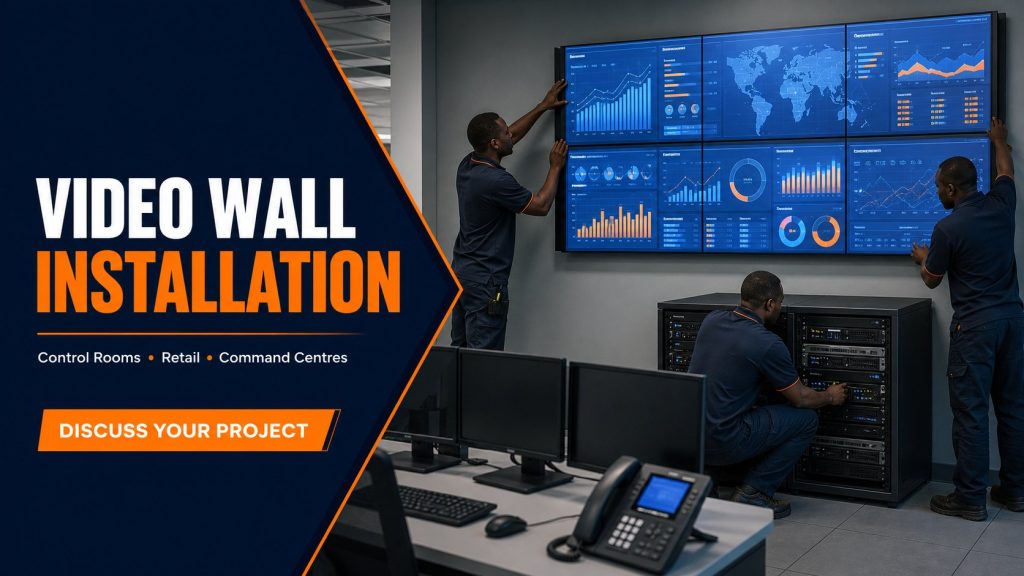
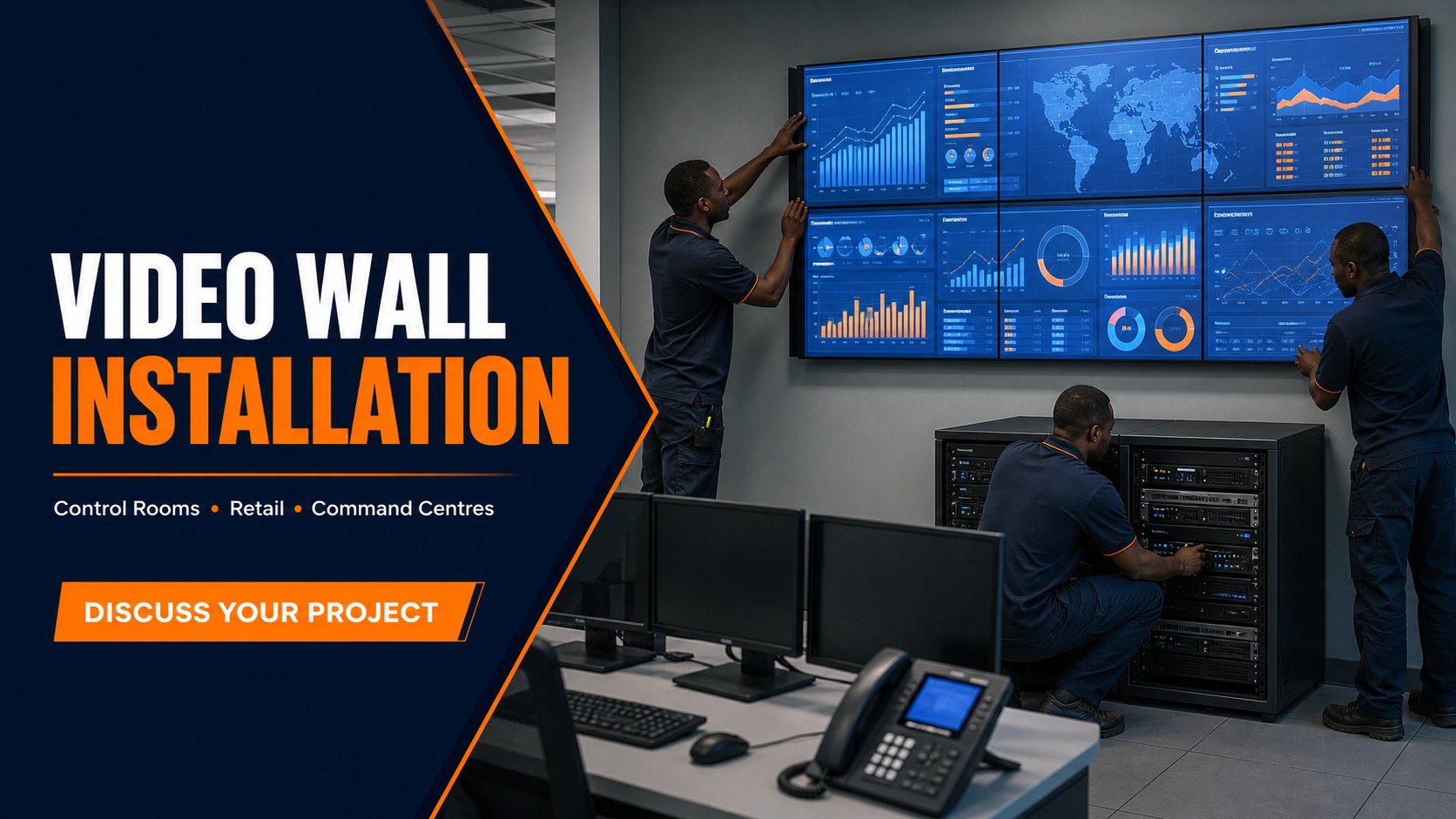
video wall installation company must coordinate structure, display geometry, signal distribution, processing, power, cooling, networking and maintenance access. A video wall is not simply several televisions placed close together: small errors in mounting or configuration become obvious across the complete canvas.
This guide is for security managers, operations teams, broadcasters, retailers, utilities, transport operators, factories, county facilities and organisations planning a large multi-screen operational or communications display.
When this service is the right fit
Video walls are appropriate where many sources must be viewed at once, one large image must reach a wide audience, or an operational team needs flexible layouts. The business case should identify the required sources, users, viewing distance, operating hours and consequence of downtime.
- Security operations and CCTV monitoring centres
- Network, fleet, utility and industrial control rooms
- Retail promotions, showrooms and experience centres
- Transport, emergency and command facilities
- Auditoriums, event spaces and corporate information walls
A useful proposal starts with the required business outcome. Screen size, camera coverage, viewing distance, wall construction, available power, network capacity, room acoustics, content sources, operating hours and future expansion can all change the correct design. Zama Engineering Systems (ZES) confirms these conditions during assessment rather than treating the installation as a one-product purchase.
What a professional scope should include
A professional video wall scope covers the physical wall and the systems behind it:
- Room and viewing-distance assessment
- Display matrix, bezel, brightness and duty-cycle selection
- Engineered wall or floor support with service access
- Video-wall controller, decoder or source-distribution design
- Power circuits, surge protection and controlled startup
- Network connectivity and approved remote-management method
- Mechanical alignment, colour and brightness calibration
- Source-layout testing, operator training and support documentation
The quotation should identify which equipment is supplied, which customer-owned devices will be retained, what cabling and builders work are included, what testing will be completed, and which subscriptions or third-party services remain the customer’s responsibility. This prevents a low headline price from becoming an incomplete installation.
Engineering and design decisions
Decisions must be tied to the content and operational environment:
- Panel size, matrix dimensions and overall aspect ratio
- LCD bezel video wall versus direct-view LED or a single large display
- Front-service or rear-service access and safe panel replacement
- Number, type, resolution and security level of content sources
- Controller capacity for present and future layouts
- Heat load, ventilation, ambient light and 24-hour duty requirements
Where displays, cameras, audio, control equipment and network devices share infrastructure, the design should document signal routes, cable categories, connection lengths, equipment ventilation, rack space, surge protection and access for future maintenance. Compatibility should be checked using exact device models rather than assumptions based only on connector appearance.
How ZES plans and delivers the project
1. Operational brief
ZES documents the content sources, audience, viewing positions, required layouts, operating hours and acceptable downtime.
2. Site and structure survey
Wall dimensions, floor loading where relevant, access, power, cooling, cable routes and maintenance clearances are checked.
3. Detailed system design
The matrix, mounting structure, displays, controller, sources, network and rack interfaces are specified as one system.
4. Mechanical and electrical installation
The support is levelled precisely, panels are installed in sequence, and labelled power and signal paths are connected.
5. Calibration and scenario testing
Alignment, brightness, colour, source switching and saved layouts are tested under realistic operating conditions before handover.
The handover should leave the customer able to operate the system without depending on undocumented settings. ZES records the agreed configuration, demonstrates normal operation, identifies routine checks and explains how faults should be reported. Passwords and administrative access should be transferred to authorised customer representatives using an agreed secure process.
Common problems this approach prevents
The most expensive video-wall problems usually come from design omissions rather than a single failed panel:
- A support structure that cannot maintain precise alignment
- No practical method to remove an inner panel for maintenance
- Controller inputs or outputs exhausted immediately after handover
- Uneven brightness, colour or scaling across the matrix
- Insufficient cooling around displays and rack equipment
- Unsecured content or management interfaces on the network
Some faults do not appear on installation day. Loose fixings, heat buildup, marginal signal paths, insufficient storage, weak wireless connectivity and inaccessible cable joints may emerge later. A practical design includes appropriate load margins, physical support, labelled cables, ventilation and maintenance access so the installation remains serviceable.
Integration with networking, security and power
ZES can integrate a video wall with CCTV recorders, fleet platforms, industrial monitoring, network-management dashboards, conferencing sources and control-room workstations. Each integration is confirmed against available outputs, resolution, licensing, cybersecurity policy and the number of simultaneous views required.
Business systems also need predictable power. Where the service is operationally important, the survey should consider surge protection, voltage quality, backup power and controlled shutdown. Remote access should use authorised accounts and appropriate network security; exposing equipment directly to the internet without a reviewed security method creates unnecessary risk.
What affects project cost?
A responsible quotation is based on the site and required outcome. The following factors normally have the greatest effect:
- Display technology, panel size and matrix dimensions
- Mounting structure and front- or rear-service mechanism
- Controller capacity, source count and required layouts
- Rack equipment, cabling, extenders and network interfaces
- Power distribution, cooling and room preparation
- Calibration, operator training, spares and support response
Customers receive a more useful quotation when they provide the site location, room or area photographs, device models, quantities, approximate mounting heights, available drawings, preferred completion date and the operational problem being solved. A site survey is recommended where wall structure, long cable routes, working-at-height access or system integrations cannot be confirmed remotely.
Service coverage across Kenya
ZES can assess projects in Kenya’s 47 counties, subject to project scope, scheduling, travel and site logistics. For county and subcounty work, the quotation identifies mobilisation, accommodation where applicable, access hours and any local coordination required. We do not publish hundreds of identical location pages; national and county content should provide genuine local service information, project evidence and useful subcounty coverage.
Questions to ask before appointing an installer
- What exact sources and layouts must be visible at the same time?
- Can every panel be safely accessed and replaced?
- What happens to the wall if the controller or one panel fails?
- Is capacity reserved for future sources and layouts?
- How are remote management and content access secured?
- What calibration and preventive maintenance are included?
Compare proposals on complete outcomes, not the cheapest equipment line. Confirm specifications, load ratings, cable management, configuration, testing, training, warranty, travel, taxes, exclusions and response arrangements. If an existing system is being expanded, ask how compatibility and current condition will be verified.
Related ZES services
- CCTV surveillance solutions
- CCTV installation company
- Network installation company
- Remote equipment monitoring
Frequently asked questions
How many screens can a video wall contain?
The matrix depends on viewing needs, available space, structure, controller capacity and budget. ZES sizes it from the operational brief.
Can a video wall show CCTV and business dashboards together?
Yes, if the controller and source interfaces support the required inputs, resolutions and layouts. Compatibility is confirmed during design.
Do video walls require special cooling?
Displays and controllers generate heat. The survey reviews ventilation, ambient temperature and rack cooling against equipment requirements.
Can one failed screen be replaced without dismantling the wall?
That depends on the mounting system and access design. Service access should be considered before the structure is ordered.
Does ZES provide ongoing maintenance?
A preventive plan can cover inspection, cleaning, calibration, source testing, backups and fault response.
Discuss your video wall project
Send the room dimensions, viewing distance, source list, preferred matrix and operating purpose for a structured design discussion.