
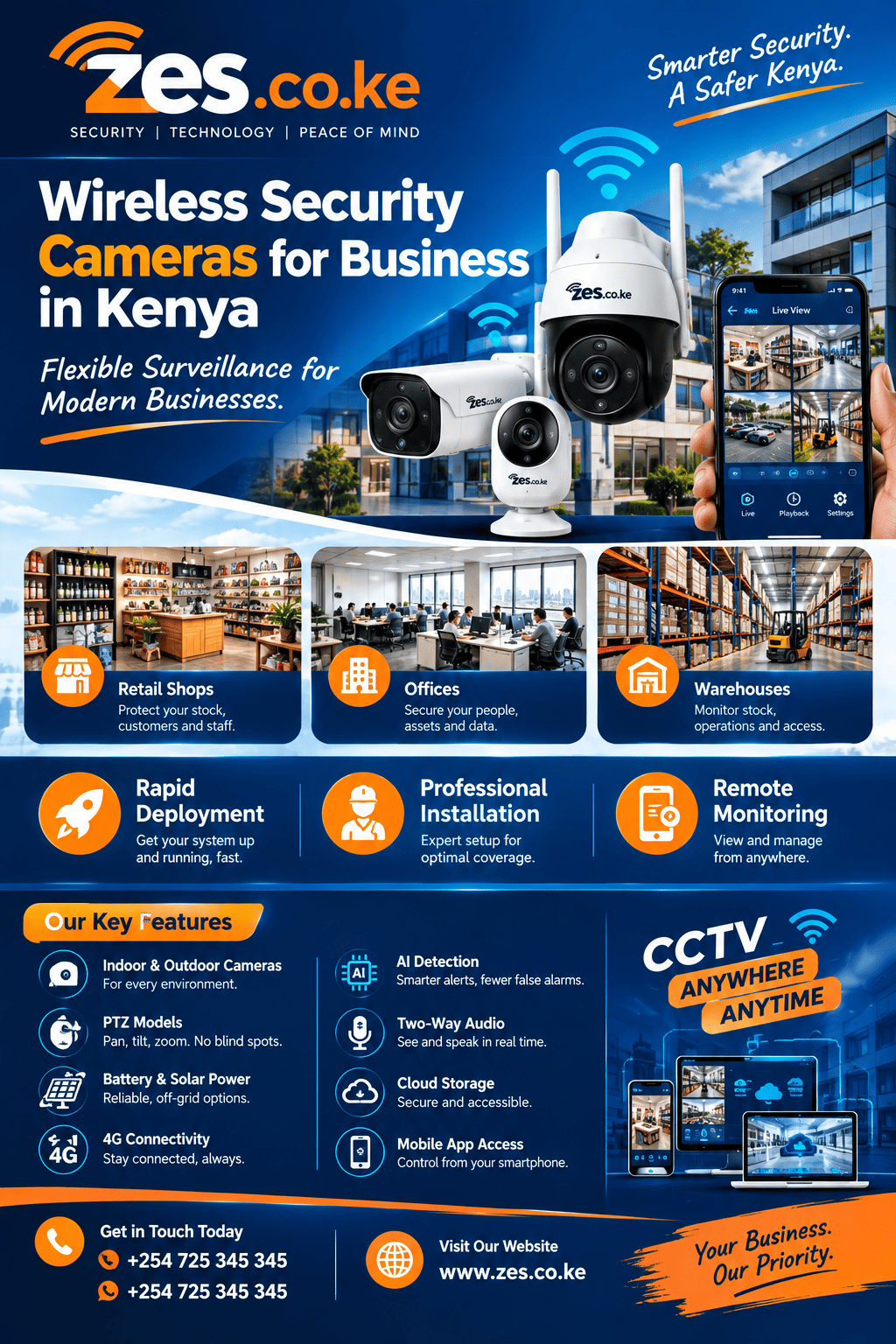
Wireless security cameras for business in Kenya have become the fastest-growing segment of the surveillance market, offering flexibility, rapid deployment, and modern features that traditional wired systems struggle to match. At zes.co.ke, we understand that wireless security cameras for business in Kenya solve real problems for organizations that cannot afford disruptive cabling works or lengthy installation timelines. Whether you operate a retail chain in Nairobi, a professional office in Mombasa, or a logistics yard in Athi River, understanding wireless security cameras for business in Kenya is the first step toward a surveillance system that fits your premises, your budget, and your operational reality.
The shift toward wireless security cameras for business in Kenya reflects broader changes in technology. Wi-Fi 6, improved battery chemistry, solar charging, and edge-based AI have removed many of the limitations that once made wireless systems a compromise. Today, wireless security cameras for business in Kenya can deliver 2K and 4K resolution, colour night vision, human and vehicle detection, and two-way audio—features that were once exclusive to premium wired installations. At zes.co.ke, we help clients match these capabilities to their specific security requirements.
For businesses evaluating wireless security cameras for business in Kenya, the appeal is straightforward. Installation does not require drilling through walls, running cables through ceilings, or hiring contractors for extended periods. A small office can be covered in hours rather than days. A temporary site can be secured without permanent infrastructure. A listed building can be monitored without damaging heritage features. These practical advantages explain why wireless security cameras for business in Kenya are increasingly specified alongside, or instead of, traditional wired systems.
Why Wireless Makes Sense for Kenyan Businesses
Kenyan businesses operate in diverse environments. Some occupy modern office parks with suspended ceilings and abundant power. Others operate from older buildings where cable routes are difficult and expensive. Some are in rented premises where landlords restrict structural modifications. Others are in industrial areas where harsh conditions demand rugged equipment. Wireless security cameras for business in Kenya address these varied scenarios with a flexibility that wired systems cannot match.
Power availability is a common constraint. Grid outages remain a reality in many areas. Wireless security cameras for business in Kenya that run on battery or solar can continue operating when mains power fails. This resilience is particularly valuable for retail premises, warehouses, and remote sites where uninterrupted surveillance is essential.
Connectivity is another consideration. While many urban areas enjoy reliable internet, some business locations do not. Wireless security cameras for business in Kenya that support 4G connectivity can operate independently of fixed broadband. This makes them suitable for construction sites, agricultural operations, and remote facilities. At zes.co.ke, we help clients choose connectivity options that match their location.
Types of Wireless Security Cameras for Business in Kenya
Understanding the categories of wireless security cameras for business in Kenya helps buyers make informed decisions. Each type has distinct characteristics, and the right choice depends on the specific application.
Indoor wireless cameras suit offices, retail floors, and reception areas. They typically plug into standard power outlets and connect over Wi-Fi. Many models offer pan and tilt capability, allowing a single camera to cover a wide area. Indoor wireless security cameras for business in Kenya are often used for employee safety, customer monitoring, and asset protection.
Outdoor wireless cameras are built to withstand weather. They feature IP65 or higher ratings, infrared or colour night vision, and durable housings. Outdoor wireless security cameras for business in Kenya protect perimeters, parking areas, loading bays, and building exteriors. Models with solar panels can operate entirely off-grid, making them suitable for gates and remote structures.
PTZ wireless cameras add pan, tilt, and optical zoom to the wireless form factor. These cameras can cover large areas and zoom in on details. PTZ wireless security cameras for business in Kenya are valuable for yards, warehouses, and large open spaces where fixed cameras would require many units.
Battery-powered cameras eliminate the need for any wiring. They record on motion and sleep between events to conserve power. Battery-powered wireless security cameras for business in Kenya are ideal for rental premises, temporary sites, and locations where power is unavailable. Battery life varies with usage, but modern models can operate for months between charges.
4G/LTE cameras use cellular networks for connectivity. These wireless security cameras for business in Kenya operate anywhere with mobile coverage. They are particularly useful for construction sites, remote warehouses, and agricultural facilities. Some models combine 4G with solar power for complete independence.
Multi-sensor cameras combine several lenses in one housing to cover wide areas without moving parts. These wireless security cameras for business in Kenya deliver panoramic coverage and are often used in large retail spaces and open-plan offices.
At zes.co.ke, we help clients select the right mix of these types based on their premises and priorities.
Key Features to Evaluate
Not all wireless security cameras for business in Kenya are equal. Several features determine whether a camera will meet your needs over its lifetime.
Resolution determines image detail. 1080p is the minimum for identifying faces and reading text. 2K and 4K provide greater detail, especially at distance. Higher resolution generally requires more bandwidth and storage, so balance is important. At zes.co.ke, we recommend resolution based on the smallest detail you need to capture.
Night vision is essential for 24/7 surveillance. Infrared night vision provides black-and-white images in darkness. Colour night vision uses advanced sensors and LED illumination to deliver colour images in low light, improving identification. Wireless security cameras for business in Kenya with full-colour night vision are increasingly common and increasingly affordable.
Field of view determines coverage. Wide-angle lenses capture more area but may distort at the edges. Some cameras offer adjustable fields of view. Matching field of view to the area being monitored ensures effective coverage without excessive overlap. At zes.co.ke, we plan coverage so each camera covers its assigned area efficiently.
AI-powered detection distinguishes people and vehicles from other movement. This dramatically reduces false alarms from animals, vegetation, and weather. Wireless security cameras for business in Kenya with on-camera AI process detection locally, reducing bandwidth and improving response times.
Two-way audio allows communication through the camera. This is useful for reception areas, delivery bays, and remote monitoring. Operators can greet visitors, instruct delivery drivers, or deter intruders. Wireless security cameras for business in Kenya with two-way audio add a layer of interaction that fixed cameras lack.
Local and cloud storage options provide flexibility. Local storage on microSD cards or NVRs keeps footage on-site without subscription fees. Cloud storage provides off-site backup and remote access. Many wireless security cameras for business in Kenya support both, allowing hybrid approaches.
Mobile app access enables monitoring from anywhere. Modern apps provide live view, playback, alerts, and camera control. The quality of the app experience often determines user satisfaction. At zes.co.ke, we prioritise cameras with well-designed apps and reliable remote access.
Weatherproofing matters for outdoor units. IP65, IP66, and IP67 ratings indicate resistance to dust and water. In coastal areas, corrosion-resistant materials extend equipment life. Wireless security cameras for business in Kenya installed outdoors must be rated for the local climate.
Network Infrastructure Requirements
Wireless security cameras for business in Kenya depend on robust network infrastructure. Unlike wired cameras that use dedicated cabling, wireless cameras share the Wi-Fi network with other business traffic. This sharing requires planning.
Wi-Fi coverage must extend to every camera location. Dead spots where cameras are installed will cause disconnections and recording gaps. A site survey identifies coverage requirements and informs access point placement. At zes.co.ke, we conduct surveys before recommending wireless security cameras for business in Kenya.
Bandwidth is another consideration. High-resolution cameras streaming continuously consume significant bandwidth. Network capacity must accommodate this traffic alongside business applications. Quality of service (QoS) settings can prioritise camera traffic or limit it to prevent impact on other systems.
Wi-Fi 6 and Wi-Fi 6E access points improve performance for wireless security cameras for business in Kenya. They support more devices, deliver higher throughput, and reduce interference. For businesses deploying multiple cameras, Wi-Fi 6 infrastructure is a worthwhile investment.
Network security is essential. Cameras are network devices and must be protected against unauthorised access. Strong passwords, encrypted communications, VLAN segmentation, and regular firmware updates are baseline requirements. At zes.co.ke, we configure wireless security cameras for business in Kenya with security best practices in mind.
Power Options for Wireless Cameras
Power is a key consideration for wireless security cameras for business in Kenya. Several options exist, each with trade-offs.
Mains power is the simplest option where outlets are available. Cameras plug in and operate continuously. This suits indoor installations and outdoor locations with accessible power. The limitation is that power outlets may not exist where cameras are needed.
Power over Ethernet (PoE) is technically wired but worth mentioning. PoE cameras receive power and data over a single cable, simplifying installation compared to separate power and data cables. While not strictly wireless, PoE cameras are often used alongside wireless security cameras for business in Kenya in hybrid designs.
Battery power eliminates wiring entirely. Cameras operate on rechargeable batteries and sleep between events. Battery life depends on usage, but modern wireless security cameras for business in Kenya can run for months on a charge. Batteries must be recharged or replaced periodically.
Solar power extends battery life indefinitely in sunny conditions. Solar panels charge batteries during the day, allowing continuous operation. Solar-powered wireless security cameras for business in Kenya are ideal for remote sites, gates, and outdoor areas without power. Kenya’s abundant sunshine makes solar an excellent option.
At zes.co.ke, we help clients select power solutions that match their sites and operational requirements.
Installation Considerations for Wireless Security Cameras for Business in Kenya
Installing wireless security cameras for business in Kenya is generally faster and less disruptive than wired installation, but it still requires planning.
Camera placement determines coverage. Cameras should be positioned to capture the areas that matter while avoiding obstructions and glare. Height affects both coverage and vulnerability to tampering. At zes.co.ke, we plan placement to optimise coverage and deter interference.
Mounting must be secure. Cameras mounted on walls, poles, or ceilings must withstand wind, vibration, and potential impact. Mounting hardware must match the surface and the camera weight. For outdoor installations, stainless steel hardware resists corrosion.
Wi-Fi signal strength at camera locations must be verified. Cameras too far from access points will experience dropouts. If signal is weak, additional access points or mesh nodes may be required. Wireless security cameras for business in Kenya perform best when network coverage is designed for them.
Cable management applies even to wireless cameras. Power cables, if used, should be routed neatly and protected from damage. Solar panels require mounting and cable routing. Battery cameras require access for battery changes. Planning these details during installation prevents problems later.
Configuration includes connecting cameras to the network, setting up recording, configuring alerts, and integrating with other systems. This is where professional installation adds significant value. Correctly configured wireless security cameras for business in Kenya deliver reliable performance; poorly configured systems generate frustration.
Integration with Business Systems
Wireless security cameras for business in Kenya should not operate in isolation. Integration multiplies their value.
Integration with access control allows camera views to be linked to door events. When a door opens, the nearest camera can display live video. When an unauthorised access attempt occurs, video evidence is captured automatically.
Integration with alarm systems ensures that intrusion alarms trigger camera recording and alerts. Operators can verify alarms visually before dispatching response. This reduces false alarm responses and improves effectiveness.
Integration with point-of-sale systems links transactions to video. Retail businesses can review footage alongside transaction records to investigate discrepancies. This integration is valuable for loss prevention.
Integration with warehouse management systems links camera views to inventory events. When a shipment is loaded or received, video can be attached to the record. This supports dispute resolution and operational auditing.
Integration with building management systems allows cameras to be part of a unified facility management platform. This simplifies administration and improves situational awareness.
At zes.co.ke, we design integrations that connect wireless security cameras for business in Kenya with the systems our clients already use. This ensures that cameras contribute to broader business objectives, not just security.
Applications Across Business Sectors
Wireless security cameras for business in Kenya serve diverse sectors, each with specific requirements.
Retail businesses use wireless cameras for loss prevention, customer analytics, and staff monitoring. Cameras cover entrances, sales floors, stockrooms, and cash handling areas. Wireless deployment suits retail chains that need rapid rollout across multiple locations.
Corporate offices use wireless cameras for access monitoring, employee safety, and visitor management. Cameras cover entrances, reception areas, corridors, and server rooms. Wireless installation avoids disruption to office operations.
Warehouses and logistics use wireless cameras for yard monitoring, loading bay oversight, and inventory protection. PTZ and multi-sensor models cover large areas. Wireless connectivity suits temporary or expanding facilities.
Hospitality businesses use wireless cameras for guest safety, perimeter security, and staff monitoring. Discreet indoor models suit public areas; weatherproof outdoor models protect perimeters and parking. Wireless security cameras for business in Kenya can be installed without disrupting guest experience.
Healthcare facilities use wireless cameras for patient safety, access control, and perimeter security. Cameras must respect privacy requirements while protecting sensitive areas. Wireless deployment suits clinics and satellite facilities.
Educational institutions use wireless cameras for campus security, student safety, and asset protection. Wireless installation suits temporary classrooms, sports facilities, and expanding campuses.
Construction sites use wireless cameras for equipment protection and site monitoring. 4G and solar-powered models operate without fixed infrastructure. As the site evolves, cameras can be relocated.
At zes.co.ke, we tailor wireless security cameras for business in Kenya to each sector’s specific needs.
Common Challenges and Solutions
Wireless security cameras for business in Kenya present challenges that buyers should understand.
Wi-Fi reliability is the most common issue. If the network is unreliable, cameras will drop offline. Solutions include improving Wi-Fi coverage, using mesh networks, adding access points, or choosing cameras with local storage that continues recording during outages.
Bandwidth limitations can degrade performance. If many cameras stream simultaneously over limited bandwidth, video quality may suffer. Solutions include QoS configuration, substream usage for live view, and edge recording that reduces continuous streaming.
Battery life can disappoint if cameras are used heavily. High-traffic areas with frequent events drain batteries faster. Solutions include selecting cameras with larger batteries, adding solar panels, or using mains-powered models in high-activity areas.
Cybersecurity is a growing concern. Cameras are network devices that can be compromised if not properly secured. Solutions include strong passwords, encrypted communications, regular firmware updates, and network segmentation.
Maintenance is required even for wireless systems. Batteries need replacement, lenses need cleaning, firmware needs updating. Solutions include maintenance contracts and remote monitoring that flags issues early.
At zes.co.ke, we address these challenges during design and installation, ensuring that wireless security cameras for business in Kenya deliver reliable performance over time.
{{VIDEO_EMBED: Insert a 2-minute video here showing a wireless security camera being installed, paired with an app, and monitored remotely, with commentary on key setup steps.}}
Cybersecurity Best Practices
Wireless security cameras for business in Kenya must be protected against cyber threats. Unsecured cameras can be accessed by unauthorised parties, used as entry points to corporate networks, or recruited into botnets.
Key practices include changing default passwords, using strong unique credentials, enabling encryption, keeping firmware updated, and segmenting camera networks from general business traffic. Where possible, cameras should connect to a dedicated VLAN or guest network.
Remote access should be secured with strong authentication. Two-factor authentication for camera accounts adds protection. Cloud services should be selected based on their security track record and data protection practices.
At zes.co.ke, we configure wireless security cameras for business in Kenya with security as a priority. We advise on network segmentation, credential management, and ongoing update practices.
Privacy and Regulatory Compliance
Wireless security cameras for business in Kenya collect personal data, including images of employees, customers, and visitors. This data is subject to Kenya’s Data Protection Act.
Businesses must ensure that camera use is lawful, transparent, and proportionate. Signage informing people of camera coverage is required in most contexts. Data retention periods should be defined and documented. Access to footage should be controlled and logged.
Employee monitoring raises additional considerations. Employees should be informed of camera locations and the purposes of monitoring. Where cameras are used for performance monitoring, consultation may be required.
At zes.co.ke, we advise clients on compliant deployment of wireless security cameras for business in Kenya. This includes signage, data handling procedures, and access controls that satisfy regulatory requirements.
Maintenance and Support
Even wireless security cameras for business in Kenya require ongoing maintenance. Batteries need replacement. Lenses need cleaning. Firmware needs updating. Network settings may need adjustment.
A maintenance contract ensures that these tasks are performed consistently. It also provides priority response when issues arise. For businesses that depend on surveillance, this support is essential.
Remote monitoring can flag issues before they become failures. Cameras that report status can indicate low batteries, network problems, or hardware faults. Proactive maintenance reduces downtime.
At zes.co.ke, we offer maintenance and support for wireless security cameras for business in Kenya. Our team helps clients keep their systems operating reliably.
Cost Considerations
While specific prices are not provided here, the cost of wireless security cameras for business in Kenya depends on several factors. Camera quantity and quality, resolution, features, storage requirements, and installation complexity all influence total cost.
Wireless systems often reduce installation costs by eliminating cabling. However, they may require investment in Wi-Fi infrastructure if existing coverage is inadequate. They may also involve subscription costs for cloud storage.
Total cost of ownership should guide decisions. A system that is cheap to install but expensive to maintain or upgrade may cost more over its life than a higher-quality system with lower ongoing costs. At zes.co.ke, we help clients evaluate total cost of ownership across different options.
Selecting the Right Provider
Choosing the right provider for wireless security cameras for business in Kenya is crucial. Look for providers with experience in wireless deployments, not just wired systems. Wireless networks behave differently, and troubleshooting requires specific skills.
Providers should offer site surveys, proper design, quality equipment, professional installation, and ongoing support. They should be able to demonstrate successful deployments at similar businesses. References matter.
At zes.co.ke, we bring experience across diverse wireless security cameras for business in Kenya projects. We provide independent advice, quality equipment, and professional installation. Our goal is to deliver systems that meet client needs reliably.
Frequently Asked Questions
Q: Are wireless cameras as reliable as wired cameras?
A: With proper network design, yes. Reliability depends on Wi-Fi coverage, power, and maintenance rather than the wireless form factor itself.
Q: How long do batteries last in wireless cameras?
A: Battery life varies from months to over a year, depending on usage, settings, and model. Solar charging extends battery life indefinitely in sunny conditions.
Q: Can wireless cameras work during internet outages?
A: Cameras with local storage continue recording during outages. Remote viewing resumes when connectivity returns.
Q: How many wireless cameras can one Wi-Fi network support?
A: With enterprise-grade access points, dozens of cameras can be supported. Consumer routers may struggle beyond a few cameras.
Q: Are wireless cameras secure?
A: Yes, if configured properly. Strong passwords, encryption, firmware updates, and network segmentation protect against threats.
Q: Can I monitor wireless cameras from my phone?
A: Yes. All modern wireless cameras support mobile apps for live view, playback, and alerts.
Q: What happens if a camera loses Wi-Fi connection?
A: The camera may continue recording locally if it has storage. Alerts are typically generated to notify of the disconnection.
Q: Are wireless cameras suitable for outdoor use?
A: Yes, with weather-rated models. Look for IP65 or higher ratings and consider solar power for locations without electricity.
Investing in wireless security cameras for business in Kenya is a strategic decision that delivers flexibility, rapid deployment, and modern features. At zes.co.ke, we provide expert design, quality equipment, and professional installation for wireless security cameras for business in Kenya. Whether you need basic guidance or a complete deployment, our team delivers reliable solutions.
Wireless security cameras for business in Kenya represent a practical and increasingly capable option for organizations of all sizes. By choosing a professional partner like zes.co.ke, you ensure your deployment is properly designed, installed, and supported. Our commitment to quality ensures you receive a system that meets your specific needs.
For more information about wireless security cameras for business in Kenya and to schedule a free site survey, contact zes.co.ke today. Our team is ready to answer your questions.