
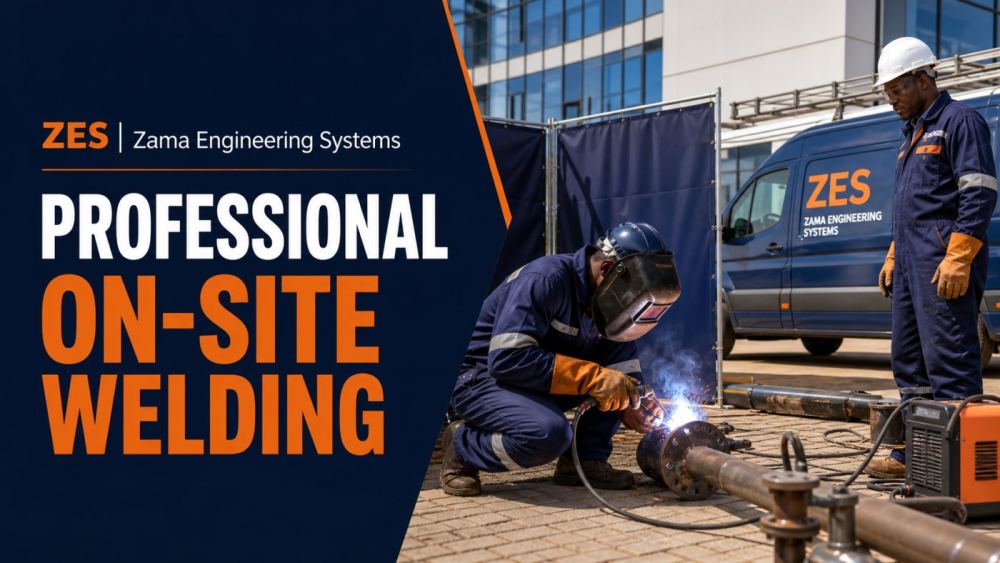
On-site welding services in Kenya are appropriate when an installed asset cannot be moved economically or when a controlled repair must be completed at the client’s premises. Mobile welding is not simply arriving with a machine. The team needs sufficient information, compatible equipment, safe power and access, hot-work controls, correct materials and a defined acceptance check.
When on-site welding is the right approach
Suitable scopes may include gates, rails, doors, frames, brackets, barriers, service platforms and repairable installed steelwork. Workshop fabrication is often better for accurate production, coating and repeatability; site work is then limited to fitting and connections. The survey should decide which tasks belong in each environment.
Do not use a mobile callout to bypass necessary design or failure analysis. A cracked support, distorted frame or corroded connection may need unloading, replacement or professional review before welding. The immediate objective can be isolation and risk control rather than a permanent repair.
Information to share before dispatch
- Site location, contact person and access times.
- Clear photographs showing the whole asset and the defect.
- Approximate dimensions and known material information.
- Whether the asset is carrying load or connected to equipment.
- Nearby combustible materials, stock, cables, finishes or public areas.
- Available electrical supply and site permit requirements.
- Operational deadline and whether a shutdown is available.
These details support triage; they do not replace the technician’s arrival assessment. The team may stop and revise the scope if hidden corrosion, unstable work or incompatible material is found.
Hot-work and occupied-site controls
Cutting, grinding and welding can produce heat, sparks, fumes, noise and flying particles. Agree isolation, screens, exclusion zones, ventilation, fire precautions, extinguishing equipment, fire watch and post-work checks. Protect glass, vehicles, cabling, stock and finished surfaces. The client controls site-specific permits and emergency arrangements in coordination with the contractor.
Schools, shops, offices, warehouses and residences require particular attention to people who may enter the work zone. Barriers and supervision must remain effective when the technician’s attention is on the weld. Weather and wet conditions can change electrical and access risks.
From temporary control to permanent repair
An urgent callout may secure a gate, remove a sharp hazard or support a damaged component. Mark any temporary measure and state what investigation or replacement follows. A permanent repair addresses damaged parent material, cause, geometry, preparation, welding method and coating reinstatement. Cosmetic sealing is not evidence that capacity has been restored.
After the repair, inspect alignment, operation, surrounding material and the areas affected by heat or grinding. Test gates and moving parts through normal travel. Record any limits placed on use and the date of a follow-up inspection.
Pricing a mobile welding callout
Price can include mobilisation, travel, minimum callout time, labour, consumables, materials, access equipment, power arrangements, permits, security waiting time and return visits. Clear photographs can help establish a provisional scope, but the final quotation may change after safe access and base-material condition are confirmed.
For recurring problems or multiple premises, a planned welding maintenance scope is normally more predictable than repeated emergencies. New project work belongs under welding and metal fabrication.
Remote triage before mobilisation
Ask the site contact to describe the consequence: Is the area unsafe, is a security gate unable to close, is production stopped, or is the defect cosmetic? Share wide and close photographs without entering an unsafe zone. Confirm whether the asset carries load, contains product, interfaces with power or has already received a temporary repair.
ZES can use this information to decide whether to send a welding team, request a technical survey first, or advise immediate isolation and another specialist. Triage should not promise that a permanent repair is possible before the base material and access are inspected.
Equipment and consumable planning
On-site work may require welding power, leads, earth return, gas, cutting and preparation tools, screens, lighting, access equipment, clamps, lifting aids and fire equipment. Confirm supply voltage and capacity; an ordinary convenience socket may be unsuitable. Protect cables from vehicles, water and pedestrian routes.
Bring material and consumables appropriate to the confirmed job, but recognise that hidden damage can change the requirement. Unknown parent material, heavy contamination or a safety-critical component may need identification or an approved procedure before work proceeds. Keep consumables dry and controlled.
Site-specific method and permits
The method should name the work area, preparation, isolation, supports, sequence, access, hot-work boundary, fume control, fire watch and post-work inspection. It also needs a stop point if the discovered condition differs from the brief. Confined spaces, tanks, fuel systems and process plant require specialist assessment; a routine mobile-welding method is not sufficient.
Agree whether the client or contractor supplies permits, power, scaffolding, lifting and area cleaning. The site owner controls information about hidden services, hazardous substances and operations. Both parties should sign the area back into use.
Preparing an installed repair
Unload or support the item as the approved method requires. Remove coatings, corrosion and damaged metal far enough to reveal sound material. Check alignment and fit before welding. Restraint and sequence should control distortion without trapping unsafe stresses. Protect bearings, glass, electronics and precision surfaces from heat and spatter.
After welding, inspect the joint and surrounding material, restore corrosion protection and test the asset. For a gate, check hinges, stops, locks and full movement. For a rail, check anchors and continuity. For a frame, confirm alignment and any specified load or function test.
Mobile-welding HSE checklist
- Is the asset stable and isolated?
- Are combustibles, vapours and dust understood?
- Is power suitable and safely routed?
- Are screens and exclusion zones effective?
- Is ventilation adequate for the process and coating?
- Are lifting and working-at-height controls provided?
- Who conducts the fire watch and post-work check?
- Who authorises return to service?
What the site report should record
Record arrival condition, photographs, differences from the reported defect, work performed, materials used where relevant, inspection, test, temporary limitations and recommended follow-up. If no repair is performed, explain the reason and the safe next step. This protects the client from treating an incomplete visit as a completed permanent repair.
Cost and response expectations
Urgency may require technician rescheduling, travel and out-of-hours work. The client should ask for a callout basis, what time is included, material treatment and approval limits. Waiting for permits, access or shutdown can be chargeable. A clear remote brief reduces wasted mobilisation.
Do not publish “24/7” or guaranteed national response claims unless ZES has approved staffing, coverage and service-level terms. A truthful confirmed attendance window builds more trust than a promise the operations team cannot sustain.
Examples of mobile-welding decisions
A gate with a torn hinge may require temporary security, post-alignment correction and a redesigned hinge detail—not just rewelding. A corroded railing may need sections replaced back to sound steel. A cracked equipment frame may require manufacturer or engineering review before heat is applied. A broken bracket can sometimes be removed and remade more reliably in the workshop.
The technician should explain the safe options and record when the requested quick repair is unsuitable. The client decides operational priorities within those technical boundaries; urgency cannot turn an unsafe method into an acceptable one.
Buyer questions before approving a callout
- Is the quoted visit assessment, temporary control or permanent repair?
- What must the client isolate or clear before arrival?
- Are power, permits, access and fire watch included?
- Which materials or parts are provisional?
- What condition will stop work or require specialist review?
- How will the asset be inspected and returned to service?
- What follow-up or coating work remains?
After-hours work
Out-of-hours access can reduce disruption but may remove normal maintenance, security or emergency support. Confirm lighting, supervision, keys, alarms, permits and the authorised handback person. Do not leave an unfinished opening or disabled security asset when the site contact has gone. State premium time and cancellation or access-waiting terms before dispatch.
Preparing the site saves callout time
Before the confirmed visit, clear authorised access, arrange isolation, identify the permit issuer, make suitable power available, protect stock and tell security who is arriving. Do not dismantle or clean a failed assembly if doing so could make it unstable or erase evidence of the cause. Keep the relevant operator or maintenance person available to explain normal function and accept testing.
Frequently asked questions
Do mobile welding services operate anywhere in Kenya?
Coverage, mobilisation cost and timing are confirmed for the actual location and scope. The page should not promise a response time that has not been operationally approved.
Can welding be done while a business remains open?
Sometimes, after an occupied-site risk review and suitable segregation. The client and contractor may instead select off-hours or a shutdown for higher-risk work.
Can every cracked item be welded?
No. Material, corrosion, loading, access and failure cause determine whether welding is suitable. Some items must be replaced or reviewed by a competent designer or equipment specialist.