
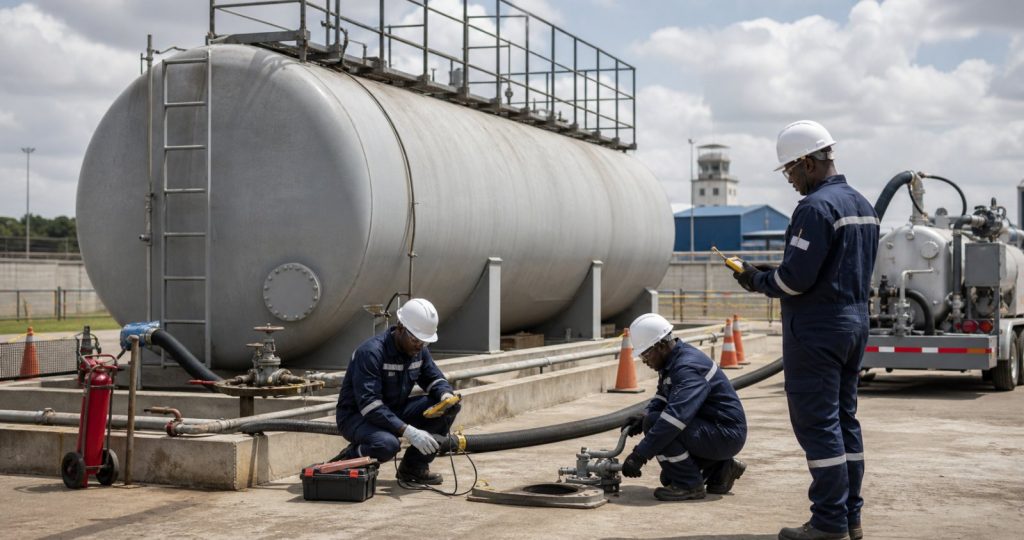
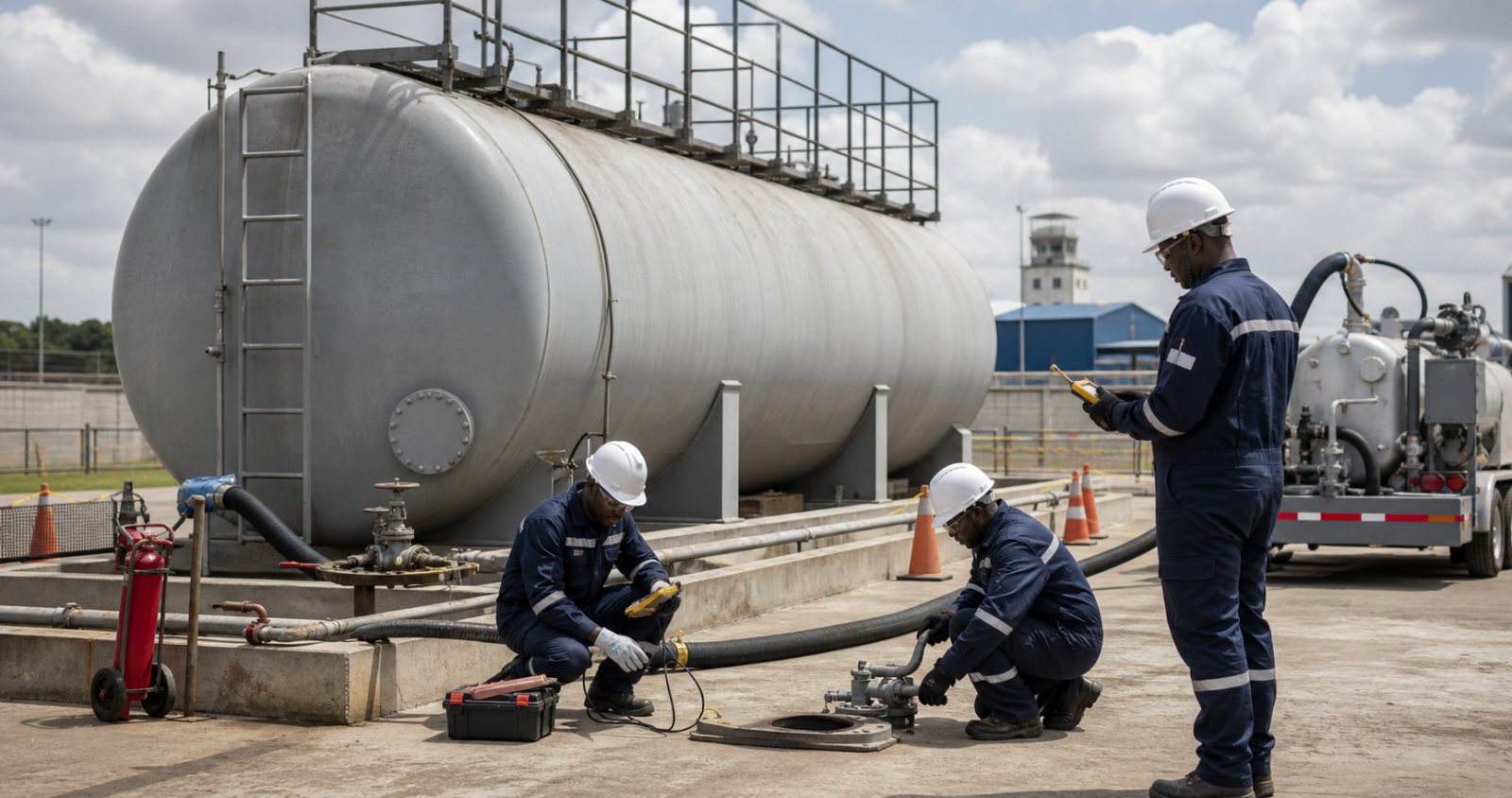
Fuel tank cleaning services in Kenya for petrol, diesel and other petroleum storage systems are specialist industrial work—not ordinary water-tank sanitation. A drained tank can still contain flammable or toxic vapour, oxygen-deficient air, trapped product and contaminated sludge. Cleaning therefore begins with engineering planning, isolation, atmosphere control, emergency arrangements and a documented waste route.
This guide helps petrol stations, fleet yards, factories, farms, generator sites and other fuel users define a safe contractor scope. It explains when cleaning may be investigated, the difference between cleaning and related services, and the records buyers should require before recommissioning.
Important: this article is a procurement and planning guide, not a tank-entry procedure. No employee or unqualified contractor should enter, open for hot work or improvise cleaning inside a petroleum tank. The site and contractor must apply Kenya’s occupational-safety, environmental and petroleum requirements to the specific job.
What does petroleum fuel tank cleaning include?
The scope depends on the stored product, tank type, condition and reason for cleaning. A specialist project may include removal or recovery of remaining product, isolation, controlled removal of residues or sludge, cleaning using an approved method, atmosphere monitoring, inspection observations, waste documentation and recommissioning checks.
Several related services should be listed separately:
- Fuel polishing: processes recoverable fuel to remove selected water or particulate contamination. It may not remove adhered tank deposits.
- Integrity testing: assesses the tank or associated system for defined leakage or structural concerns. Cleaning alone does not prove integrity.
- Repair or lining: corrects identified defects under a separate engineered and authorized scope.
- Hot work: welding, cutting or other ignition-producing work needs additional authorization and safeguards. Draining alone does not make it safe.
- Decommissioning: permanently removes the tank or system from service and includes separate regulatory and disposal decisions.
A quotation should say exactly which of these outcomes is included. “Clean and certify” is too vague unless the certificate type, test method, issuer and acceptance criteria are defined.
When should a site investigate tank cleaning?
There is no responsible universal annual cleaning interval for every tank. The decision should be based on condition, product quality, monitoring, manufacturer information, operating history and the work planned. Reasons to investigate can include:
- water or sediment indications from sampling or monitoring;
- repeated filter blockage or suspected contamination;
- product-quality concerns requiring a documented investigation;
- planned internal inspection, repair, lining or change of product;
- decommissioning, relocation or return to service after a long shutdown;
- unexplained operating symptoms after other likely causes have been assessed.
Automatic tank data, deliveries, dispensing records and physical observations can help define the problem. See automatic tank gauging and fuel inventory monitoring. Cleaning should not be sold as a cure for every inventory or fuel-quality variance.
Information needed before a cleaning quotation
A contractor cannot responsibly select a method from capacity alone. Provide:
- site location and operator contact;
- above-ground or underground tank type;
- capacity, dimensions, access arrangement and available drawings;
- product currently or previously stored and its safety data;
- connected pipes, pumps, dispensers, gauges, alarms and other tanks;
- known leaks, water, contamination, sludge or previous repairs;
- last cleaning, inspection or test records where available;
- operating constraints, required outage window and surrounding activities;
- the desired outcome: cleaning, inspection access, repair preparation, product change or decommissioning.
The initial survey should identify missing information and define the assessment needed before a final method statement and price are approved.
Kenya confined-space and ignition-control requirements
Kenya’s Occupational Safety and Health Act contains specific precautions for work in tanks and other confined spaces where dangerous fumes may be present. It addresses safe access, removal or control of fumes, atmosphere testing, breathing and rescue equipment, training, written authorization, permit-to-work controls and precautions around explosive or flammable substances.
These requirements mean that an “empty” tank is not automatically safe. Residual vapour can remain after liquid removal, and the atmosphere can change during the job. A competent plan should define isolation, ignition control, atmospheric acceptance criteria, monitoring, communication, supervision and emergency response.
International technical guidance such as OSHA’s tank-cleaning work-activity guidance also organizes the job around preplanning, product recovery, isolation, gas freeing, atmosphere testing, cleaning and recommissioning. It is useful as a procurement reference but does not replace Kenyan law or the site-specific risk assessment.
Non-entry cleaning versus tank entry
The contractor should evaluate whether the required result can be achieved without a person entering the tank. Non-entry approaches can reduce exposure, but they still require product control, isolation, ignition precautions, suitable equipment, atmosphere management and waste handling.
If entry is unavoidable, the job becomes a confined-space operation with additional written authorization, trained personnel, supervision, an attendant, atmosphere monitoring, communications and a task-specific rescue plan. Rescue should not depend on untrained colleagues improvising after an emergency.
The owner should ask the contractor to state why entry is necessary, who controls the permit, who monitors conditions, what stops the job, how rescue is provided and which records will be handed over. Do not accept “we have done it many times” as a method statement.
High-level planning stages for fuel tank cleaning
- Define the outcome: identify the suspected condition and why cleaning is required.
- Survey and assess: confirm tank, product, connections, access, surroundings and operating constraints.
- Prepare the work package: risk assessment, method statement, permits, responsibilities and emergency arrangements.
- Recover product and isolate: control remaining fuel and prevent product, energy or vapour from entering the work area.
- Control the atmosphere: apply the approved gas-freeing, ventilation, testing and monitoring plan.
- Remove residues and clean: use the approved non-entry or entry method with the defined controls.
- Inspect and record: document visible condition and refer defects to a separate assessment or repair scope.
- Manage waste: track sludge, oily water and other materials to an authorized receiving route.
- Recommission: reconnect, test, restore monitoring and return the system under an approved checklist.
This sequence intentionally avoids operational detail that belongs in the contractor’s controlled procedure.
Sludge, oily water and waste documentation
Tank-bottom material can include product, water, sediment, rust, cleaning residues and contaminated PPE or absorbents. The waste stream should be characterized, contained and assigned an approved transport and treatment or disposal route before work begins.
Kenya’s current Waste Management Regulations include controls for waste transport, tracking and receiving facilities. NEMA’s environmental licensing information explains its role in licensing waste transporters and facilities. Verify that licences cover the actual waste and activity; a general company registration is not proof of authorization.
Do not accept routine discharge of oily wash water to the ground, storm drain or sewer. The proposed route must comply with current environmental and water-quality requirements and be supported by tracking and receiving records.
What should happen after cleaning?
The cleaned tank should be examined to the extent defined in the scope. Observations can include corrosion, pitting, lining damage, damaged fittings, water-ingress points or unexpected deposits. Cleaning does not itself certify that the tank is structurally sound or leak-free; any required integrity testing or repair must have a defined method and competent responsible party.
Recommissioning should verify connections, valves, gauges, leak-detection interfaces, alarms and the agreed operating checks. Product should not be reintroduced until the responsible parties have accepted the condition and documentation.
Link the final recommendations to fuel tank leak detection, petrol station maintenance and the site’s inventory-reconciliation process.
How to compare fuel tank cleaning contractors
Ask each bidder to address the same scope and provide evidence relevant to the actual job:
- tank types and products within their confirmed technical coverage;
- proposed non-entry or entry method and the reason for it;
- isolation, gas freeing, ventilation and atmospheric testing;
- confined-space program, trained team and rescue arrangements where entry is proposed;
- equipment suitability, ignition control and bonding/earthing provisions;
- waste characterization, licensed transport, tracking and receiving facility;
- insurance, permits, competency evidence and subcontractor responsibilities;
- before-and-after records, gas-test logs, waste documents and recommissioning pack;
- shutdown assumptions, exclusions and conditions that can change the price.
Do not rely on a generic claim that a contractor is “EPRA approved for tank cleaning.” Verify the facility’s petroleum obligations and the contractor’s actual licences, competencies and role for the work proposed.
What determines fuel tank cleaning cost?
Price depends on tank type and size, number of tanks, previous product, residue load, access, site location, shutdown constraints, gas freeing, atmosphere testing, entry and rescue controls, waste volume, transport and receiving route. Inspection, integrity testing, repair, lining or fuel treatment should be priced separately unless clearly included.
A remote flat price can omit the most important safety and waste requirements. Begin with tank information and a site assessment, then require a written scope and documented route for every recovered material.
Frequently asked questions
Is an empty fuel tank safe to enter?
No. Flammable or toxic vapour, oxygen deficiency and trapped product can remain after draining. Entry requires the applicable confined-space assessment and controls.
Does fuel tank cleaning always require entry?
No. The contractor should assess whether the required outcome can be achieved by a controlled non-entry method. Entry adds significant safety and rescue requirements.
Is fuel polishing the same as tank cleaning?
No. Polishing treats recoverable fuel for selected contaminants; it may not remove adhered deposits or provide access for tank-condition observations.
Does cleaning prove that a tank is leak-free?
No. Integrity testing and leak investigation are separate scopes with their own methods and acceptance criteria.
How often should a fuel tank be cleaned?
There is no safe universal interval. Use tank condition, product quality, water and sediment monitoring, operating history, manufacturer guidance and the maintenance plan.
What should the handover pack include?
Include applicable permits and authorizations, isolation and gas-test records, entry records where relevant, waste tracking documents, receiving evidence, before-and-after observations and recommissioning checks.
Define a safe fuel-tank maintenance scope
Share the site location, tank type, capacity, stored product, suspected problem, access details and preferred outage window. ZES can help assess the wider fuel system and define the technical information needed for a specialist cleaning or maintenance quotation.