
Petrol Station Facility Maintenance Kenya enquiries should define the assets and tasks included before a visit frequency is priced. Building finishes, lighting, security equipment and fuel-related systems do not automatically belong to one contractor’s competence or scope. This guide adds a facilities checklist to ZES’s existing station-maintenance page. ZES can review an asset list and confirm the supplied work, specialist interfaces and support arrangements in a written proposal.
1. Build a defined facility register
List the buildings, fixtures and systems included in the requested service. Record location names, available equipment references and the party responsible for each asset. Separate customer-owned tasks and specialist systems. A facility-maintenance contract should not imply that every item at the station is included merely because it appears on the same premises.
2. Establish the initial condition
Arrange an appropriate baseline assessment and record reported defects. Distinguish an observation from a verified diagnosis and identify further specialist review where needed. The customer should understand whether an existing issue is included in routine care, requires a separate remedial scope or remains outside the proposed service. Do not hide pre-existing condition behind a generic monthly visit description.
3. Define tasks and frequencies
Set the proposed schedule from the actual equipment documentation, condition, operating needs and responsible professional requirements. Avoid applying one frequency to every asset without a basis. Identify what the contractor does during a visit and what remains with the operator. The schedule should be specific enough for the customer to check whether the agreed service occurred.
4. Separate ordinary and specialist responsibilities
Distinguish basic facilities observations and agreed routine tasks from electrical, structural, fuel-system or other specialist work. Verify relevant credentials and responsibility for the particular scope. A general maintenance contract does not automatically establish authority to perform every task. Station operating controls and approved work arrangements remain part of the site-specific service planning.
5. Agree fault reporting and escalation
Identify who receives a report, what information the operator supplies and how the next action is communicated. Distinguish acknowledgement, attendance and resolution. Confirm operating hours, travel assumptions and dependencies on parts or specialist attendance. A response target should not be presented as an unconditional repair guarantee.
6. Control parts and additional work
Show included consumables, excluded major components and the process for approving replacements. Record who confirms component suitability and any change from the original arrangement. Ask for additional work to be described before approval rather than absorbed into an unexplained invoice. A transparent scope helps both parties distinguish routine service from a new project requirement.
7. Close findings with evidence
Ask each service report to identify tasks completed, defects found, limitations and the person responsible for the next action. Keep completion or verification evidence with the original finding. Review recurring issues and unresolved work at an agreed interval. The value of maintenance lies in managed condition and clear follow-up, not simply the number of visits recorded.
Petrol Station Facility Maintenance Kenya: demonstration and review workbook
An operator wants one point of coordination for building and facility-maintenance requests but already has specialist suppliers for some equipment. The enquiry should clarify whether ZES is asked to inspect defined assets, perform listed tasks, coordinate others or provide an agreed combination. This hypothetical case does not imply that one contractor holds every specialist authorisation. Build the scope around an asset register, defined service responsibilities and a useful reporting process so that a broad facilities request does not become an unlimited and unreviewable promise.
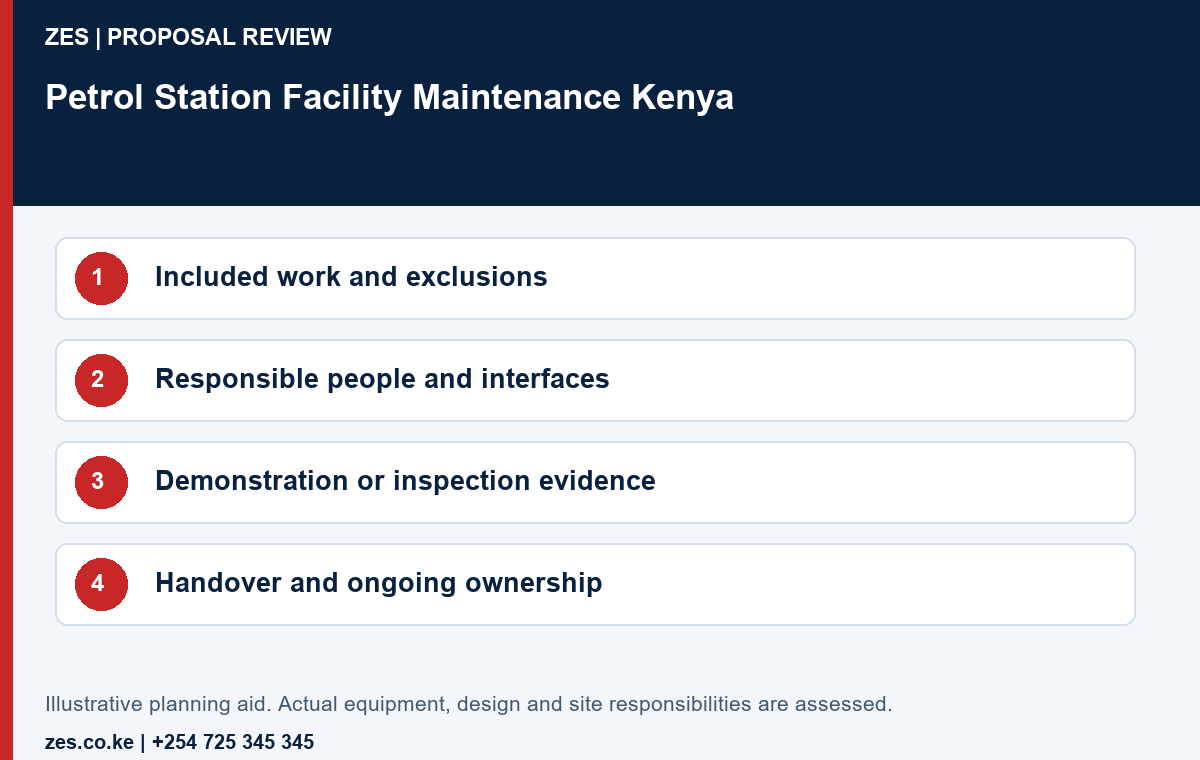
The following cases help the buyer specify and compare the actual project. Agree which apply to the proposed scope and record any exclusions before acceptance. They are hypothetical review prompts, not evidence of a completed ZES client project. The responsible site team and relevant competent parties approve any physical tests or changes to live operations.
Asset schedule
Identify each included asset or facility element at a useful level. Distinguish building fabric, services and specialist equipment rather than hiding every responsibility under general station maintenance.
Service type
Separate inspections, routine tasks, fault diagnosis, corrective work and coordination. A provider can supply one of those functions without automatically accepting every other facility-maintenance responsibility.
Existing contracts
List relevant manufacturer or specialist arrangements and their owners. Confirm the approval and communication boundary before another contractor is instructed to alter equipment covered by those arrangements.
Request intake
Define who receives a facility fault report and what non-sensitive information helps identify the asset and symptom. A clear asset reference improves triage without encouraging unqualified diagnosis.
Response terms
Distinguish acknowledgement, attendance and resolution commitments. Request actual written terms and explain dependencies rather than interpreting a proposed response time as guaranteed restoration of every asset.
Visit evidence
Require the maintenance report to identify included work, observations and inaccessible items. An attendance signature should not imply that unlisted assets or concealed conditions were verified.
Corrective approval
Identify who can approve expenditure and specialist work. Keep the requested repair, agreed scope and remaining exclusions visible before the contractor proceeds with a changed task.
Parts handling
Agree the commercial treatment of consumables, replacement parts and customer-held spares. Routine visit pricing does not automatically include every later component or procurement task.
Finding closure
Connect each approved action to the relevant asset and verification evidence. Retain recurring or unresolved findings instead of restarting the same fault as a completely unrelated service request.
Programme review
Review the facility register, operating changes and recurring faults at an agreed interval. Revise the scope with appropriate technical owners rather than assuming the first asset list remains complete forever.
Detailed buyer questions
Can one maintenance contract cover every station asset?
Only to the extent defined and appropriately supplied in the contract. Identify specialist responsibilities, exclusions and third-party dependencies instead of treating a broad title as unlimited technical coverage.
What information helps obtain a comparable proposal?
Provide the location, asset schedule, requested service types, existing records, operating constraints and reporting expectations. Ask each bidder to identify the same inclusions, exclusions and commercial assumptions.
How should facility-maintenance performance be reviewed?
Compare agreed visits and reports, unresolved findings, approved corrective work and recurring problems. Use the actual service commitments and technical evidence rather than relying only on the number of visits made.
Prepare a clear enquiry for ZES
Share the station location, the problem or intended outcome, relevant quantities and the existing equipment or application references. Include available approved plans or anonymised examples where useful. Identify the person who can authorise site access and the contacts responsible for operations and technical interfaces. Keep credentials, employee biometric records and confidential transaction information out of a general enquiry.
Ask the written proposal to identify the supplied work, exclusions, customer dependencies, current commercial terms and the evidence used for acceptance. Confirm specialist responsibilities and relevant credentials for the actual scope. ZES can review the brief and confirm the appropriate assessment and proposal arrangements. Site attendance, timing, product availability and support commitments are agreed directly rather than promised solely because a project names a particular county or town.
Compare the same complete scope
- Equipment or materials: identify the actual model, specification and documentation.
- Supporting tasks: record enabling work, site access and customer-supplied dependencies.
- Configuration or fabrication: state the work and the responsible approving party.
- Acceptance: agree the demonstration, inspection or verification evidence required.
- Ownership: confirm accounts, records, recurring charges and the future support route.
Frequently asked questions
Does a facility contract include every system on the site?
No. Define included assets, tasks and specialist exclusions explicitly.
Is a fault report the same as a completed repair?
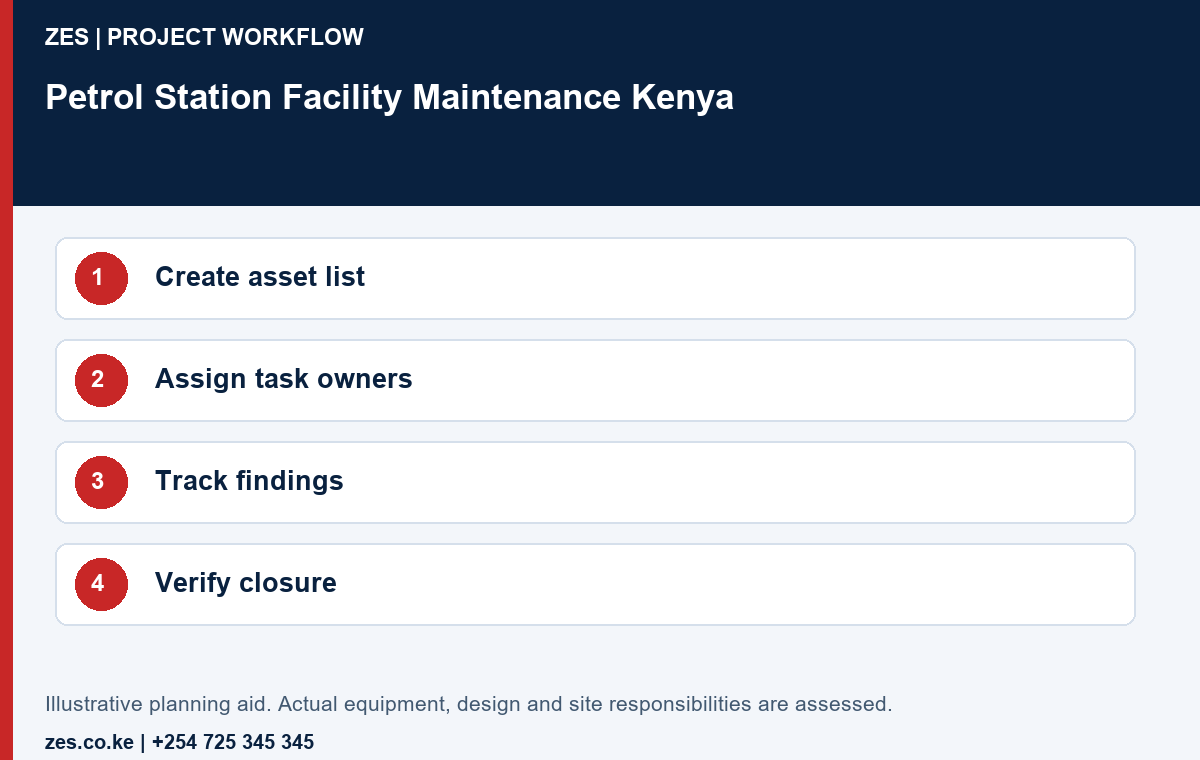
No. Track acknowledgement, assessment, approved work and verified closure as separate steps.
Reference information: EPRA petroleum application guidance.
Related ZES service · Petrol-station engineering enquiries · Request a scoped quotation · Request a site assessment · Call +254 725 345 345
Further guidance on the existing service
Petrol station maintenance services Kenya operators purchase should be built around an asset list, operating risks and clear responsibility for follow-up. A visit that produces no usable record makes it difficult to know what was checked, what was found and what still needs attention. Good maintenance turns those questions into a documented programme.
ZES can assess station equipment and infrastructure to develop an agreed maintenance scope. The programme should distinguish routine servicing, specialist inspections, corrective repairs and replacement projects. It should also explain which activities are included in the service price and which require separate approval or attendance by another responsible specialist.
Begin with a baseline assessment
List the assets by location, function, manufacturer and model where known. Include dispensers, monitoring equipment, electrical interfaces, canopy components, drainage, CCTV and other systems that fall within the requested scope. Record available manuals, previous service reports and recurring faults. Missing information is a task to resolve, not a reason to assume an asset is in acceptable condition.
An initial assessment should identify existing defects before a recurring agreement starts. Otherwise, a new maintenance provider and the owner may disagree over whether an early failure was pre-existing or covered by the service. Give each finding a location, description, priority and proposed next action. Photographs and asset references make the report easier to use.
Distinguish routine tasks from specialist work
Maintenance does not mean that every person attending the station is authorised to work on every system. Fuel equipment, electrical systems, measurement verification and structural concerns may require different competence and authority. The service plan should name the responsible discipline and any external dependencies for each activity.
Manufacturer instructions, asset condition, use and the responsible maintenance assessment should inform the service schedule. A universal monthly checklist is not enough to establish the correct interval for every component. Where a task is deferred, record the reason, the person approving the decision and any operating restriction or interim measure.
Make fault escalation practical
Station staff need a simple way to report problems without attempting unsafe diagnosis. A useful report includes the asset reference, time, visible symptoms, displayed messages and the operating circumstances. Suspected leaks, electrical damage or unstable structures require the site’s safety and emergency procedures; ordinary service booking should not delay those actions.
The contract should distinguish acknowledgement, technical assessment, attendance and restoration. These are different milestones. An acknowledgement promise is not a repair-time guarantee, especially where parts, access or specialist verification are needed. Confirm service hours, travel arrangements and escalation contacts in writing rather than assuming that support is available at every hour.
Close findings rather than count visits
Use a defect register to track each issue from identification to correction and acceptance. A completed attendance sheet proves that someone visited; it does not prove that every defect was resolved. The owner should be able to see which items remain open, their effect on operation and the person responsible for the next action.
Review repeated failures across several visits. A recurring fault may indicate unsuitable equipment, an unresolved environmental problem, poor operating practice or the need for a replacement project. That review helps separate maintenance expenditure from capital improvement. Send ZES the station location, asset list, fault history and required service coverage to start a scoped maintenance discussion.
Further project planning guidance
petrol station maintenance services projects require more than buying the main equipment. A preventive programme considers tanks, dispensers, piping, electrical systems, automation, safety equipment, CCTV and networking according to criticality and manufacturer guidance. This guide explains the questions owners, operators, consultants and procurement teams should resolve before requesting a final quotation.
Moving from emergency repairs to planned maintenance
The first step is to define the required operating outcome. Capacity, transaction volume, site conditions, available utilities, existing equipment, reporting needs and future expansion can change the correct design. A clear requirement also helps suppliers quote the same scope, making commercial comparisons more meaningful.
Zama Engineering Systems approaches petroleum work as an integrated engineering task. Mechanical equipment, electrical power, earthing, controls, networking, security and maintenance access must be coordinated. Final brands, quantities, interfaces and regulatory responsibilities are confirmed during assessment and quotation.
Key items to include in the scope
- Asset register and maintenance schedule
- Routine inspection and functional testing
- Fault logging and corrective action
- Spares, escalation and service reporting
The quotation should state who supplies each component, who installs it, what tests will be completed and what information the customer must provide. It should also identify exclusions such as civil work, statutory fees, third-party inspections, internet service, ongoing software subscriptions or work by other appointed professionals.
Site assessment and design questions
- What products, volumes or assets will the system handle?
- What equipment and infrastructure already exist?
- Which users need operational, reporting or administrative access?
- What power, network and backup arrangements are available?
- Which alarms, reports, integrations or retention periods are required?
- What environmental, safety and access restrictions affect installation?
Answers to these questions should be documented before procurement. When existing equipment is involved, model numbers, firmware, interfaces, condition and ownership of configuration credentials may need verification.
Installation and commissioning stages
- Requirement review: Confirm the operational problem and measurable outcome.
- Site survey: Review positions, routes, distances, utilities, risks and existing assets.
- Design: Define equipment, interfaces, supporting works and responsibilities.
- Approval and procurement: Confirm the quotation, programme and product availability.
- Installation: Complete the agreed mechanical, electrical, control or network work.
- Testing: Verify integrity, operation, alarms, measurements and communications as applicable.
- Training and handover: Provide authorised users with operating guidance and relevant records.
Common mistakes to avoid
Common problems include ordering equipment before confirming compatibility, omitting essential accessories, undersizing storage or power, failing to define who configures integrations, and accepting a proposal without testing or handover criteria. Another risk is treating remote monitoring or automation as a substitute for sound operating procedures. Technology is most effective when responsibilities, exception handling and maintenance are also clear.
Maintenance and lifecycle planning
The project should identify consumables, inspection intervals, calibration or test requirements, software support, backup procedures and critical spare parts. Operators should know how to recognise an abnormal condition and who receives the first alert. Where data is used for reconciliation or management decisions, time settings, user permissions and audit records should be controlled.
How to compare quotations
Compare complete outcomes rather than headline equipment prices. Check capacities, specifications, accessories, installation, configuration, testing, training, warranty, subscriptions, travel, taxes and exclusions. Ask whether the design can be maintained locally and expanded without replacing the entire system.
Frequently asked questions
Can ZES provide a site survey?
Yes. A survey can establish the current site conditions, required scope and interfaces before a tailored quotation is prepared.
Can existing equipment be retained?
Possibly. Retention depends on condition, capacity, compatibility, documentation and the customer’s required outcome.
Does the system require ongoing support?
Most petroleum, automation and monitoring systems benefit from preventive inspection, fault support and periodic review of settings, sensors, records and user access.
Is regulatory approval included automatically?
No. Permits, licences, professional approvals and inspection responsibilities must be explicitly defined in the project scope and checked against current official requirements.
Petrol station maintenance services Kenya should be purchased against an asset register and risk-based schedule. A generic monthly visit cannot show whether dispensers, pumps, gauges, electrical panels, controllers, drainage assets, safety equipment and network devices receive the right inspection. The owner should identify critical assets, manufacturer tasks, statutory or authorized activities and the response needed when an item is unsafe or unavailable.
Build a measurable service agreement
The tender should list asset quantities and models, site hours, preventive frequencies, call-out categories, remote-triage rules, travel assumptions, included labour, excluded parts and report format. Spares should be divided into consumables, recommended site stock and quotation-only components. Use the fuel dispenser repair scope to separate corrective work from routine inspection, and include gauge health checks informed by the automatic tank gauging guide.
Response times need a defined start, severity and restoration target. An acknowledgment is not the same as arriving on site or returning an asset to service. The agreement should identify escalation contacts, access requirements, safe-isolation responsibility and any activity that requires an authorized third party.
Accept every visit through useful records
A maintenance report should identify the asset, observed condition, measurements, work performed, parts used, photographs, outstanding risk, recommended action and responsible approver. Closed work requires a functional check and customer sign-off; deferred work needs a due date and interim control. Repeat faults should trigger root-cause review rather than repeated part replacement.
Quarterly reviews can examine availability, response, recurring faults, overdue actions, parts consumption and planned upgrades. The owner should retain updated manuals, configurations and as-built information. Ask ZES for an asset-based maintenance assessment so the proposed service levels reflect the real station.
First-quarter service checkpoint
Use the first three months to validate the maintenance plan against real faults and asset condition. Review whether the asset register is complete, visit durations are realistic, parts approvals are fast enough and recurring failures need engineering work rather than more call-outs. Confirm that reports reach the decision-maker and that safety-critical recommendations cannot disappear in email. Adjust frequencies only with a recorded technical reason. This early review turns the contract from a generic schedule into a station-specific control and provides the evidence needed to set a realistic spares holding and annual maintenance budget.
Discuss Your petrol station maintenance services Project
Contact ZES with the site location, project stage, available drawings and required outcome.
Request a Tailored Quote View Related Service
Discuss your project with ZES
Share the site location, photographs taken from a safe position, available drawings, quantities and intended outcome. ZES can confirm the assessment needed and provide a scoped proposal with responsibilities and exclusions.
Request a project quotation | Explore the related ZES service | Call +254 725 345 345
For current petroleum permit and licence application information, consult EPRA application guidance. Project-specific regulatory advice should come from the responsible professionals and authorities.