
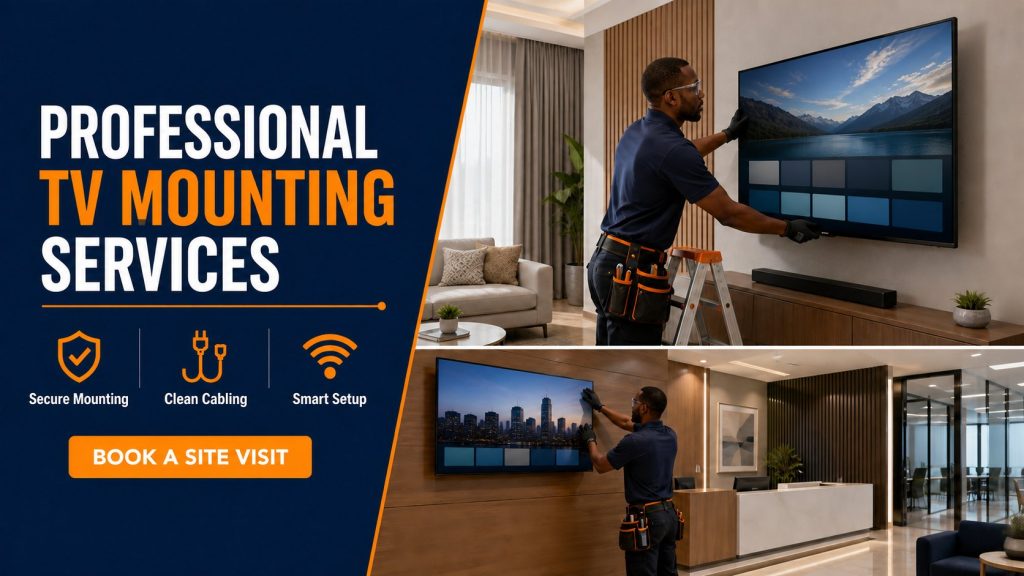
professional TV mounting services help property owners and facilities teams secure valuable screens, position them for comfortable viewing and organise power, signal and network cables neatly. The work is not only drilling four holes: the installer must understand the wall, television weight, bracket rating, viewing height, cable routes and nearby electrical or plumbing services before fixing anything.
This guide is for homeowners, offices, schools, universities, churches, hospitals, hotels, restaurants, gyms, retail shops and property managers who want a clean installation with clear responsibility for assessment, mounting, setup and handover.
When this service is the right fit
Professional mounting is valuable whenever a screen is large, expensive, installed above normal reach, mounted on an unfamiliar wall, connected to several devices or placed in a public area. It is also useful when appearance, cable concealment and future maintenance matter.
- Living rooms, bedrooms and home entertainment spaces
- Office reception areas, staff rooms and executive offices
- Classrooms, lecture halls, churches and training rooms
- Hotels, restaurants, gyms, hospitals and waiting areas
- Retail promotions, menu displays and customer-information screens
A useful proposal starts with the required business outcome. Screen size, camera coverage, viewing distance, wall construction, available power, network capacity, room acoustics, content sources, operating hours and future expansion can all change the correct design. Zama Engineering Systems (ZES) confirms these conditions during assessment rather than treating the installation as a one-product purchase.
What a professional scope should include
The final scope depends on the screen, bracket and wall, but a complete installation normally addresses the following items:
- Confirm the television model, size, weight and mounting pattern
- Assess concrete, masonry, timber-frame, panelled or other wall construction
- Select a compatible fixed, tilting or full-motion bracket with a suitable load rating
- Agree viewing height, angle, glare control and furniture clearances
- Plan surface trunking, conduit or concealed cable routes
- Mount compatible soundbars, media devices or small accessories where agreed
- Connect power, HDMI, aerial, network and source devices
- Level, secure, test and demonstrate the completed installation
The quotation should identify which equipment is supplied, which customer-owned devices will be retained, what cabling and builders work are included, what testing will be completed, and which subscriptions or third-party services remain the customer’s responsibility. This prevents a low headline price from becoming an incomplete installation.
Engineering and design decisions
A screen can fit a bracket and still be unsuitable for the intended wall or viewing position. These decisions should be made before drilling:
- Wall strength, fixing type and the position of hidden services
- Bracket reach and leverage, especially for full-motion mounts
- Viewing distance, seated eye level and the range of viewer positions
- Ventilation, service access and safe connector bend radius
- Cable length, signal quality and future device additions
- Wi-Fi coverage or wired Ethernet for reliable smart-TV connectivity
Where displays, cameras, audio, control equipment and network devices share infrastructure, the design should document signal routes, cable categories, connection lengths, equipment ventilation, rack space, surge protection and access for future maintenance. Compatibility should be checked using exact device models rather than assumptions based only on connector appearance.
How ZES plans and delivers the project
1. Requirement review
ZES confirms the screen model, room use, preferred position, connected devices and whether the customer already owns a bracket. Photos help with initial planning, but unusual walls or concealed routes may need a site visit.
2. Position and wall assessment
The technician reviews viewing height, glare, nearby sockets, likely cable routes and the wall structure. The fixing plan is matched to the load and bracket geometry.
3. Bracket and cable planning
Fixed mounts keep a screen close to the wall, tilting mounts help with higher positions, and full-motion mounts support angle changes but create greater leverage. Cable routes are agreed before work begins.
4. Installation and connection
The bracket is positioned, fixed and checked before the screen is lifted into place. Power and signal cables are routed without crushing, sharp bends or exposed trip hazards.
5. Setup and handover
The screen is levelled, source inputs and network access are tested, and the customer is shown how to operate the agreed setup.
The handover should leave the customer able to operate the system without depending on undocumented settings. ZES records the agreed configuration, demonstrates normal operation, identifies routine checks and explains how faults should be reported. Passwords and administrative access should be transferred to authorised customer representatives using an agreed secure process.
Common problems this approach prevents
Poorly planned TV mounting can damage the wall, screen, cables or people using the space. Common avoidable problems include:
- Using a bracket without confirming screen weight and mounting pattern
- Fixing into weak finishes rather than an appropriate structural substrate
- Mounting too high or where glare makes the screen uncomfortable to use
- Drilling without considering concealed electrical, water or communication routes
- Leaving stretched power leads, tight HDMI bends or hanging extension cables
- Blocking ventilation or making inputs impossible to reach
Some faults do not appear on installation day. Loose fixings, heat buildup, marginal signal paths, insufficient storage, weak wireless connectivity and inaccessible cable joints may emerge later. A practical design includes appropriate load margins, physical support, labelled cables, ventilation and maintenance access so the installation remains serviceable.
Integration with networking, security and power
ZES can coordinate the television with structured cabling, enterprise Wi-Fi, soundbars, boardroom equipment, CCTV displays and backup power. For business locations, a wired network point may provide more predictable streaming and signage connectivity than relying only on distant Wi-Fi.
Business systems also need predictable power. Where the service is operationally important, the survey should consider surge protection, voltage quality, backup power and controlled shutdown. Remote access should use authorised accounts and appropriate network security; exposing equipment directly to the internet without a reviewed security method creates unnecessary risk.
What affects project cost?
A responsible quotation is based on the site and required outcome. The following factors normally have the greatest effect:
- Screen size, weight and number of televisions
- Wall material, height and access equipment required
- Bracket type and whether it is supplied by ZES or the customer
- Surface trunking versus concealed cable work and making-good
- Number and length of power, HDMI, network and aerial connections
- Travel, working-hour restrictions and additional accessories
Customers receive a more useful quotation when they provide the site location, room or area photographs, device models, quantities, approximate mounting heights, available drawings, preferred completion date and the operational problem being solved. A site survey is recommended where wall structure, long cable routes, working-at-height access or system integrations cannot be confirmed remotely.
Service coverage across Kenya
ZES can assess projects in Kenya’s 47 counties, subject to project scope, scheduling, travel and site logistics. For county and subcounty work, the quotation identifies mobilisation, accommodation where applicable, access hours and any local coordination required. We do not publish hundreds of identical location pages; national and county content should provide genuine local service information, project evidence and useful subcounty coverage.
Questions to ask before appointing an installer
- Will you verify the exact TV and bracket compatibility?
- How will you assess the wall and avoid hidden services?
- Are bracket, fixings, trunking and cables included in the quotation?
- Will cables be concealed, placed in trunking or left ready for another contractor?
- Who is responsible for power sockets or electrical alterations?
- What testing and workmanship support are included?
Compare proposals on complete outcomes, not the cheapest equipment line. Confirm specifications, load ratings, cable management, configuration, testing, training, warranty, travel, taxes, exclusions and response arrangements. If an existing system is being expanded, ask how compatibility and current condition will be verified.
Related ZES services
- Commercial TV installation
- Boardroom display installation
- Enterprise Wi-Fi installation
- Network installation services
Frequently asked questions
Can ZES mount any television size?
ZES assesses the screen, bracket, wall and access requirements before confirming the scope. Very large or high installations may require additional technicians or lifting equipment.
Can you hide all cables inside the wall?
It depends on the wall construction, cable type, fire and electrical considerations, and whether making-good is included. Surface trunking is often the safer maintainable option.
Can I supply my own bracket?
Yes, subject to inspection and confirmation that its mounting pattern, load rating and condition suit the screen and wall.
Do you install TVs outside Nairobi?
ZES can quote work across Kenya. Travel and mobilisation are confirmed according to county, subcounty and project size.
Can you set up Wi-Fi and smart-TV applications?
ZES can connect the television to the available network and test basic smart functions. Customer subscriptions and account credentials remain customer-controlled.
Book a professional TV mounting site visit
Send the TV model, screen size, site location, wall photographs and preferred mounting position for an initial scope review.