
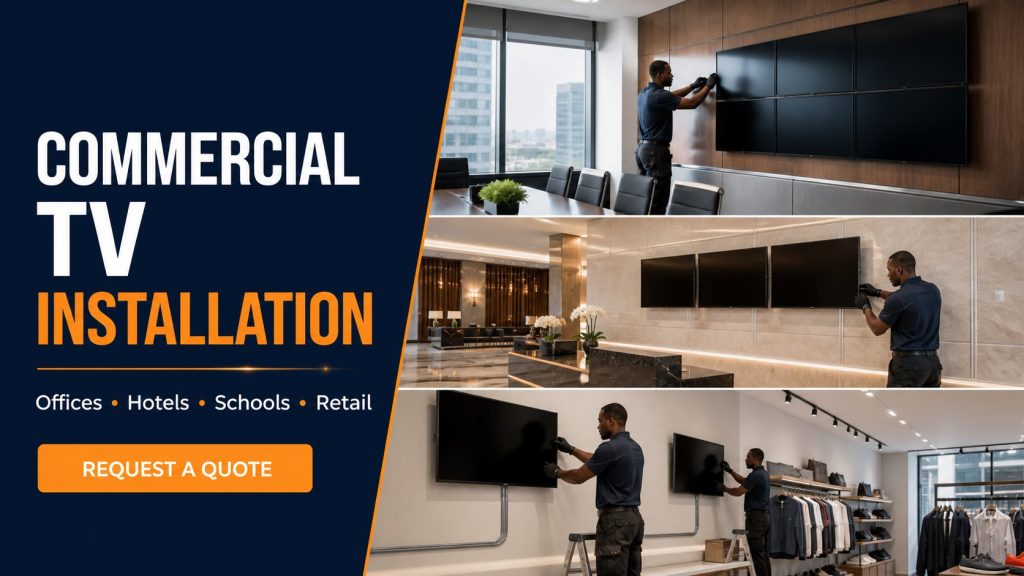
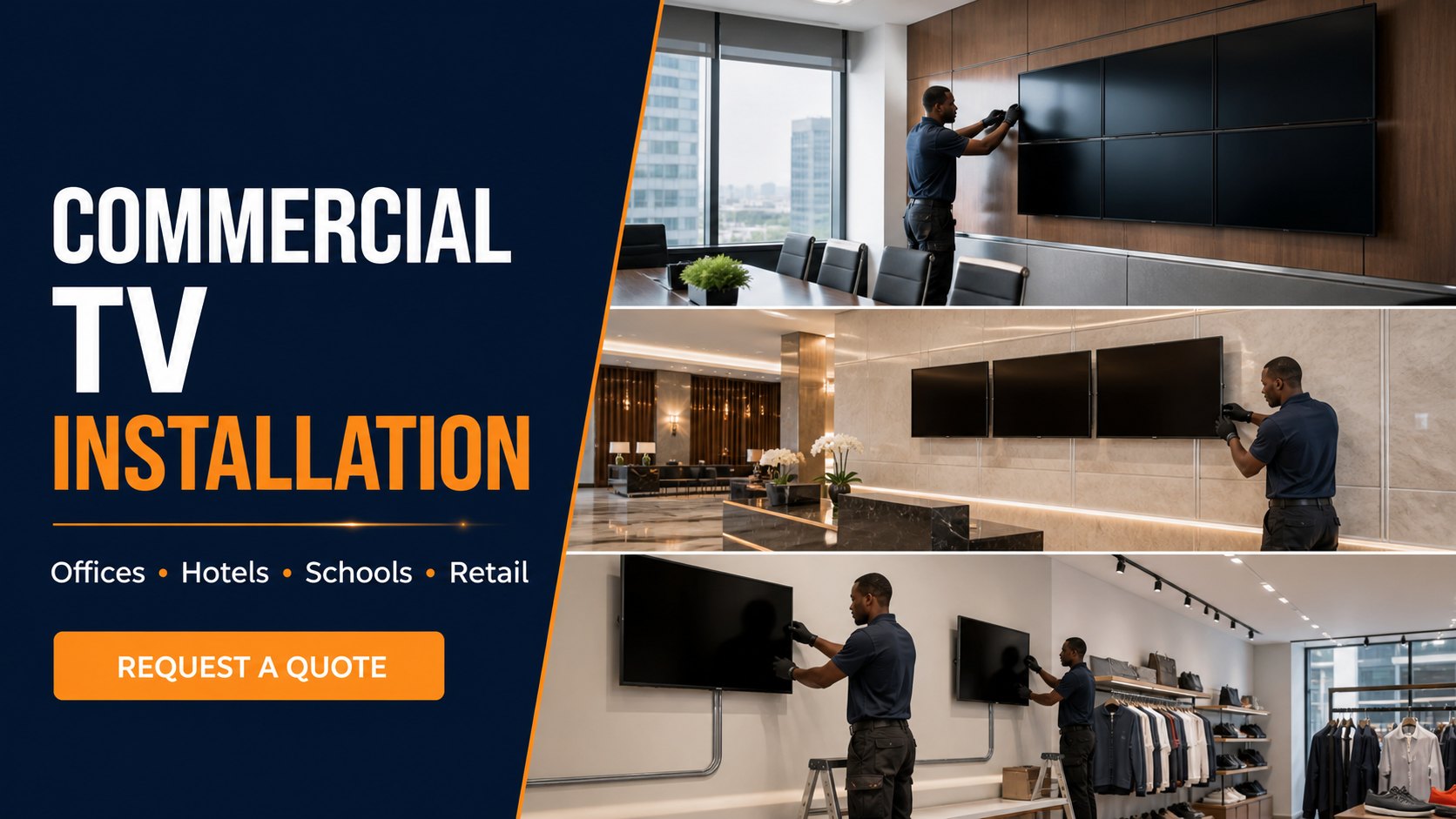
commercial TV installation requires consistent mounting, reliable signal distribution and serviceable cabling across spaces used by staff, guests, students or customers. Unlike a single residential screen, a business project may involve many displays, extended operating hours, controlled content sources, central management and strict installation windows.
This article helps facilities managers, procurement teams, architects, contractors, IT managers and business owners define a complete display-installation scope before requesting quotations.
When this service is the right fit
A commercial installation is appropriate when screens support customer information, internal communication, training, entertainment, menus, promotions, dashboards or live operational content. The solution should match the purpose of each display and the people responsible for operating it.
- Office receptions, meeting spaces and staff communication areas
- Hotels, restaurants, hospitals and waiting rooms
- Schools, universities, churches and training centres
- Retail shops, supermarkets, showrooms and menu boards
- Factories, logistics facilities and operational dashboards
A useful proposal starts with the required business outcome. Screen size, camera coverage, viewing distance, wall construction, available power, network capacity, room acoustics, content sources, operating hours and future expansion can all change the correct design. Zama Engineering Systems (ZES) confirms these conditions during assessment rather than treating the installation as a one-product purchase.
What a professional scope should include
A complete commercial TV installation may combine mounting, connectivity, configuration and operational documentation:
- Display schedule with model, size, room and intended use
- Wall, ceiling, floor-stand or recessed mounting assessment
- Commercial-duty brackets and tamper-aware fixing where appropriate
- Power, data, HDMI and content-source route planning
- Media-player, decoder or signage-device mounting
- Consistent display settings and input configuration
- Asset labels, cable labels and basic location records
- Testing, user briefing and a maintenance route
The quotation should identify which equipment is supplied, which customer-owned devices will be retained, what cabling and builders work are included, what testing will be completed, and which subscriptions or third-party services remain the customer’s responsibility. This prevents a low headline price from becoming an incomplete installation.
Engineering and design decisions
Business installations should be designed for repeatability and support. Important decisions include:
- Screen brightness and viewing distance for the room or public area
- Operating hours and whether consumer or commercial-grade displays are appropriate
- Orientation, ventilation and access to controls and connectors
- Local content sources versus network-managed content
- Signal-extension method for distances beyond ordinary cable limits
- Security of equipment, remotes, media players and administrative access
Where displays, cameras, audio, control equipment and network devices share infrastructure, the design should document signal routes, cable categories, connection lengths, equipment ventilation, rack space, surge protection and access for future maintenance. Compatibility should be checked using exact device models rather than assumptions based only on connector appearance.
How ZES plans and delivers the project
1. Display requirement schedule
ZES records each location, audience, purpose, screen size, source and operating schedule. This becomes the reference for design and pricing.
2. Site survey and route review
Mounting surfaces, power, network points, cable routes, working heights, public access and installation hours are checked.
3. Equipment and interface design
Compatible mounts, cables, extenders, media devices, network connections and protection are selected around the approved screens.
4. Phased installation
Work can be sequenced by floor, branch, room or operating window to reduce disruption. Screens and cables are labelled against the schedule.
5. Commissioning and support handover
Inputs, content sources, network functions and remote controls are tested. The customer receives the agreed records and fault-reporting process.
The handover should leave the customer able to operate the system without depending on undocumented settings. ZES records the agreed configuration, demonstrates normal operation, identifies routine checks and explains how faults should be reported. Passwords and administrative access should be transferred to authorised customer representatives using an agreed secure process.
Common problems this approach prevents
Commercial projects fail when each screen is treated as an isolated installation. Common problems include:
- Inconsistent mounting heights and poor alignment across a customer-facing site
- Insufficient ventilation in cabinets or decorative recesses
- Long HDMI runs installed without a proven signal-extension design
- No network port or weak Wi-Fi at a smart-signage location
- Consumer accounts shared across staff without ownership controls
- No asset list, cable labels or support process after handover
Some faults do not appear on installation day. Loose fixings, heat buildup, marginal signal paths, insufficient storage, weak wireless connectivity and inaccessible cable joints may emerge later. A practical design includes appropriate load margins, physical support, labelled cables, ventilation and maintenance access so the installation remains serviceable.
Integration with networking, security and power
ZES can connect commercial screens with wired networking, managed Wi-Fi, digital-signage players, meeting-room systems, CCTV monitoring and central equipment racks. Where several branches are involved, the network and content-management approach should be reviewed before equipment is purchased.
Business systems also need predictable power. Where the service is operationally important, the survey should consider surge protection, voltage quality, backup power and controlled shutdown. Remote access should use authorised accounts and appropriate network security; exposing equipment directly to the internet without a reviewed security method creates unnecessary risk.
What affects project cost?
A responsible quotation is based on the site and required outcome. The following factors normally have the greatest effect:
- Number, size and duty rating of displays
- Mount types, heights and required access equipment
- Cable routes, containment and signal-extension hardware
- Network points, media players and central management requirements
- Installation phasing, night work or operational restrictions
- Documentation, training, warranty and maintenance response scope
Customers receive a more useful quotation when they provide the site location, room or area photographs, device models, quantities, approximate mounting heights, available drawings, preferred completion date and the operational problem being solved. A site survey is recommended where wall structure, long cable routes, working-at-height access or system integrations cannot be confirmed remotely.
Service coverage across Kenya
ZES can assess projects in Kenya’s 47 counties, subject to project scope, scheduling, travel and site logistics. For county and subcounty work, the quotation identifies mobilisation, accommodation where applicable, access hours and any local coordination required. We do not publish hundreds of identical location pages; national and county content should provide genuine local service information, project evidence and useful subcounty coverage.
Questions to ask before appointing an installer
- Is every display tied to a documented business purpose and content source?
- Are the proposed screens suitable for the expected daily operating hours?
- How will long signal distances and network connectivity be handled?
- Are power, mounts, extenders and media players included?
- Will the installation be labelled and recorded for future maintenance?
- Can the contractor support multiple branches or county locations?
Compare proposals on complete outcomes, not the cheapest equipment line. Confirm specifications, load ratings, cable management, configuration, testing, training, warranty, travel, taxes, exclusions and response arrangements. If an existing system is being expanded, ask how compatibility and current condition will be verified.
Related ZES services
- Professional TV mounting services
- Boardroom display installation
- Video wall installation
- Structured cabling installation
Frequently asked questions
Can ZES install customer-supplied commercial screens?
Yes, after confirming model specifications, condition, mounts, interfaces and the intended operating outcome.
Can installations be completed outside normal business hours?
Where practical, phased or after-hours work can be quoted to reduce disruption. Access and supervision requirements must be agreed.
Do you provide digital-signage content?
ZES can install compatible display and connectivity infrastructure. Content creation, licences and ongoing publishing are defined separately if required.
Can one project cover different counties?
Yes. ZES can develop a repeatable standard and quote mobilisation for branches across Kenya.
Do commercial displays need maintenance?
Periodic checks can identify loose mounts, ventilation issues, failed cables, offline media players and inconsistent settings before they disrupt operations.
Plan your commercial TV installation
Share the site list, display quantities, room uses, preferred models and content sources so ZES can prepare a coordinated scope.