
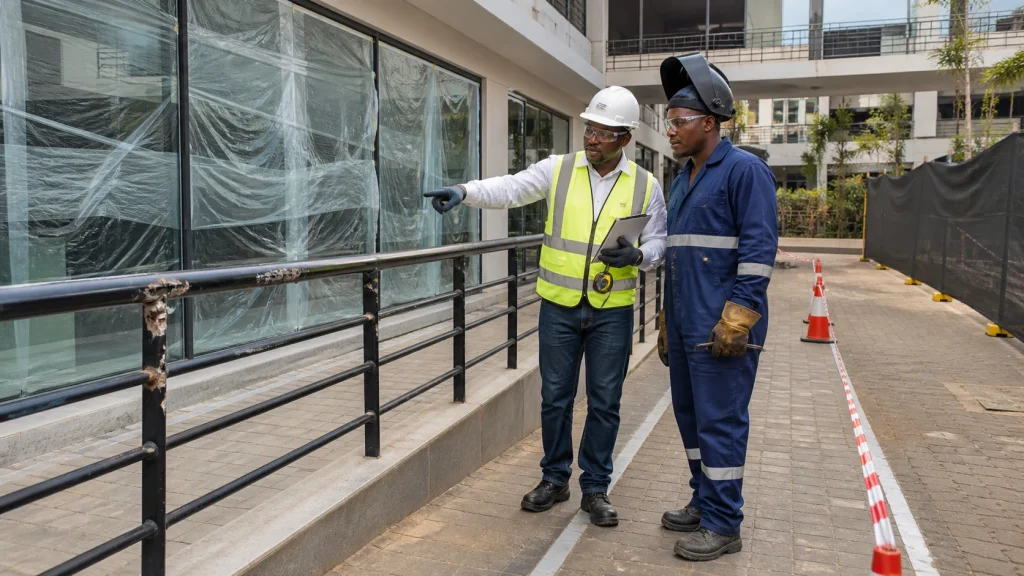
Before arranging on-site welding services Kenya property teams should confirm whether the location is ready for assessment and controlled work. Gates, rails, frames, brackets and installed equipment cannot always be removed for workshop repair, but bringing welding activity to a property introduces access, occupants, nearby materials, power, weather and finish-protection questions. A readiness checklist helps surface those issues before mobilisation.
This guide is intended for facilities managers, schools, estates, warehouses and commercial premises. It complements the ZES on-site and mobile welding service, which is the main commercial page for location-specific enquiries.
Confirm that the work can be assessed safely
Begin with clear photographs of the damaged or proposed work and wider views of its surroundings. Provide approximate dimensions, the location within the property and a description of the problem. For a repair, state whether the item is loose, cracked, misaligned, corroded or difficult to operate and whether the responsible site team has restricted its use.
Do not clean, dismantle or continue loading a questionable component merely to improve a photograph. The site owner should control access according to the actual condition. A visual image is useful for triage but cannot confirm hidden deterioration or the suitability of a repair.
Identify conditions that may require another specialist or approved information. Metalwork affecting a building structure, escape route, machine guard or utility system may need review beyond a normal fabrication scope.
Map the route and working space
Show how people, tools and any replacement pieces will travel from the property entrance to the work area. Record gate widths, stairs, lifts, low roofs, security checks, parking limits and the distance from unloading. If the item is at height or within a restricted room, disclose that before a visit.
Measure the space around the joint, not just the component. Screens, leads, tools and safe movement require room. Mark customer routes, classrooms, tenant entrances, loading bays and vehicle paths that may need separation or temporary closure.
Confirm available power information without assuming a socket is suitable. The work team should determine equipment needs, while the property team identifies distribution restrictions and approved connection points. If access relies on another contractor or landlord, assign who will coordinate it.
Identify heat, spark and finish exposures
List materials and activities near the work: stored goods, ceilings, timber, glass, cables, finished floors, landscaping, fuel, dust-producing processes or occupied rooms. Some exposure may be hidden behind a wall or cladding. The site’s responsible parties must establish suitable permits, isolation, fire controls, ventilation and monitoring for the actual conditions.
Protecting appearance also needs planning. Grinding particles and handling can damage glass, paint, tiles or vehicles beyond the immediate work point. State which finishes are sensitive and what can be moved. Agree who supplies and removes protection and how the area will be inspected afterwards.
Weather affects external work and coatings. Provide a covered alternative or allow the work plan to respond to rain and wind rather than forcing activity in unsuitable conditions.
Prepare dimensions and replacement details
For a new bracket, rail section or frame, supply a sketch that identifies the intended use and critical dimensions. Mark measurements as approximate until the assigned party verifies them. Where an item must align with existing hinges, holes or posts, photographs should show the whole interface.
For repairs, avoid hiding the cause beneath a replacement part. Corrosion, impact, overload, settlement or misalignment may continue to affect the assembly. The assessment should determine whether sufficient sound base material remains and whether repair, reinforcement or replacement is the appropriate documented course.
If deterioration is the central issue, the related ZES welding repair service provides a focused route for condition assessment and planned metalwork maintenance.
Coordinate occupants and the work window
Identify the property contact who can release the area, confirm controls and receive it at completion. Provide building operating hours and periods when noise, access restrictions or vehicle movement would have the least operational impact. Do not assume after-hours work is automatically available; security, lighting and supervision may differ.
Notify affected occupants through the property’s normal process. State alternative routes where needed and prevent unrelated activity entering the controlled area. If several tasks are planned, sequence measurement, fabrication, removal, installation, touch-up and cleanup so closures are not repeated unnecessarily.
Keep a short list of prerequisites: access approval, cleared work zone, authorised isolation, verified dimensions, approved detail, finish reference and responsible contact. Review it before travel to reduce preventable abortive visits.
Agree the completion and reopening check
Define what the site representative will review. Common points include alignment, operation of hinges or latches, agreed dimensions, visible finish, sharp edges, removal of offcuts, protection removal and cleanliness. Testing or acceptance related to loads, structures or equipment must follow the approved project requirements.
Record photographs and any remaining item before the area reopens. If a coating needs a later stage or an adjacent trade must complete work, state the temporary condition and who controls access. Do not allow an unfinished arrangement to become permanent through silence.
For repairs, note the observed failure cause and any recommendation for follow-up inspection. A completed weld is only one part of restoring a useful asset.
Frequently asked questions
What should I send before requesting on-site welding?
Send close and wide photographs, the site location, affected item, approximate measurements, access description, operating hours and the practical outcome required.
Can every damaged steel item be repaired in place?
No. Base condition, access, surrounding exposure, alignment and the item’s role may make workshop work or replacement more appropriate. Assessment should come before the repair decision.
Who prepares the site for hot work?
Responsibilities should be agreed between the property and contractor. The site’s authorised team must apply its procedures and controls for the actual environment.
How can disruption be limited?
Share access constraints early, clear the area, verify dimensions, prefabricate suitable pieces, coordinate occupants and agree the work sequence before mobilisation.
For a site-readiness review, send ZES the location, photographs and access notes. The team can confirm what further details or site assessment are needed before quotation.