
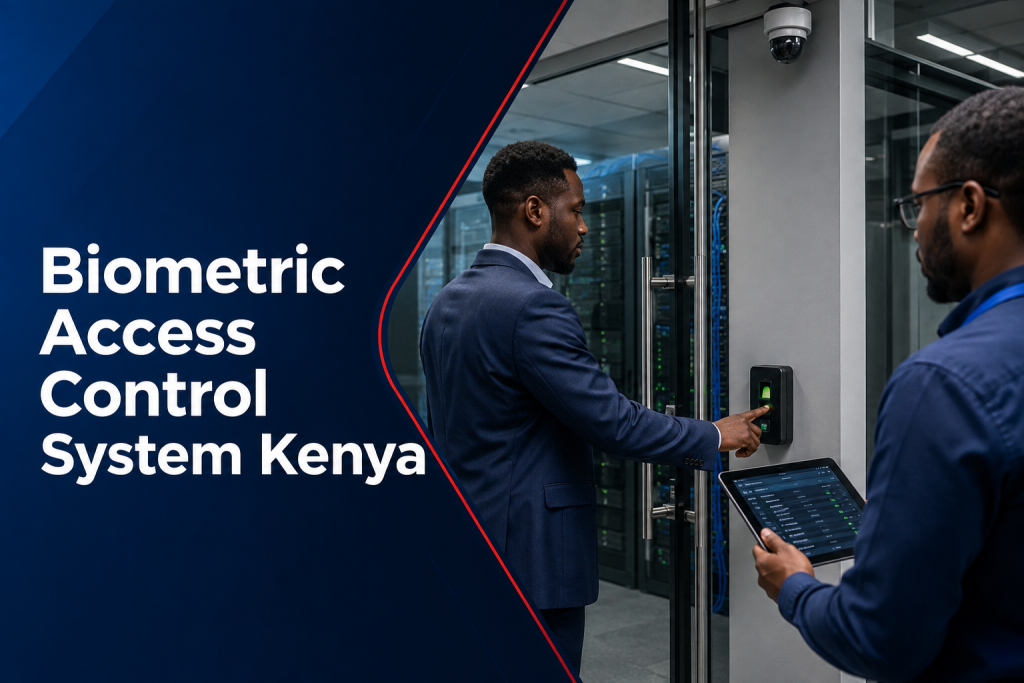
A Biometric Access Control System Kenya project should connect identity, authorization, door hardware, life-safety requirements and administration. A fingerprint or face reader confirms a presented identity; it does not decide who should enter unless roles, schedules and exception procedures are configured correctly.
Separate identification from authorization
Enrollment links a person to a credential or biometric template. Authorization determines which door, gate or area that person may access and at what time. HR, facilities or security should approve roles before an installer programs them.
Identify the protected areas
Typical zones include main offices, server rooms, stores, laboratories, records rooms, cash offices and warehouse cages. Each area needs its own risk assessment, door behavior and emergency plan. Not every internal door requires biometric control.
Reader, controller and lock architecture
A complete door system can include a biometric reader, controller, electric lock, request-to-exit device, door contact, power supply and backup. For higher-security doors, keeping decision logic in a protected controller can reduce reliance on a reader mounted outside the secure area. Compatibility must be confirmed before purchase.
Fail-safe, fail-secure and emergency egress
Lock behavior during fire alarm, power loss or emergency must be designed with the building’s life-safety requirements. People should never be trapped by a credential failure. A competent building and safety team should approve door hardware and egress arrangements; access control must not override mandatory escape provisions.
Roles, schedules and temporary access
Define access by job function and zone instead of granting every enrolled user every door. Contractors and visitors should have approved time-limited access. Staff changes need prompt revocation, and administrator privileges should be limited and reviewed.
Biometric method and fallback
Fingerprint readers can be practical but may struggle with some users or work environments. Face recognition offers contactless use but depends on placement, lighting and suitable enrollment. Every site needs a controlled fallback for legitimate users who cannot be reliably recognized or when a device fails.
Events, monitoring and incident review
Door contacts and event records can show granted access, denied attempts, forced doors or doors held open, depending on the installed system. These records require protected administrator access, accurate time settings and a retention policy. They support investigation but do not prove a complete incident story without context.
Privacy by design
Biometric data is sensitive personal data under Kenya’s Data Protection Act. The organization should determine the lawful purpose, minimize collection, assess risks, protect biometric templates and access logs, communicate with users and define retention. The ODPC guidance library provides current biometric and impact-assessment materials.
Implementation checklist
- Door and zone inventory with risk classification
- Approved user roles and access schedules
- Compatible reader, controller, lock and power design
- Emergency egress and outage behavior
- Enrollment, fallback and revocation procedures
- Administrator roles, logs and retention
- Commissioning tests for every controlled door
Fingerprint installation and warehouse access
For physical installation questions, see Fingerprint Scanner Installation Kenya. Facilities with loading bays, stores and restricted stock areas should also review the warehouse access control guide.
What affects an access-control quotation?
Cost depends on the number and type of doors, existing door condition, lock hardware, controller architecture, cabling distance, fire-alarm or building interfaces, backup power, credential method and software administration. The proposal should identify each controlled opening and list civil, electrical and network assumptions rather than presenting only a reader price.
Frequently asked questions
Can one biometric reader control several doors?
A reader is normally associated with a specific controlled opening, while a central controller or platform may manage several doors. The correct architecture depends on risk, wiring and the selected equipment.
Can existing staff fingerprints be transferred?
Do not assume portability. Template formats, encryption and vendor controls vary. Compatibility, lawful purpose and secure migration must be assessed before any biometric data is moved.
Does a biometric system stop all unauthorized entry?
No. Door strength, credential governance, visitor procedures, tailgating controls, monitoring and staff behavior all matter. Biometrics are one layer in a wider security design.
Request an access-control survey
Share the number of doors, user groups, restricted areas, existing locks, visitor process and integration needs. Request a scoped ZES access-control assessment based on the actual building and operating rules.