
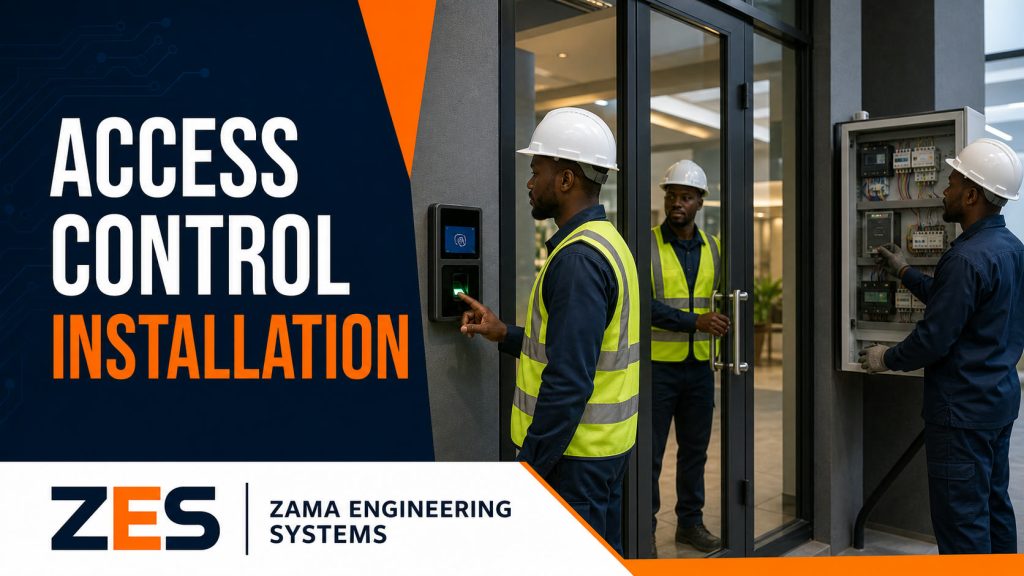
access control installation investment should solve a measurable operating problem—not merely add more hardware or another dashboard. For corporate offices, warehouses, laboratories, schools, server rooms and residential developments, the commercial case usually begins with lost keys, uncontrolled entry, weak visitor records and no access audit trail. This guide explains how decision-makers can define the requirement, evaluate suppliers and build a solution that remains useful after commissioning.
The business problem this solution must solve
Lost keys, uncontrolled entry, weak visitor records and no access audit trail can affect margins, customer service, safety, compliance and management confidence. Before requesting prices, the organisation should document the current process, the known failure points and the evidence available today. A credible project establishes a baseline and agrees how success will be measured.
The requirement should identify affected sites, assets, users, transaction volumes, operating hours and response responsibilities. It should also distinguish confirmed facts from assumptions. This prevents a supplier from designing around a vague request while the customer expects a different commercial outcome.
Who should consider this investment?
Corporate offices, warehouses, laboratories, schools, server rooms and residential developments should consider the solution when the cost of poor visibility, downtime, loss or manual administration has become material. The best time to implement is before rapid expansion makes processes and infrastructure harder to standardise.
Core capabilities to include
- door and gate survey
- credentials, readers and controllers
- locks, power and emergency release
- permissions, reporting and lifecycle management
These capabilities must be converted into a complete scope covering equipment, installation, configuration, data, user access, testing, training and support. Compatibility with existing assets should be verified using model numbers, interfaces, site measurements and available documentation. Brand selection comes after the operational requirement is clear.
Expected business outcomes
- grant access by role and schedule
- revoke credentials quickly
- record entry events
- integrate doors with wider security
Management should attach an owner and a metric to each desired outcome. Examples include variance percentage, incident-response time, vehicle availability, system uptime, reporting time, unplanned call-outs or the number of manual site visits. A system cannot deliver value if nobody reviews its exceptions or acts on its information.
Discovery and site-assessment checklist
- Describe the current workflow: show how people, equipment and information operate today.
- Identify the costly exceptions: quantify losses, delays, faults and recurring disputes.
- Survey the environment: inspect locations, distances, power, network, access, hazards and existing systems.
- Confirm users and decisions: define who operates, approves, monitors and responds.
- Agree integrations: list required links to other platforms and who owns each interface.
- Set acceptance tests: decide what must work before handover is signed.
How ZES approaches the project
Zama Engineering Systems treats the project as an operating system made from people, procedures and technology. The team can coordinate relevant mechanical, electrical, networking, security, monitoring and automation requirements instead of leaving critical interfaces between unrelated contractors.
Delivery typically moves through discovery, survey, design, quotation, procurement, installation, configuration, testing, training and documented handover. The exact scope, brands, licences, approvals, subscriptions, travel and third-party responsibilities are confirmed in writing for the customer’s location and project.
Questions to ask competing suppliers
- Which customer problem and measurable outcome does the design address?
- What is included, excluded and dependent on third parties?
- How was equipment capacity and compatibility confirmed?
- What happens during power, network or sensor failure?
- Which tests, drawings, settings and records form part of handover?
- Who provides maintenance, escalation and critical spare parts?
- Are software, connectivity or platform fees recurring?
- How will the system expand to new users, assets or sites?
Implementation risks serious clients should control
Common risks include buying products before a survey, underestimating supporting infrastructure, unclear integration ownership, shared administrator accounts, poor documentation and no maintenance budget. Another risk is automating an inconsistent process. The customer should standardise approvals, naming, exception handling and reporting responsibilities alongside the technology.
Maintenance, security and lifecycle planning
The operating plan should cover inspections, backups, calibration or functional tests where applicable, software updates, access reviews, cleaning, consumables and replacement cycles. Critical alarms need named recipients, escalation times and a manual fallback procedure. Data retention and privacy should match operational, contractual and legal requirements.
Preparing a serious request for quotation
Send the site locations, number of assets or users, current equipment, drawings or photographs, operational pain points, required reports, integration needs and implementation timetable. State the desired outcome rather than requesting a product list alone. ZES can then prepare an assessment-led scope instead of an unreliable generic price.
Frequently asked questions
Can ZES work with existing equipment?
Potentially. Condition, capacity, compatibility, documentation and configuration access must be assessed first.
Can the solution support multiple sites?
Many systems can, but connectivity, user permissions, naming standards, reporting and support arrangements must be designed for central operation.
Is installation enough to guarantee results?
No. Results depend on correct design, user adoption, operating procedures, exception response and ongoing maintenance.
Can ZES provide maintenance after commissioning?
Yes, where included in the agreed service scope. Preventive visits, remote support, response times and exclusions should be documented.
Discuss Your access control installation Requirement
Request a professional assessment covering the business problem, site conditions, technical scope and measurable outcomes.
Access Control Installation: 7 critical procurement checks
A successful access control installation project starts with a documented operational problem, accountable stakeholders and measurable acceptance criteria. Serious buyers should compare lifecycle value, support response and integration risk—not equipment price alone.
How to specify access control installation for dependable results
Before approving a access control installation proposal, confirm the site survey, system boundaries, equipment compatibility, implementation method, user training, warranty responsibilities and preventive-maintenance plan. These checks protect uptime and make supplier comparisons more objective.
The compliance and governance requirements surrounding access control installation should also be recorded during design. Procurement teams can consult the relevant guidance published by the responsible standards or regulatory authority and obtain project-specific professional advice where required.
Why organisations invest in access control installation
The business case for access control installation should connect technical performance to reduced loss, better visibility, safer operations and faster management decisions. ZES translates those outcomes into a practical scope, commissioning plan and support framework.
Request a site assessment if your organisation needs a defensible access control installation specification, an implementation budget and a clear path from current operational risk to verified performance.