
Updated 4 November 2026 · Zama Engineering Systems buyer guide
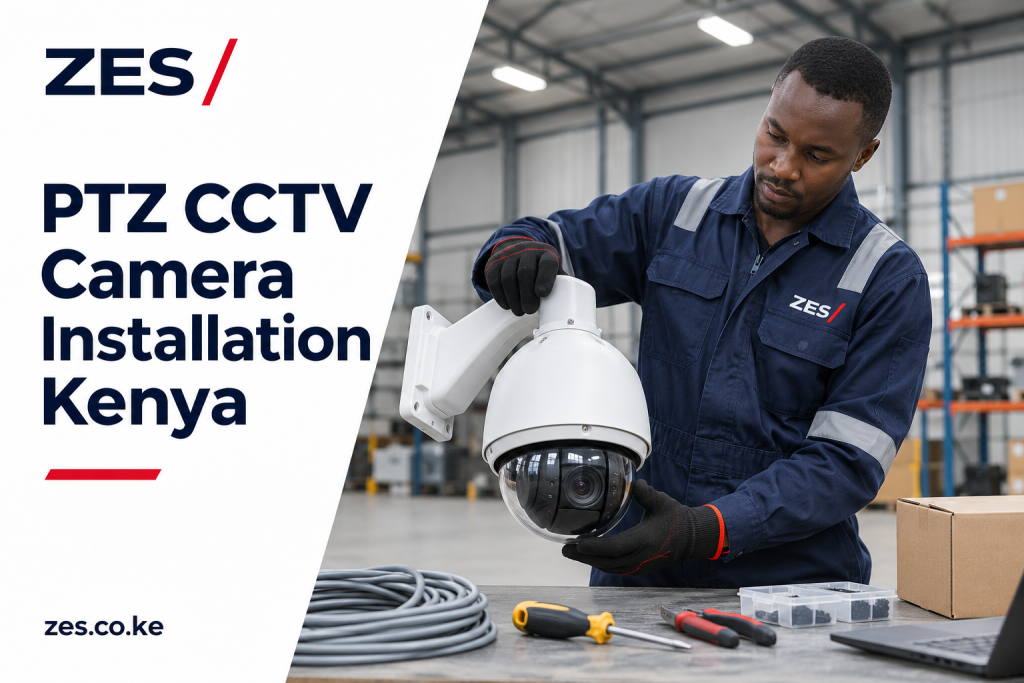
PTZ CCTV Camera Installation Kenya is worth assessing when an authorised operator needs to change a camera's viewing direction or examine a relevant scene more closely. The installation brief should explain who uses that capability and what must remain recorded elsewhere. This guide helps commercial and warehouse buyers compare a PTZ proposal through operating responsibilities, recording expectations and a practical handover.
Explain why the view needs to move
Describe the operator's task and the areas that need review without publishing sensitive observation details. Ask whether a movable camera adds value to that task or whether separately planned fixed views would be more appropriate. A moving demonstration can be impressive, but the buyer needs a reason to use it in ordinary operations. Include the intended user, work pattern and review responsibilities in the initial brief so the design follows a real operating need.
PTZ CCTV Camera Installation Kenya: keep coverage expectations realistic
Clarify what the proposed camera records while it is directed at a particular view. Do not assume that the ability to move between areas means all those areas are recorded in equivalent detail at once. Ask the designer to identify any fixed coverage required alongside the PTZ camera. The accepted camera schedule should distinguish overview requirements, operator-directed tasks and any functions that depend on a particular equipment or software configuration.
Compare the quoted camera and supporting equipment
Obtain exact model references and ask for the relevant manufacturer documentation. Identify the proposed mounting work, power arrangement, network connection and recorder compatibility. Access for safe inspection and maintenance belongs in the installation scope, particularly where a camera is placed above ordinary reach. Keep equipment supply separate from any structural or access work that needs assessment. Avoid treating a product photograph as proof that a proposed mounting location is suitable.
Agree operator control and training
Decide which authorised users can move the camera and how competing requests for control will be handled by the selected system. Ask what operator training is included and how the normal operating arrangement will be restored after use. Record any included automated functions precisely rather than assuming them from the PTZ label. The customer's responsible administrator should approve permissions and retain control of the configuration and account-recovery arrangements.

Test controls and recorded results together
During acceptance, have the intended operator perform the agreed tasks and retrieve the related recording. Confirm that camera labels, displayed times and normal operating arrangements are understandable. Record the supplied equipment and any limitations observed during testing. A later change to the view, operating procedure or supporting software should be assessed against the accepted scope. Include the support route and maintenance responsibilities so control problems can be reported with useful context.
Compare the supplied scope
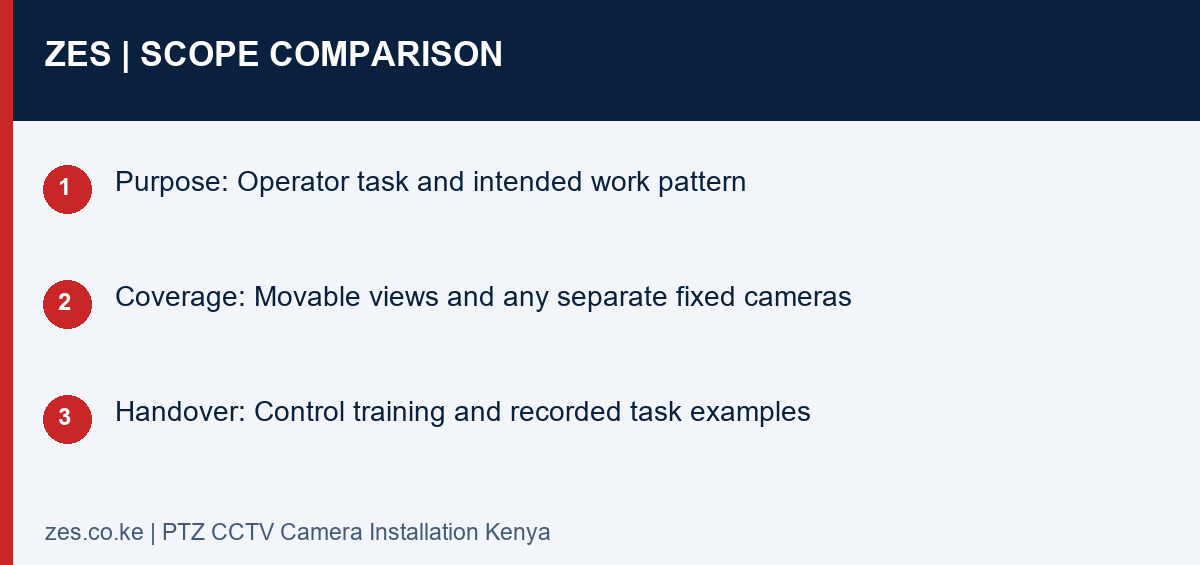
| Decision | Information to confirm | Useful result |
|---|---|---|
| Purpose | Operator task and intended work pattern | A justified PTZ requirement |
| Coverage | Movable views and any separate fixed cameras | Clear recording expectations |
| Handover | Control training and recorded task examples | An operator-ready installation |
A practical planning example
A warehouse supervisor may need to inspect a reported activity from an authorised workstation while entrances retain their own planned recording views. The proposal can identify those as different functions and demonstrate both. This is more useful than assuming one movable camera replaces every fixed position. The scenario is illustrative and does not disclose an actual site's layout.
PTZ CCTV Camera Installation Kenya: enquiry checklist
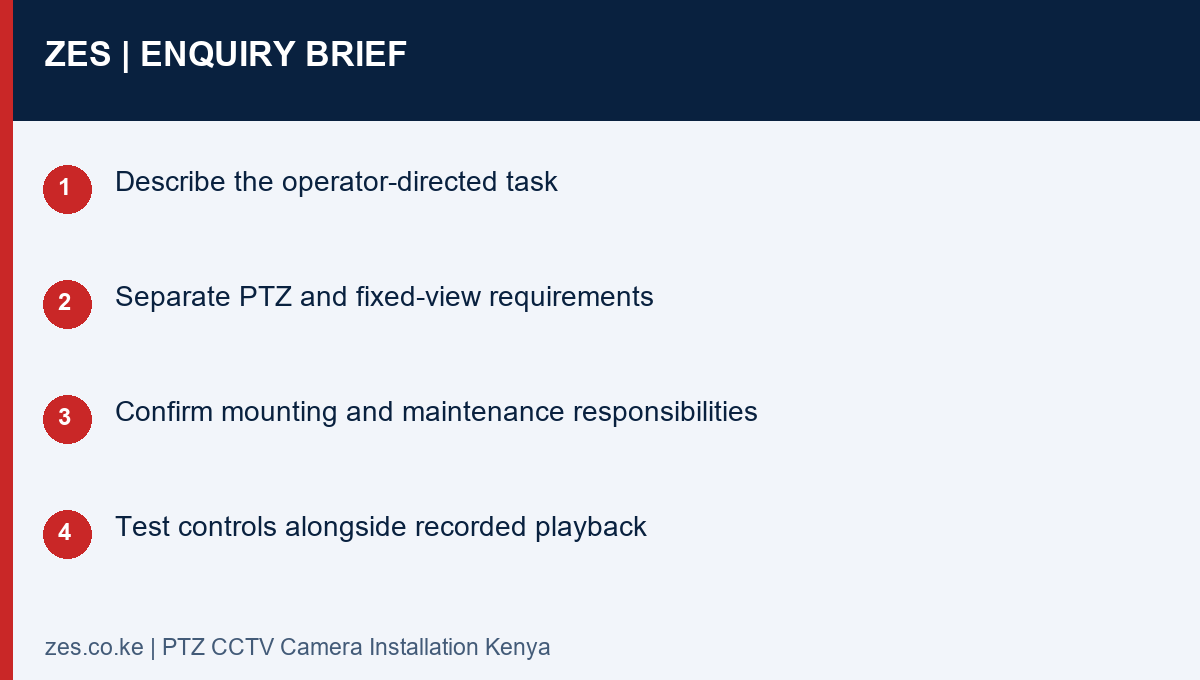
- Describe the operator-directed task
- Separate PTZ and fixed-view requirements
- Confirm mounting and maintenance responsibilities
- Test controls alongside recorded playback
Questions before commissioning
Does PTZ automatically include tracking?
Not necessarily. Ask for the precise model, software and included function, with an acceptance demonstration where relevant.
Can the existing recorder control a new PTZ camera?
Compatibility must be confirmed for the specific devices, software and required controls. Request that assessment before equipment purchase.
Discuss your CCTV requirement with ZES
Read the related ZES CCTV planning guide and explore CCTV surveillance services. Share the location, equipment information and intended outcome. ZES confirms the appropriate assessment, availability, proposed delivery responsibilities and commercial terms for the actual enquiry.
Request a scoped quotation · Request a site assessment · Call +254 725 345 345
Technical background: ONVIF video-system profile information. Confirm the actual project requirements with the responsible advisers and relevant product information.
More detailed project planning
PTZ cameras for large warehouses in Kenya have become the go-to solution for facility managers who need to monitor vast floor areas without installing dozens of fixed units. At zes.co.ke, we understand that PTZ cameras for large warehouses in Kenya solve a problem that fixed cameras cannot: the ability to pan, tilt, and zoom across an entire storage facility from a single mounting point. Whether you operate a distribution centre along Mombasa Road, a cold store in Embakasi, or a manufacturing warehouse in Thika, understanding PTZ cameras for large warehouses in Kenya is the foundation for comprehensive coverage and operational intelligence.
The surveillance landscape in Kenya’s industrial sector has evolved rapidly. Warehouses are getting larger, racking is getting taller, and inventory volumes are growing. Fixed cameras, while cost-effective, struggle to cover long aisles and wide loading yards. That is why PTZ cameras for large warehouses in Kenya are increasingly specified in new builds and upgrades. These cameras deliver optical zoom, remote directional control, and auto-tracking that fixed units simply cannot match.
At zes.co.ke, we specialise in helping warehouse operators evaluate PTZ cameras for large warehouses in Kenya based on their specific building geometry, racking layout, and operational priorities. Some facilities need wide yard coverage. Others need aisle-level detail for inventory disputes. A few need both, which means mixing PTZ cameras for large warehouses in Kenya with fixed and multi-sensor units in a layered design. Our team walks every facility before recommending any configuration.
Why Warehouses Need Pan-Tilt-Zoom Capability
Fixed cameras are excellent at monitoring a defined field of view continuously. But in a warehouse, that field of view is often too narrow. A single fixed camera at the end of a 60-metre aisle may capture movement, but not licence plates at the gate, not pallet labels on racking, and not the facial detail needed for investigations. PTZ cameras for large warehouses in Kenya address this limitation by allowing operators to zoom in on demand.
When an alarm triggers at a loading bay, an operator can immediately swing a PTZ camera for large warehouses in Kenya toward the bay, zoom in on the vehicle, and capture identifying details. When a dispute arises over damaged goods, recorded PTZ footage can be reviewed to confirm exactly what happened. The flexibility that PTZ cameras for large warehouses in Kenya provide is what makes them indispensable in high-value storage environments.
There is also the deterrence factor. Visible PTZ cameras for large warehouses in Kenya that move and track activity signal to potential intruders that the facility is actively monitored. This psychological effect is difficult to quantify but well documented in security literature. At zes.co.ke, we often find that a small number of well-positioned PTZ cameras for large warehouses in Kenya deliver more deterrence than a larger number of static units.
Coverage Planning for Large Warehouse Floors
Effective coverage starts with geometry. Warehouse aisles are linear, so cameras placed at aisle ends with adequate zoom can monitor the full length. Wide open floor areas near staging and dispatch zones suit higher-mounted units with broad pan ranges. Loading yards and perimeter areas require weather-rated PTZ cameras for large warehouses in Kenya with long-range IR or thermal capability.
Ceiling height matters. A 12-metre ceiling allows a wider field of view but reduces facial detail at distance unless optical zoom is substantial. A 6-metre ceiling improves detail but limits how much floor area each camera can cover. Matching PTZ cameras for large warehouses in Kenya to ceiling height and aisle length is a core design activity.
Racking is the enemy of visibility. Tall, dense racking blocks sightlines and creates shadows. This is one reason PTZ cameras for large warehouses in Kenya are often mounted on perimeter walls or dedicated poles rather than ceiling-mounted in central aisles. When racking is unavoidable, cameras are positioned to look down aisles rather than across them.
At zes.co.ke, we use predictive coverage software to model how PTZ cameras for large warehouses in Kenya will perform before any hardware is purchased. This eliminates guesswork and prevents the expensive mistake of installing cameras that cannot see what matters.
Optical Zoom and Resolution Considerations
Optical zoom is the defining feature of PTZ cameras for large warehouses in Kenya. Digital zoom simply crops and enlarges an image, degrading quality. Optical zoom physically adjusts the lens, preserving resolution at long distances. A 25× optical zoom on a camera at 50 metres can resolve fine detail that a 4× zoom cannot.
Resolution matters equally. A 2MP camera may be adequate for general monitoring but insufficient for identification at range. 4MP and 8MP PTZ cameras for large warehouses in Kenya provide the pixel density needed to read pallet labels, vehicle registrations, and facial features from a distance. For facilities handling high-value goods, higher-resolution PTZ cameras for large warehouses in Kenya are a worthwhile investment.
Lens speed also plays a role. Cameras with larger apertures perform better in low light, reducing reliance on IR illumination. Warehouses with overnight operations benefit from fast-lens PTZ cameras for large warehouses in Kenya that deliver usable colour images even under artificial lighting.
At zes.co.ke, we specify resolution and zoom based on the smallest object that must be identified and the greatest distance from which it must be captured. This practical approach ensures that the PTZ cameras for large warehouses in Kenya we recommend actually solve the client’s problem.
Low-Light and Night Vision Performance
Warehouses run around the clock. Night shifts, early deliveries, and late dispatches are routine. PTZ cameras for large warehouses in Kenya must therefore perform in low light, and often in near-total darkness across large yards.
IR illumination is the standard solution. Modern PTZ cameras for large warehouses in Kenya offer IR range from 100 to 300 metres, with smart IR that adjusts intensity to prevent overexposure at close range. For very large yards, external IR illuminators supplement built-in LEDs.
Full-colour night vision has advanced considerably. Cameras using large-aperture lenses and high-sensitivity sensors can produce colour images at very low light levels. This is valuable because colour aids identification—vehicle colour, clothing colour, and packaging colour all become evident. In perimeter applications, PTZ cameras for large warehouses in Kenya with full-colour night vision reduce ambiguity in alarm verification.
Thermal PTZ cameras for large warehouses in Kenya are a further option for perimeter and yard coverage. Thermal imaging detects heat signatures regardless of lighting, fog, or smoke, making it ideal for long-range detection. While thermal units do not provide identification, they are excellent at detection and can cue optical PTZ cameras to investigate.
Auto-Tracking and AI Analytics
Modern PTZ cameras for large warehouses in Kenya go beyond remote control. Auto-tracking uses AI to detect a moving subject and follow it automatically, keeping it in frame without operator intervention. In a warehouse yard, this means a vehicle entering the gate can be tracked to the loading bay without anyone touching a joystick.
Analytics add further value. Human and vehicle classification reduces false alarms from wildlife, vegetation, or lighting changes. Line-crossing detection triggers alerts when someone crosses a defined boundary. Loitering detection flags individuals who remain in an area beyond a set time. Abandoned object detection identifies packages or items left behind.
Combined, these features make PTZ cameras for large warehouses in Kenya far more than cameras. They become active security assets that prioritise operator attention and provide actionable intelligence. At zes.co.ke, we configure analytics according to each client’s risk profile, avoiding the over-configuration that leads to alert fatigue.
Integration with Warehouse Management Systems
PTZ cameras for large warehouses in Kenya do not operate in isolation. Integration with warehouse management systems (WMS) allows camera views to be linked to inventory events. When a picking discrepancy is flagged, the relevant camera footage can be retrieved automatically. When a shipment is loaded, video evidence is attached to the dispatch record.
Integration with access control is equally valuable. When a gate opens for a registered vehicle, the nearest PTZ camera can automatically pan to the entry point and begin recording. When an unauthorised access attempt occurs, cameras can be directed to the location and the event logged with video evidence.
Integration with alarm systems is standard. Intrusion alarms trigger camera presets, turning cameras toward the alarm location and starting recording. This reduces response times and ensures that evidence is captured. At zes.co.ke, we design integration that links PTZ cameras for large warehouses in Kenya into the broader security and operations ecosystem.
Network and Bandwidth Planning
High-resolution PTZ cameras for large warehouses in Kenya generate substantial data. A single 4K PTZ camera streaming continuously can consume significant bandwidth. Careful network design ensures that recording and remote viewing function reliably without compromising warehouse operations.
Edge recording on camera-side SD cards provides resilience. If the network fails, footage continues to record locally and synchronises when connectivity is restored. This is particularly valuable in warehouses with unreliable power or network infrastructure.
PoE and PoE+ switches deliver power and data over a single cable, simplifying installation. However, high-power PTZ cameras for large warehouses in Kenya may require PoE++ or dedicated power. Switch selection must account for the total power budget across all cameras and access points.
Bandwidth management uses substreams for live viewing and full-resolution streams for recording. Operators see smooth video on their screens while the recorder captures maximum detail. This balance is essential when multiple operators access PTZ cameras for large warehouses in Kenya simultaneously.
At zes.co.ke, we design network infrastructure that supports the full capability of every camera without bottlenecks. This includes structured cabling, PoE switching, VLAN segmentation, and where necessary, fibre backbone for long runs.
Storage and Retention Requirements
Retention periods vary by facility. Some warehouses require 30 days of footage; others require 90 days or more for insurance or dispute resolution. Storage capacity must match camera count, resolution, frame rate, and retention period.
PTZ cameras for large warehouses in Kenya benefit from smart codec technologies such as H.265+ that reduce storage requirements without compromising quality. Motion-based recording reduces storage further by only recording when activity is detected.
Storage architecture may use NVRs, server-based recording, or cloud storage. Hybrid approaches keep high-resolution footage locally while backing up critical events to the cloud. For facilities concerned about theft of recording equipment, off-site backup is essential. This is a factor that often favours cloud-connected PTZ cameras for large warehouses in Kenya in high-risk locations.
Installation Considerations for Large Facilities
Installing PTZ cameras for large warehouses in Kenya involves practical challenges. Mounting height must balance coverage against maintenance access. Cameras too high are difficult to service; cameras too low are vulnerable to damage from forklifts and other equipment.
Power availability affects placement. Locations without existing power require cable runs or PoE extension. Where power is unavailable, solar-powered PTZ cameras for large warehouses in Kenya offer an alternative, particularly for perimeter positions.
Weatherproofing is essential for outdoor units. IP66 or IP67 ratings protect against dust and water. In coastal warehouses, corrosion-resistant housings extend equipment life. Vibration resistance matters in facilities near heavy machinery or transport routes.
Cable management must protect against damage and environmental exposure. Conduit or armoured cable suits exposed routes. Labelling and documentation simplify future maintenance and expansion.
At zes.co.ke, our installation teams are experienced with the practical realities of large warehouse environments. We coordinate with facility managers to schedule work that minimises disruption to operations.
Maintenance and Reliability
PTZ cameras have moving parts, which means they require more maintenance than fixed units. Pan and tilt mechanisms, zoom lenses, and wiper assemblies all wear over time. Scheduled maintenance extends equipment life and prevents failures at critical moments.
Cleaning is essential. Dust on domes and lenses degrades image quality, particularly in warehouses with high particulate levels. In dusty industrial areas, cleaning frequency may need to be higher than manufacturer recommendations.
Firmware updates address security vulnerabilities and add features. Regular updates keep PTZ cameras for large warehouses in Kenya performing optimally and protected against emerging threats.
Health monitoring features in modern cameras report status to management platforms. Motor faults, temperature issues, and network problems can be detected before they cause failures. This proactive approach reduces downtime and maintenance costs.
At zes.co.ke, we offer maintenance contracts for PTZ cameras for large warehouses in Kenya that include scheduled inspections, cleaning, firmware updates, and priority response for faults. This ensures continuous protection.
Comparison with Alternative Technologies
PTZ cameras are not always the right answer. For continuous monitoring of defined areas, fixed cameras are more cost-effective. For wide area coverage, multi-sensor cameras that combine several fixed lenses in one housing may be preferable. For perimeter detection, thermal cameras may outperform optical units.
The most effective designs often combine technologies. Fixed cameras provide continuous coverage of critical areas. PTZ cameras for large warehouses in Kenya provide flexibility for investigation and tracking. Multi-sensor cameras fill gaps. Thermal units handle perimeter detection.
At zes.co.ke, we design hybrid systems that use each technology where it adds most value. This avoids over-spending on PTZ cameras for large warehouses in Kenya in areas where they are not needed, while ensuring that flexible coverage is available where it matters.
{{VIDEO_EMBED: Insert a 2-minute video here showing a PTZ camera tracking a forklift through a warehouse aisle, with commentary explaining auto-tracking and preset configuration.}}
Regulatory and Privacy Considerations
Warehouses with CCTV must comply with Kenya’s Data Protection Act. Signage informing staff and visitors of camera coverage is required. Retention periods should be defined and documented. Access to footage should be controlled and logged.
Cameras should not intrude on neighbouring properties or public spaces unnecessarily. Where coverage extends beyond the facility boundary, privacy impact should be assessed.
Workplace monitoring raises employment considerations. Staff should be informed of camera locations and the purposes of monitoring. Where cameras are used for performance monitoring rather than security, additional consultation may be appropriate.
At zes.co.ke, we advise clients on compliant deployments of PTZ cameras for large warehouses in Kenya. This includes signage, data handling procedures, and access controls that satisfy regulatory requirements.
Selecting the Right PTZ Cameras for Large Warehouses in Kenya
Camera selection should follow coverage design, not precede it. Once coverage requirements are documented, specifications can be matched. Key criteria include optical zoom, resolution, low-light performance, IR range, analytics capability, environmental rating, and integration support.
Manufacturer support matters. Cameras with local warranty support and available spare parts reduce downtime. Brands with established presence in Kenya make maintenance simpler and faster.
Total cost of ownership should guide decisions. A cheaper camera that fails frequently or lacks support costs more over its life than a premium camera that performs reliably for years. The best PTZ cameras for large warehouses in Kenya are those that deliver consistent performance with predictable maintenance costs.
At zes.co.ke, we work with reputable manufacturers and provide independent advice. Our goal is to specify PTZ cameras for large warehouses in Kenya that meet the client’s technical requirements and budget without compromise on reliability.
Common Mistakes to Avoid
Avoiding common mistakes saves money and frustration. Skipping the site survey is the most frequent error. Design based on assumptions rather than measurements invariably underperforms.
Specifying digital zoom as a substitute for optical zoom is another mistake. Digital zoom does not improve identification capability. Only optical zoom preserves detail at distance.
Underestimating bandwidth is common. High-resolution PTZ cameras for large warehouses in Kenya require adequate network capacity. Bottlenecks cause stuttering video and missed events.
Ignoring maintenance requirements leads to premature failure. PTZ cameras need scheduled cleaning and inspection. Facilities that treat cameras as install-and-forget discover problems only when incidents occur.
Over-relying on PTZ alone is a design error. The best systems combine technologies. Fixed cameras for continuous coverage, PTZ for flexibility, thermal for detection—each has a role. At zes.co.ke, we help clients avoid the trap of thinking any single technology solves every problem.
The Future of Warehouse Surveillance
Warehouse surveillance continues to evolve. AI analytics are becoming more capable. Cloud management simplifies multi-site operations. Integration with robotics and automated systems creates new possibilities.
Thermal and multi-sensor cameras are becoming more affordable. Edge computing allows analytics to run on camera, reducing bandwidth. Cybersecurity features are improving as manufacturers respond to rising threats.
For warehouse operators, this evolution means better protection at lower cost over time. The PTZ cameras for large warehouses in Kenya available today are more capable than those of five years ago, and tomorrow’s will be better still. Investing in scalable, well-integrated systems protects that investment.
At zes.co.ke, we stay current with developments in surveillance technology. Our recommendations reflect the best available options for each client’s specific needs and budget.
Frequently Asked Questions
Q: How many PTZ cameras does a large warehouse need?
A: There is no fixed number. Coverage depends on building geometry, racking layout, and the level of detail required. A survey determines the optimal count.
Q: Can PTZ cameras replace fixed cameras entirely?
A: Not usually. PTZ cameras provide flexibility but cannot monitor every area continuously. Most designs combine fixed and PTZ units.
Q: What is the typical lifespan of a PTZ camera?
A: With proper maintenance, quality PTZ cameras last 5–8 years. Moving parts and environmental exposure affect lifespan.
Q: Do PTZ cameras work in cold storage?
A: Yes, with appropriate models. Cold-rated cameras with heated housings operate reliably at low temperatures.
Q: How much bandwidth does a PTZ camera consume?
A: A 4MP camera streaming at full resolution may use 4–8 Mbps. Substreams for viewing reduce this significantly.
Q: Can I control PTZ cameras from my phone?
A: Yes. Modern systems support mobile apps for remote viewing and control, with appropriate security measures.
Q: What happens if the network fails?
A: Edge recording on SD cards continues capturing footage locally. It synchronises when connectivity returns.
Q: Are PTZ cameras suitable for outdoor yards?
A: Yes, with weather-rated models. IP66 or higher ratings, plus wipers and heaters, ensure reliable outdoor operation.
Investing in PTZ cameras for large warehouses in Kenya is a strategic decision that improves coverage, enhances investigation capability, and strengthens deterrence. At zes.co.ke, we provide expert design, quality equipment, and professional installation for every warehouse surveillance project. Whether you need basic guidance or a complete deployment, our team delivers reliable solutions.
PTZ cameras for large warehouses in Kenya represent a critical component of modern industrial security. By choosing a professional partner like zes.co.ke, you ensure your deployment is properly designed, installed, and supported. Our commitment to quality ensures you receive a system that meets your specific needs.
For more information about PTZ cameras for large warehouses in Kenya and to schedule a free site survey, contact zes.co.ke today. Our team is ready to answer your questions.