

Petrol Station Preventive Maintenance Contractors should be compared against a defined asset and task schedule. A broad service claim does not establish competence for every specialist system or explain what the operator receives after each visit. This guide adds a contractor-selection checklist to ZES’s existing preventive-maintenance contract page. ZES can review the required scope and confirm appropriate responsibilities, evidence, service arrangements and exclusions before a proposal is accepted.

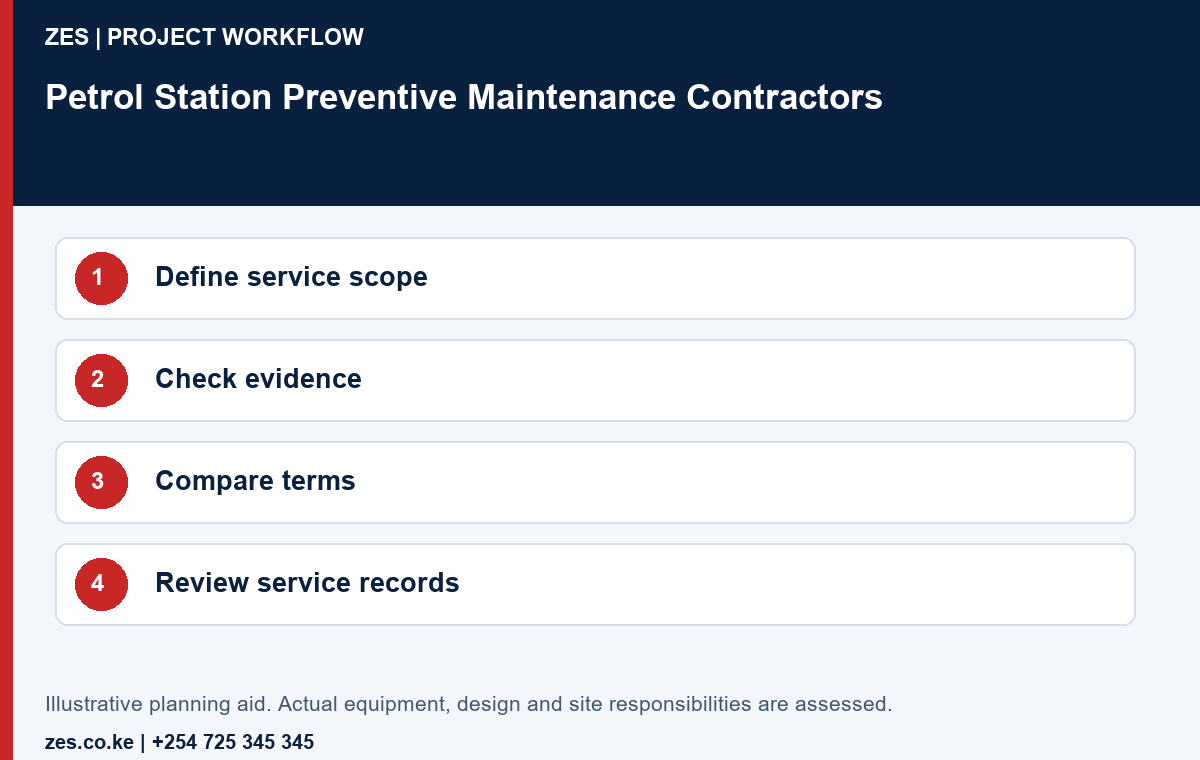
1. Issue the same service brief
Provide each bidder with the included asset list, available condition information and expected deliverables. Identify the site operating constraints and customer-supplied responsibilities. Comparable briefs help explain differences in price and method. Without a common scope, one contractor may quote routine observations while another includes technical tasks, parts or specialist attendance that the first has excluded.
2. Check competence for the actual tasks
Ask for current evidence relevant to each proposed work package and verify the responsible parties. Separate general facility work from electrical, structural, fuel-system or other specialist tasks. Do not infer a licence or technical capability from a logo, a uniform or an unrelated project photograph. The evidence should match the work being procured.
3. Review the proposed task schedule
Ask the contractor to explain the basis for each task and frequency, using equipment information, assessed condition and applicable requirements. Identify tasks the station operator performs between visits. Avoid accepting a standard visit count without understanding what it covers. A useful schedule makes service delivery checkable while allowing condition findings to be referred for the right follow-up.
4. Test the reporting and escalation process
Request an illustrative service report and a walkthrough of a sample fault. Identify who receives the report, who decides the next action and how status is communicated. Distinguish response targets from guaranteed resolution. Parts availability, authorised access and specialist dependencies should be clear in the proposed arrangement rather than discovered only after a fault occurs.
5. Compare parts, exclusions and changes
Identify included consumables, excluded components and approval rules for additional work. Ask who confirms the suitability of any replacement and what records are retained. A quotation should make it possible to understand how an unusual finding becomes a separately scoped repair. Vague all-inclusive wording can leave important differences unresolved between the owner and the contractor.
6. Examine customer ownership and handover
Keep asset references, service history, reports and relevant configuration ownership with the responsible customer team. Define how records are made available if the contractor changes. Sensitive access information should be handled privately. The operator should be able to explain the service arrangement without relying entirely on the personal knowledge of one supplier contact.
7. Review actual service outcomes
At an agreed interval, review completed tasks, repeat faults, unresolved findings and the quality of follow-up records. Assign responsibilities for improvements and confirm any scope change in writing. The purpose is to maintain a managed asset condition and a practical escalation process, rather than reward a contractor only for recording that a visit took place.
Petrol Station Preventive Maintenance Contractors: demonstration and review workbook
An operator is comparing preventive-maintenance contracts after several recurring faults. A useful programme starts with the actual asset population and relevant technical requirements, then identifies maintenance tasks, frequencies, evidence and the handling of findings. It should not promise that routine visits eliminate every failure. This hypothetical buying exercise distinguishes planned maintenance from fault response and capital replacement, helping the station compare equivalent scopes instead of selecting a low recurring fee that leaves its most important assets or specialist needs undefined.
The following cases help the buyer specify and compare the actual project. Agree which apply to the proposed maintenance scope and record any exclusions before acceptance. They are hypothetical review prompts, not evidence of a completed ZES client project. The responsible site team and relevant competent parties approve any physical tests or changes to live operations.
Asset population
Identify the included assets with references and locations. A preventive-maintenance plan cannot be compared fairly if one offer covers a defined list while another relies on an ambiguous general description.
Task basis
Ask the responsible competent parties to establish appropriate maintenance tasks using relevant information and actual duty. A generic calendar should not replace assessment of the included equipment or site conditions.
Frequency
Record the agreed frequency or trigger for each included task and its basis. Explain who reviews that requirement when operating patterns, technical information or asset condition change.
Visit readiness
Identify customer dependencies such as authorised access, available records and attendance by another responsible supplier. A missed dependency should be reported rather than silently recorded as completed maintenance.
Work evidence
Specify the report entries required for each task. Distinguish completed checks, observations, inaccessible items and exclusions so that a visit report can be compared with the scheduled work.
Finding priority
Use the responsible site’s process and appropriate competent advice to review findings. The contract should identify escalation ownership without presenting a generic blog as a site-specific risk assessment.
Corrective work
Separate planned maintenance tasks from the approval and pricing of repairs. Confirm which labour, parts or investigations are included and which require another quotation or specialist service.
Fault response
If reactive support is requested, state its actual terms separately. A scheduled maintenance arrangement does not automatically supply continuous monitoring, immediate attendance or guaranteed restoration.
Repeat faults
Review recurring findings against prior work and operating history. Identify whether further investigation or replacement assessment is needed instead of closing the same symptom repeatedly without explanation.
Contract review
Compare scheduled completion, evidence quality, unresolved findings and changes in asset use. Keep renewed maintenance scope, commercial terms and specialist responsibilities visible to both customer and contractor.
Detailed buyer questions
Does preventive maintenance guarantee no breakdowns?
No. A programme supplies defined maintenance tasks and evidence intended for the assessed requirement. Failures and changing conditions still need reporting, appropriate investigation and authorised corrective decisions.
Should every asset receive the same visit frequency?
Not automatically. The responsible technical assessment should consider the actual asset, relevant information and operating duty. Record the agreed basis and review changes through the appropriate owners.
How should two maintenance contracts be compared?
Use the same asset schedule, maintenance tasks, evidence, frequencies and reactive-support expectations. Compare exclusions, parts, specialist work, customer dependencies and renewal terms alongside the recurring price.
Prepare a clear enquiry for ZES
Share the station location, the problem or intended outcome, relevant quantities and the existing equipment or application references. Include available approved plans or anonymised examples where useful. Identify the person who can authorise site access and the contacts responsible for operations and technical interfaces. Keep credentials, employee biometric records and confidential transaction information out of a general enquiry.
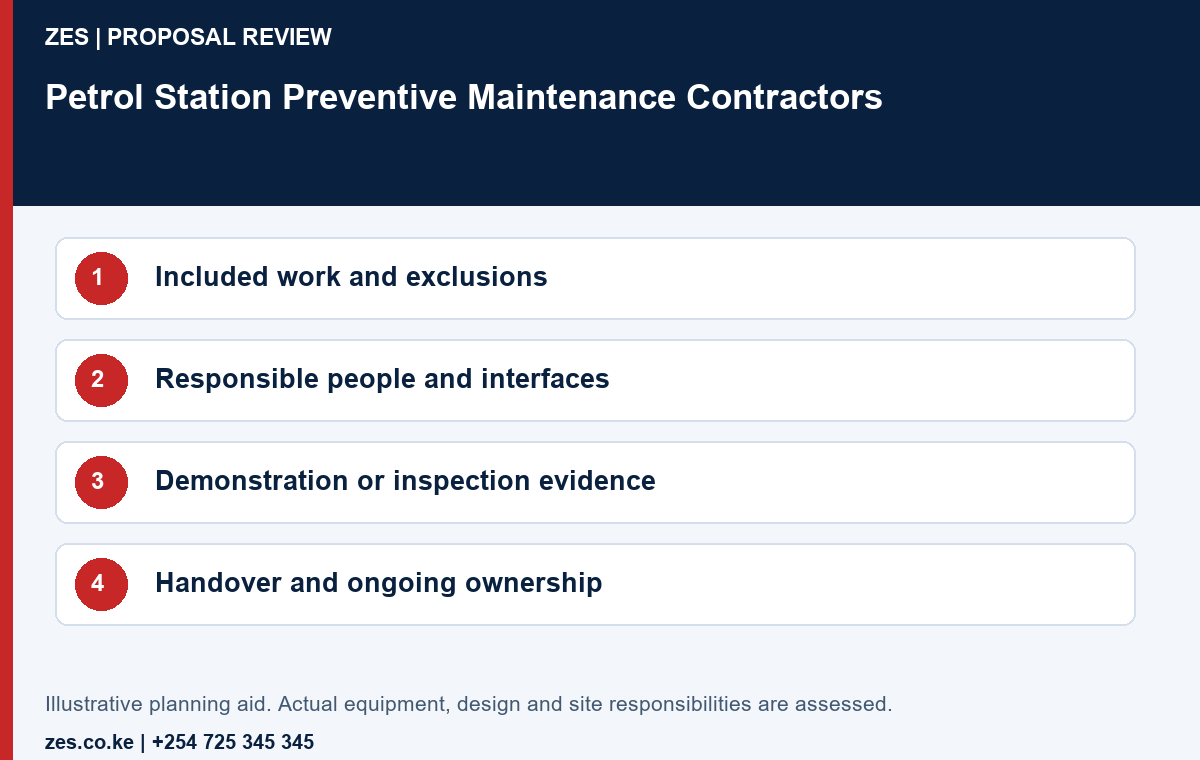
Ask the written proposal to identify the supplied work, exclusions, customer dependencies, current commercial terms and the evidence used for acceptance. Confirm specialist responsibilities and relevant credentials for the actual scope. ZES can review the brief and confirm the appropriate assessment and proposal arrangements. Site attendance, timing, product availability and support commitments are agreed directly rather than promised solely because a project names a particular county or town.
Compare the same complete scope
- Equipment or materials: identify the actual model, specification and documentation.
- Supporting tasks: record enabling work, site access and customer-supplied dependencies.
- Configuration or fabrication: state the work and the responsible approving party.
- Acceptance: agree the demonstration, inspection or verification evidence required.
- Ownership: confirm accounts, records, recurring charges and the future support route.
Frequently asked questions
Is the lowest visit price necessarily the best comparison?
No. Compare the included assets, tasks, parts, specialist responsibilities and reporting arrangements.
Does a general maintenance offer prove all required licences?
No. Request and verify current evidence for the actual work packages and responsible parties.
Reference information: EPRA petroleum application guidance.
Related ZES service · Petrol-station engineering enquiries · Request a scoped quotation · Request a site assessment · Call +254 725 345 345
Further guidance on the existing service

A petrol station preventive maintenance contract should make maintenance predictable and accountable. It should identify the assets covered, the activities to be completed, the records the owner will receive and the process for dealing with faults. A vague promise to “maintain the whole station” leaves too much room for disagreement when an expensive component fails or a contractor discovers an issue outside the planned visit.
For Kenyan station owners and operators, the best starting point is an asset and condition review. ZES can discuss a proposed maintenance scope based on the station’s equipment, operating pattern and existing support arrangements. The contract should then reflect the services actually agreed, including any work that requires a specialist supplier, qualified professional or separate regulatory process.
Build an asset register before pricing the contract
List each asset by location, make, model and identifying reference where available. Typical groups may include dispensers, tank monitoring equipment, electrical systems, canopy and drainage, signage, CCTV and supporting IT equipment. The list should reflect the actual site. Do not assume every item falls within one contractor’s competence or one supplier’s warranty terms.
Record known defects and existing service agreements alongside the equipment details. A baseline review helps distinguish an inherited problem from deterioration after the contract begins. It also prevents double payment where an equipment supplier already provides a particular service. If information is missing, identify the discovery work required rather than pricing the unknown as if the records were complete.
Separate preventive work from breakdown response
Preventive maintenance consists of planned activities intended to identify deterioration and support reliable operation. Breakdown response begins when a fault is reported. Both can belong in one agreement, but their commercial terms and service expectations should be stated separately. A scheduled inspection does not automatically include unlimited emergency attendance or replacement of every failed component.
Ask the proposal to describe what happens between planned visits. Identify the reporting channel, information required for triage and the process for arranging attendance. Remote guidance should remain within safe limits and should not require station staff to open equipment or attempt hazardous repairs beyond their competence. The operator’s incident and emergency procedures remain important independently of the maintenance contract.
Set frequencies from the equipment and site requirements
Maintenance frequency should be informed by manufacturer guidance, asset condition, operating intensity and applicable requirements. There is no single schedule that fits every petrol station. A high-use site with older equipment may need a different approach from a new site with comprehensive supplier support. Seasonal conditions and recurring faults may also justify changes to particular inspection tasks.
The agreement should list the planned activities and their intervals clearly. It should say how missed visits are rescheduled and how changes to the asset list affect the programme. Where a required activity can only be completed during a shutdown or by a specialist, identify that dependency. A calendar full of visits is less useful than a programme tied to actual maintenance needs.
Define the work included in each visit
For each asset group, specify the inspection or maintenance tasks and the evidence to be recorded. Descriptions should be meaningful enough that an owner can understand what was done, without turning the contract into an unsafe instruction manual. Distinguish observation, functional testing, adjustment, replacement and specialist examination where relevant.
Clarify the limits of the visit. For example, an inspection may identify a damaged canopy component without including structural design or replacement. A CCTV check may confirm recording behaviour without including additional storage hardware. A dispenser service does not by itself establish that every applicable metrology or licensing obligation has been satisfied. Separate these responsibilities explicitly.
Agree realistic response commitments
A response commitment should define what “response” means. It may refer to acknowledgement, remote assessment or arrival on site. Those are different milestones. The agreement should state service hours, geographical coverage and any conditions affecting attendance. Avoid accepting a headline promise without understanding how weekends, public holidays, travel and simultaneous incidents are handled.
Restoration time is often less predictable because diagnosis, parts availability and third-party support can affect the repair. The contract should distinguish a target from a guarantee and explain escalation when an issue cannot be resolved promptly. The owner benefits from clear updates and decision points even when a particular restoration time cannot reasonably be promised.
Make parts and consumables transparent
Identify whether the contract fee includes specified consumables, labour only or a defined allowance. List exclusions for major components and explain how replacement parts are approved. The proposal should state whether equivalent parts may be offered and who confirms compatibility. Do not assume that a lower-priced part is suitable simply because it appears physically similar.
For critical equipment, discuss the value of holding agreed spares based on failure history and procurement lead times. Define ownership, storage and replenishment responsibilities. A stock recommendation should be justified by the site’s needs, not by a generic list of expensive components. Keep equipment model and revision information accurate so that later procurement does not introduce avoidable errors.
Establish site access and operational responsibilities
The operator should identify who authorises work, provides access and communicates operating restrictions. The contractor should identify the personnel and specialist support needed for the agreed tasks. Site induction, work controls, isolation arrangements and return-to-service decisions should follow the requirements appropriate to the work and location.
Maintenance at a fuel facility can involve significant hazards. Competent personnel must assess and manage the activities under the applicable procedures. A signed annual contract does not remove the need to assess an individual job. The agreement should support safe coordination and should not pressure staff to keep equipment operating when the responsible assessment calls for restrictions.
Require a useful report after each visit
A service report should identify the site, visit date, assets attended and work completed. It should record defects, relevant test outcomes, recommended actions and any equipment remaining unavailable. Photographs can help when they are clearly labelled and do not expose private information or sensitive system access details. A signature should acknowledge the report without concealing unresolved technical issues.
Use an action register to track recommendations through to closure. Assign each action an owner and an agreed priority based on competent assessment. The next visit should review previous outstanding items rather than start from a blank checklist. Over time, this creates a record that supports budgeting and reveals recurring problems that repeated small repairs have not resolved.
Monitor performance with practical measures
Useful measures include planned visits completed, reports delivered, outstanding corrective actions and recurring faults by asset. Track response milestones according to the definitions in the contract. If downtime is measured, agree when the clock starts and stops and how delays outside the contractor’s control are recorded. Consistent definitions make the review more informative than a single headline percentage.
Hold periodic review meetings proportionate to the size of the agreement. Discuss what has improved, which failures repeat and whether the maintenance plan needs revision. The purpose is to make evidence-based decisions about repair, replacement and support arrangements. Avoid rewarding the number of call-outs when the real objective is dependable service and fewer avoidable disruptions.
Review commercial and exit terms
The agreement should state its duration, payment schedule, taxes, renewal process and variation procedure. Clarify how new equipment or an additional station is brought into scope. Define approval limits so a routine visit does not unexpectedly commit the owner to a major purchase. Where subcontractors are involved, the responsibilities and reporting arrangement should remain understandable.
At expiry or termination, the owner should retain the service history, asset register and documentation they are entitled to receive. Agree the return of keys or access devices and the handling of system access through the owner’s authorised process. Continuity matters: a change of contractor should not leave the station without its maintenance records or unclear about outstanding defects.
Request a scoped proposal from ZES
Prepare the site location, equipment list, current faults, previous reports and desired coverage. Explain whether you need planned visits, breakdown support or both. Include existing supplier warranties and the contact responsible for approving work. ZES can use this information to define an assessment and proposed service boundaries, giving you a clearer basis for comparing the contract and budgeting for maintenance.
Discuss your project with ZES
Share the site location, photographs taken from a safe position, available drawings, quantities and intended outcome. ZES can confirm the assessment needed and provide a scoped proposal with responsibilities and exclusions.
Request a project quotation | Explore the related ZES service | Call +254 725 345 345
For current petroleum permit and licence application information, consult EPRA application guidance. Project-specific regulatory advice should come from the responsible professionals and authorities.