
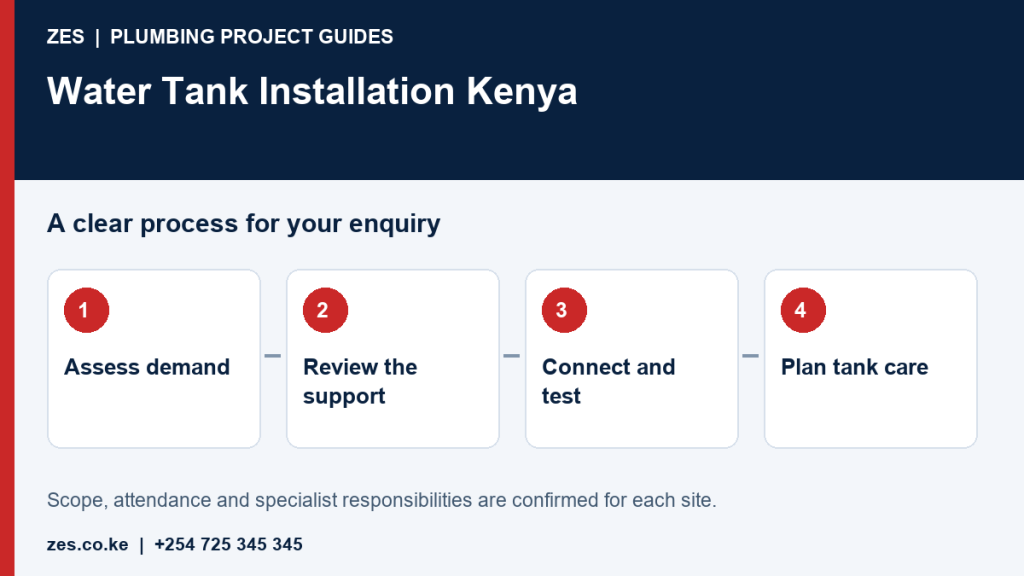
Water tank installation in Kenya should address demand, refill reliability, tank type, support, connections, overflow and maintenance access. A larger tank does not automatically solve an inadequate source or unsuitable base. Homes, schools, apartments and institutions need different operating arrangements. This guide explains what to establish before purchasing and how to define the installation quotation. ZES accepts storage and distribution enquiries, with structural, electrical and specialist responsibilities confirmed for the particular site and tank system.
Estimate demand and refill conditions
List users, activities and fixtures drawing from storage. Consider daily peaks, refill intervals and the interruption the owner wants to accommodate. A boarding school, kitchen and household have different patterns. Use actual consumption or an appropriate design assessment where available. More capacity also adds load and footprint. Identify the source and whether multiple sources will share the installation. Consider turnover, hygiene and operating responsibility as well as nominal litres. Storage should be chosen as part of a maintainable supply arrangement, rather than an isolated purchase.
Assess location and structural support
Confirm the selected model dimensions, delivery access and manufacturer support requirements. The base or structure must suit the operating load and environment. A roof, tower or platform requires appropriate structural review; an apparently substantial surface is not sufficient evidence. Ground-supported arrangements need a suitable base and consideration of settlement or physical damage. Allocate support design and construction explicitly. Keep room for inspection and replacement. The actual manufacturer instructions govern the selected product, not dimensions borrowed from another tank or an installation photograph.
Specify inlet, outlet and overflow arrangements
Identify the inlet, outlet, overflow, drain and isolation requirements for the intended use. Valves should be serviceable without unsafe access. Pipework supports should avoid imposing unintended loads on tank fittings. Agree appropriate overflow routing and protection against contamination. If level devices or pumps are included, specify compatibility, controls and power responsibilities. Ask the quotation to list fittings and connection boundaries. A description saying tank installation alone leaves uncertainty about whether necessary accessories, alterations and commissioning are covered.
Plan delivery and placement
Check gates, turning areas, handling equipment and the route to the final position. Competent personnel should plan the handling method. Inspect the tank for damage before connection. Support works should be ready and accepted before placement, and people kept clear of the handling area. Replacing an existing tank also requires a plan for supply interruption, disconnection and removal. Confirm whether the quote includes disposal and temporary arrangements. The equipment price can be only one part of the complete installation cost at a constrained site.
Agree hygiene and operational checks
Demonstrate the agreed filling, leak, isolation and overflow checks. Test any included level or pump interface through its operating sequence. Cleaning, flushing, disinfection and water-quality checks should follow the specified system requirements and competent advice. Do not assume storage makes an unsuitable source safe to drink. Record restrictions before the tank enters service. Keep the support and connection details with manufacturer information. Handover should identify what was checked, who accepts the installation and which tasks remain with the owner.
Assign ongoing operation and care
Name the person who observes levels, investigates unexplained losses and arranges service. Keep access covers secure and maintenance space clear. Inspect visible fittings and supports as part of property checks. Follow manufacturer care guidance and the site water-management plan. Institutions should record visits and communicate planned interruptions. If demand increases, review refill, storage and distribution together. Adding capacity without addressing source limitations or unsuitable controls can recreate the original problem. Clear operating records support a better decision when the next upgrade is proposed.
Information to include in your project brief
- Daily use and refill conditions
- Tank model, capacity and location
- Support and handling responsibility
- Connections and maintenance access
Frequently asked questions
Can a tank go on any roof?
No. The tank and operating load need appropriate assessment of support and building structure.
Does installation include supplying the tank?
Only if stated. Confirm model, capacity, delivery, base, fittings, labour and tests individually.
Does a tank purify water?
Storage alone does not prove water safety. Source quality, hygiene and any treatment or testing requirements need separate assessment.
Related plumbing planning guides
- Water Pump Installation Nairobi: Duty, Controls and Commissioning Guide
- Plumbing Maintenance Services Nairobi: Asset Records, Inspections and Repair Planning
Discuss your plumbing requirement with ZES
Share the location, property use, symptoms or proposed work, and available drawings or photographs. ZES will review the information and confirm the suitable scope, any assessment arrangements and current attendance availability. Materials, responsibilities, programme and applicable terms are agreed in the written quotation.
Explore ZES plumbing services · Request a plumbing quotation · Call +254 725 345 345