
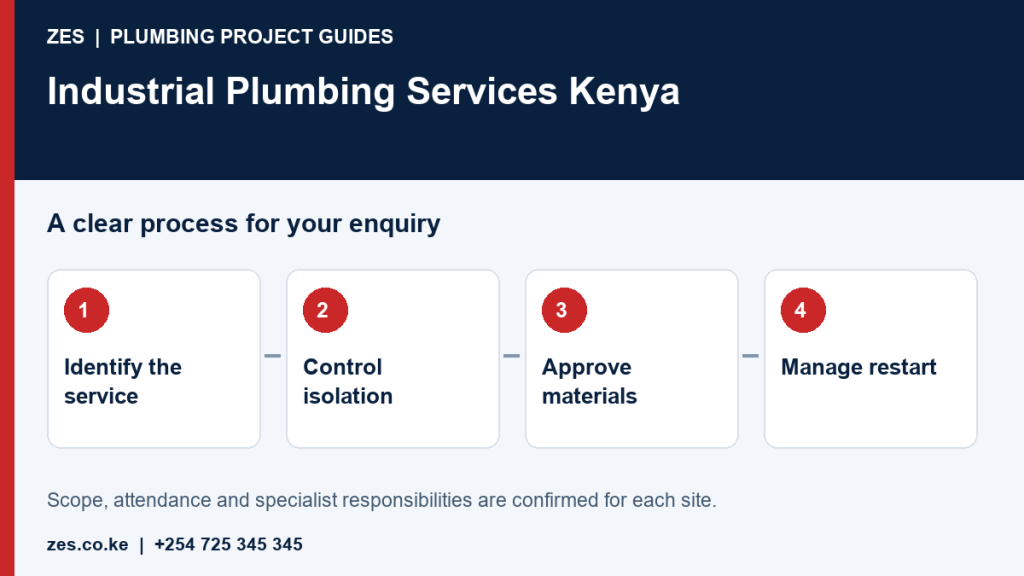
Industrial plumbing services in Kenya need clear boundaries between ordinary building services and specialist process systems. Factory washrooms, utility water, washdown points and equipment feeds can have different operating requirements. A proposal should establish the fluid, pressure, temperature, contamination risks and production constraints before selecting materials or a repair. This guide helps plant managers and engineering teams prepare controlled enquiries. ZES reviews industrial plumbing requirements and confirms suitable scope and delivery arrangements, including separately appointed specialists where required.
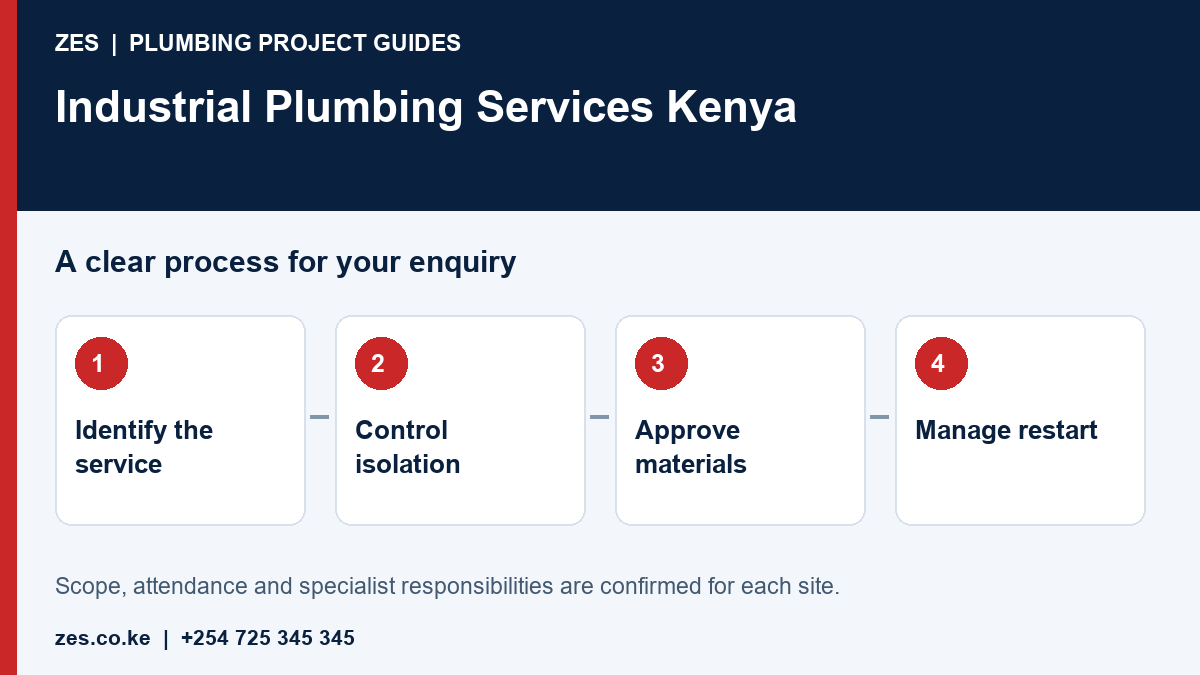
Identify the service and technical authority
Record the system purpose, conveyed fluid, operating conditions and equipment connections. Drinking water, cleaning water, process liquids and hazardous services are not interchangeable. Identify the appointed technical authority and the documents governing modifications. A pipe photograph cannot establish contents or rating. Mark uncertainties and obtain technical assessment. Ordinary plumbing experience should not be presented as evidence of competence for steam, pressure or chemical systems. The appointment must identify which systems are included and which remain outside the confirmed contractor responsibility.
Coordinate isolation with production
The factory should nominate authorised personnel controlling shutdown and restart. Map affected equipment, shared services and possible stored energy or residual contents. Follow site isolation and permit procedures. Agree the production window, access, lifting and any temporary arrangements. A closed valve should not be independently assumed to prove a line safe. Record work-area handover and the conditions required before work begins. The contractor method and factory controls need to form one coordinated plan rather than separate documents with conflicting assumptions about service status.
Make compatibility and traceability explicit
Specify the pipe system, fittings, joint method and operating limits. Temperature, cleaning chemicals, exposure and conveyed fluid can affect selection. Manufacturer information and appointed design requirements should guide decisions. Avoid substitutions made solely because a component is available. Product-contact or hygienic duty needs defined cleaning, finish and inspection criteria with appropriate specialists. Establish material documentation requirements before buying so the records follow the work. Clear traceability supports inspection and future maintenance, particularly where several similar-looking systems occupy the same service route.
Control drainage and discharge interfaces
Factory streams may need separate collection, treatment or disposal. Responsible process and environmental professionals should determine appropriate routing and discharge requirements. Do not assume an equipment outlet can join ordinary foul drainage. Provide current drawings, existing connections and the proposed operating change. Coordinate levels, supports, inspection access and associated civil work. State where the plumber's scope ends and who approves the final connection. A quotation should distinguish a building drainage repair from an alteration that changes the factory's process or environmental arrangements.
Set inspection and restart requirements
Use an agreed inspection and test plan for the actual system and risk. Record concealed work before closure. Assign specialist tests and acceptance to competent parties. Reconcile installed work with approved information and remove or document temporary measures. Restart follows the site-controlled process and any required cleaning, quality or operating checks. Completion of installation alone is not permission to resume production. Identify who accepts each stage and how unresolved issues are communicated before the system is handed back to operations.
Keep asset and change records
Retain updated routes, material information, tests and approved alterations with factory asset records. Use consistent identification for valves and equipment. Review recurrent leaks against operating conditions rather than repeatedly replacing the same component. Assess the installation before increases in demand or changes to temperature or fluid. Production and maintenance teams should share close-out information. This reduces uncertainty at later shutdowns and helps prevent undocumented modifications becoming the assumed baseline for future work. Good records remain valuable even when contractors or maintenance personnel change.
Information to include in your project brief
- Fluid identity and operating conditions
- Approved technical documents
- Isolation and restart authority
- Material and inspection requirements
Frequently asked questions
Does industrial plumbing include specialist process piping?
Only where scope, competence, design responsibility and operating conditions are explicitly confirmed. Ordinary water and drainage work does not establish that capability.
Can production continue during repairs?
The factory must assess isolation and process interfaces. Some work can be phased, while other tasks require an approved shutdown.
What should an enquiry contain?
System identity, fluid, operating conditions, drawings, equipment interfaces, shutdown window and acceptance criteria.
Related plumbing planning guides
- Plumbing Maintenance Services Nairobi: Asset Records, Inspections and Repair Planning
- Plumbing Services Nairobi: Repairs, Installation and Quotation Guide
Discuss your plumbing requirement with ZES
Share the location, property use, symptoms or proposed work, and available drawings or photographs. ZES will review the information and confirm the suitable scope, any assessment arrangements and current attendance availability. Materials, responsibilities, programme and applicable terms are agreed in the written quotation.
Explore ZES plumbing services · Request a plumbing quotation · Call +254 725 345 345