
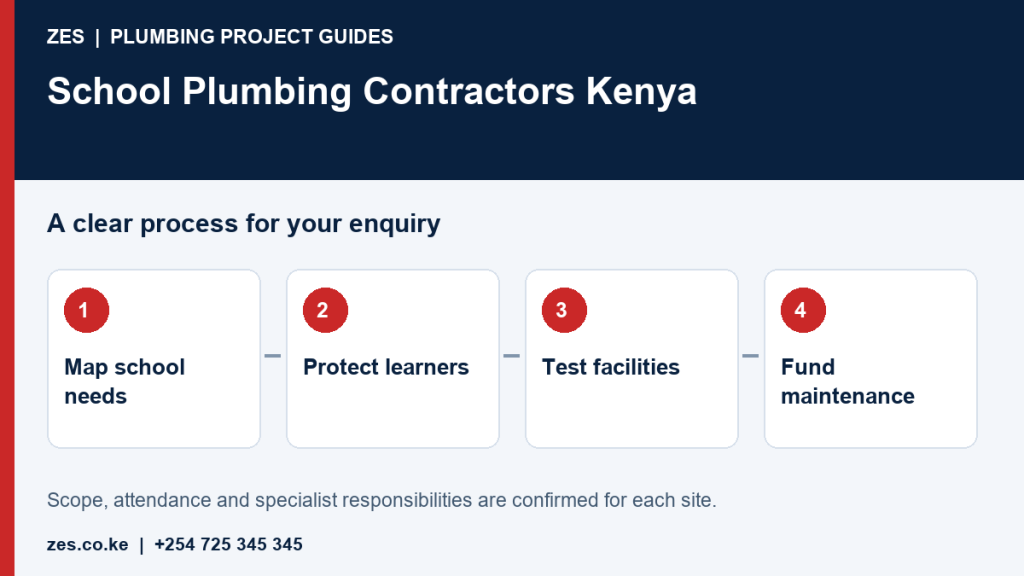
School plumbing contractors in Kenya need to plan around learners, staff, term dates and the availability of usable facilities. A project may involve washrooms, handwashing points, kitchens, boarding areas, tanks or repairs to an existing network. A strong brief connects installation with daily operation and long-term care. This guide helps headteachers, boards, bursars and facilities teams prepare assessable work. ZES accepts school plumbing enquiries and confirms suitable scope and specialist responsibilities after reviewing the requirement.
Map the school routine and affected facilities
List served areas and peak demand at arrival, breaks, meals, cleaning and boarding times. Identify out-of-service facilities and their effect on learners and staff. Different age groups and accessibility needs require consideration by the appointed design team. Avoid defining the project only by the number of taps or toilets. Refill reliability, cleaning access and repeat damage may also need attention. A site map and condition record help bidders understand the operational problem and prevent procurement from focusing on visible fixtures alone.
Plan construction around learners
Agree the working period, access route, storage and responsible school contact. Term-time work may require segregation, controlled deliveries and continued access to essential facilities. Confirm the site's safety and safeguarding arrangements before mobilisation. Keep learners away from tools, open excavations and disconnected services. Holiday work still needs supervision and an acceptance plan before reopening. The programme should include testing, defect correction and handover, not simply installation. School management and contractor should share the same understanding of which areas remain unavailable during each stage.
Coordinate usable supply and sanitation
A new washroom block remains incomplete if water supply, storage or drainage is unresolved. Review source, demand, distribution and tank siting with appropriate technical parties. Elevated tanks and supports need suitable design responsibility. Identify inspection, cleaning access and operating staff. If alternative water sources are considered, define intended use and any required treatment or quality checks. Availability and safety are different questions. The brief should state the complete facility outcome so the school is not left with new fittings but insufficient supporting infrastructure.
Prepare comparable procurement information
Issue the same drawings, scope and fixture schedule to bidders. Require quantities, materials, labour, tests, reinstatement, programme and exclusions. Allocate tank, pump, electrical, civil and drainage interfaces. Identify who approves alternatives and variations. Verify relevant references and required qualifications for the actual work. A headline price per fixture may conceal different infrastructure assumptions. A documented appointment supports accountability and gives the board a clear basis for checking expenditure against delivered work. Record approved changes rather than relying on informal instructions during construction.
Test before reopening affected areas
Agree leak, flow, drainage and included-equipment checks. Record results and correct defects before use resumes. Demonstrate accessible isolation and provide an understandable layout or as-built record. Assign any required water-quality testing or specialist acceptance explicitly. Give caretaker staff guidance on permitted observations and escalation. Keep component details and written defect-reporting terms. A phone number alone is not a handover pack. School management should understand what was tested, what remains outstanding and who is responsible for maintaining the installation after the contractor leaves.
Budget for continued operation
Cleaning, consumables, minor repairs and periodic technical service require an owner and budget. Log leakage, blockages, broken fittings and supply interruptions, then review repeat incidents. Include the staff who operate facilities when assessing maintainability. UNICEF school WASH work emphasises operation and maintenance alongside infrastructure. Use applicable local guidance and technical advice to set the school plan. The value of a construction project depends on facilities remaining usable after handover. Maintenance arrangements should therefore be considered during procurement, rather than left until the first post-installation breakdown.
Information to include in your project brief
- School calendar and affected facilities
- Learner access and safeguarding arrangements
- Water, storage and drainage information
- Acceptance, training and maintenance ownership
Frequently asked questions
Can work be planned for school holidays?
Include term dates and reopening in the enquiry. The programme and contractor availability need confirmation before appointment.
Should fixtures be purchased before the contractor is selected?
Only after suitability, quantities, connection and design requirements are agreed. Early purchases can create avoidable incompatibility.
What should the school retain at handover?
Scope, drawings, material details, test records, valve identification, care instructions and the outstanding-defect list.
Further reading: UNICEF Kenya on school WASH and operation and maintenance.
Related plumbing planning guides
- Plumbing Services Nairobi: Repairs, Installation and Quotation Guide
- Plumbing Installation Nairobi: A New-Build Planning and Handover Guide
Discuss your plumbing requirement with ZES
Share the location, property use, symptoms or proposed work, and available drawings or photographs. ZES will review the information and confirm the suitable scope, any assessment arrangements and current attendance availability. Materials, responsibilities, programme and applicable terms are agreed in the written quotation.
Explore ZES plumbing services · Request a plumbing quotation · Call +254 725 345 345