

Biometric Installation Westlands: Biometric installation in Westlands needs a coordinated site brief. The installer may depend on a landlord, fit-out contractor, IT team and employer administrator before a reader can produce a usable result. This guide focuses on those practical interfaces and the checks that establish completion. ZES reviews each location and confirms the equipment, supporting work, survey timing and access requirements for the actual premises.

Biometric Installation Westlands: Agree permissions and the work area
Identify who may approve wall fixing, cable routes, network changes and access to common areas. A tenant’s request does not necessarily cover shared building infrastructure. Confirm the allowed working hours, contractor access and any reinstatement obligations. Give the technician an authorised site contact. Record the boundary between a workplace terminal and a building security installation so different teams do not issue conflicting instructions about how or where it should operate.
Assess mounting as a user journey
Observe the intended approach, clear standing space and likely queue. Keep the terminal accessible without obstructing door movement or an escape route. Confirm the chosen model’s environmental and mounting requirements. A device should not be placed simply beside the nearest socket if users would have to cross another tenancy or block a reception desk. Review the position with facilities staff and the people responsible for daily attendance administration.
Specify the supporting infrastructure
List the power source, data connection, containment and cable length assumptions. Identify who supplies and configures the network port. A working internet connection is not proof that device communication is permitted by the organisation’s network controls. Define backup requirements for the complete agreed function. Ask who repairs finishes and labels connections. These items belong in the quotation, even if some are delivered by another contractor before the biometric installer attends.
Configure with sample data first
Agree employee identifiers, initial schedules and administrator roles before bulk enrolment. Demonstrate clocking, correct time settings, software transfer and the intended report. Keep migration from existing devices a separately checked task. Authorise installer access and agree how it ends at handover. A reader displaying a successful recognition is not the final test; the event needs to reach the correct employee record and be visible to the responsible administrator.
Record acceptance and unfinished interfaces
Witness normal operation and the agreed exception and connectivity tests. If door control is included, define its separate hardware and safe-release assessment with competent parties. Record outstanding tasks, owners and dates. Provide equipment details, account ownership, training and support information. ZES can assess the Westlands installation brief and confirm attendance and logistics directly. Timing and integration commitments should follow the agreed scope, rather than an assumption of immediate availability.
An installation handover that can be checked
Before work starts, agree a drawing or marked photograph showing the terminal position, cable route and supporting equipment. Confirm who provides power and network access, what surfaces may be drilled and who approves work around occupied areas. Include a clear completion test: the terminal powers up, its clock is correct, a sample event reaches the agreed software and the administrator can retrieve that event. Record unresolved items before accepting the work.
At handover, identify the installed model, serial number, software licence and administrator account owner. Transfer credentials through an appropriate private process rather than printing them in a public handover report. Ask for a brief demonstration of enrolment, routine exports and raising a support request. Any door-control work should have its own approved safety and exit arrangements; installing an attendance terminal does not automatically establish an appropriate access-control design.
Biometric Installation Westlands: supporting guidance
For privacy planning, consult the ODPC guidance notes, including its biometric data guidance. Check equipment and software behaviour against the documentation for the exact proposed version. ZKTeco publishes a ZKBio CVAccess user manual as one product-specific reference; it is not evidence that every device or platform has the same functions. Confirm the model and supported features in your quotation.
A worked example: an occupied office fit-out
Consider an illustrative tenant fitting a biometric terminal into an office that remains in use during the work. The biometric installation depends on more than a convenient wall position. The organisation needs permission for the fixing, an agreed communication route, suitable supporting power and access to the intended application. The first survey should identify those dependencies before the equipment is ordered.
Ask the responsible customer contact to confirm whether the installer is working inside the tenant’s area or using shared building infrastructure. Record which party approves each route and what work the tenant is permitted to authorise. A biometric installation quotation should state the assessed boundary. It should not silently include responsibility for common services that belong to another organisation.
Build a readiness list before booking the work
Prepare a readiness list for the biometric installation. Include site access, approved terminal position, working hours, network contact, application owner and any enabling work by other contractors. Identify evidence of readiness that can be checked before attendance. This can be a marked plan, an approved route or a confirmation from the responsible IT contact rather than an informal assumption.
Review the list before agreeing the installation programme. If a dependency is unresolved, describe the effect on the proposed visit and completion test. A supplier can then identify which tasks can proceed and which require another party. This is more useful than scheduling a biometric installation as though every supporting component will automatically be ready when the installer arrives.
Coordinate cabling with finishes and other services
For an existing office, agree how cable routes will be assessed and approved. Consider the actual surface condition, access to containment and any restrictions identified by the property team. Avoid promising a concealed route before it has been inspected. Where another contractor provides containment or a network point, show that interface in the biometric installation work package.
State who is responsible for reinstatement and leaving the work area usable. If a proposed route changes after inspection, issue an agreed variation before proceeding. Record the reason, revised route and implications. A clear record helps the customer compare the delivered biometric installation with the original quotation and avoids treating a changed site assumption as an unexplained increase in cost.
Check application access before the terminal test
The biometric installation cannot be fully accepted if the intended application is unavailable during commissioning. Identify the application location, administrator and supported connection method in advance. Ask the customer’s IT team to confirm the required access through its own approved process. Keep credentials and sensitive network information private; an installer should not require those details to be published in a general project brief.
Use sample identities to test the connection. Check that the terminal is communicating with the intended application rather than another demonstration account. Retrieve a known event and compare the time and user identifier. If the proposed biometric installation includes several devices, identify each one in the test record so that a successful result from one point is not assumed to cover every terminal.
Biometric installation: turn the survey into a work package
A biometric installation survey should produce a usable plan. Record the proposed terminal location, mounting surface, approach route, power source, communication route and intended application. Identify which facilities and IT contacts approve the work. Photograph or mark the relevant routes with permission and avoid including confidential material in general tender documents. The quotation should distinguish what has been surveyed from what remains an assumption requiring confirmation.
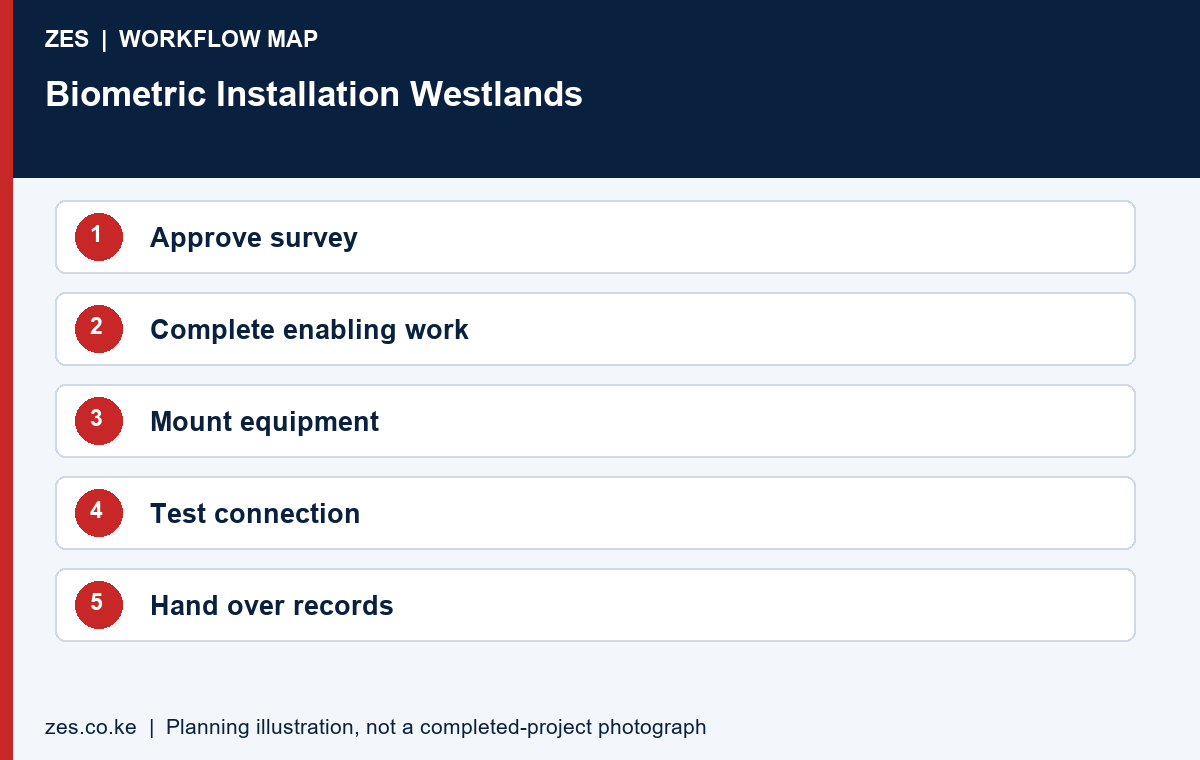
Divide the biometric installation into enabling work, equipment mounting, connectivity, configuration, testing and handover. Name the party responsible for each stage. If a customer or another contractor supplies the network point, state when it must be ready and what connectivity the selected system needs. If electrical work is required, assign it to the appropriate competent contractor. This division makes it easier to diagnose delays without treating every unfinished dependency as a device fault.
Installation sequencing and change control
Agree a biometric installation sequence that suits the occupied premises. Confirm access arrangements, working hours, material delivery, permitted fixing methods and how the work area will be left usable. Record any temporary protection or reinstatement responsibilities. A clear sequence helps the customer coordinate building management, the installer and other contractors. It also provides a basis for checking whether the proposed completion date depends on work that has not yet been approved.
Use a written variation record when a biometric installation survey assumption changes. State the new route, additional equipment or revised working arrangement and identify the resulting cost and time implications before proceeding. Keep the original scope alongside the agreed variation. This is particularly useful where finished surfaces, shared infrastructure or restricted working hours become apparent only after a closer site inspection. A variation should explain the change rather than hide it inside a revised total.
Commission the whole biometric installation
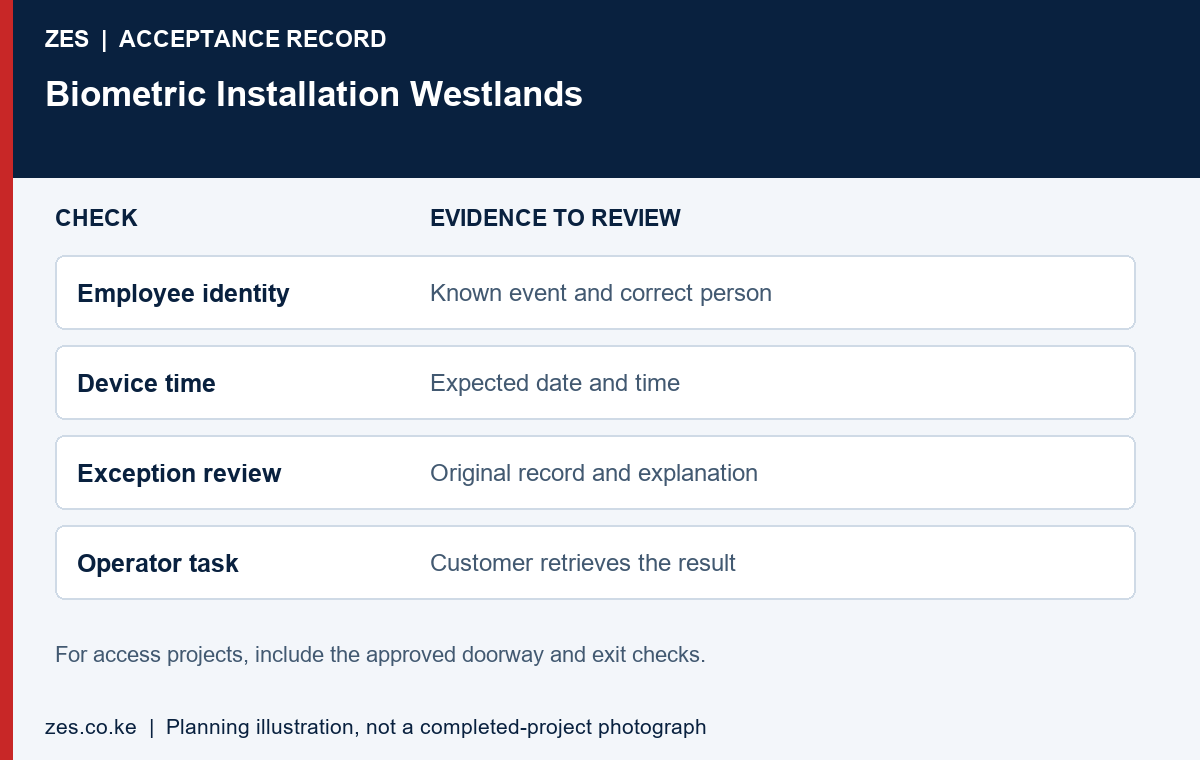
Commissioning should follow the intended event from the biometric installation to the actual output. Confirm equipment identity, the configured time, connection to the intended application and association with a sample user. Retrieve the resulting record through the intended administrator account. Where door control is included, the approved hardware and exit arrangements require their own competent assessment and acceptance checks. Attendance commissioning alone does not establish that a controlled doorway is suitable for use.
Keep a biometric installation completion sheet with expected results, observed results, outstanding items and the people who witnessed the test. Include a connection interruption test only under an agreed method that will not disrupt unrelated systems. Identify the conditions under which the customer will accept the installation and how outstanding work will be tracked. A signed equipment delivery note and a working end-to-end system demonstrate different things; retain evidence for both where both are required.
Handover and maintenance boundaries
The biometric installation handover should identify the equipment, application, licence basis, account owner, support contact and basic operating procedure. Demonstrate enrolment, a routine report and the approved handling of a failed clocking attempt. Transfer administrative access through a private process. Keep passwords out of public project photographs and general proposal documents. Confirm whether follow-up assistance is included, time limited or separately quoted.
Agree what routine biometric installation maintenance means for the selected equipment. Follow the manufacturer’s instructions for cleaning and environmental limits rather than applying a generic method to every reader. Identify who checks time settings, application availability and recurring licences. Define what the customer can inspect safely and what requires technical attendance. Maintenance commitments should identify the actual scope and response arrangements without implying a guaranteed service level that has not been contracted.
Witness commissioning from the customer’s perspective
Ask the intended operator to perform an ordinary task during biometric installation handover. That could be retrieving a daily report, enrolling a test profile or raising an approved exception. Observe where the operator needs help and include that step in the operating guide. A technician demonstrating a function quickly does not necessarily show that the customer can operate it independently.
Record the expected and observed result for each agreed test. Where a report or connection is outside the supplied scope, identify the exclusion rather than marking it complete. Keep outstanding items with an owner and a review arrangement. The biometric installation should be accepted against the agreed purpose, not only because the terminal powers on and displays a menu.
Separate attendance work from controlled-door work
If the office also needs a controlled doorway, scope that requirement separately within the project. The biometric installation must then be considered with the actual opening, lock, release and approved exit arrangements. Assign competent assessment responsibilities and identify interfaces with other building systems. An attendance-only terminal position does not automatically become an appropriate door-control design.
For a combined project, maintain separate acceptance checks for recognition, reporting and doorway operation. Ask the responsible site team to witness the approved operating tests. Document component references and limitations. This makes it easier to identify whether a later problem concerns the reader, the attendance application, the door hardware or the agreed operating procedure.
Make the handover usable for future office changes
A biometric installation record should remain useful if the tenant’s IT contact or administrator changes. Keep equipment identification, the application arrangement, licence information and support contacts in an accessible private file. Include a short route description or approved drawing where appropriate. Sensitive account information should be transferred through an agreed private method, with ownership clearly assigned to the customer.
Review the record when staff numbers, office layout or reporting requirements change. Ask whether the existing biometric installation supports the revised requirement before extending it. Additional users, devices or integrations may involve separate licences or configuration. A documented system makes those decisions more manageable than relying on memory of what the original installer said during a busy handover.
Prepare a Westlands biometric installation enquiry
Send ZES the site location, intended use, approximate user count, existing equipment and any known access restrictions. State whether the project is a new fit-out, a retrofit or a repair assessment. Include approved plans or photographs that explain the work area without disclosing confidential material. Identify the person who can approve building access and the organisation’s IT interface.
ZES can confirm the assessment and proposal arrangements for the actual site. Ask the quotation to separate equipment, enabling works, configuration, commissioning and training. Confirm logistics and timing directly. This guide does not establish a standard installation price, a guaranteed same-day visit or a claim that ZES has already completed work at a particular Westlands property.
A private and usable project handover
Keep a private implementation file alongside the public buying guide. It should identify the supplied equipment, application arrangement, account owner, support contact and agreed acceptance results. Separate public marketing material from operational configuration and employee records. For an initial enquiry, anonymised examples are usually more useful than a large collection of personal records because they show the required output without exposing information unrelated to the purchase decision.
Ask the responsible organisation to review the purpose, necessity and handling of biometric information with appropriate advisers before live enrolment. The selected product documentation should explain its actual supported functions, but a technical specification does not by itself establish that every proposed use is appropriate. Confirm responsibilities for administration, access to reports, profile withdrawal and the organisation’s approved retention arrangements. Keep those decisions connected to the intended workflow rather than relying on a generic claim that a device is compliant.
Use a short readiness and acceptance record. Before work, confirm the site contact, approved position, enabling tasks and application access. During testing, record the expected result, observed result and unresolved item. At handover, identify who owns the next action and how it will be reviewed. This gives the customer a practical basis for accepting the actual scope, while avoiding a vague completion statement that cannot be compared with the original requirement.
The proposal should also explain how later changes are managed. A new premises, additional users, changed working patterns or another reporting application can create a different requirement. Keep equipment references and the approved scope available for that review. Ask for revised terms and tests where necessary instead of assuming that the original purchase includes every future alteration. Clear documentation is useful to both the customer and the supplier when the people involved in the original project change.
Information to include in your enquiry
Share the site location, organisation type, staff numbers, clocking points or controlled doors, existing devices and software, and the required outcome. Include available layouts and sample reports with personal information removed. Identify the person who approves building access and the person who will administer the system. Ask the quotation to identify assumptions, exclusions, recurring charges, testing and handover responsibilities.
Frequently asked questions
Can installation be completed during office hours?
Some work can be coordinated during occupation. Access, cabling, safety and permitted disruption determine the method and schedule.
Does installing the reader include payroll integration?
Only when specifically quoted and verified against accessible compatible interfaces. Physical installation and an automated payroll connection are different deliverables.
Related Westlands biometric guides
- Fingerprint Attendance System Westlands: Run a Useful Recognition and Enrolment Pilot
- Employee Attendance System Westlands: Hybrid Duties, Daily Exceptions and Reviewable Reports
Discuss your requirement with ZES
ZES is based in Kamakis, Ruiru and reviews Westlands enquiries before confirming the appropriate assessment and delivery arrangements. Travel, installation timing, equipment availability and support commitments are agreed directly for the actual scope.
Biometric attendance services · Access-control services · Request a quotation · Request a site assessment