

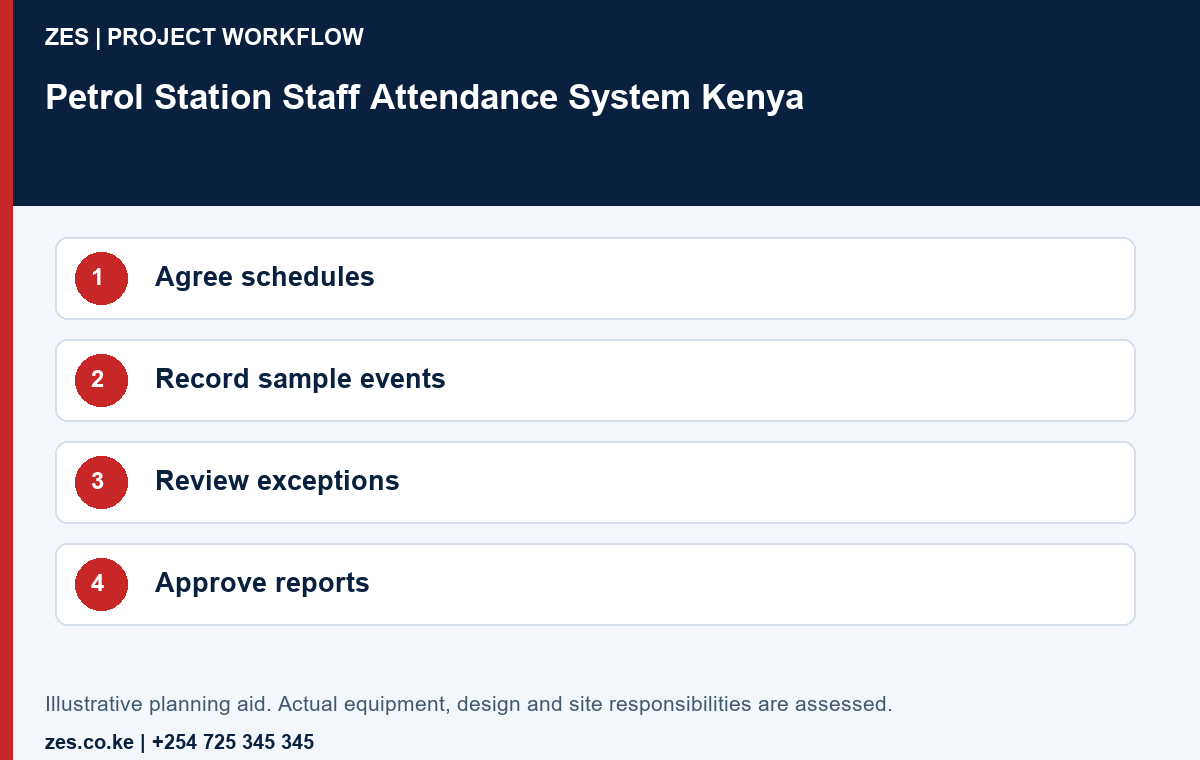
Petrol Station Staff Attendance System Kenya enquiries should begin with approved schedules and the reporting process the employer needs. A clocking device records events; the organisation still needs to review missed entries, changed duties and authorised explanations. This guide helps station managers specify a usable attendance workflow before choosing equipment. ZES can assess the requirement and confirm suitable devices, software, installation and training within a written scope.

1. Define the employee attendance boundary
Identify the employer, included staff and clocking locations. Distinguish permanent employees from contractors and visitors. If a group operates several stations, explain whether staff move between them and who owns the combined reporting requirement. Do not use a general property-entry record as an employee attendance process without reviewing its purpose, event meaning and operating rules.
2. Translate shifts into sample cases
Prepare invented examples of ordinary shifts, a change of duty and a shift crossing a date boundary. Ask the proposed software to demonstrate the employer’s approved interpretation. Device defaults should not silently become employment policy. The intended reviewer should understand what the report records and which exceptions still require an authorised explanation.
3. Assess the clocking point
Choose a proposed location through the station’s site assessment and appropriate equipment-suitability review. Consider ordinary staff access and practical operation without treating a reader as suitable for every fuel-site position. Explain where staff should clock and what to do after an unsuccessful attempt. An administrative office may form part of the assessment, but the actual arrangement must be confirmed for the premises.
4. Test missed events and corrections
Use sample identities to demonstrate a normal day, a missed clocking and an approved correction. Ask the reviewer to retrieve the original event and the available change history. Identify who can request, approve and apply a correction. A machine-generated absence or overtime label should be reviewed against the organisation’s approved rules rather than treated as a complete decision by itself.
5. Check reports and payroll interfaces
Ask for an anonymised sample of the required daily exception list and period summary. If another application receives the output, compare its actual interface requirements with a sample export. State whether the deliverable is a manual file or a supported integration. Device branding does not establish compatibility with every payroll platform, and a successful file transfer does not remove the need for review.
6. Assign privacy and administration responsibilities
The employer should review the purpose and handling of biometric information with appropriate advisers and relevant ODPC guidance. Identify authorised users, account ownership and the approved leaver process. Demonstrate the selected product’s supported controls. Keep operational employee records and credentials out of a general sales enquiry when invented or anonymised examples can explain the required workflow.
7. Review the first reporting period
Train the intended administrator and appropriate cover on the ordinary tasks. After the first complete period, compare the output with the agreed sample cases and assign unresolved findings. Keep equipment references, software licences, recurring charges and support contacts in the handover. A useful attendance system should remain manageable when the original station manager or installer changes.
Petrol Station Staff Attendance System Kenya: demonstration and review workbook
Consider an employer with a day team, a night team and a supervisor who occasionally works at another station. The requested attendance system must produce reviewable records for those arrangements, including an approved change of duty. The example is invented and does not prescribe employment or payroll rules. Ask the selected application to process the sample events using the employer’s stated policy, then have the intended reviewer explain the result. This distinguishes usable staff attendance administration from merely seeing a person recognised at a terminal.
The following cases help the buyer specify and compare the actual project. Agree which apply to the proposed attendance scope and record any exclusions before acceptance. They are hypothetical review prompts, not evidence of a completed ZES client project. The responsible site team and relevant competent parties approve any physical tests or changes to live operations.
Staff boundary
Identify the employee groups and clocking locations included in staff attendance. Keep contractors, visitors and employees under different employers distinguishable where their reporting purposes differ.
Shift definition
Prepare a sample ordinary shift with the organisation’s approved start, end and review rules. Confirm who authorises those rules before they are configured in the attendance system.
Date boundary
Demonstrate a night duty crossing midnight. Ask the reviewer to identify the reporting day and trace the original events so that a calendar change does not obscure the explanation.
Changed duty
Use an authorised sample shift change and show how it reaches the report. Distinguish a corrected schedule from a changed raw event and identify the available approval history.
Missing event
Process a sample day with one clocking absent. Confirm that the reviewer can investigate and document the explanation rather than treating an automatic label as a complete decision.
Cross-site work
If required, trace a sample employee working at another included station. Confirm identity matching, site identification and the relevant licensing or communication dependencies in the selected application.
Period review
Generate the agreed daily exceptions and reporting-period summary. Check that the administrator can explain which records are final, unresolved or subject to an approved adjustment.
Payroll output
Compare an actual supported sample export with the receiving application’s requirements. Identify whether transfer is manual or integrated and who reviews rejected or unmatched records.
Cover administrator
Have an authorised second operator retrieve and interpret the sample attendance report. Confirm role permissions without distributing a shared account to everyone who needs occasional cover.
Leaver handling
Withdraw a sample active profile through the approved process and check the included locations. Keep that action distinct from the employer’s decision on handling historical staff attendance information.
Detailed buyer questions
Can the attendance system approve overtime by itself?
The employer must establish the applicable policy and authorised approval process. Software can apply configured calculations, but an output should be understood and reviewed rather than treated as an independent employment decision.
What helps compare two attendance proposals?
Use the same sample shifts, exceptions, required reports, sites and administrator tasks. Compare the demonstrated workflow and complete commercial attendance scope instead of only maximum employee capacity.
Does staff movement between stations require several identities?
The appropriate arrangement depends on the selected product and organisational structure. Demonstrate the required identity and reporting behaviour before committing to a multi-site attendance purchase.
Make the employee workflow clear before selecting a terminal
Employee attendance, identity recognition and permission to open a door are related but different requirements. Attendance concerns the employer’s use of time records. Recognition associates an attempt with a profile. Access control applies an approved permission at an opening. A single product may support some combination, but the proposal must demonstrate each required workflow. Avoid buying one function and assuming the other two will appear automatically.
Prepare invented employee examples instead of sending live biometric records with the enquiry. Describe ordinary duties, a missed event, a change of shift and a person moving between sites where applicable. Include the administrator’s task as well as the employee’s action. A successful recognition attempt does not establish that an attendance report is correct or that the intended access permission has been applied to every included opening.
The employer should decide how raw events are interpreted. A device can record a time without deciding why someone arrived, whether a changed duty was authorised or how a payroll rule applies. Demonstrate the selected software using the employer’s approved examples. Record which conclusions are calculated, which require review and who can approve a correction. An unexplained system label should not substitute for the organisation’s decision process.
Trial the whole process with the intended administrator
For an authorised representative trial, agree who participates, what information is collected and what happens to test profiles afterward. Identify the actual terminal, application and configuration used. Ask the intended operator to perform the ordinary task after training. Sales staff completing the demonstration themselves can conceal a workflow that is difficult for a station administrator to repeat without assistance.
Test continuity using a planned and permitted method appropriate to the selected arrangement. State the reporting result expected during or after an interruption. Trace known sample events through recovery and check whether duplicates, gaps or delayed permissions require attention. Do not interrupt live security or attendance operations casually to prove a feature. The responsible site team must approve the method and any temporary operating arrangement.
Review the full identity lifecycle: approval to enrol, association with the correct person, authorised changes, exceptional use and withdrawal. If a product offers an alternative credential, document its actual support and the organisation’s approval process. Avoid an informal shared identity that defeats attribution. Historical attendance records and active permission are different matters; the responsible organisation must decide how each is handled.
Biometric information requires a deliberate organisational assessment. Review the purpose, necessity, people affected, authorised access and appropriate information handling with the responsible advisers and relevant ODPC guidance. A claim that a reader is compliant does not settle every proposed use. Establish customer ownership of administrative accounts, restrict access to sensitive records and keep employee templates or personal details out of public handover examples and promotional images.
Build a proposal that can be compared and accepted
A useful specification separates the result the station wants from the product a supplier proposes. Start with a short statement of the operational problem, the people affected and the evidence that would show improvement. Give each requested deliverable a reference. A supplier can then identify the equipment, labour, configuration, documentation and customer dependencies against that reference. This makes it easier to compare offers without assuming that similar item names describe the same complete service.
Keep a simple comparison register with columns for requirement, included work, excluded work, customer action, acceptance evidence and price basis. An item marked included should have enough detail to distinguish supply alone from installation, configuration or commissioning. An exclusion is not necessarily a poor offer; it becomes a problem when the station discovers it only after work starts. Clarify unanswered questions in writing and attach the clarification to the agreed proposal.
The station should nominate one commercial contact and the operational or technical people who can approve their respective parts. A cashier may explain a daily workflow without having authority to approve a system change. A premises manager may approve access while another party owns an interface or structure. Record these boundaries early. Give the supplier a coordinated response instead of several conflicting instructions from people who assume somebody else has approved the change.
Use a dependency list before agreeing an implementation date. Examples include approved access, available records, enabling works, an authorised test window and attendance by another supplier. For each dependency, identify who provides it and how readiness will be confirmed. Separate the proposed working duration from the full calendar programme. A short installation task can still depend on an assessment, procurement or approval that has not yet been completed.
Use an evidence register rather than a completion claim
Create one acceptance entry for each important requirement. Record the agreed condition, the expected result, the observed result, the person witnessing it and any remaining action. Use the selected product documentation and approved design to decide what is appropriate to test. The examples in this guide are purchasing questions, not permission to carry out hazardous operations or alter live station equipment. Tests must be planned and performed by the responsible people under the site’s arrangements.
An entry should be specific enough for another manager to understand later. An observation such as tested successfully does not explain what was tested. A clearer entry identifies the relevant asset or sample record, the conditions checked and the evidence retained. Do not publish sensitive configuration, employee information or security layouts in a public project gallery. Keep the operational evidence in the customer’s controlled handover file, with access appropriate to its contents.
Distinguish a defect from an agreed exclusion, a customer dependency and a later improvement request. Each needs a different decision. Assign an owner and review date to unresolved matters. If an issue affects the safe or intended use of the delivered work, the responsible parties must decide the appropriate restriction and resolution before treating the affected attendance scope as accepted. A signature should record an informed decision rather than conceal an incomplete requirement.
Customer acceptance and a supplier invoice serve different purposes. An invoice identifies a commercial charge; it does not replace the technical evidence agreed for the project. Similarly, a photograph can show a visible installation without establishing its configuration, structural adequacy or reporting behaviour. Retain the relevant inspection, demonstration or test record alongside the commercial documents so that future reviews do not depend on recollection.
Plan ownership, changes and the next review
Ask for a handover index before completion. Depending on the attendance scope, it may list equipment references, approved drawings, configured functions, maintenance information, licences, acceptance records and support contacts. Mark documents as supplied, not applicable or outstanding. Keep passwords and sensitive access arrangements separate from general manuals. The customer should know who controls each account and how authorised access will be transferred when an employee or contractor changes.
The person expected to use or maintain the result should demonstrate the ordinary task during handover. A presentation to the purchasing team is useful, but it is not the same as the nominated operator retrieving a report, identifying an asset or following the approved support route. Arrange cover for that role. Record the limits of the training and the subjects that still require a competent specialist rather than encouraging staff to improvise repairs.
Compare ongoing obligations as carefully as the initial price. Identify recurring licences, replacement consumables, support arrangements, inspection responsibilities and customer-provided services where relevant. Ask what happens if a renewal is not made, an account changes or an additional site is added. Do not assume that a one-time purchase includes every later configuration change, site visit or third-party service. Request current written commercial terms for the actual attendance scope.
Schedule a review after a representative operating period. Compare the original requirement with actual use, note unresolved findings and decide whether the proposed improvement achieved its purpose. If the station changes layout, staffing, operating hours or another connected system, review the affected assumptions. Keep the approved baseline and later changes together. This gives future suppliers a reliable starting point and reduces the risk of replacing working equipment simply because its documentation has been lost.
Prepare a clear enquiry for ZES
Share the station location, the problem or intended outcome, relevant quantities and the existing equipment or application references. Include available approved plans or anonymised examples where useful. Identify the person who can authorise site access and the contacts responsible for operations and technical interfaces. Keep credentials, employee biometric records and confidential transaction information out of a general enquiry.
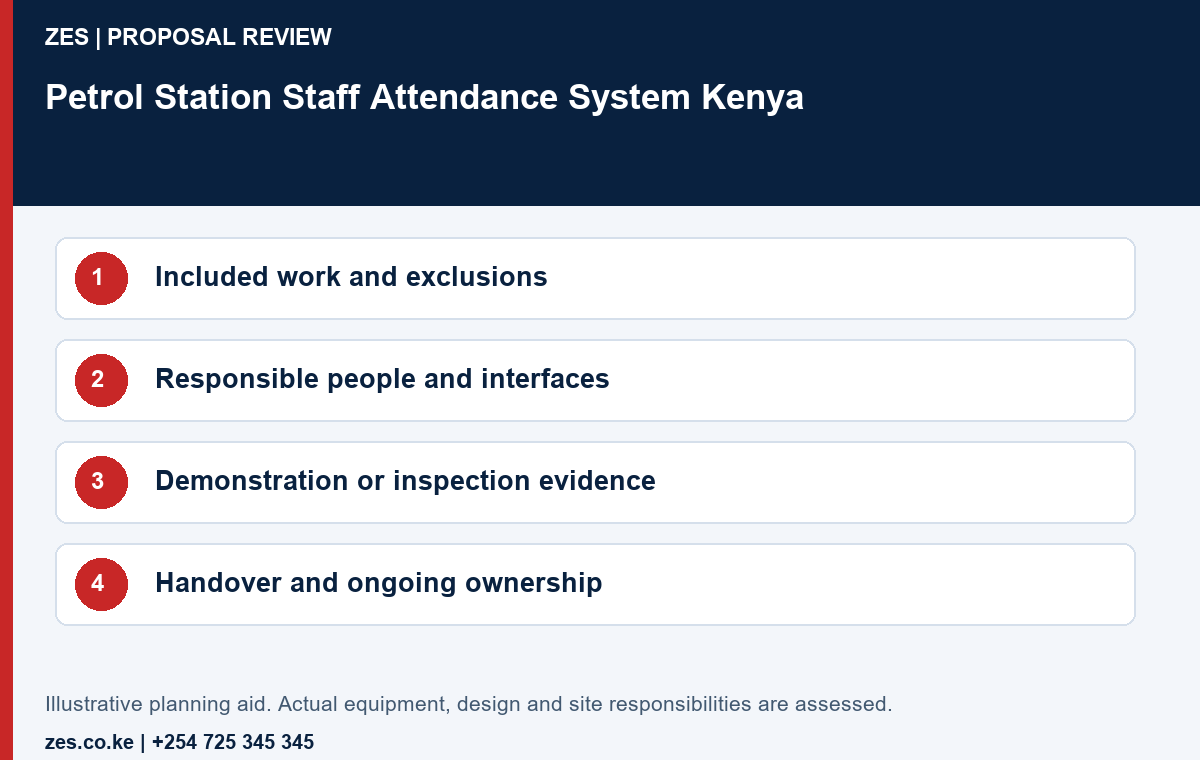
Ask the written proposal to identify the supplied work, exclusions, customer dependencies, current commercial terms and the evidence used for acceptance. Confirm specialist responsibilities and relevant credentials for the actual scope. ZES can review the brief and confirm the appropriate assessment and proposal arrangements. Site attendance, timing, product availability and support commitments are agreed directly rather than promised solely because a project names a particular county or town.
Compare the same complete scope
- Equipment or materials: identify the actual model, specification and documentation.
- Supporting tasks: record enabling work, site access and customer-supplied dependencies.
- Configuration or fabrication: state the work and the responsible approving party.
- Acceptance: agree the demonstration, inspection or verification evidence required.
- Ownership: confirm accounts, records, recurring charges and the future support route.
Frequently asked questions
Does a clocking device decide overtime entitlement?
No. The employer’s approved rules and authorised review determine how event information is used.
Can one report cover several stations?
Confirm the selected software, identities, connections and licence arrangement through a specific multi-site demonstration.
Reference information: ODPC biometric-data guidance.
Related ZES service · Petrol-station engineering enquiries · Request a scoped quotation · Request a site assessment · Call +254 725 345 345