
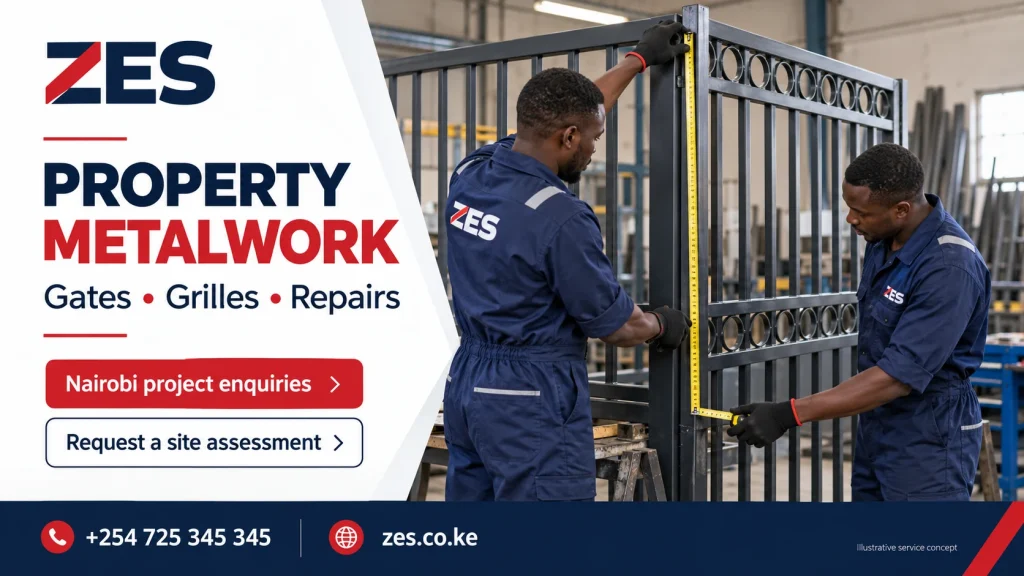
Welding Services Kasarani enquiries on a shared or occupied site need more than a description of the metal item. The tenant, landlord, facility manager and other suppliers may control different decisions. Clear permissions and a workable installation boundary help turn a site-welding request into a project that can be assessed and accepted. This guide is for buyers planning repairs, grilles, gates or small fabricated fittings. ZES can confirm assessment and supply arrangements for the actual Kasarani requirement.
1. Distinguish a request from authority to alter the premises
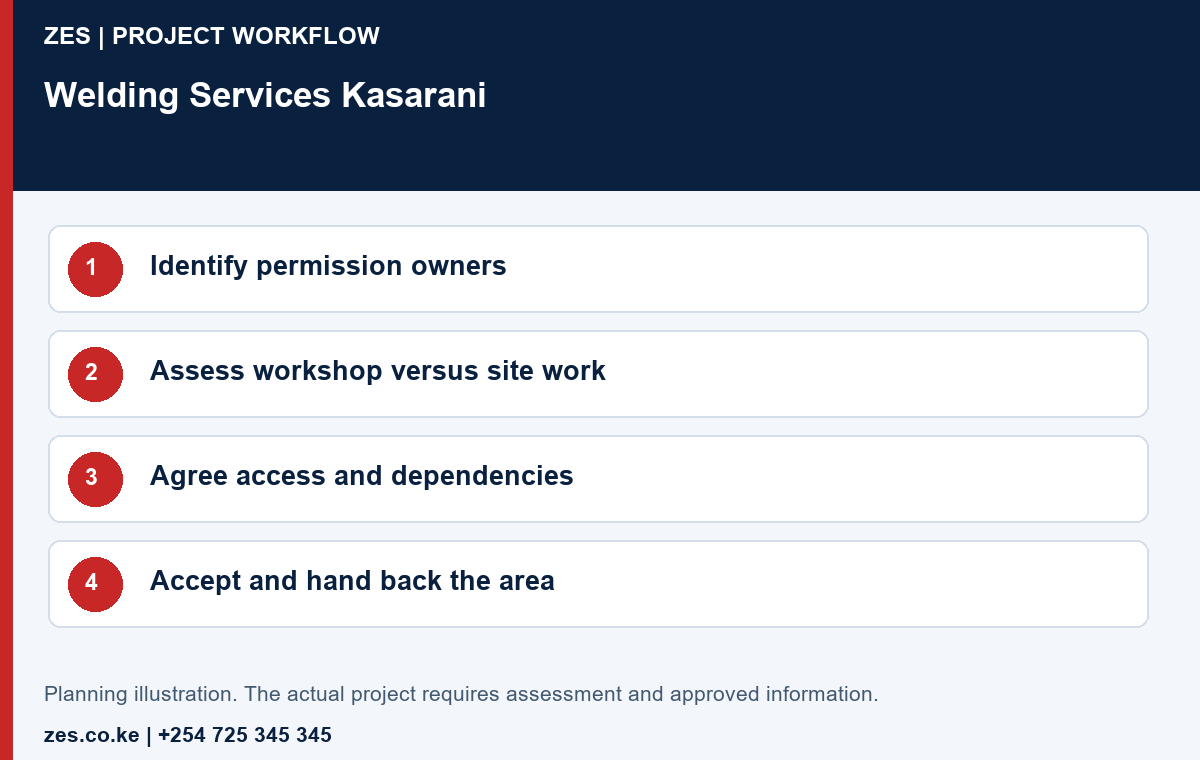
Identify the person authorised to approve the work and the parties who control relevant building or site interfaces. A tenant may explain a problem without having authority to change supporting construction or shared access. Record approvals in the project brief. Site welding should follow the responsible owner’s arrangements rather than assume that one person’s preferred installation date settles every permission.
2. Explain what must continue operating
Describe the activities, routes and services affected by the proposed work. The responsible site team should decide relevant operating boundaries and any temporary arrangement. Avoid a promise of uninterrupted use before those conditions are assessed. Welding services Kasarani should be planned around actual readiness, with the responsibilities for access, supervision and other suppliers identified in the proposal.
3. Review whether site welding is necessary
Ask whether suitable components can be fabricated or repaired in a workshop and then installed through an approved method. Some work may require site-specific assessment; another task may be removable. The choice depends on the actual asset, design and interfaces. Do not treat a mobile welding request as proof that the whole job must be performed beside occupied premises.
4. Make the site-welding scope comparable
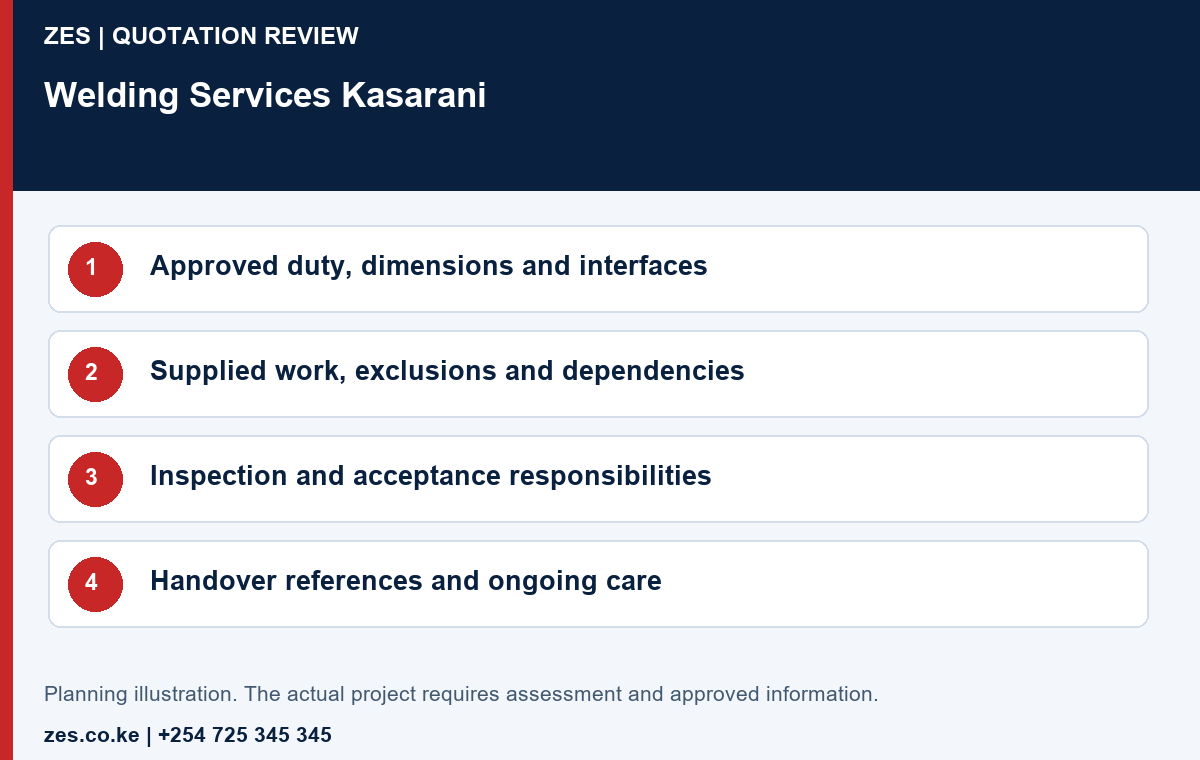
Identify assessment, fabrication, enabling work, delivery, installation and any reinstatement separately. State customer-provided dependencies and work retained by others. An offer for a component differs from an offer covering its complete installation. Compare those boundaries explicitly rather than interpreting a low figure as the same result with fewer costs. Ask which missing information prevents the price from becoming firm.
5. Put the work method with the responsible people
Hot work and installation activities need the relevant site assessment, controls and authorisation. This buying guide does not provide a method for carrying out welding in an occupied building. Identify who approves and manages the actual approach and the interaction with other activities. If a dependency is absent, agree the decision process instead of expecting the attending technician to improvise around it.
6. Agree handback and evidence
The project should identify what constitutes completion of the supplied work and readiness of the affected area for its approved use. Request the relevant inspection, operation or other acceptance evidence from the responsible parties. Keep exclusions and outstanding actions visible. A contractor’s attendance or a photograph of a finished weld should not substitute for the agreed handback process.
7. Leave the next manager a useful record
Keep the approved references, supplied-work description, relevant product information and support contact with the premises record. Distinguish the installed item from surrounding work that was not assessed. Future welding services Kasarani enquiries should identify the asset and any later changes, particularly where another tenant or supplier has altered the original interfaces or operating conditions.
Illustrative project brief for Kasarani
For an invented shared-site example, a tenant requests a steel equipment frame while the landlord controls the proposed attachment area and another contractor provides the connected equipment. The enquiry needs one approved interface drawing, a named dimensional verifier and a coordinated installation window. It also needs a clear decision if the equipment or supporting area is not ready. This makes the site-welding proposal reviewable without claiming that ZES has completed that project or that the example is suitable for every Kasarani premises.
Prepare a clear enquiry for ZES
Send the site location, intended use, quantity, photographs, available drawings and approximate dimensions. Mark measurements that still need verification. Identify the person authorised to approve the work and the relevant technical or property contacts. Explain the preferred programme and which activities must continue. Avoid sending private tenant information, security credentials or unrelated personal records when a simple project description will explain the requirement.
A written proposal should identify supplied work, exclusions, customer dependencies, approved references and acceptance evidence. Confirm current commercial terms and any assessment, travel, delivery or installation arrangements directly. Relevant design, approvals and specialist verification remain with the appropriately qualified responsible parties where required. This guide provides buying questions; it is not a site-specific welding method, structural design or certification of an existing installation.
- Required result: identify the item, duty and quantity.
- Information: distinguish approved details from assumptions.
- Interfaces: name customer and third-party responsibilities.
- Commercial scope: compare equivalent supplied outcomes.
- Acceptance: agree evidence, outstanding actions and handover references.
Frequently asked questions
Can a tenant approve every site-welding task?
Authority depends on the actual property and scope. Identify the responsible owner or manager and any relevant technical approvals rather than assuming that access to the premises permits every alteration.
Are access equipment and reinstatement always included?
No. Ask the written proposal to identify supplied tasks, customer dependencies and exclusions. The complete installed outcome may require contributions from several responsible parties.
Can the work be scheduled outside ordinary operating hours?
State the preferred window and site conditions in the enquiry. ZES must confirm availability, assessment requirements, programme and commercial terms for the actual request.
Related specialist ZES guide · Welding and metal fabrication services · Request a welding quotation · Request a site assessment · Call +254 725 345 345.
Reference: NCA contractor information. Confirm requirements applicable to the actual scope with the responsible advisers.