

Commercial Welding Services Starehe buyers need a proposal that procurement, facilities and the responsible technical team can all understand. A steelwork description and total price may leave design, enabling work, inspection and handover undefined. This guide explains how to organise a commercial-welding request for quotation around a complete outcome. ZES can review Starehe enquiries and confirm the supplied scope, assessment requirements, relevant credentials and commercial terms for the actual project rather than advertise unverified approvals or unlimited capability.
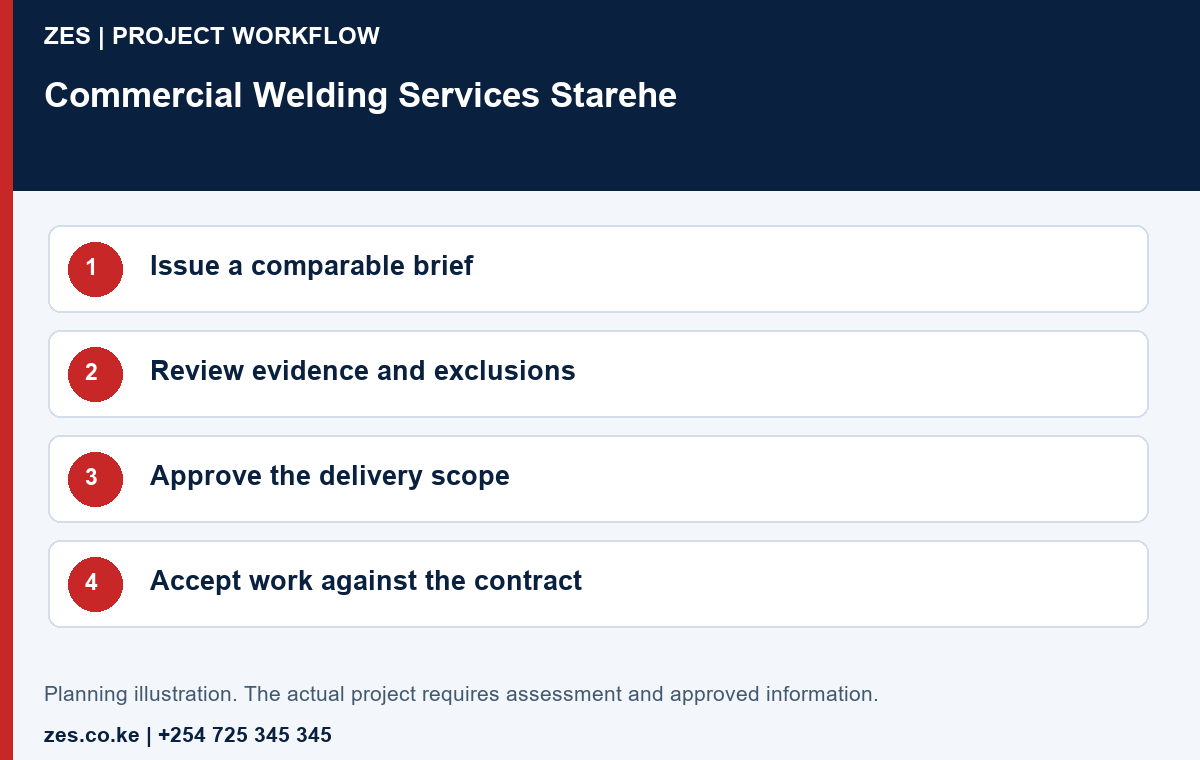
1. Issue the same brief to each supplier
Identify the required items, intended duty, quantities, location and approved references. State which information remains provisional. Ask bidders to identify assumptions and exclusions against that brief. Commercial welding offers cannot be compared fairly when one supplier prices installation and another assumes workshop supply. A shared scope schedule gives the buyer a basis for clarifying the difference before appointment.
2. Request evidence relevant to the actual work
Ask for the credentials, experience and technical information appropriate to the project. Where construction or specialist requirements apply, the responsible advisers should confirm the relevant current requirements and verification route. Do not treat a general business description as evidence of every licence, certification or project history. Commercial welding services Starehe should be evaluated using verifiable information for the actual supplied scope.
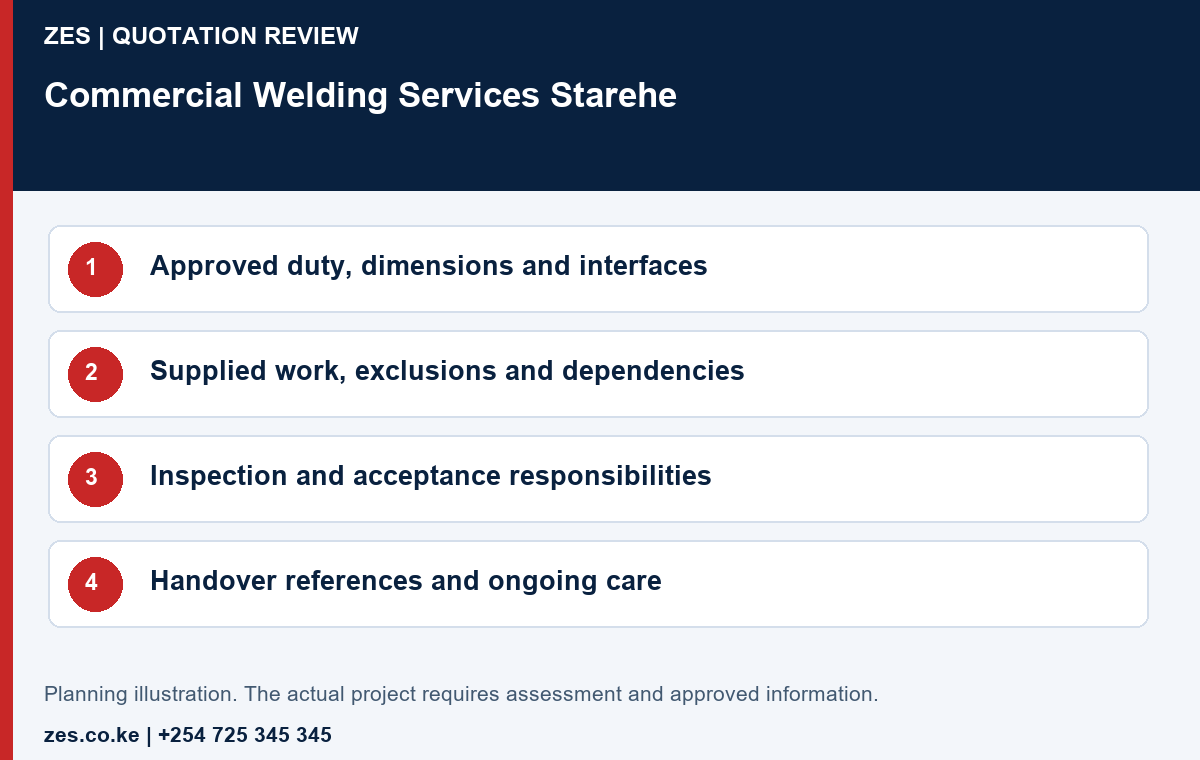
3. Assign design and interface responsibilities
Identify who provides measured information, relevant design, approvals and supporting construction. Keep the fabricator’s supplied responsibilities separate from work belonging to the customer or other contractors. A proposal may coordinate several parties without transferring every design duty to one supplier. Use references and revisions so commercial approval does not hide a technical decision that has not yet been made.
4. Clarify the complete price basis
Compare materials, fabrication, finishes, transport, handling, installation, enabling tasks and relevant acceptance evidence. Record provisional quantities and customer dependencies. Ask how changes are approved and priced. A commercial-welding quotation should explain what triggers another decision rather than rely on a broad total that later becomes a dispute over assumptions. Current tax and commercial terms should be confirmed in the actual written offer.
5. Link programme to readiness
Identify the information, approvals, access and third-party tasks needed before production and site work. The responsible site team must assess and authorise the actual method and operating arrangements. A preferred completion date does not establish readiness. Keep the workshop duration, delivery arrangement and installation window distinguishable so the programme can be reviewed when one dependency changes.
6. Define acceptance before award
List the documents, inspections, dimensions or operating demonstrations required for the actual duty, with appropriately qualified responsibility where needed. Agree how defects, exclusions and incomplete interfaces are recorded. A delivery note or supplier invoice is not a substitute for the commercial-welding acceptance evidence specified in the contract. Avoid a handover signature that obscures unresolved work.
7. Transfer an understandable asset record
Request final approved information, relevant material and finish references, supplied-work evidence and support details. Sensitive security layouts or private operating information should remain in the customer’s controlled file rather than a public project gallery. Future commercial welding services Starehe enquiries can use that record to explain additions, faults or changes without relying on the recollection of the original purchasing team.
Illustrative project brief for Starehe
A hypothetical organisation requests a fabricated enclosure and supporting installation. Its procurement team compares a line-by-line scope, while the responsible technical team approves interfaces and acceptance evidence. Each supplier identifies design assumptions, enabling work and exclusions before commercial appointment. The final handover links the supplied work to that same schedule. This example describes a proposed purchasing process, not a completed Starehe tender, a government appointment or evidence that ZES holds a particular certification.
Prepare a clear enquiry for ZES
Send the site location, intended use, quantity, photographs, available drawings and approximate dimensions. Mark measurements that still need verification. Identify the person authorised to approve the work and the relevant technical or property contacts. Explain the preferred programme and which activities must continue. Avoid sending private tenant information, security credentials or unrelated personal records when a simple project description will explain the requirement.
A written proposal should identify supplied work, exclusions, customer dependencies, approved references and acceptance evidence. Confirm current commercial terms and any assessment, travel, delivery or installation arrangements directly. Relevant design, approvals and specialist verification remain with the appropriately qualified responsible parties where required. This guide provides buying questions; it is not a site-specific welding method, structural design or certification of an existing installation.
- Required result: identify the item, duty and quantity.
- Information: distinguish approved details from assumptions.
- Interfaces: name customer and third-party responsibilities.
- Commercial scope: compare equivalent supplied outcomes.
- Acceptance: agree evidence, outstanding actions and handover references.
Frequently asked questions
Can these guides prove eligibility for a tender?
No. Eligibility must be checked against the actual tender and genuine current evidence. Ask ZES to confirm relevant documents and capability directly rather than treating a blog as a credential.
Should the lowest commercial-welding total always win?
Compare the same required outcome, evidence, exclusions and commercial terms. An apparently lower total may cover a different supply or installation boundary.
What should a buyer retain after completion?
Keep approved references, the agreed scope, relevant verification, final supplied-work information, outstanding actions and support contacts. The appropriate contract and technical team determine the actual handover requirement.
Related specialist ZES guide · Welding and metal fabrication services · Request a welding quotation · Request a site assessment · Call +254 725 345 345.
Reference: NCA contractor information. Confirm requirements applicable to the actual scope with the responsible advisers.