

Updated 4 November 2026 · Zama Engineering Systems buyer guide
Night Vision CCTV Installation Kenya should be assessed against the scene the customer actually needs to review after dark. A daytime demonstration or a generic night photograph cannot establish how a proposed camera will perform at a particular property. This guide helps buyers plan the lighting discussion, installation assessment and night acceptance test before committing to a camera package.
Describe what changes after closing time
Tell the installer which views matter at night, when lighting changes and what activity needs review. Explain whether lights are normally left on, controlled by another system or affected by the business schedule. The observation task should be as specific as the daytime requirement. Keep sensitive site details in the controlled assessment, while the general enquiry can state the type of property, intended outcome and the need for an after-dark demonstration.
Night Vision CCTV Installation Kenya: ask about the actual image mode
Request the exact camera model and the proposed low-light arrangement. Have the supplier explain what the customer should expect from the recorded image under the assessed conditions, including whether the relevant result is colour or another supported mode. Avoid generalising an advertised feature across all cameras. Ask what site lighting is assumed and which parts of the proposal depend on equipment that the customer or another contractor must provide.
Assess the scene rather than selecting on a distance label
The installer needs to consider the scene, obstructions and the activity being recorded. A nominal product distance does not describe the quality of every subject throughout a real property. Ask how the proposed view will be approved and what representative activity can be used for acceptance. The buyer does not need to prescribe technical settings; the useful requirement is a clear recorded result under agreed conditions and a documented explanation of any limitations.
Include lighting coordination and installation work
Where additional or changed lighting is proposed, identify who designs, supplies and installs it. Obtain the necessary customer approvals and keep electrical work with the appropriate competent party. Record mounting, containment and making-good allowances alongside camera supply. If a quotation relies on existing lights, establish their operating pattern and ownership. Changing those lights later may change the accepted camera scene, so the handover should make the dependency understandable.
Arrange a separate night acceptance appointment
Agree how and when after-dark performance will be assessed, using authorised representative activity and the customer's intended playback process. Test recorded footage rather than relying solely on a live screen. Record the relevant conditions and any work still outstanding. If daytime and night tests happen on different dates, document partial acceptance clearly. Include the support route and a process for reviewing scene changes after handover instead of assuming the original result is permanent.
Compare the supplied scope
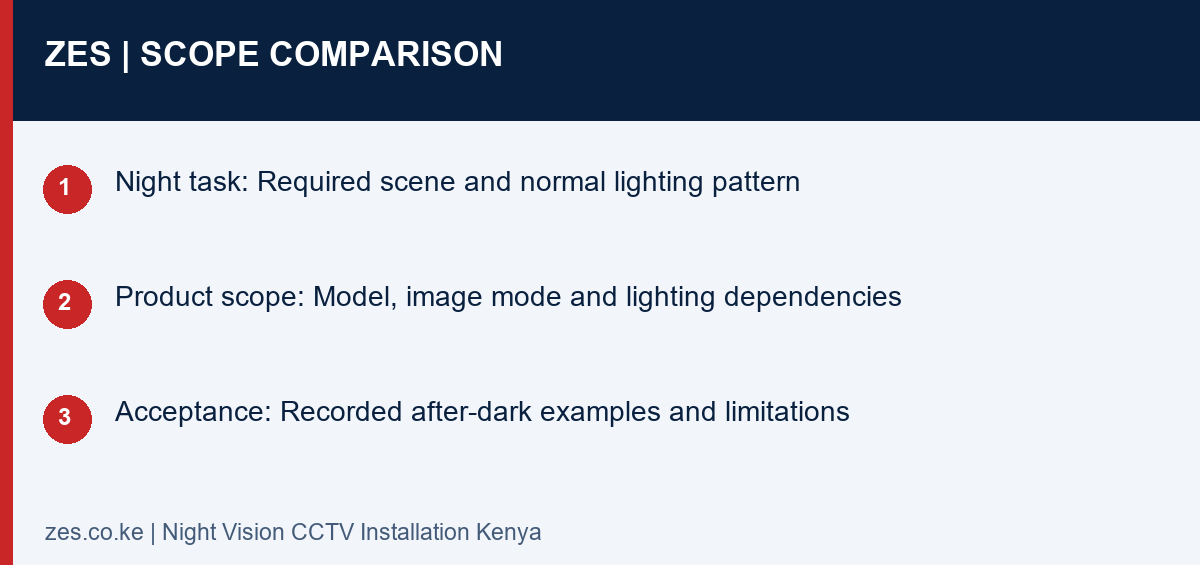
| Decision | Information to confirm | Useful result |
|---|---|---|
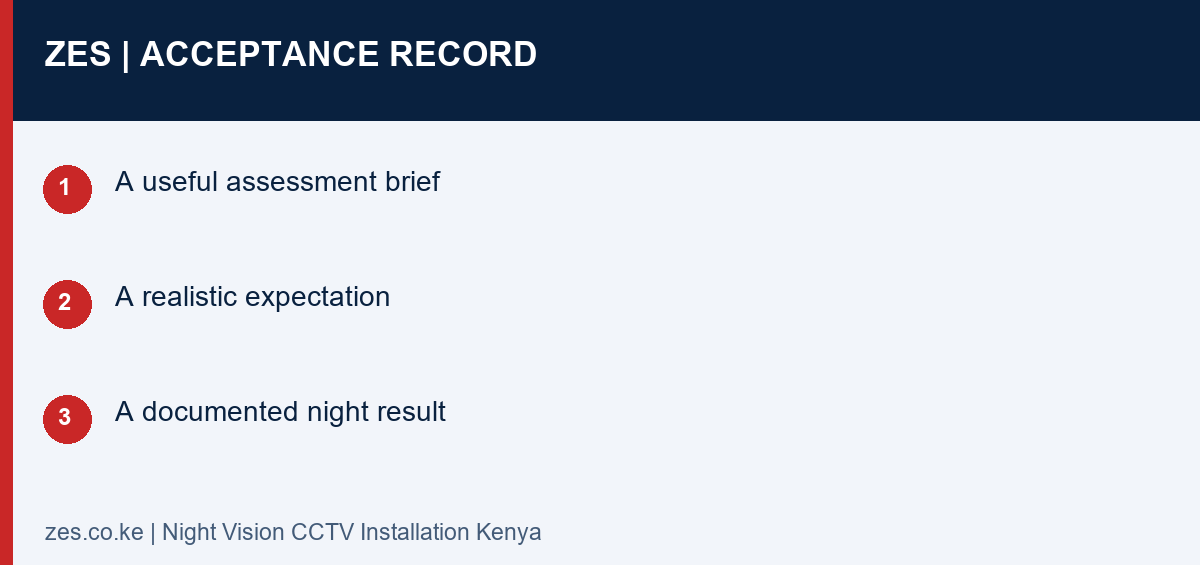
| Night task | Required scene and normal lighting pattern | A useful assessment brief |
| Product scope | Model, image mode and lighting dependencies | A realistic expectation |
| Acceptance | Recorded after-dark examples and limitations | A documented night result |
A practical planning example
A shop entrance may appear well lit during trading hours but look different after the business switches off its display lighting. The customer can describe both periods and request a demonstration under the conditions that matter. That allows a proposal to account for the real operating pattern rather than rely on a daytime sample. This example does not promise a particular result from an unassessed camera.
Night Vision CCTV Installation Kenya: enquiry checklist
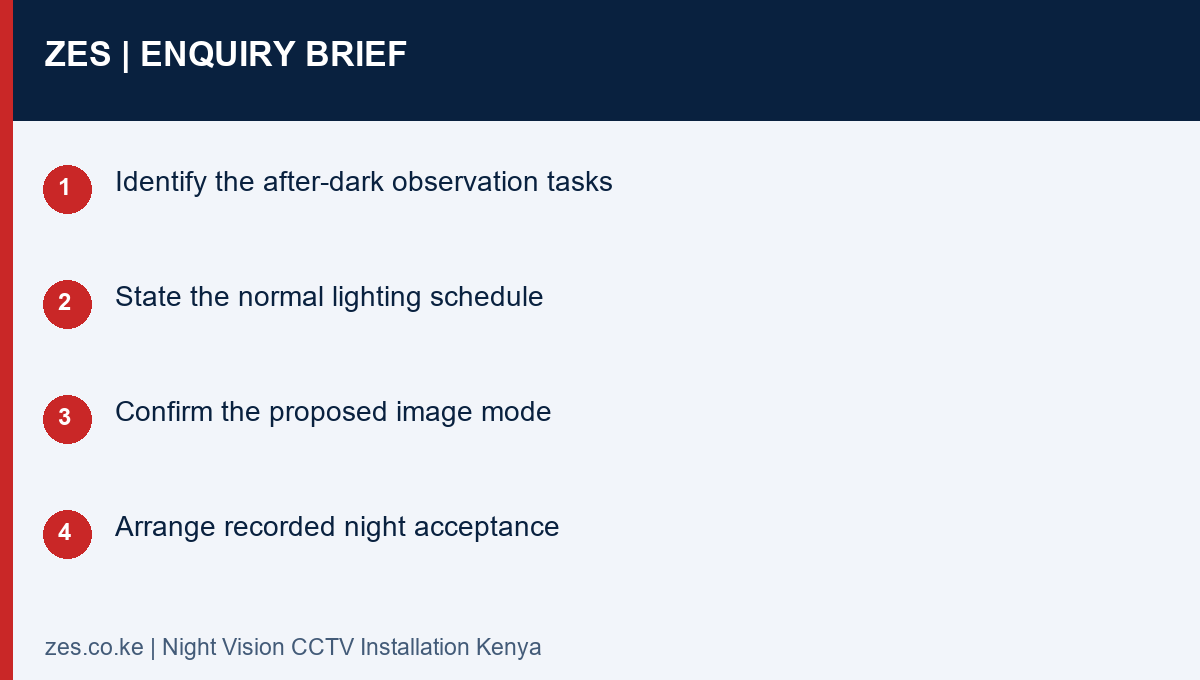
- Identify the after-dark observation tasks
- State the normal lighting schedule
- Confirm the proposed image mode
- Arrange recorded night acceptance
Questions before commissioning
Does night vision always mean colour video?
No. Confirm the selected model's supported functions and the scene conditions required for the proposed result.
Is daytime commissioning sufficient?
If after-dark performance is an important requirement, agree a relevant night test and record any outstanding acceptance conditions.
Discuss your CCTV requirement with ZES
Read the related ZES CCTV planning guide and explore CCTV surveillance services. Share the location, equipment information and intended outcome. ZES confirms the appropriate assessment, availability, proposed delivery responsibilities and commercial terms for the actual enquiry.
Request a scoped quotation · Request a site assessment · Call +254 725 345 345
Technical background: Axis guide to image quality and surveillance purpose. Confirm the actual project requirements with the responsible advisers and relevant product information.