
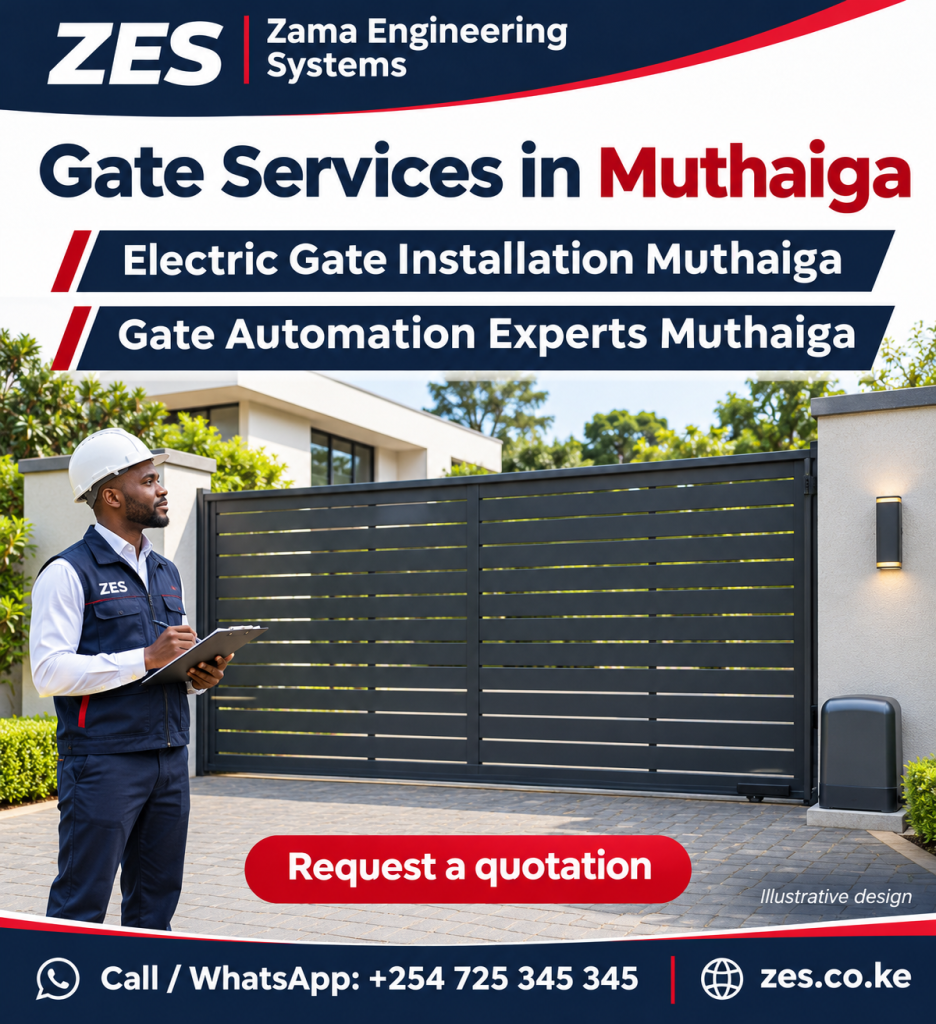
Gate Motor Installation Muthaiga — planning, quotation and owner guidance
The right gate motor should suit your entrance from the first opening of the day to the last. Choosing it by price or brand alone leaves important questions unanswered: can it handle the gate, does it suit the operating pattern, and will it work with your existing controls?
For gate motor installation in Muthaiga, Zama Engineering Systems (ZES) helps customers define the installation before committing to equipment. Whether you are automating a manual gate or replacing an existing operator, the aim is a complete working entrance with a clear scope and manageable controls.
Gate motor installation Muthaiga: new installation or replacement?
A first installation begins with the gate itself. Its type, dimensions, condition and movement determine the preparation and operator requirements. A suitable motor does not remove the need for sound supports and appropriate movement hardware.
A replacement begins with another question: why is the old unit being changed? The answer may involve damage, recurring faults, equipment condition or a changed access requirement. Establishing the reason helps distinguish a necessary replacement from a repair that could address the problem.
If the gate has stopped working, start with an assessment rather than buying a replacement immediately. The ZES gate motor repair guide explains why the operator and the rest of the entrance should be considered together.
What determines the right motor?
The proposed operator should match the gate arrangement and the manufacturer’s installation requirements. Sliding gates and swing gates need different equipment. The assessor also needs to understand the gate’s characteristics and expected use.
Describe the busiest period at your entrance. Several vehicles arriving close together creates a different operating pattern from the same number of arrivals spread across a day. If the entrance serves several occupants or a staffed property, include that information.
Ask the supplier to explain the selection in plain language. You should know the proposed model, the assumptions behind it and any work needed before it can be fitted.
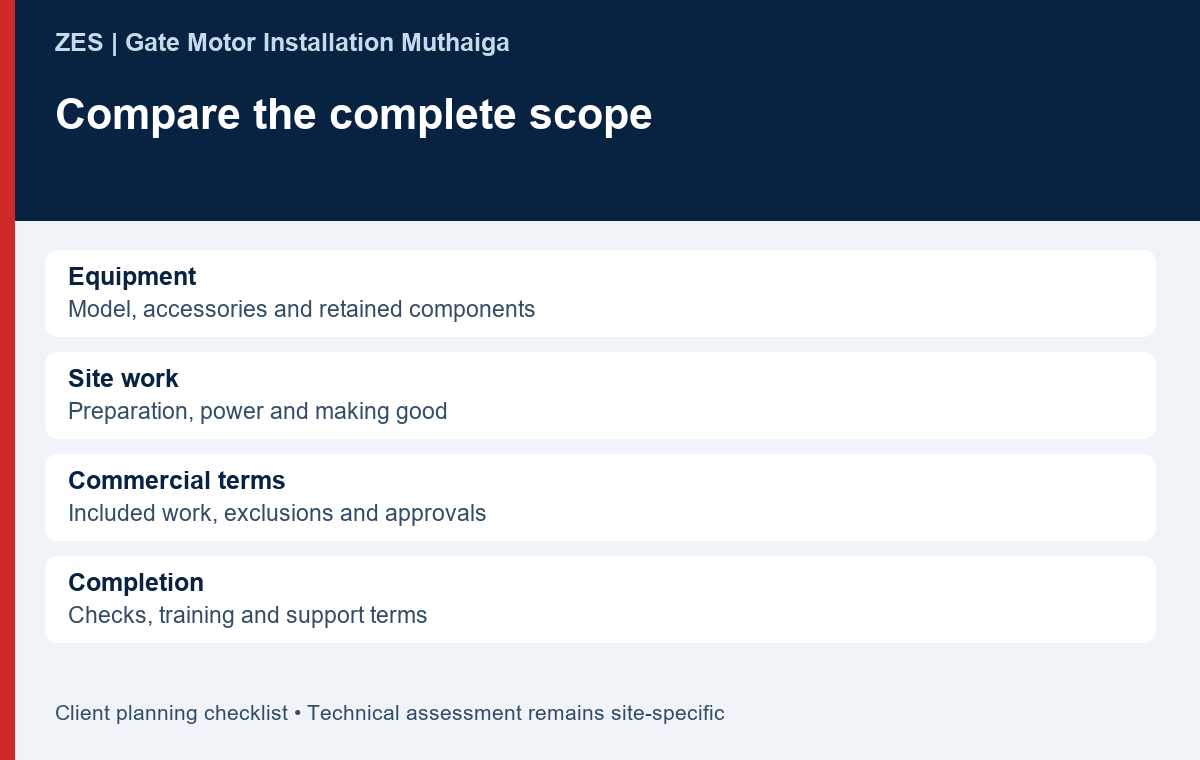
A useful equipment specification
| Detail | Why it matters to your purchase |
|---|---|
| Exact operator model | Makes quotations and supplied equipment comparable |
| Gate arrangement | Confirms the proposal matches sliding or swing movement |
| Usage assumptions | Records the demand the installer has planned for |
| Existing components | Shows what stays and what is replaced |
| User controls | Establishes which devices and quantities are included |
| Power provision | Defines electrical work and selected backup options |
Keep this specification with the quotation. If a supplier changes the proposed model, ask how the alternative meets the same requirement and whether the price or accessory compatibility changes.
Can you keep your remotes and intercom?
Possibly, but compatibility should be checked rather than assumed. Existing remotes, receivers, intercoms and other accessories may influence the replacement scope.
Ask for a clear list of retained and replacement items. If new remotes are needed, include enough for the authorised users and agree how old access permissions are managed. For connected controls, identify the account owner and any ongoing service requirements.
This is also a good time to review how visitors enter. An operator upgrade can be planned alongside access-control improvements where they address a real need.
Understand the complete installed price
The equipment cost is only one part of the project. Mechanical preparation, electrical work, accessories and commissioning can materially affect the total.
For a replacement, an existing base or cable route may be reusable, but it still needs assessment. For a new installation, confirm who supplies the supporting work. A quote that excludes preparation should not be compared directly with one that includes it.
Request a written breakdown showing equipment, labour, additional work, taxes and exclusions. Ask which items are provisional. This makes budget decisions easier and reduces the chance of an apparently inexpensive package becoming a larger project after work begins.
What you should receive at handover
A completed motor installation should come with more than a working remote. Ask for the equipment details, relevant user instructions and a demonstration of the agreed access functions.
The responsible installer should also complete the applicable commissioning checks. Authorised users need to understand what to do during an outage or if operation becomes abnormal. Keep release keys and administrative access under the control of the responsible property contact.
Confirm actual equipment and workmanship support terms in writing. A familiar brand name does not, by itself, explain what a particular quotation covers.
Frequently asked questions
Can I supply my own gate motor?
Discuss the model before purchasing it. Its suitability and installation requirements need to be checked against the gate and site.
Does a heavier gate always need the largest available operator?
Equipment selection should follow the complete assessed requirement. A headline capacity rating alone is not enough to choose the installation.
Must a replacement use the same brand?
Not necessarily. The decision depends on suitability, compatibility, supporting work and available equipment.
How long will installation take?
The work programme depends on site readiness, preparation and equipment availability. Ask for a project-specific schedule with the quotation.
Seven easy checks when comparing gate motor proposals
A useful specification connects equipment selection to the entrance. These seven checks help you understand that connection and compare offers. They are purchasing questions, not instructions for testing or installing a gate operator.
1. Record the reason for installing or replacing the motor
Write down the problem you want to solve. First-time automation, a confirmed equipment failure and a change in access requirements are different starting points. Give the supplier enough history to distinguish them.
If an existing gate motor has failed, include previous service information. Describe the symptoms and any earlier work without deciding in advance which internal component is responsible. A replacement proposal should explain why replacement addresses the assessed problem.
If the entrance works but no longer meets your needs, explain the changed requirement. More users, different visitor arrangements or a desired control method may affect the system without necessarily requiring every component to be replaced.
A clear project reason helps you assess the recommendation. You should be able to connect the proposed gate operator and supporting work to the original need. This is a better basis for approval than buying a familiar model because it appears in another property’s installation.
2. Request the exact model and selection assumptions
Ask each supplier to name the proposed gate motor. A quotation that says only “heavy-duty motor” does not provide enough information for a meaningful comparison.
The specification should identify the gate arrangement, assessed characteristics and expected usage. Ask which assumptions remain provisional and what needs site confirmation. If a different model is later offered, request an explanation of the substitution.
Do not treat a maximum capacity figure as a complete selection method. The product requirements, gate condition and installation geometry matter together. A competent installer should explain the recommendation in language the owner can understand.
Keep the specification with the quotation and equipment records. It becomes a reference for delivery, commissioning and future service. You do not need to memorise every technical parameter, but you should know what equipment you have approved and why it was proposed for your entrance.
3. Identify mechanical preparation separately
Ask which work must be completed before the gate operator is fitted. Existing gate movement and structural conditions should be assessed rather than hidden inside a general installation line.
If the gate requires attention to supports, hinges, wheels or alignment, the scope should name those tasks. It should also identify who undertakes them and how the installation team confirms readiness.
Where another contractor performs preparation, agree the coordination point. An operator installer should not arrive expecting a prepared gate while the owner assumes preparation is included in the motor package.
This distinction also helps when comparing replacement offers. A new gate motor may be appropriate, but the proposal must still address any relevant gate problem. Paying for a larger or newer operator does not by itself resolve an unsuitable mechanical arrangement. Ask for the explanation before approving equipment, particularly if the entrance has a history of recurring faults.
4. Review controls and retained equipment
List every existing control you expect to keep: remotes, receiver, intercom, keypad or other access device. Ask the supplier to confirm which items are compatible and which need replacement.
A proposed gate motor may work with some existing equipment and require changes elsewhere. Those decisions affect both cost and user convenience. Include new remote quantities and the work required to enrol authorised users.
Connected controls introduce administrative questions. Establish who owns the account, who can change access and what connectivity or recurring service is required. A new feature should not leave the property dependent on an account controlled by someone who will not manage it.
If an accessory remains subject to testing, keep it marked as provisional. That is more useful than assuming it will work and discovering a compatibility issue at handover. The final proposal should describe one complete entrance system, including the items supplied and retained.
5. Compare lifetime ownership responsibilities
The purchase price is important, but the owner also needs to understand how the equipment will be supported. Ask for actual maintenance guidance and written support terms for the proposed installation.
Identify who receives fault reports and what information they will need. Keep model details, installation records and service history together so later assistance does not start from an unidentified enclosure.
Discuss parts support for the particular gate operator without assuming that every brand or model has the same availability. If replacement parts would need ordering, ask how that affects the proposed work programme.
Consider the way users are trained. The gate motor will become part of an everyday entrance, and the responsible people should understand normal controls and the documented outage procedure. A clear handover reduces dependence on informal explanations that may be forgotten when staff or occupants change.
6. Understand the boundary of the installation price
Check whether the quotation includes mechanical preparation, electrical work, controls, making good and commissioning. Compare the full delivered result rather than only the gate motor line.
Where an existing base or supply is retained, ask how suitability will be confirmed. Where new work is needed, identify who supplies it. Clarify assessment charges, taxes, provisional items and any return visit required to complete the work.
Ask what happens if the survey reveals a condition that changes the scope. Agree who authorises variations and how the revised price is recorded. A quotation should not become an open-ended instruction to replace whatever is encountered.
Keep optional convenience features separate from the required installation. That allows a realistic budget decision while preserving the work needed for the assessed gate operator. If later expansion is likely, ask which provisions are sensible now and which decisions should wait.
7. Match the finished installation to the agreed proposal
At completion, check the supplied model and accessories against the approved scope. Document any agreed substitution and keep the relevant product information.
Ask for normal user functions to be demonstrated. The installer should complete the applicable commissioning and protective checks through appropriate procedures. Do not use a person or vehicle to test an uncertain response.
Obtain the user instructions, release keys and agreed support contacts. Identify the person who will manage access changes and the location of the owner record. Keep security-sensitive credentials separate from general project documents.
If anything remains incomplete, record it with the next action and responsible contact. The gate motor project is easier to manage when completion is defined by the agreed functioning entrance, not simply by the presence of a new operator on its base.
An example of comparing replacement offers
Suppose two offers propose replacing an existing operator. One lists a gate motor and labour. The other also includes new remotes, preparation and electrical alterations. Their totals cannot be compared fairly until the differences are understood.
Ask the first supplier whether those additional items are unnecessary, excluded or still unassessed. Ask the second supplier why each is needed. The aim is not automatically to choose the more extensive package. It is to understand which work addresses the actual entrance.
This hypothetical comparison shows why a written specification matters. A low equipment price may be good value for a prepared installation, but it is not a complete project price when important dependencies remain outside the offer.
The owner should approve the option that has an explained scope and suitable equipment. Keep the reasoning with the quotation so later changes can be assessed against the same requirement.
What to include in your first message
Send the Muthaiga location, gate type and a brief project description. Say whether the current gate is manual, automated but faulty, or working and being upgraded. Include photographs taken from safe stationary positions.
If available, attach the existing equipment model and previous service summary. Do not remove covers to obtain identification. Records from the original purchase may provide the information safely.
Describe the usual access pattern and the busiest period. Mention which controls you want to retain and which new functions matter. Include the project schedule and any contractor already working on the entrance.
That information helps ZES discuss the assessment and prepare a proposal around the gate motor installation you need. Final equipment selection and pricing should follow the necessary site checks.
Questions to resolve before paying a deposit
Confirm the exact supplied equipment, the agreed scope, payment milestones and the work programme. Ask which items are subject to availability and which site tasks must be ready before installation.
Check that the quotation names the party responsible for preparation and power provision. Make sure any promised support term appears in writing rather than relying on an assumption about the brand.
Finally, keep a copy of the approved proposal. If the gate operator or project scope changes, agree the revision before proceeding. Clear purchase records make installation, handover and later support more straightforward.
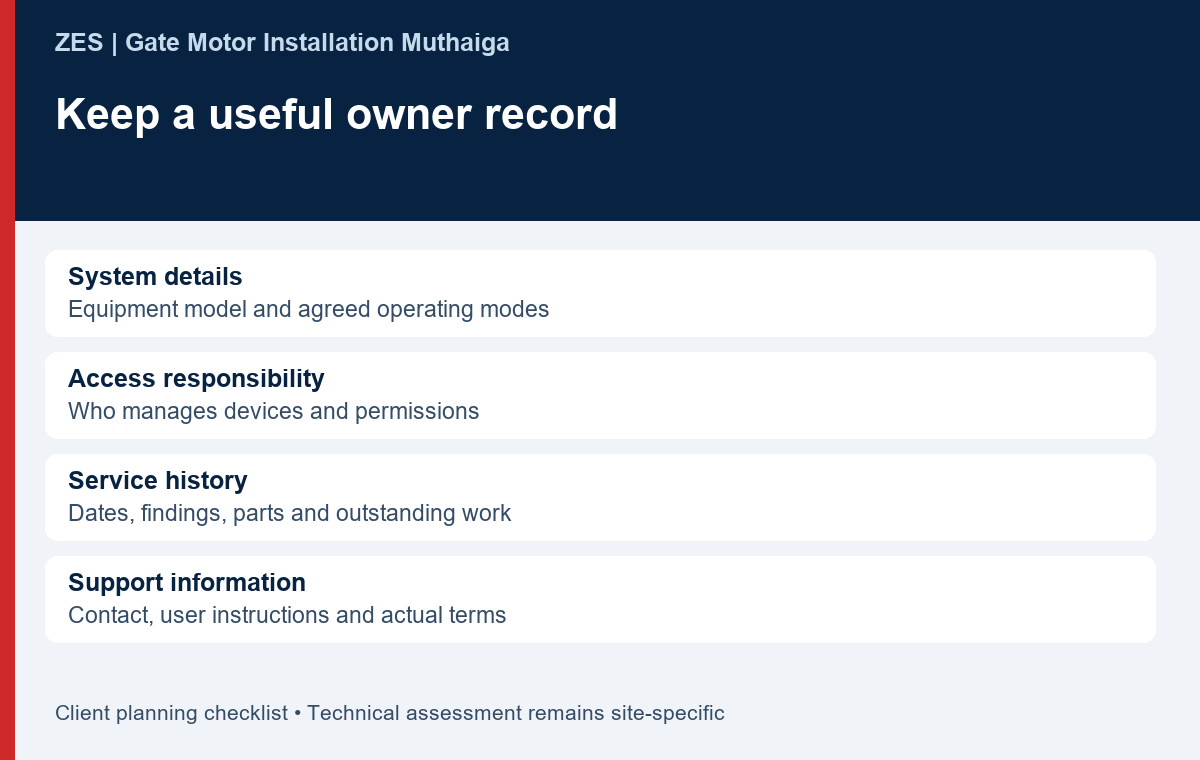
Keep the specification useful after installation
A gate motor specification should not disappear into an old quotation folder once the work is paid for. Keep the approved model, supplied accessories and installation date where the responsible property contact can find them.
If a later service replaces a component, add that information. If an access device changes, record the change without exposing private credentials. The gate operator history should show the current arrangement rather than several conflicting versions.
When requesting another quotation, send the relevant record with the symptom or upgrade brief. It can help the supplier identify equipment and plan the assessment, although it does not replace inspection.
A gate motor that is being upgraded should be reviewed against the new requirement, not simply the original specification. More users or different controls may introduce questions that did not exist when it was installed.
Clear records therefore serve two purposes: they explain what you own and support decisions about what should happen next. They are a practical part of the handover, alongside user instructions and the actual support terms.
Get a motor installation quotation in Muthaiga
Send ZES your location, gate type, photographs and any safely accessible model information. Tell us whether the project is first-time automation or replacement. Request a quotation or call +254 725 345 345 to discuss the next step.
Further reading: HSE powered-gate safety guidance explains why the complete installation needs assessment. This is UK technical background, not a statement of Kenyan legal requirements.
Electric Gate Installation Muthaiga: confirm power readiness
Electric Gate Installation Muthaiga should coordinate the operator with the gate, power arrangement and intended controls. Identify who is responsible for electrical preparation, cable routes and any site work before approving the equipment. A nearby power point does not by itself establish that the installation is ready.
Describe the expected use and the desired arrangement during an outage. Ask what the selected equipment supports and which items are included. Backup performance depends on the actual system, demand and condition; it should not be promised from a generic package description.
Gate Automation Experts Muthaiga: what evidence to request
If you are comparing providers under the search phrase Gate Automation Experts Muthaiga, ask practical questions about the assessment, proposed model, installation responsibilities and completion checks. A marketing label is not evidence of manufacturer authorisation or a particular qualification. Request verification where procurement requires credentials.
A useful proposal explains why the equipment suits the gate and how retained accessories will work with it. Ask who will address fabrication, civil or electrical issues discovered during assessment. Confirm the quotation’s exclusions and how changes to scope will be approved.
At handover, retain equipment details, manuals, work records and actual warranty terms. ZES can assess the requirement without claiming an unverified manufacturer affiliation. Use the quotation form or review FAAC gate motor installation guidance for model and scope questions.