
Updated 3 November 2026 · Zama Engineering Systems buyer guide
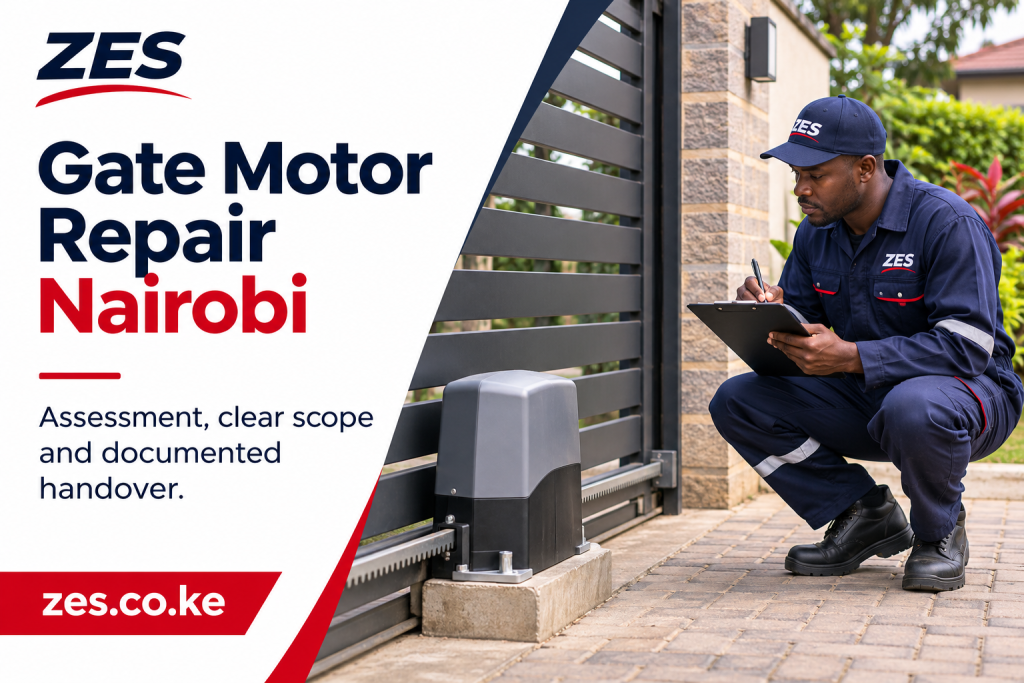
Gate Motor Repair Nairobi enquiries should identify the operator and the behaviour observed at the entrance. Noise, intermittent movement or a failure to respond does not by itself establish which component has failed. The following motor-repair guidance extends this established gate-operator page and explains how a buyer can ask for an accountable diagnosis, quotation and return-to-service check.
Identify the operator and its history
Share the model reference, available service record and a description of recent symptoms. State whether the gate or driveway has been altered or damaged. Information about ordinary use can help plan the assessment, but do not guess electrical values or dismantle an enclosure to obtain them. The competent technician should use information applicable to the actual product and configuration rather than treat every motor as the same design.
Gate Motor Repair Nairobi: distinguish the source
The assessment should consider both the operator and the physical gate. Poor movement, unsuitable geometry or damaged hardware may affect operation without proving that the motor itself needs repair. Power and control issues also need appropriate competent checks. Ask which findings support the proposed work. Replacing an assumed component before reviewing the entrance can leave the original cause untouched and make quotations difficult to compare.
Review repair against replacement
A useful offer explains whether repair is appropriate, which components are proposed and what limitations remain. Availability, compatibility, condition and support for the actual equipment can affect the recommendation. Request the complete installed scope, not just a replacement part price. Any change of operator should trigger the relevant review of gate suitability, controls and acceptance requirements rather than a simple assumption that a larger unit is better.
Keep commissioning and records in the scope
The responsible technician should establish and demonstrate the relevant checks before the entrance returns to ordinary use. Keep the equipment identity, work record, user information and any outstanding issues. Clarify the support terms for the specific repair. Unauthorised adjustments or later structural changes can affect the installation, so future work should refer to its actual configuration and records.
Compare the supplied scope
| Decision | Information to confirm | Useful result |
|---|---|---|
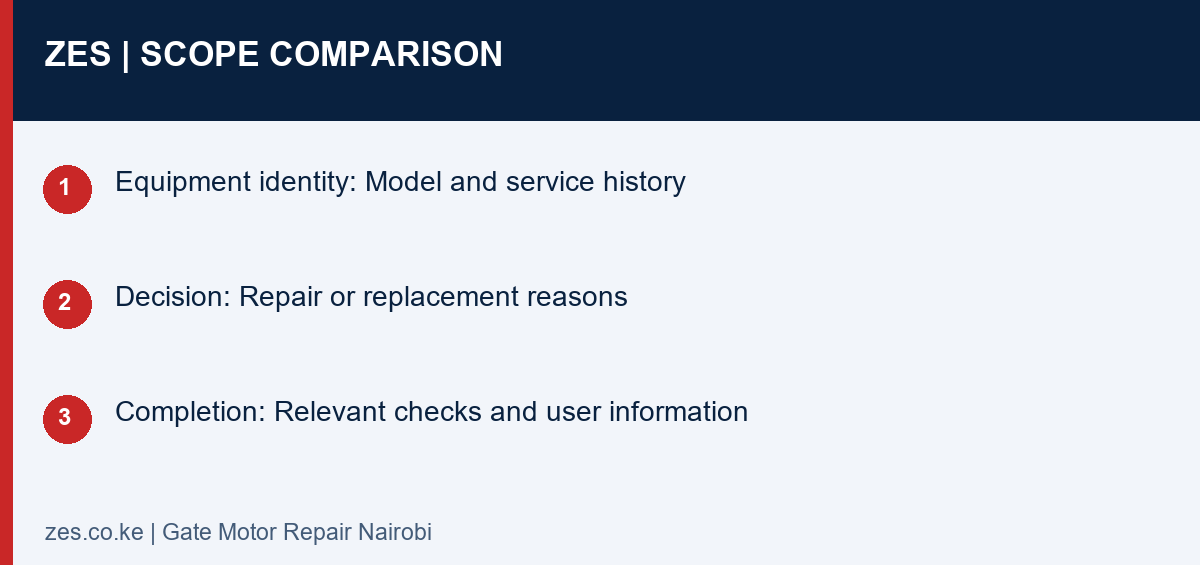
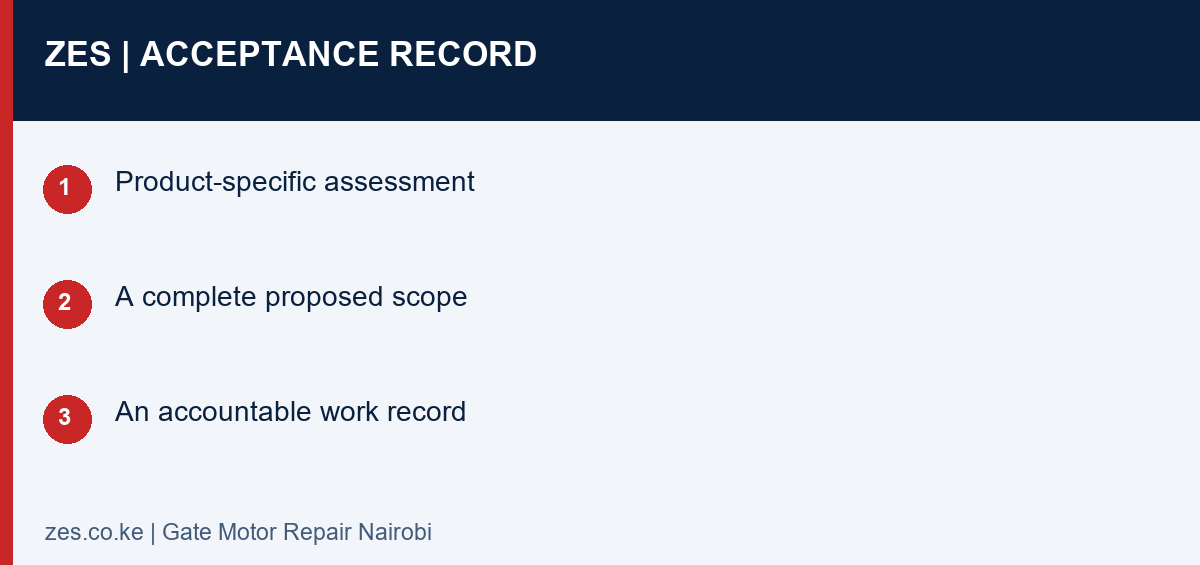
| Equipment identity | Model and service history | Product-specific assessment |
| Decision | Repair or replacement reasons | A complete proposed scope |
| Completion | Relevant checks and user information | An accountable work record |
A practical planning example
A noisy entrance may involve gate movement hardware as well as the operator. An assessment should establish the cause rather than assume that noise alone proves motor failure. This is an illustrative enquiry scenario.
Gate Motor Repair Nairobi: enquiry checklist
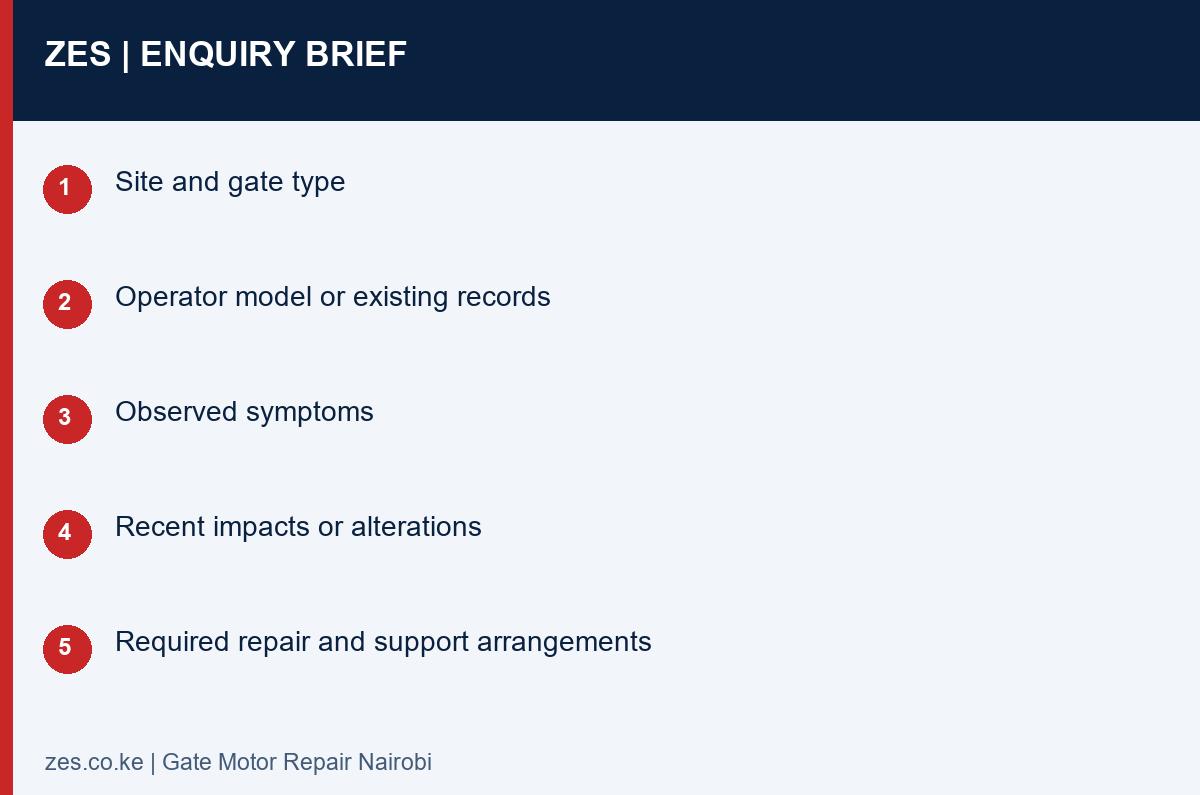
- Site and gate type
- Operator model or existing records
- Observed symptoms
- Recent impacts or alterations
- Required repair and support arrangements
Questions before arranging work
Is a more powerful motor always the solution?
No. The gate, duty, geometry and relevant safety requirements need appropriate assessment.
Can an older operator be repaired?
Possibly, depending on condition, compatible parts and support. Request the reasons and limitations behind the proposed option.
Discuss the gate requirement with ZES
Read the related ZES gate project guide and explore the service categories. Share the location, equipment information and intended outcome. ZES confirms the appropriate assessment, availability, proposed delivery responsibilities and commercial terms for the actual enquiry.
Request a scoped quotation · Request a site assessment · Call +254 725 345 345
Technical background: HSE powered-gate technical background (UK). This background does not establish Kenyan legal requirements for a particular project. Use the actual product instructions and appropriate project-specific advice.
More detailed project planning
The motor is what turns a gate into an automatic entrance. It is also the component most likely to fail, because it works every day, carries the gate's weight and is exposed to weather and power fluctuations. Choosing, installing and maintaining the right motor is what keeps a gate reliable.
Electric gate motor installation and repair in Kenya covers the selection, installation, commissioning, diagnosis and repair of motors for sliding gates, swing gates and barriers. This guide explains the motor types, how to size and install them, the common faults and how they are diagnosed, when to repair versus replace, the role of spares, maintenance, what affects cost, and how to choose a contractor.
It is written for homeowners, estate managers, facility managers and business owners.
Motor Types
Different gates need different motors.
Sliding gate motors. Rack-and-pinion motors that move the gate along a track or cantilever structure. They are the most common motor type in Kenya.
Swing gate motors. Articulated arm, linear piston or underground operators that rotate the gate on its hinges.
Barrier motors. Boom barriers for vehicle control at commercial and parking entrances.
Heavy-duty motors. For commercial and industrial gates with high usage.
Residential motors. Lighter duty for homes and small estates.
Solar-compatible motors. Efficient motors suited to solar power systems.
The motor must match the gate type, weight and usage.
Choosing the Right Motor
Motor selection is the most important decision.
Gate weight. The motor must be rated for the gate plus fittings.
Gate length. Longer gates place more load on the motor.
Frequency of use. A home gate opens a few times a day; a commercial gate may open hundreds.
Duty cycle. The motor's rated usage must match demand.
Environment. Dust, rain and heat affect motor life.
Power. Mains, battery backup or solar.
Safety inputs. For photocells and safety edges.
Spares. Choose a motor with local support and spare parts.
Brand. Reputable brands with proven reliability.
Under-specifying the motor is the most common cause of early failure.
Installation Process
Professional installation follows a sequence.
1. Survey. Assess the gate, ground, power and access.
2. Motor selection. Match the motor to the gate and usage.
3. Preparation. Prepare foundations, track, brackets or chamber.
4. Mounting. Fit the motor, rack, arm or operator.
5. Wiring. Run power and control cables safely.
6. Controls. Fit the controller, receivers and safety devices.
7. Commissioning. Set limits, force, speed and safety; test thoroughly.
8. Training. Show the client how to operate, release and maintain the gate.
9. Handover. Provide documentation and warranty.
Poor installation is a major cause of motor failure.
Power and Backup
Motors depend on reliable power.
Mains power. Common but subject to outages and fluctuations.
Battery backup. Keeps the gate working during outages.
Solar power. Suitable for remote or unstable-grid sites.
Surge protection. Protects controllers and motors from spikes.
Earthing. Protects equipment and users.
Isolation. A means to isolate power for maintenance.
Manual release. Essential for power failure.
Power quality problems often appear as motor or controller faults.
Common Motor Faults
Knowing the faults helps diagnosis.
Motor runs but gate does not move. Rack, pinion, coupling or arm issue.
Gate moves slowly. Motor wear, binding or settings.
Motor stops and resets. Overheating or controller fault.
Gate reverses unexpectedly. Obstruction, safety device or force setting.
Gate does not close fully. Limit switch or obstruction.
Remote does not work. Battery, receiver or interference.
Motor runs continuously. Limit or controller fault.
Noise. Worn gears, rollers or bearings.
Motor will not start. Power, controller, safety input or motor fault.
Battery failure. No backup during outages.
Professional diagnosis prevents unnecessary replacement.
Diagnostics
Good diagnostics follow a logical order.
Power. Confirm supply, fuses and protection.
Controller. Check fault codes and settings.
Safety inputs. A triggered device can prevent movement.
Limits. Confirm open and closed positions.
Mechanical load. Check for binding or obstruction.
Motor windings. Test for faults where accessible.
Gearbox and coupling. Check for wear or failure.
Battery and charging. For backup and solar systems.
Remote and receiver. Test operation and coding.
Documentation. Record findings and actions.
Diagnostics should identify the cause, not just the symptom.
Repair versus Replace
Not every fault needs a new motor.
Repair is usually right when: the fault is a component, setting or wiring issue.
Replacement is usually right when: the motor is undersized, worn out or repeatedly failing.
Cost. Compare repair cost with replacement and remaining life.
Parts availability. Local spares make repair practical.
Upgrade. A better motor can solve recurring problems.
Safety. If safety is compromised, act immediately.
A good contractor will advise honestly.
Spares and Brands
Support matters as much as the motor.
Local spares. Motors, boards, remotes and safety devices should be available.
Service support. Technicians trained on the system.
Warranty. Clear terms and a local claims process.
Compatibility. With access control and safety devices.
Documentation. Manuals and wiring diagrams.
Future replacement. Choose systems likely to remain supported.
A well-supported mid-range motor often outperforms an unsupported premium brand.
Maintenance
Motors need periodic care.
Servicing. Check the motor, gears, mountings and controls.
Lubrication. Moving parts need appropriate lubrication.
Safety testing. Test obstruction detection and release.
Battery checks. For backup and solar systems.
Controller checks. Verify settings and connections.
Cleaning. Keep the motor area clear of debris.
Records. Track maintenance and repairs.
Response. Choose a contractor with reliable support.
Maintenance extends motor life and prevents emergencies.
What Affects Motor Installation and Repair Cost
Cost depends on the motor and the work.
Motor type and rating. Heavier-duty motors cost more.
Gate type. Sliding and swing installations differ.
Installation complexity. Ground, access and wiring affect labour.
Safety devices. Photocells and safety edges add cost.
Access control. Remotes, keypads and intercoms add cost.
Power. Backup and solar add cost.
Repair type. Component repairs cost less than replacement.
Spares. Genuine parts may cost more but last longer.
Urgency. Emergency work costs more.
A good quotation itemises equipment, labour and commissioning.
How to Choose a Motor Contractor
Use this checklist.
1. Do they survey the site? Gate, ground and power.
2. Do they specify the motor rating? Matched to weight and usage.
3. Do they install safely? Wiring, earthing and protection.
4. Do they commission and test? Limits, force and safety.
5. Do they diagnose faults properly? Not just replace parts.
6. Do they carry spares? Common parts available.
7. Do they provide documentation? Manuals and warranty.
8. Do they offer maintenance? Ongoing support.
9. Do they have references? Comparable installations.
10. Do they respond to faults? Reliable support.
Common Mistakes
Undersized motors. Early failure.
Poor installation. Binding and strain.
No safety devices. Serious risk.
No surge protection. Controller failures.
No manual release. Locked out during outages.
Replacing parts without diagnosis. Repeat failures.
Non-genuine spares. Short life and compatibility issues.
No maintenance. Gradual failure.
Choosing on price alone. Cheap work costs more.
Motor Sizing: A Worked Approach
Sizing a motor is not guesswork.
Step one: gate weight. Weigh or estimate the gate plus fittings, reinforcement and infill.
Step two: gate length. Longer gates create more leverage and require more torque.
Step three: usage. Count openings per day, including residents, visitors and deliveries.
Step four: duty cycle. Match the motor's rated duty cycle to the usage.
Step five: environment. Dust, rain, heat and coastal air affect motor life.
Step six: power. Confirm mains quality, backup and surge protection.
Step seven: safety. Ensure the motor supports the required safety devices.
Step eight: margin. Choose a motor slightly above the requirement for reliability.
Step nine: spares. Confirm local support and spare parts.
Step ten: review. Reassess if the gate or usage changes.
A motor that is correctly sized lasts far longer than one pushed to its limit.
Symptom-to-Cause Guide
Common symptoms point to likely causes.
Gate does not move, no sound. No power, tripped protection, controller fault or dead battery.
Gate does not move, motor hums. Mechanical jam, failed capacitor or gearbox issue.
Gate moves slowly. Low battery, worn motor or binding.
Gate stops and resets. Overheating, overload or controller protection.
Gate reverses unexpectedly. Obstruction, photocell, safety edge or force setting.
Gate stops short. Limit switch or obstruction.
Motor runs continuously. Limit or controller fault.
Remote does not work. Remote battery, receiver or interference.
Noise or grinding. Worn gears, rack, rollers or bearings.
Works in sun, fails at night. Battery or charging issue (solar).
This guide helps buyers describe faults accurately, but diagnosis should be done by a technician.
Installation Checklist
A complete installation includes:
- Gate and site assessed
- Motor correctly rated
- Foundations, track or brackets prepared
- Motor mounted securely
- Rack, arm or operator aligned
- Power and control cables protected
- Controller installed and configured
- Safety devices fitted and tested
- Manual release accessible
- Limits, force and speed set
- Remote controls and access control tested
- Backup power tested
- Client trained
- Documentation and warranty provided
A checklist prevents missed steps and callbacks.
Repair Scenarios
Typical repair situations show how diagnosis works.
Scenario one: gate jerks and stops. A worn rack or binding track increases load, tripping the controller. Repair: align the rack, clear the track, adjust settings.
Scenario two: motor hums but gate does not move. A failed capacitor or seized gearbox. Repair: replace the failed component after testing.
Scenario three: gate reverses on closing. A misaligned photocell or damaged safety edge. Repair: align or replace the device, then test.
Scenario four: remote range drops. A weak remote battery or interference. Repair: replace batteries and reposition the receiver antenna.
Scenario five: gate fails during outages. A dead backup battery. Repair: replace the battery and test charging.
Scenario six: motor overheats. An undersized motor or excessive duty cycle. Repair: adjust usage or replace with a higher-rated motor.
Good repairs address the cause, not just the symptom.
Motor Brands and Selection
Brand choice should follow support, not marketing.
Reliability. Proven performance in Kenyan conditions.
Duty rating. Matched to the gate and usage.
Spares. Local availability of boards, remotes and safety devices.
Service support. Technicians trained on the system.
Warranty. Clear terms and a local claims process.
Compatibility. With access control and safety devices.
Weather resistance. Suited to dust, rain and heat.
Documentation. Manuals and wiring diagrams.
Price. Balance cost with support and lifespan.
A well-supported mid-range motor often outperforms an unsupported premium brand.
Warranty, Spares and Support
Long-term satisfaction depends on support.
Warranty period. Understand what is covered.
Installation warranty. Workmanship should be covered.
Response time. How quickly faults are attended.
Spare parts. Availability of motors, boards, remotes and safety devices.
Service plans. Preventive maintenance options.
Documentation. Manuals and contact details.
Training. Ensure the client can operate and release the gate.
Records. Keep installation and service records.
Good support makes a mid-range system reliable.
Motor Installation Mistakes That Cause Failures
Most early failures trace back to installation.
Undersized motor. The motor works at its limit and overheats.
Poor alignment. The rack, arm or coupling is misaligned, increasing load.
Weak mounting. The motor moves under load, causing wear and misalignment.
Incorrect limits. The motor strains against a stop.
Wrong force settings. The gate may crush or fail to reverse.
No surge protection. Controllers fail after power spikes.
Poor earthing. Electrical faults and safety risks.
Exposed wiring. Damage and intermittent faults.
No manual release. Locked out during outages.
No safety devices. Serious injury risk.
Correcting installation mistakes is cheaper than replacing motors.
Repair or Replace: A Decision Framework
Use a simple framework.
Assess the cause. Is the fault a component, setting or wear?
Estimate remaining life. How old is the motor and how much has it been used?
Compare costs. Repair cost versus replacement cost.
Check parts availability. Are spares available locally?
Consider upgrades. Would a higher-rated motor solve recurring problems?
Consider downtime. How long can the gate be out of service?
Consider safety. If safety is compromised, act immediately.
Get advice. A good contractor will recommend honestly.
The cheapest immediate option is not always the best long-term decision.
Preventive Motor Maintenance Schedule
A simple schedule keeps motors reliable.
Monthly. Visual check, listen for noise, check the gate moves freely.
Quarterly. Clean the motor area, check fixings and test the remote.
Every six months. Test safety devices, check battery backup and inspect wiring.
Annually. Full service: motor, gears, controller, limits, force, lubrication and safety.
After incidents. Inspect after impacts, power surges or extreme weather.
Before rainy seasons. Check drainage and protection.
Records. Log every service and repair.
Review. Adjust the schedule based on usage.
Preventive maintenance is cheaper than emergency repairs.
Upgrading an Older Gate Motor
Upgrading can improve reliability and safety.
Assess the gate. Is it sound and suitable for a new motor?
Check the structure. Rack, track, hinges and posts.
Choose a suitable motor. Matched to the gate and usage.
Add modern features. Battery backup, soft start/stop and smart access.
Improve safety. Add photocells and safety edges.
Plan power. Surge protection and backup.
Commission and test. Limits, force and safety.
Dispose responsibly. Old motors and batteries should be recycled.
Upgrading is often better than repeatedly repairing an ageing motor.
Frequently Asked Questions
How much does electric gate motor installation cost in Kenya?
Cost depends on the motor type and rating, gate type, installation complexity, safety devices, access control and power arrangements. Request an itemised quotation after a survey.
Which motor is best for my gate?
The motor must be rated for the gate weight, type and usage. Sliding gates use rack-and-pinion motors; swing gates use arm, piston or underground operators.
Can you repair my existing gate motor?
Often yes. Many faults are component, setting or wiring issues. Diagnosis determines whether repair or replacement is better.
How long do gate motors last?
It depends on the motor, usage and maintenance. Serviced motors last significantly longer.
Why does my motor stop and reset?
Overheating or a controller fault are common causes. The motor may be undersized or overloaded.
Do you supply spare parts?
Yes. Spare parts and replacements can be supplied, subject to availability.
Can I upgrade to a stronger motor?
Yes, if the gate and structure are suitable. The system should be assessed.
Do motors work during power outages?
With battery backup or manual release, yes.
Do you service solar gate motors?
Yes. Solar motors, batteries and controllers are part of the service.
Do you work outside Nairobi?
Yes. Installation and repair can be arranged across Kenya.
A Final Pre-Purchase Checklist
Before installing or repairing a gate motor, confirm the following. Make sure the gate and site have been assessed. Check the motor rating against weight and usage. Confirm the quotation itemises equipment, labour and commissioning. Ask about power and backup. Confirm safety devices and manual release. Ask about spares and warranty. Confirm maintenance options. Check references. Finally, compare quotations against the same specification.
A contractor who explains these points clearly is usually the one worth trusting with your gate motor.
Conclusion
Electric gate motor installation and repair in Kenya is about matching the motor to the gate, installing it properly and maintaining it. The difference between reliable operation and constant faults is the sizing, the installation, the power protection and the support.
If your gate motor needs installation or repair, start with a proper assessment. Then insist on the right motor, safe installation and a maintenance plan.
ZES installs, repairs and maintains electric gate motors for homes, estates and businesses across Kenya. If you would like a practical assessment and a clear, itemised quotation, start with a site survey.
Request a gate motor survey and quotation from ZES
Related Gate Automation Services
Explore our full gate and access-control capability:
- Automatic gate installation
- Sliding gate motors
- Automatic swing gates
- Sliding and swing gate automation
- Gate access control systems
- Automatic driveway gates
- Commercial automatic gate systems
- Solar powered automatic gates
- Automatic gate maintenance
- Automatic gate repair
- Gate welding and fabrication services