
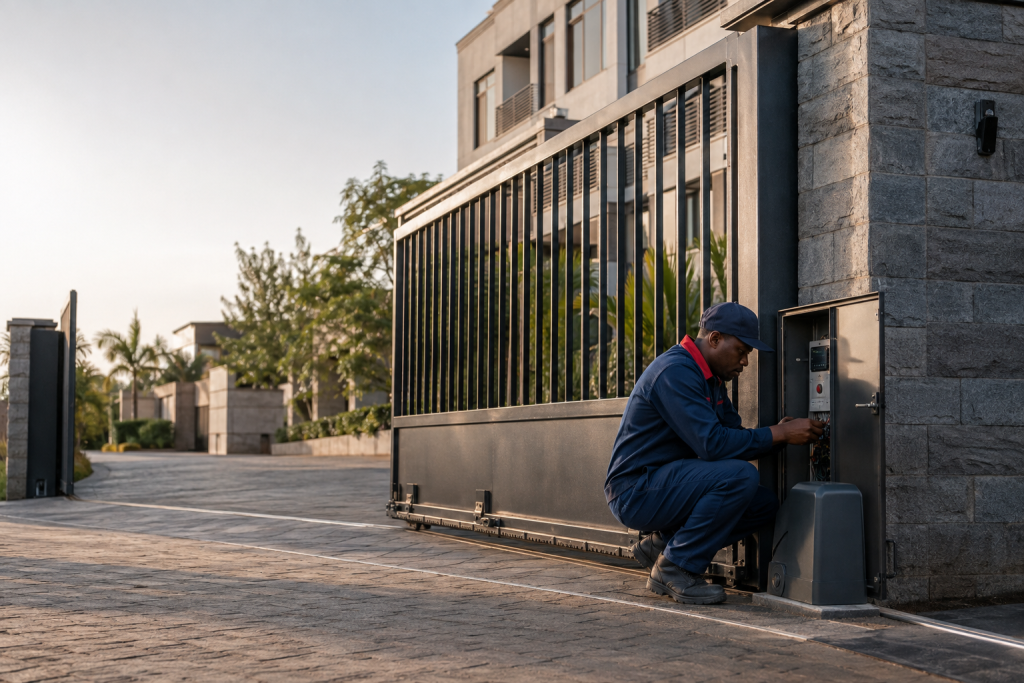
Gate automation Kenya projects work best when the motor, gate structure, power supply, safety devices and access method are designed as one system. A powerful motor cannot correct a gate that drags, a weak foundation or an unsafe entrance layout. The right starting point is therefore a site survey—not a motor model.
This guide explains the decisions that homeowners, apartment managers, schools, warehouses and commercial facilities should make before requesting an automatic-gate quotation from ZES.
What a complete automatic gate system includes
A dependable installation is more than a remote control. The scope may include a sliding or swing gate, motor and control board, mechanical stops, photocells or other obstacle-detection devices, warning indicators, manual release, backup power, remotes, intercom or access-control credentials, and documented user training. The exact combination depends on the property and how the entrance operates.
- Gate and hardware: a straight, balanced structure with suitable hinges, wheels, rack, track or guide system.
- Drive system: a motor sized for the gate’s measured weight, movement, wind exposure and expected daily cycles.
- Safety layer: physical stops, obstacle detection, safe closing logic and a clear pedestrian route.
- Power and continuity: protected electrical supply, earthing where required, battery backup options and a manual-release procedure.
- Access method: remotes, keypad, card, intercom, mobile credential, guard control or another approved workflow.
Sliding gate or swing gate?
A sliding gate travels sideways along the boundary. It can suit entrances where driveway depth is limited, but it needs adequate run-back space and a well-prepared track or cantilever arrangement. A swing gate needs clear opening arcs and strong, correctly aligned posts. It can suit a level driveway with enough internal clearance.
The decision should consider slope, drainage, wind loading, available space, traffic flow and the condition of the existing gate. Read the focused guides to sliding gate motors in Kenya and swing gate automation in Kenya before selecting a mechanism.
Seven questions the site survey should answer
- Does the gate move smoothly by hand across its entire travel?
- Are the posts, hinges, wheels, track, guides and stops structurally suitable?
- What is the gate’s actual size and estimated weight?
- How many opening cycles are expected during the busiest hour and day?
- Where could a vehicle, person, animal or object enter the moving-gate zone?
- What happens during a power outage, emergency or equipment fault?
- Who should be allowed to open the gate, and how will visitors be handled?
Motor sizing should follow real operating conditions
Motor selection is not simply “small gate” or “large gate.” An installer should consider gate mass, friction, wind resistance, travel length, gradient and duty cycle. A lightly used home entrance has a different workload from an apartment driveway at morning peak or a warehouse receiving vehicles throughout the day.
Oversizing alone is not a substitute for correct mechanics. The gate should be repaired, aligned and tested before automation. ZES can survey the entrance and define the suitable equipment class in a scoped proposal.
Safety, pedestrians and emergency access
An automatic gate is moving machinery. The design should reduce trapping and impact risks, keep pedestrians away from vehicle movement where practical, and follow the selected manufacturer’s installation instructions. Safety devices must be positioned and tested for the real entrance—not added as decoration.
Users should know how to isolate the system and operate the manual release. Property managers should also document emergency access and egress, especially at apartments, schools and workplaces. No access-control device should create an unsafe evacuation route.
Power outages, rain and Kenyan site conditions
Local conditions can expose gate equipment to dust, rainwater, lightning activity, voltage variation and outages. Good planning considers drainage around the track and motor base, weather-resistant equipment placement, cable protection, suitable electrical protection and a realistic backup-power strategy. A battery may support a limited number of cycles; the expected performance must be confirmed for the chosen system and site.
Remote control, intercom or managed access?
For a private home, coded remotes may be sufficient. Apartments often need resident credentials plus visitor confirmation. Commercial premises may require staff roles, guard control, event records or integration with intercom, CCTV or vehicle-recognition workflows. For the integration decisions, see the access control gate system guide.
What affects a gate automation quotation?
Price depends on the existing gate condition, motor class, civil and electrical works, safety devices, access method, backup requirements, cabling distance and commissioning scope. A quotation should make inclusions, exclusions, equipment assumptions and handover items clear. A low equipment-only figure may exclude the work needed to make the entrance reliable.
Maintenance after installation
Keep the track and movement zone clean, report unusual noise or slow travel early, protect remotes and credentials, and arrange periodic inspection based on usage and the manufacturer’s guidance. Maintenance should check mechanical wear, fixings, safety responses, backup condition and manual release—not merely add lubricant.
Frequently asked questions
Can an existing manual gate be automated?
Often yes, provided the gate, posts, track, hinges and foundations are suitable or can be repaired. A survey is needed before equipment is selected.
Can the gate work when power is off?
Depending on the selected system, battery backup or another continuity arrangement may be possible. Every installation should also have an accessible, controlled manual-release procedure.
Can gate automation connect to access control?
It can be designed to work with approved remotes, intercoms, cards, keypads, mobile credentials or other controllers, subject to compatibility and the agreed security workflow.
Request a site-based gate automation proposal
Share the property type, location, gate dimensions, current gate condition, estimated daily traffic, preferred access method and power situation. Request a scoped quotation from ZES so the recommendation can be based on the actual entrance.