
Updated 3 November 2026 · Zama Engineering Systems buyer guide
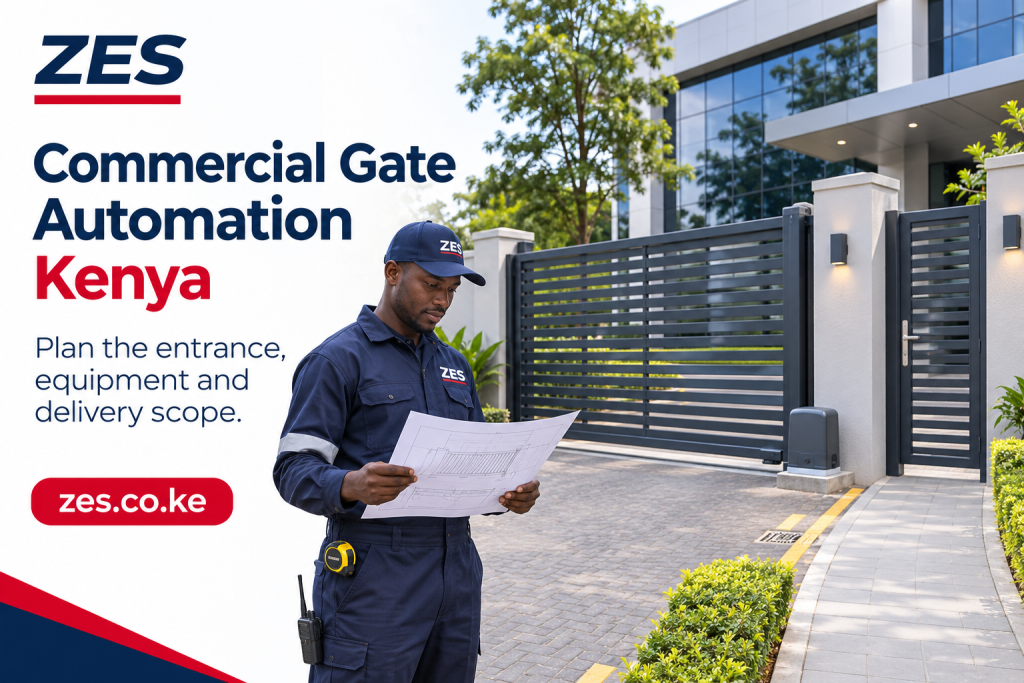
Commercial Gate Automation Kenya projects should define staff, visitors, deliveries and pedestrian movement before controls and equipment are selected. A business entrance is an operating arrangement supported by automation. This section extends the established commercial gate guide with a clearer scope, interface and acceptance process for assessed project enquiries.
Map the business entrance journeys
Describe the people and vehicles arriving during normal and busy periods. Identify who approves visitors and deliveries and what happens when the usual contact is unavailable. Include pedestrian routes and other relevant site movements. The responsible team should assess the actual entrance, not assume that copying a neighbouring business's gate gives an equivalent result. A useful brief explains decisions as well as traffic.
Commercial Gate Automation Kenya: assign delivery roles
Name the parties responsible for gate construction, supports, power, automation and connected services. The competent assessment should establish suitability and relevant safety arrangements. Record which information each supplier needs before procurement. A general integration promise should become a defined supported interface with an acceptance party. This prevents several individually supplied products leaving an unresolved combined operating procedure.
Specify user controls and administrative ownership
Confirm how staff, reception, guards or other authorised users interact with the entrance. Visitor systems and remote controls should fit the actual process. State who manages accounts, permissions and lost access where relevant. Include licensing or recurring charges in the proposal. Do not assume every operator can exchange information with every access or visitor platform simply because both products are described as smart.
Commission the agreed operational functions
The responsible parties should establish relevant gate and control checks and demonstrate the agreed end-to-end functions. Provide equipment records, user instruction and support contacts. Record remaining work and limitations. Review the arrangement when tenants, traffic or access responsibilities change. A professional handover explains what was supplied and who maintains it rather than promise that the installation will accommodate every future business change.
Compare the supplied scope
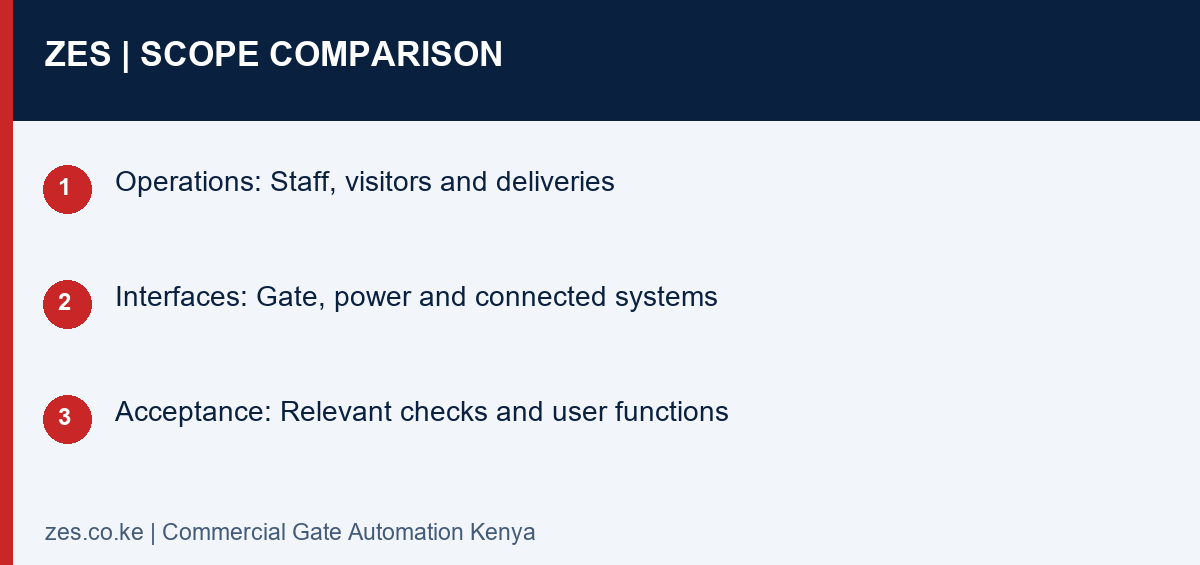
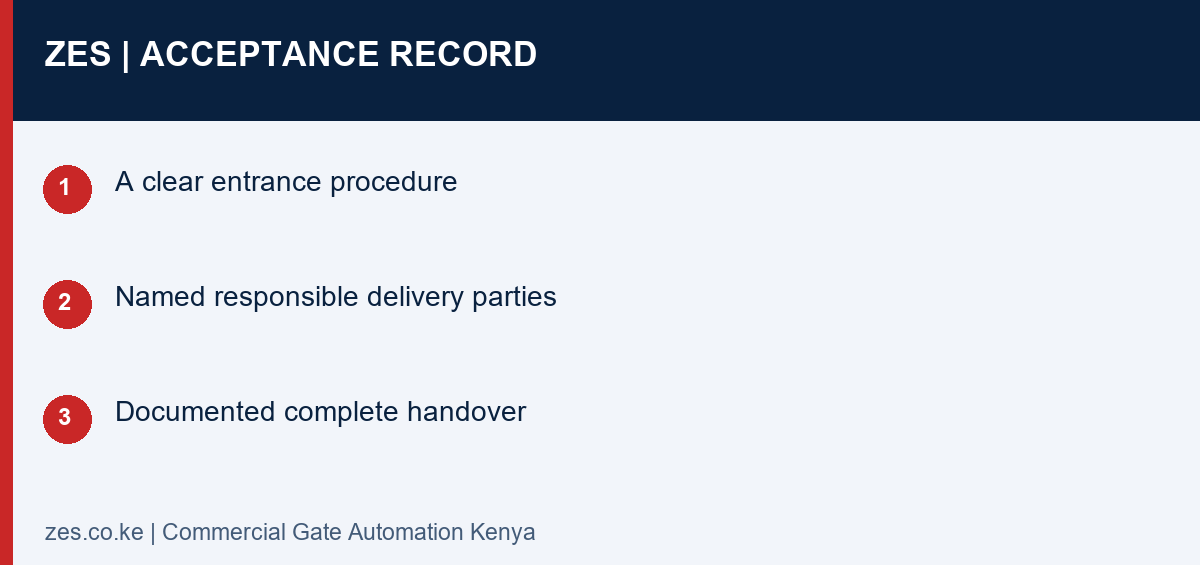
| Decision | Information to confirm | Useful result |
|---|---|---|
| Operations | Staff, visitors and deliveries | A clear entrance procedure |
| Interfaces | Gate, power and connected systems | Named responsible delivery parties |
| Acceptance | Relevant checks and user functions | Documented complete handover |
A practical planning example
A business may need reception to approve visitor entry while a separate team manages deliveries. Defining those roles before equipment selection helps the proposal address the actual operation. This is a hypothetical business-planning example.
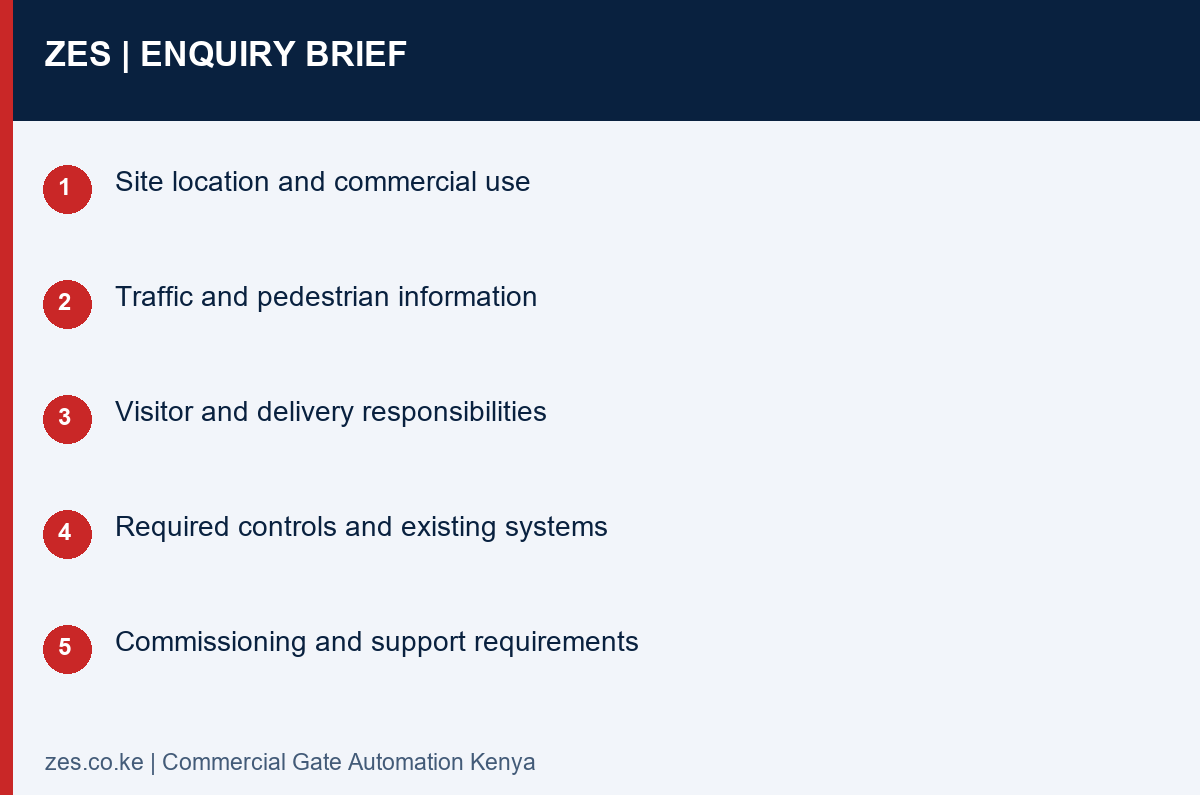
Commercial Gate Automation Kenya: enquiry checklist
- Site location and commercial use
- Traffic and pedestrian information
- Visitor and delivery responsibilities
- Required controls and existing systems
- Commissioning and support requirements
Questions before arranging work
Does one commercial package suit every business?
No. Site geometry, duty, users, interfaces and relevant requirements need assessment.
Can access-control integration be included?
Describe the required functions and existing products so supported interfaces, responsibilities and commercial scope can be confirmed.
Discuss the gate requirement with ZES
Read the related ZES gate project guide and explore the service categories. Share the location, equipment information and intended outcome. ZES confirms the appropriate assessment, availability, proposed delivery responsibilities and commercial terms for the actual enquiry.
Request a scoped quotation · Request a site assessment · Call +254 725 345 345
Technical background: HSE powered-gate technical background (UK). This background does not establish Kenyan legal requirements for a particular project. Use the actual product instructions and appropriate project-specific advice.
More detailed project planning
Commercial entrances operate under pressure. Staff arrive in waves, visitors need verification, deliveries queue, and security teams must balance throughput with control. A residential gate scaled up is rarely the right answer. Commercial automatic gate systems must be engineered for traffic, durability, access control and integration.
This guide explains commercial automatic gate systems in Kenya, the gate types and duty cycles, how access control and visitor management work, the safety and pedestrian considerations, integration with CCTV and alarms, installation, maintenance, what affects cost, and how to choose a contractor.
It is written for facility managers, security managers, property managers, business owners and procurement teams.
Why Commercial Gates Differ
Commercial gates face demands that residential gates do not.
Higher traffic. Staff, visitors, deliveries and service vehicles pass through daily.
Longer operating hours. Gates may operate from early morning to late evening.
Duty cycle. Motors must handle frequent use without overheating.
Security requirements. Access must be controlled and recorded.
Visitor management. Visitors need verification and logging.
Pedestrian safety. Staff and visitors move on foot near vehicles.
Integration. Gates must work with CCTV, intercoms and alarms.
Reliability. A failed gate disrupts operations and security.
Support. Commercial sites need responsive maintenance.
These factors drive the design and equipment selection.
Gate Types for Commercial Sites
Different commercial entrances need different gates.
Sliding Gates
Reliable and space-efficient, sliding gates suit many commercial entrances. Cantilever systems avoid track problems.
Swing Gates
Swing gates suit entrances with clearance and lower traffic.
Barrier Gates
Boom barriers suit high-traffic entrances, parking and vehicle control, often with ticketing or access control.
Bi-fold Gates
Bi-fold gates suit tight spaces where a full run is unavailable.
Heavy-Duty Industrial Gates
Designed for factories, warehouses and high-security sites.
Pedestrian Gates and Turnstiles
Separate pedestrian access improves safety and control.
The gate type must match traffic, space and security.
Traffic and Duty Cycle
Commercial gates must handle usage.
Peak flows. Morning and evening peaks create queues.
Opening speed. Faster gates improve throughput but require safety.
Duty cycle. Motors must be rated for frequent use.
Queue management. Layout and access control should prevent congestion.
Separate lanes. Entry and exit separation improves flow.
Visitor lane. A dedicated visitor lane reduces delays for staff.
Delivery access. Deliveries may need a separate route or scheduling.
Emergency access. Fire and emergency vehicles must be able to enter.
Traffic planning is as important as the gate itself.
Access Control for Commercial Sites
Access control is central to commercial gates.
Staff credentials. Cards, tags, biometrics or mobile access.
Visitor management. Pre-registration, verification and temporary passes.
Vehicle tags. Long-range access for fleet and frequent users.
Intercoms. Audio or video verification.
ANPR. Number plate recognition for vehicle access.
Guard control. Manual override and verification.
Logging. Records of entries and exits.
Integration. With CCTV, alarms and time attendance.
Policy. Rules for issuing, changing and revoking access.
Access control should match the security risk and the traffic.
Visitor Management
Commercial sites need efficient visitor handling.
Pre-registration. Visitors register in advance and receive instructions.
Reception. Verification at reception or the gate.
Temporary credentials. Passes or codes with expiry.
Escorting. Visitors may be escorted in secure areas.
Logging. Entry and exit times recorded.
Delivery management. Deliveries logged and routed.
Contractor management. Contractors verified and supervised.
Integration. Visitor systems linked to access control and CCTV.
Good visitor management reduces queues and improves security.
Safety and Pedestrian Management
Commercial gates must protect people.
Pedestrian separation. Walkways and gates separate from vehicles.
Obstruction detection. Gates stop or reverse on contact.
Safety edges and photocells. Detect people and vehicles.
Warning lights and signage. Alert users to movement.
Speed. Gate speed balanced with safety.
Guard supervision. Guards manage traffic and safety.
Emergency release. Manual release for power failure.
Training. Staff and guards understand safe operation.
Incident reporting. Record and investigate incidents.
Pedestrian safety is a common weakness in commercial gate design.
Integration with CCTV and Security
Commercial gates work best as part of a security system.
CCTV at the gate. Cameras verify vehicles and people.
Video intercoms. See and speak to visitors.
Alarm integration. Alarms trigger gate closure or alerts.
Access control software. Manage users and logs.
Time attendance. Staff access linked to attendance.
Perimeter security. Electric fence, sensors and lighting.
Security room. Guards monitor and control access.
Recording. Events and footage support investigations.
Integration improves security and operational efficiency.
Power and Backup
Commercial gates need reliable power.
Mains power. Common but subject to outages and fluctuations.
Battery backup. Keeps gates operating during outages.
Solar power. Suitable for remote sites.
Surge protection. Protects controllers and motors.
Generator backup. For critical sites.
Manual release. Essential for emergencies.
Monitoring. Alerts for power and battery issues.
A power failure should not compromise security or access.
Installation Process
Professional installation follows a sequence.
1. Survey. Assess traffic, gates, power and security.
2. Design. Select gates, motors, access control and integration.
3. Quotation. Itemise equipment, labour, wiring and commissioning.
4. Civil works. Foundations, tracks, barriers and drainage.
5. Installation. Fit gates, motors, controls and safety devices.
6. Wiring and network. Power, control and connectivity.
7. Integration. Connect CCTV, intercoms and software.
8. Configuration. Set up users, permissions and schedules.
9. Commissioning. Test every device, credential and safety function.
10. Training and handover. Train guards and administrators; provide documentation.
Commissioning and training are critical on commercial sites.
Maintenance
Commercial gates need planned maintenance.
Servicing. Regular checks of motors, tracks, rollers and controls.
Safety testing. Test obstruction detection and release.
Access control reviews. Remove users who no longer need access.
Log reviews. Check for unusual activity.
Battery checks. For backup and solar systems.
Cleaning. Keep gate areas clear.
Spare parts. Keep critical spares available.
Response times. Choose a contractor with reliable support.
Records. Track maintenance and repairs.
Downtime affects security and operations, so maintenance is business-critical.
Compliance and Standards
Commercial gates are subject to safety and security expectations.
Workplace safety. Protect staff and visitors.
Fire and emergency access. Gates must allow emergency vehicles.
Electrical safety. Safe installation and protection.
Accessibility. Consider pedestrians and people with disabilities.
Data protection. Access logs and CCTV footage are personal data.
Insurance. Security measures may affect cover.
Signage. Warning signs on automated gates.
Compliance protects the business and its people.
What Affects Commercial Gate Cost
Cost depends on scale and specification.
Gate type and size. Sliding, swing and barrier gates differ in cost.
Motor rating and duty cycle. Heavy-duty motors cost more.
Access control. Cards, biometrics, intercoms and ANPR add cost.
CCTV integration. Cameras and recording add cost.
Civil works. Foundations, barriers and drainage add cost.
Power and backup. Generators, batteries and solar add cost.
Wiring and network. Long runs and connectivity add cost.
Installation complexity. Access and traffic constraints affect labour.
Maintenance. Ongoing servicing should be budgeted.
A good quotation itemises equipment, labour, integration and commissioning.
How to Choose a Commercial Gate Contractor
Use this checklist.
1. Do they understand commercial access? Traffic and security.
2. Do they specify duty ratings? Matched to usage.
3. Do they design access control? Users, visitors and integration.
4. Do they handle civil works? Foundations and barriers.
5. Do they integrate CCTV and intercoms? A complete system.
6. Do they provide a clear quotation? Itemised and transparent.
7. Do they commission and train? Guards and administrators.
8. Do they support the system? Maintenance and faults.
9. Do they have references? Comparable commercial sites.
10. Are they safe and compliant? Electrical and workplace safety.
Common Mistakes
Residential equipment on a commercial site. Early failure.
Undersized motors. Overheating and downtime.
Poor traffic planning. Queues and congestion.
Weak access control. Shared codes and unmanaged access.
No pedestrian separation. Safety risk.
No integration. Blind spots and manual processes.
No backup power. Lockouts during outages.
No maintenance. Unplanned downtime.
Skipping training. Guards and staff misuse the system.
Choosing on price alone. Cheap systems cost more.
Traffic Modelling and Peak Flow
Commercial gates must handle peaks, not averages.
Peak times. Staff arrival, shift changes, lunch and departure create surges.
Vehicles per minute. Estimate how many vehicles must pass at peak.
Gate cycle time. Opening and closing time determines throughput.
Lane configuration. Separate entry and exit lanes reduce conflicts.
Visitor lane. A dedicated visitor lane prevents staff queues behind verification.
Delivery windows. Schedule deliveries outside peak times where possible.
Guard speed. Manual verification takes time; pre-registration speeds it up.
Queue space. Ensure vehicles can queue without blocking the road.
Fail-safe. Have a plan for gate failure during peak.
Traffic modelling prevents bottlenecks before they happen.
ANPR and Vehicle Identification
Automatic number plate recognition adds convenience and control.
How it works. Cameras read number plates and compare them with a database.
Authorised vehicles. Known vehicles can enter automatically.
Visitor vehicles. Visitors can be pre-registered and recognised.
Logging. Every plate is recorded with time and direction.
Integration. ANPR links to access control, CCTV and visitor management.
Limitations. Poor lighting, dirty plates and unusual formats affect accuracy.
Backup. A manual process is needed when recognition fails.
Privacy. Plate data is personal data and must be protected.
ANPR suits sites with many known vehicles and high traffic.
Guard House and Security Room Integration
Guards need the right tools.
Control console. Gate controls, intercom and CCTV displays.
Override. Manual control for emergencies and exceptions.
Visitor logs. Paper or digital records.
Communication. Radios, phones and intercoms.
Monitoring. Screens for gate cameras and perimeter.
Lighting. Adequate lighting for verification.
Shelter. A comfortable guard house improves attention and retention.
Procedures. Clear instructions for access, visitors and emergencies.
Training. Guards must understand the system and its limitations.
Technology supports guards; it does not replace them.
Emergency Access and Fire Lane Requirements
Emergency access is a safety requirement.
Fire lane. Keep a clear route for fire engines.
Gate opening. Emergency services must be able to open the gate quickly.
Manual release. Accessible and clearly marked.
Override. Guards should have an emergency open procedure.
Power failure. Backup or manual release must allow access.
Signage. Mark emergency access points.
Coordination. Local fire requirements may apply.
Testing. Confirm emergency opening works during maintenance.
Emergency access should never be blocked by security design.
Multi-Site Gate Management
Organisations with several sites need consistency.
Standard systems. Common equipment simplifies support and spares.
Central management. Software can manage users and logs across sites.
Standard procedures. Consistent access rules and visitor handling.
Reporting. Compare activity across sites.
Maintenance. Coordinated servicing and response.
Procurement. Standard specifications and pricing.
Training. Consistent training for guards and administrators.
Escalation. Clear process for faults and incidents.
Multi-site standardisation reduces cost and complexity.
Frequently Asked Questions
What is a commercial automatic gate system?
A gate and automation system designed for business traffic, with higher duty cycles, access control, visitor management and integration with security systems.
How is a commercial gate different from a residential gate?
It handles more traffic, longer hours, stronger motors, access control, visitor management and integration with CCTV and alarms.
What access control options are available?
Cards, tags, biometrics, intercoms, ANPR, mobile access and guard control.
Can gates integrate with CCTV?
Yes. Cameras verify vehicles and people, and footage supports investigations.
How do you manage visitor access?
Through pre-registration, reception verification, temporary credentials and logging.
What happens during a power outage?
Battery backup, generator backup or manual release keep access available.
How often should commercial gates be serviced?
Regularly, based on usage. High-traffic gates need more frequent servicing.
Can emergency vehicles access the site?
Yes, with planning and manual release or emergency override.
Do you install barrier gates?
Yes. Barrier gates are common for parking and high-traffic vehicle control.
Do you work outside Nairobi?
Yes. Installation and support can be arranged across Kenya.
A Final Pre-Purchase Checklist
Before installing a commercial gate system, confirm the following. Make sure traffic and security requirements have been assessed. Check the gate type, motor duty rating and access control. Confirm the quotation itemises equipment, civil works, integration and commissioning. Ask about power and backup. Confirm safety and pedestrian management. Ask about training and maintenance. Check references. Finally, compare quotations against the same specification.
A contractor who explains these points clearly is usually the one worth trusting with a commercial entrance.
Conclusion
Commercial automatic gate systems in Kenya are security and access infrastructure. The difference between a smooth, secure entrance and a daily bottleneck is the traffic planning, the duty rating, the access control, the integration and the support.
If you are planning a commercial gate, start with the traffic and the security requirements. Then insist on the right equipment, proper integration, commissioning and maintenance.
ZES designs, installs, integrates and maintains commercial automatic gate systems for businesses, institutions and industrial sites across Kenya. If you would like a practical assessment and a clear, itemised quotation, start with a site survey.
Request a commercial gate survey and quotation from ZES
Related Gate Automation Services
Explore our full gate and access-control capability:
- Electric gate motor installation and repair
- Automatic gate installation
- Sliding gate motors
- Automatic swing gates
- Sliding and swing gate automation
- Gate access control systems
- Automatic driveway gates
- Solar powered automatic gates
- Automatic gate maintenance
- Automatic gate repair
- Gate welding and fabrication services