
Automatic Gate Motor Repair Kasarani — planning, quotation and owner guidance
When an automatic gate stops working, replacing the motor can seem like the quickest answer. It may be the right answer, but it should follow a diagnosis. A fault in the controls, power arrangement or gate movement can produce the same complaint: “the motor is not opening the gate.”
Automatic gate motor repair in Kasarani should therefore begin with the complete system. Zama Engineering Systems (ZES) helps customers organise an assessment and understand the proposed work before approving repairs or replacement equipment.
Automatic gate motor repair Kasarani: describe what happens
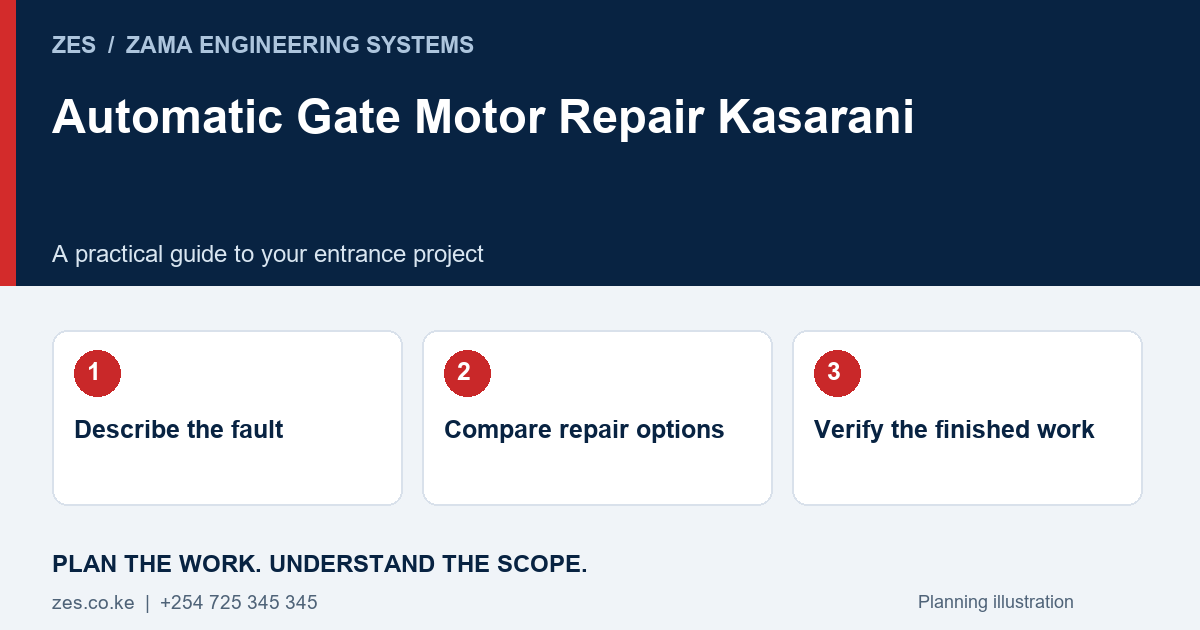
You do not need to identify the failed part before calling. You do need to explain what you observed.
Does the system give no response? Does it make a sound without normal movement? Does the gate travel partway, stop repeatedly or work for some users but not others? Record when the problem began and whether it is constant.
If operation is unpredictable or the gate is damaged, stop using it and keep the area clear. Do not repeatedly activate it to demonstrate the fault.
Why the motor is only one part of the assessment
The operator works with other components. A repair assessment may need to consider the gate’s mechanical movement, electrical provision, controls, protective devices and previous alterations.
| Reported symptom | Useful detail for the assessment |
|---|---|
| No response | Whether every normal control is affected |
| Starts then stops | Where movement stops and how often it occurs |
| Unusual sound | Whether the gate moves and when the sound began |
| Inconsistent operation | Conditions and timing of the failures |
| Fault returns after repair | Previous work and replaced components |
| Problem after an incident | What changed, without assuming it caused the fault |
These observations guide the investigation. They are not instructions to test electrical parts or bypass protection.
The ZES gate motor repair guide explains the value of separating operator problems from faults elsewhere in the entrance.
What information should you send ZES?
Start with your Kasarani location, contact person and current access situation. Include the gate type and equipment model if it can be identified safely from existing records or a visible label.
A short description is often more useful than several unexplained photographs. For example, “the gate opens normally from the guard’s control but not from one remote” gives a clearer starting point than “the motor is dead.” This is an illustrative report, not a diagnosis.
Provide previous invoices or service notes where available. They can show which components have already been changed and whether the current symptom resembles an earlier problem.
When a repair may be appropriate
A repair can make sense when the fault is identified, suitable parts or corrective work are available, and the remaining installation is serviceable. The proposal should explain what will be done and the expected result.
Ask whether the quotation covers diagnosis and repair together or whether assessment is a separate stage. If further tests are needed, agree how additional work will be approved.
A limited repair should also have clear boundaries. It may address the reported fault without renewing unrelated components. Understanding that distinction prevents unrealistic expectations about the whole system.
When to consider motor replacement
Replacement may be worth considering when the assessed condition, parts support, compatibility or changed operating requirement makes repair less suitable. The recommendation should explain the reason.
Compare the replacement as a complete installation. Will the existing controls work with it? Is the base suitable? Does the gate need mechanical correction? Are new remotes or electrical changes included?
A replacement that leaves an unresolved gate problem can be an expensive disappointment. Ask the supplier to explain how the proposed work addresses both the reported fault and the requirements of the new equipment.
Compare the options side by side
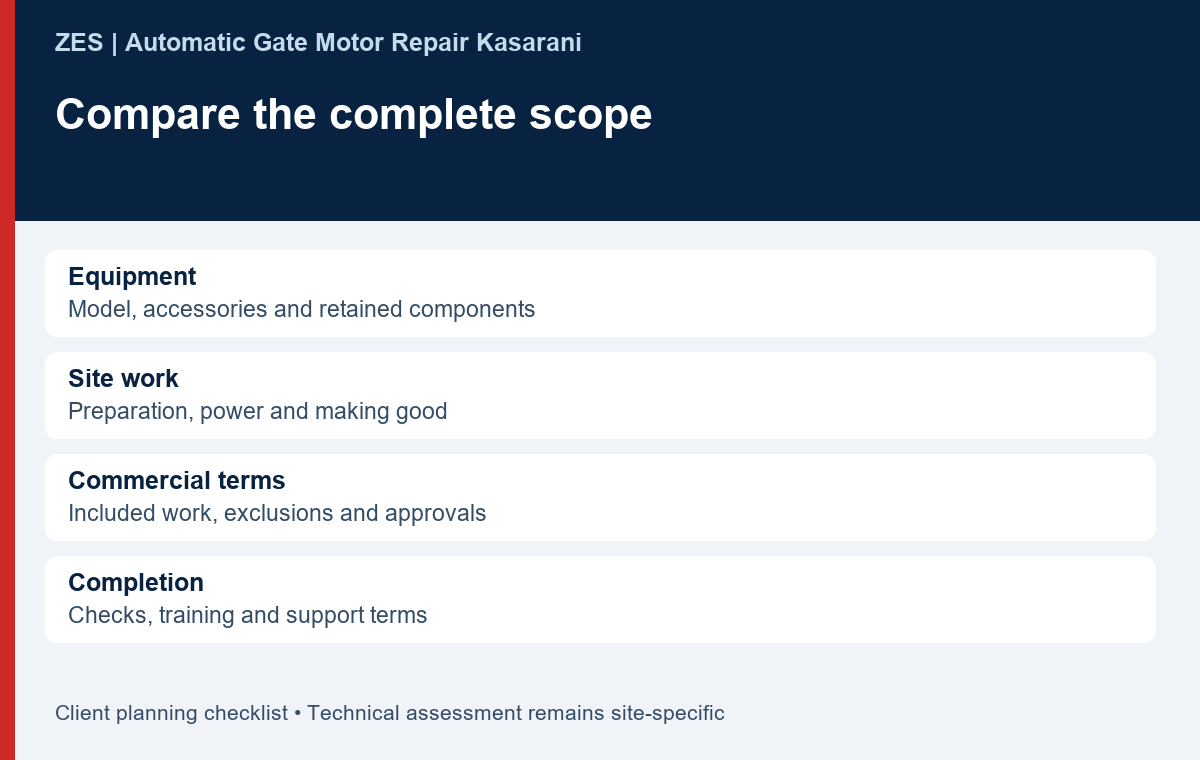
Request a written comparison where repair and replacement are both viable. It should identify:
- The equipment and labour included in each option.
- Which existing components remain.
- Any preparation or compatibility changes.
- Confirmed parts availability and the proposed work schedule.
- The actual support terms and known limitations.
This helps you make a decision based on the delivered result rather than the price of one component.
Recurring faults deserve a better explanation
If the gate repeatedly fails, avoid treating each incident as unrelated. Keep a simple service history with dates, symptoms and work performed.
Ask whether the latest assessment explains why the problem returns. The answer may require further investigation, and that uncertainty should be stated rather than hidden behind a confident parts recommendation.
Do not request higher force settings or bypassed sensors as a shortcut. Repair work should restore the appropriate operation of the installation.
Questions customers ask
Does a humming motor need replacement?
The sound alone does not establish the cause. Stop repeated attempts and report the behaviour for assessment.
Can you quote from a photograph?
A photograph can help identify equipment and visible conditions. A final repair scope may still require inspection and testing.
How should a completed repair be checked?
The agreed operation and relevant protective functions should be verified professionally. Ask for a work record and any outstanding recommendations.
Are parts available for every model?
Availability must be confirmed for the actual equipment. Send the model information early so it can be considered when planning the work.
Seven easy checks before approving gate motor repair
These checks help you assess the proposed work and communicate useful information. They are not electrical troubleshooting instructions. Internal inspection and technical testing belong with a competent technician using the actual equipment documentation.
1. Describe the operating behaviour precisely
Record whether the gate gives no response, makes a sound without normal travel, stops partway or works inconsistently. Note which normal control was used and whether other users reported the same behaviour.
Avoid turning a symptom into a diagnosis. A gate motor that appears inactive may not be receiving the expected command, while a movement problem can have a mechanical cause. Assessment is needed to establish the fault.
If the gate is unstable or behaves unpredictably, stop repeated attempts and keep people away. Do not create a dangerous situation to obtain better evidence.
A concise, accurate report helps the motor repair discussion. It gives the technician a starting point without pushing the assessment toward a replacement part chosen before the system has been checked.
2. Identify the equipment without exposing yourself to risk
Find the model in an invoice, manual or earlier service record. A visible label can be photographed only if it is safely accessible with the equipment stationary.
Do not remove covers or reach into the mechanism for identification. The gate motor enclosure may not tell the whole story anyway; an installation can include separate controls or later alterations.
If the model is unknown, say so and provide an overall photograph from a safe position. The technician can establish the equipment during assessment.
Collect previous repair information where available. Knowing which parts were changed and when helps the assessor understand the current system. A motor repair proposal should relate to the actual installation rather than a generic picture of a similar-looking unit.
3. Review the fault history before ordering parts
Write a short timeline showing when the problem began and whether it is constant or intermittent. Include recent service, impacts, construction work and power interruptions as context.
If the gate motor worked normally between incidents, record that. Intermittent behaviour can be important to an assessment, even when the gate happens to operate on the day of the visit.
Attach earlier work records rather than relying only on memory. The technician should know whether the current symptom resembles a previous complaint and what action was taken then.
Do not assume a recurring fault proves that every earlier repair was incorrect. Ask what further investigation is needed. A useful motor repair recommendation explains the present findings and their relationship to the history, including any uncertainty that remains.
4. Ask what the diagnosis establishes
The assessment should identify what has been checked and what findings support the recommended work. If a component is suspected but not confirmed, that distinction should be visible.
Ask whether the quote covers a complete diagnosed repair or one stage of investigation. Agree the charge and approval process for additional testing before work expands.
For a shared property, name the person who can authorise expenditure. If that person is not on site, arrange how the technician communicates the findings and options.
A clear diagnosis does not need to overwhelm the owner with technical language. It should explain why the proposed gate motor work is appropriate, what it is intended to restore and which parts of the installation remain outside the scope.
5. Compare repair and replacement as complete options
Where both options are viable, request a comparison that includes parts, labour, supporting work and commissioning. A replacement gate motor may require changes to controls, mounting or electrical provision.
For the repair option, identify retained components and any known limitations. For replacement, ask why the new equipment is suitable and which existing accessories can remain.
Confirm actual parts availability and the proposed work sequence. Do not assume an online product listing establishes stock for the specific model or immediate attendance.
Motor repair is not automatically the best choice because its initial price is lower, and replacement is not automatically better because the unit is new. The decision should follow the assessed condition, explained scope and practical outcome. Written support terms belong in that comparison.
6. Agree how the repaired system will be checked
Before normal use resumes, the responsible technician should verify the agreed operation and relevant protective functions through appropriate procedures. Ask for a demonstration of user controls and any changed instructions.
Do not test an uncertain response with a person or vehicle in the gate’s path. Technical checks should use appropriate methods and equipment.
If the motor repair changes remotes, settings or other access functions, make sure authorised users understand the new arrangement. Keep administration under the responsible property contact’s control.
Record the work completed, the components changed and any outstanding recommendation. The completion record should distinguish a demonstrated result from an assumption that the entire installation is now renewed. This is especially useful where a gate motor repair retains older accessories or supporting components.
7. Keep the next service enquiry connected to this one
Store the diagnosis and work record with the equipment details. Include dates, service contacts and the actual terms covering the supplied work.
If a symptom returns, describe what happened after the repair and when the problem reappeared. That history helps the next assessment avoid starting from an incomplete description.
Keep records of access changes separate from technical service information. General documents should not expose codes or credentials. The responsible owner should still know who manages those details.
Report changes in movement, impacts or unusual noise rather than making undocumented adjustments. A gate motor is part of a maintained entrance system. Clear reporting and records make future motor repair decisions more informed and help distinguish repeated symptoms from unrelated new faults.
Reading a repair quotation line by line
Begin with the stated diagnosis. Does the proposal name the problem that the assessment identified, or does it only list a replacement component? Ask for clarification where the connection is unclear.
Next, check supplied parts and labour. Confirm whether assessment, transport, testing and a return visit are included. Identify taxes, exclusions and any provisional work.
Then review retained equipment. If the proposed motor repair leaves other components in place, understand their assessed condition and any limitations. If an upgrade is recommended separately, have it listed as a distinct decision.
Finally, confirm the approval process for changes. The quotation should give the property a clear instruction to authorise, not an open-ended commitment to whatever work might later be considered useful.
An illustrative repair-versus-replacement discussion
Suppose an owner receives one proposal to repair a diagnosed component and another to install a new gate motor with replacement controls. The totals are different because the scopes are different.
The owner should ask what each option resolves, which equipment remains and whether additional preparation is required. The repair provider should explain its boundaries; the replacement provider should justify the wider work.
This is a hypothetical comparison, not a diagnosis or a completed ZES job. Its purpose is to show why a component price cannot settle the whole decision.
The better choice is the one supported by the actual assessment and the owner’s requirements. A clear comparison can prevent unnecessary replacement while also recognising situations where a limited motor repair would not achieve the intended result.
What to do if the gate is the only vehicle entrance
Explain that constraint when enquiring. The site contact and technician need to discuss access arrangements and the conditions for carrying out the assessment.
Do not assume that a gate motor can be released or moved safely simply because a key is available. The documented procedure and the gate’s condition both matter. A damaged or unstable structure needs appropriate professional handling.
Tell affected users which temporary arrangement applies and who is coordinating updates. Avoid promising a completion time before the work and parts have been confirmed.
These practical decisions help the motor repair visit proceed with a clearer scope. They also reduce confusion for the people who rely on the entrance while the fault is being investigated.
Prepare an equipment and service folder
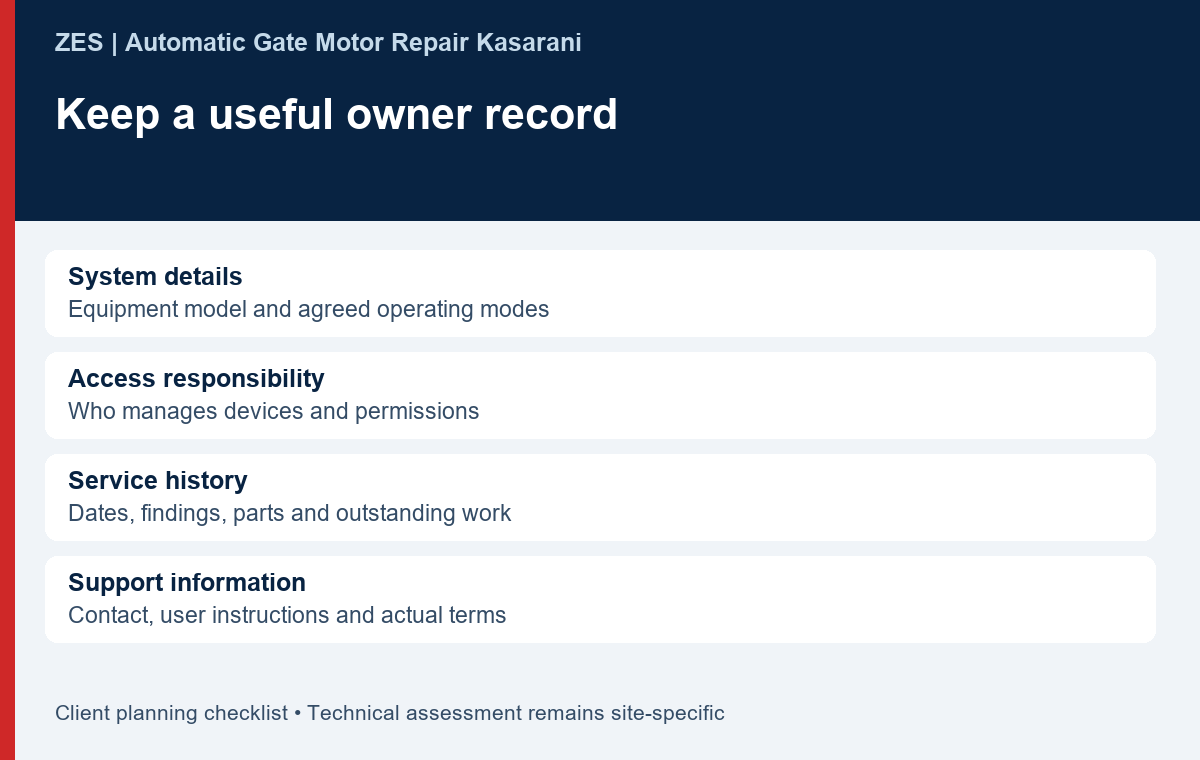
Keep the gate motor model, installation information, user instructions and previous work records together. Add the current repair report when the job is completed.
The folder can be digital or printed, provided the responsible contact can find it. Store security-sensitive credentials separately and limit access to authorised people.
Include a short list of the normal user controls and the person who administers them. If equipment or permissions change later, update the record rather than leaving several conflicting versions.
Good documentation does not eliminate faults. It makes the next assessment easier to organise and gives the owner a better basis for approving work. It is a practical part of owning an automatic entrance rather than an optional technical extra.
Make the repair record easy to understand
Ask for a short summary that separates the reported symptom, assessment finding and work completed. Those are different pieces of information and should not be combined into a vague note saying “gate motor fixed.”
Include the identity of any replaced component and whether other recommendations remain outstanding. Keep the date and service contact with the record.
If another provider later assesses the entrance, share the relevant history. The previous motor repair report can help explain what changed, but the new technician still needs to establish the present condition.
When users report a later problem, compare the observed behaviour with the earlier record. Describe similarities without assuming the cause is identical. A gate motor can experience different faults that look similar to the person operating the entrance.
This straightforward documentation helps the owner approve future work with better information. It also gives the service provider a clearer starting point than an isolated photograph or a general claim that the equipment has “always had problems.”
Request a Kasarani motor repair assessment
Send ZES the fault description, location and available equipment details. Tell us who can authorise the work and how the property is currently managing access. Request a repair quotation or call +254 725 345 345 to discuss the next step.
Further reading: HSE powered-gate safety guidance explains why the complete installation needs assessment. This is UK technical background, not a statement of Kenyan legal requirements.
Gate Automation Kasarani: describe shared entrance demand
Gate Automation Kasarani proposals should reflect the actual entrance and its use. For a shared property, explain the busiest periods, visitor arrangements and pedestrian access. Nominate who will approve equipment, manage controls and accept handover.
Keep a record of the installed operator and relevant accessories. If occupancy or the access arrangement changes, mention it during an assessment. Suitability depends on the equipment and operating requirement, not simply the number of households.
Automatic Gate Repair Kasarani: report intermittent behaviour
For Automatic Gate Repair Kasarani, a dated record of observed behaviour can be more useful than a guessed diagnosis. State which control was affected, what the gate did and whether the issue is consistent. Include the current gate position and effect on access.
Do not repeatedly cycle an abnormal gate for evidence or bypass protective provisions to keep it operating. Follow the installed-system instructions and seek assistance if the temporary access arrangement is unclear.
Ask the technician to document the finding, proposed work and any compatible parts required. The property manager should approve the scope and retain the final service report. Where replacement is recommended, compare the full installation scope and retained items. Read gate automation for apartments for shared-property planning, then request a quotation with the relevant records.