
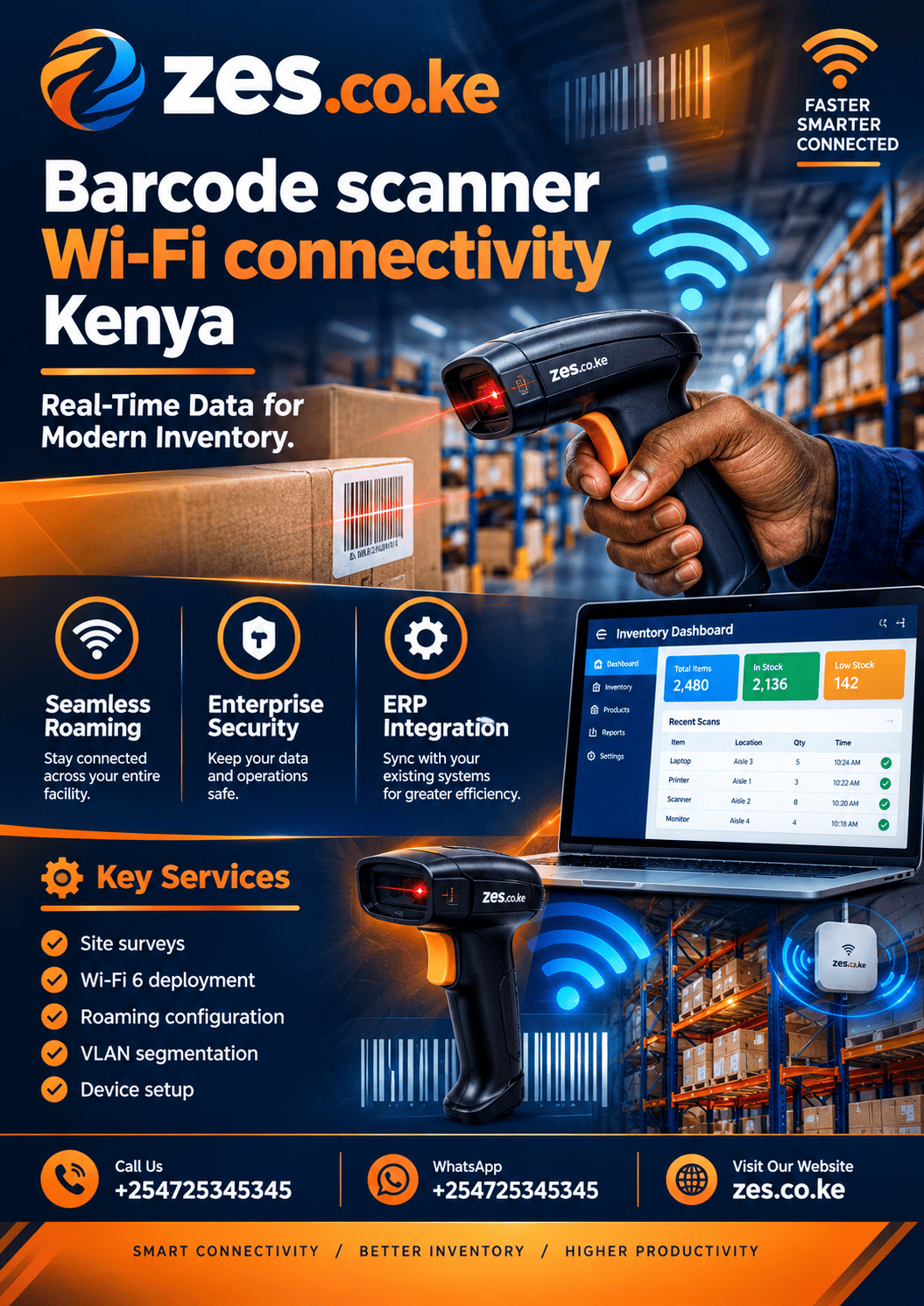
Barcode scanner Wi-Fi connectivity Kenya represents a critical technological leap for businesses seeking to eliminate manual data entry, reduce errors, and achieve real-time inventory visibility. At zes.co.ke, we understand that the modern warehouse, retail floor, or manufacturing plant cannot function efficiently with tethered scanners or batch-processing devices.
Deploying barcode scanner Wi-Fi connectivity Kenya allows your staff to scan items anywhere in the facility, instantly transmitting data to your central ERP or inventory management system.
When evaluating barcode scanner Wi-Fi connectivity Kenya, organizations must look beyond the hardware itself and assess the underlying wireless network. A weak or poorly designed Wi-Fi network will cause scanners to drop connections, leading to lost scans and frustrated employees.
At zes.co.ke, we specialize in deploying barcode scanner Wi-Fi connectivity Kenya that is robust, secure, and specifically engineered for high-density industrial environments.
The transition to barcode scanner Wi-Fi connectivity Kenya transforms inventory management from a reactive, delayed process into a proactive, real-time operation.
To achieve seamless barcode scanner Wi-Fi connectivity Kenya, businesses must utilize enterprise-grade access points capable of handling seamless roaming. When a worker walks from the receiving bay to the storage racks, the scanner must switch access points without dropping the connection.
Investing in barcode scanner Wi-Fi connectivity Kenya also requires careful attention to cybersecurity. Scanners transmit sensitive inventory data; therefore, the Wi-Fi network must use WPA3 encryption and VLAN segmentation to protect this information.
The implementation of barcode scanner Wi-Fi connectivity Kenya is particularly valuable in large warehouses where metal racking blocks cellular signals but can be overcome with well-placed internal Wi-Fi access points.
Optimal barcode scanner Wi-Fi connectivity Kenya relies on a site survey to map dead zones and ensure that every aisle has sufficient signal strength for the handheld devices.
By implementing barcode scanner Wi-Fi connectivity Kenya, companies can integrate their point-of-sale (POS) systems with their back-end accounting software, ensuring that every sale instantly updates stock levels.
Enterprise-grade barcode scanner Wi-Fi connectivity Kenya solutions support multiple devices simultaneously without latency, allowing entire teams to conduct stock-taking exercises in hours rather than days.
Reliable barcode scanner Wi-Fi connectivity Kenya is the backbone of modern logistics, enabling real-time pick, pack, and ship operations that meet the demands of e-commerce.
Secure barcode scanner Wi-Fi connectivity Kenya ensures that rogue devices cannot intercept your operational data, protecting your competitive advantage.
Advanced barcode scanner Wi-Fi connectivity Kenya supports IoT integration, allowing scanners to communicate directly with smart shelving and automated conveyor systems.
Expert barcode scanner Wi-Fi connectivity Kenya deployment involves configuring the scanners to prioritize the corporate Wi-Fi network and fall back to cellular data only when necessary.
Comprehensive barcode scanner Wi-Fi connectivity Kenya services include not just the installation of access points, but also the configuration of the scanners’ roaming thresholds and power-saving settings.
The hardware for barcode scanner Wi-Fi connectivity Kenya typically includes handheld terminals, ring scanners, and mobile computers. These devices must be ruggedized to withstand drops, dust, and moisture.
According to industry leaders like Zebra Technologies, barcode scanner Wi-Fi connectivity Kenya solutions must be paired with devices that feature fast processors and advanced antennas to maintain a strong link.
Furthermore, Honeywell highlights that barcode scanner Wi-Fi connectivity Kenya must utilize modern 802.11ac or Wi-Fi 6 standards to handle the high bandwidth requirements of modern applications.
Global standards from GS1 dictate the barcode formats that are read, ensuring that barcode scanner Wi-Fi connectivity Kenya systems can interpret and transmit data accurately across the supply chain.
The Wi-Fi Alliance provides certifications for barcode scanner Wi-Fi connectivity Kenya, ensuring that devices are interoperable and secure.
For a deeper technical understanding of how these devices function, Wikipedia’s article on barcode scanners provides a comprehensive overview of the technology behind barcode scanner Wi-Fi connectivity Kenya.
The technical nuances of barcode scanner Wi-Fi connectivity Kenya involve managing latency. If the network is slow, the scanner will take longer to beep, slowing down the operator.
A professional site survey is the most important step in deploying barcode scanner Wi-Fi connectivity Kenya. You must map the racking to determine how metal and dense inventory will affect signal propagation.
Why Real-Time Data Matters
The primary advantage of barcode scanner Wi-Fi connectivity Kenya is real-time data transmission. In a traditional batch scanning environment, workers scan items throughout the day and then dock the scanner at the end of the shift to upload the data. This creates a massive lag in inventory visibility.
With barcode scanner Wi-Fi connectivity Kenya, the moment an item is scanned in the receiving bay, the ERP system knows it is available for sale or picking. This real-time visibility is critical for businesses with high turnover or complex supply chains.
Hardware Selection for Wi-Fi Scanners
Choosing the right hardware is crucial for maximizing the benefits of barcode scanner Wi-Fi connectivity Kenya. Not all scanners are built to handle the rigorous demands of continuous Wi-Fi transmission.
Handheld Scanners: These are the most common devices. They offer a balance of mobility and ergonomics. For barcode scanner Wi-Fi connectivity Kenya, handhelds must have batteries that last a full 8 to 12-hour shift while maintaining the Wi-Fi radio.
Ring Scanners: These are worn on the finger, leaving both hands free for picking and packing. For barcode scanner Wi-Fi connectivity Kenya, ring scanners drastically improve productivity in high-volume fulfillment centers.
Mobile Computers: These devices combine a scanner with a full-screen computer, allowing staff to view inventory dashboards and receive complex instructions. Effective barcode scanner Wi-Fi connectivity Kenya ensures these mobile computers stay connected to the central server for real-time task updates.
Designing the Wireless Infrastructure
You cannot achieve reliable barcode scanner Wi-Fi connectivity Kenya without a properly designed wireless network. Standard office Wi-Fi is rarely sufficient for industrial environments.
Warehouses and manufacturing plants are filled with metal racking, which reflects Wi-Fi signals and creates dead zones. To achieve flawless barcode scanner Wi-Fi connectivity Kenya, access points must be strategically placed within the aisles, not just on the ceiling.
Furthermore, the network must be configured to handle seamless roaming. When a worker moves from one aisle to the next, their device must switch access points instantly. A delay of even a few seconds can cause the scanner to disconnect, requiring the worker to log in again.
Security in Wireless Scanning
Security is a major concern when deploying barcode scanner Wi-Fi connectivity Kenya. An unsecured network allows malicious actors to intercept inventory data or inject false information into the ERP system.
To secure barcode scanner Wi-Fi connectivity Kenya, we implement robust WPA3 enterprise encryption. We also use VLANs (Virtual Local Area Networks) to segregate the scanner traffic from the guest Wi-Fi and the corporate office network.
{{VIDEO_EMBED: Insert a 2-minute video here showing a worker using a Wi-Fi barcode scanner in a warehouse aisle, demonstrating real-time data transmission to a laptop screen showing a live inventory dashboard.}}
Integrating with ERP and WMS
The true power of barcode scanner Wi-Fi connectivity Kenya is unlocked when the data integrates seamlessly with your software. We ensure that the scanners communicate directly with your Warehouse Management System (WMS) or Enterprise Resource Planning (ERP) platform.
This integration allows for:
-
Automated Stock Updates: Every scan instantly updates the inventory database.
-
Guided Picking: The system directs the worker to the exact location of the item, scanning verifies they picked the correct product.
-
Error Reduction: If a worker scans the wrong item, the barcode scanner Wi-Fi connectivity Kenya system sounds an error tone, preventing a mis-pick.
Common Challenges and Solutions
Even with a good design, barcode scanner Wi-Fi connectivity Kenya can face challenges. One common issue is Wi-Fi interference from other devices, such as microwave ovens or cordless phones.
To resolve this, we conduct a spectrum analysis during the site survey. This helps us choose the best channels for the barcode scanner Wi-Fi connectivity Kenya deployment, avoiding congested frequencies.
Another challenge is battery drain. Continuous Wi-Fi transmission drains batteries faster than batch mode. We mitigate this by implementing power-saving protocols, ensuring that the barcode scanner Wi-Fi connectivity Kenya devices remain operational for a full shift.
The Installation and Configuration Process
Our process for barcode scanner Wi-Fi connectivity Kenya begins with a wireless site survey. We walk the entire facility, using professional tools to measure signal strength and identify interference.
Next, we install enterprise-grade access points, ensuring they are mounted securely and connected to PoE (Power over Ethernet) switches. We configure the network controllers for optimal barcode scanner Wi-Fi connectivity Kenya, prioritizing traffic from scanning devices.
Finally, we configure the scanners themselves. We set the roaming thresholds, configure the security certificates, and test the devices under real-world conditions to ensure flawless performance.
Applications Across Kenyan Sectors
The demand for barcode scanner Wi-Fi connectivity Kenya spans multiple industries.
Retail Supermarkets: Store managers use barcode scanner Wi-Fi connectivity Kenya for rapid price changes, shelf-edge stock checks, and fast-moving checkout lanes.
Logistics and Distribution: Large warehouses rely on barcode scanner Wi-Fi connectivity Kenya to orchestrate complex pick-and-pack operations for thousands of daily orders.
Manufacturing: Factory floors use barcode scanner Wi-Fi connectivity Kenya to track raw materials, work-in-progress, and finished goods, ensuring accurate costing and quality control.
Healthcare: Hospitals use barcode scanner Wi-Fi connectivity Kenya to track medical supplies, equipment, and patient wristbands, improving patient safety.
Maintenance and Support
Maintaining a reliable wireless network is an ongoing task. The demand for barcode scanner Wi-Fi connectivity Kenya fluctuates as your business grows. We offer ongoing support to ensure your network scales with your needs.
Our maintenance contracts include regular Wi-Fi health checks, firmware updates for the scanners, and troubleshooting support. We ensure your barcode scanner Wi-Fi connectivity Kenya infrastructure remains fast and reliable.
Cost Considerations
While specific pricing is not provided here, the investment in barcode scanner Wi-Fi connectivity Kenya depends on the size of the facility, the number of access points required, and the complexity of the ERP integration.
The return on investment for barcode scanner Wi-Fi connectivity Kenya is typically realized through reduced labor costs (faster stock-taking) and reduced inventory holding costs (better accuracy).
Frequently Asked Questions
Q: Can any barcode scanner connect to Wi-Fi?
A: No. You must specifically purchase scanners equipped with a Wi-Fi radio. Standard USB or Bluetooth scanners cannot connect to a corporate Wi-Fi network.
Q: How many access points do I need?
A: The number depends entirely on the square footage, ceiling height, and racking density. A professional site survey is required to determine the optimal number.
Q: Will the scanners work outdoors?
A: Yes, provided the outdoor area is covered by your wireless network and the scanners are rated for outdoor use (IP65 or higher).
Q: How do you handle roaming issues?
A: We configure the network controllers and the scanners to use fast roaming protocols (like 802.11r), ensuring seamless handoffs between access points.
Q: What happens if the Wi-Fi goes down?
A: Some advanced scanners have a “batch mode” fallback, storing scans locally until the connection is restored.
Investing in professional barcode scanner Wi-Fi connectivity Kenya is a strategic decision that drives efficiency, accuracy, and real-time visibility across your operations. At zes.co.ke, we provide expert design, quality hardware, and professional configuration for your wireless scanning needs.
Barcode scanner Wi-Fi connectivity Kenya represents the intersection of hardware and network engineering. By choosing a professional partner like zes.co.ke, you ensure your deployment is flawless, secure, and scalable.
For more information about barcode scanner Wi-Fi connectivity Kenya and to schedule a free site survey, contact zes.co.ke today. Our team is ready to answer your questions.