
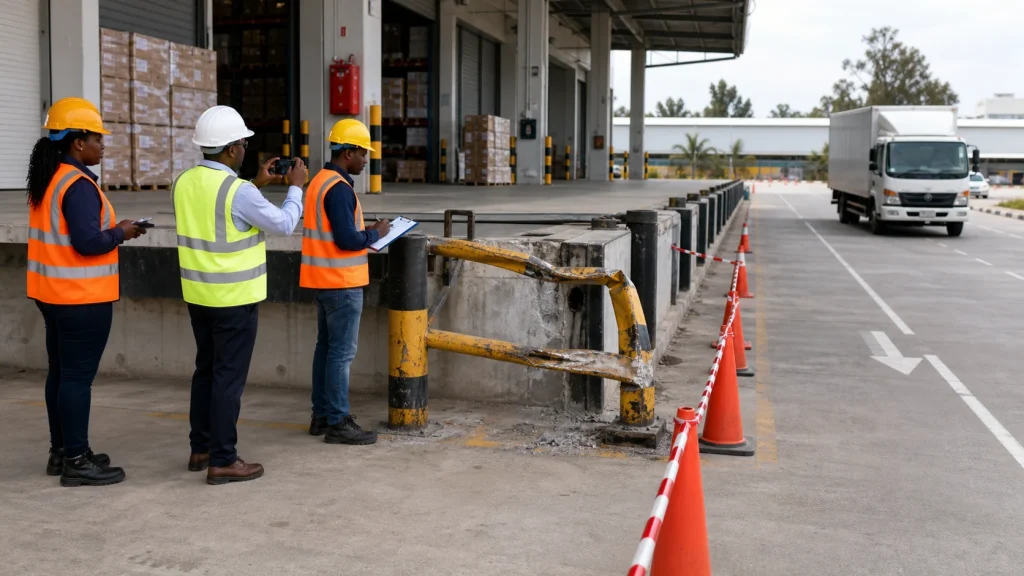
When a gate, rail, frame, barrier or support fails unexpectedly, an emergency commercial welding Nairobi enquiry should begin with safe triage and clear facts—not an unverified promise that a quick weld will restore the asset. The immediate priorities are controlling access, protecting people and operations, recording the condition and directing the request to the right type of assessment.
This guide helps commercial property, warehouse, retail and facilities teams prepare an incident brief that a contractor can understand. It complements the main ZES welding repair and metalwork maintenance service, which is the commercial owner for repair enquiries.
Control the area before collecting details
Follow the property’s incident and safety procedures. Restrict use or access according to the actual condition, and involve the responsible facility personnel. A damaged gate may move unexpectedly; a loose rail may no longer provide support; a distorted frame may affect adjacent finishes or equipment.
Do not ask staff to hold, load, climb or operate the item for a photograph. Avoid grinding, heating, straightening or adding temporary welds before assessment unless an authorised emergency process specifically requires it. Early alteration can conceal evidence of the failure and create additional exposure.
If the defect affects building stability, fire escape, machinery, utilities or another specialist system, escalate to the appropriate responsible professionals and authorities. “Welding emergency” is a description of urgency, not proof that welding is the correct technical solution.
Create a concise incident brief
Provide the precise Nairobi location, building or yard area, access contact and time the condition was discovered. Describe the affected item and current restriction in plain language. State whether anyone witnessed an impact, unusual noise, sticking movement or progressive deterioration.
Attach close and wide photographs taken from a safe position. The wide view should show supports, surrounding routes, nearby equipment and anything that could obstruct assessment. Include approximate dimensions only if they can be obtained without approaching an unsafe area.
Add any available drawing, asset record, earlier repair report or maintenance history. Note what is unknown. A short, honest brief is more useful than a confident diagnosis made by phone.
Separate business continuity from permanent repair
The property may need an interim operational arrangement while the metalwork remains isolated. This could involve another entrance, controlled vehicle route, temporary security procedure or relocation of stock, subject to the property’s own assessment. Treat this as a business-continuity decision, not part of a permanent weld by default.
Record who controls the temporary arrangement, the areas affected and when it will be reviewed. Do not allow an improvised prop, tied component or unapproved barrier to become a forgotten substitute. Where temporary structural support is considered, it must be addressed by the appropriate competent parties and authorised process.
A permanent scope should follow condition assessment. It may be a local repair, replacement component, wider reinforcement under approved details or complete replacement. Separate those options from immediate area control so urgency does not eliminate proper review.
Prepare for site access and assessment
Tell the contractor about security registration, parking, loading, stairs, lifts and permitted work windows. Clear movable vehicles, merchandise or furniture from a safe distance under the property’s direction. Identify overhead services, fuel, stored goods, glass and occupied spaces near the defect.
The site’s responsible team must establish appropriate permits, isolations, fire controls, ventilation and work boundaries for actual conditions. Assessment may not involve welding at all, but access planning helps the team arrive prepared to inspect measurements, base material and interfaces.
If work at the installed location is later selected, ZES on-site and mobile welding services provide a related route for planning the practical mobilisation scope.
Use an escalation path for hidden damage
Cleaning or removing a cover may reveal corrosion, cracks or distortion beyond the visible point. Agree who receives that information and who can authorise a changed scope. If the asset falls outside routine metalwork or relies on specialist design, stop and request appropriate review.
Ask the assessment to consider likely cause: impact, overload, settlement, misalignment, wear, water retention, vibration or previous alteration. The conclusion may remain provisional until material is exposed. Record that uncertainty instead of hiding it inside a broad “emergency repair” line.
For several related items, number each location and identify which one controls business reopening. Lower-priority maintenance can then be scoped separately without confusing it with the immediate incident.
Define evidence for reopening
Before permanent work starts, agree who authorises the area to return to service and which checks are required. Depending on the asset, these may include alignment, operation, connection condition, fasteners, finish, removal of temporary items and housekeeping. Structural, machine or load-related acceptance must follow the approved project process.
Retain the incident photographs, assessment note, approved repair or replacement detail, change record and completion images. Record any item awaiting coating, adjustment or wider review. The property contact should understand the temporary status of unfinished work.
Schedule follow-up based on the observed cause and operating environment. A gate exposed to repeated vehicle contact needs a different operational response from a frame affected by trapped water. Avoid a universal promise; base the action on the evidence.
Frequently asked questions
Does “emergency welding” mean the repair happens immediately?
No fixed response or completion time should be assumed. Access, condition, materials, site controls and the need for specialist review determine the next safe and practical step.
What information should I send first?
Send the exact location, safe close and wide photographs, affected item, current access restriction, incident description, approximate dimensions if available and the site contact.
Can staff install a temporary support?
Do not improvise support for a questionable component. Follow the property’s procedures and obtain appropriate competent direction for any temporary works or structural condition.
When is replacement preferable to repair?
Replacement may be appropriate when sound base material is insufficient, damage is widespread, geometry is badly distorted, access prevents a controlled repair or recurrence risk remains. Assessment should document the reasoning.
If a commercial metalwork incident needs triage, send ZES safe photographs, the Nairobi location and the current area restriction. ZES can review the enquiry and indicate the information or assessment needed next, without an unsupported response-time commitment.