

Fingerprint Attendance System Kitisuru: A fingerprint attendance system in Kitisuru can still require careful administration even when the workforce is small. Misassociated employee identifiers, informal enrolment and an unclear failure procedure can undermine an otherwise working terminal. This guide focuses on enrolment quality and the decisions an employer should make before operational rollout. ZES can review the proposed duty, equipment and reporting workflow, with suitability and deployment arrangements confirmed against the real requirement.

Fingerprint Attendance System Kitisuru: Keep enrolment under an identified authority
Choose who validates employee identity and who is permitted to create a terminal profile. Do not treat informal recognition by a colleague as the complete administrative process. Use stable identifiers and check the association before records are relied upon. Staff changes and returning employees also need a defined approach. A small workforce can make errors less obvious because people assume everyone knows whose profile is being used, even when the software record is wrong.
Choose only the information the process needs
Describe the purpose of fingerprint attendance and how the resulting records will be used. The responsible employer should review staff communication, access and handling requirements with suitable advisers. Avoid collecting extra fields merely because the application offers them. Installer demonstrations should use sample identities wherever possible. Operational biometric records and unredacted personnel information should not be attached to a general quotation enquiry or sent as a convenient shortcut to diagnosing a device problem.
Test the method with intended users
Ask how the proposed equipment handles people who cannot reliably enrol or recognise by fingerprint. Observe instructions, retries and the exception route during a controlled demonstration. Do not infer real-site performance from a product speed claim or one successful sample. Position and environment need their own review. An agreed alternative should remain manageable for the operator and the employer, rather than forcing staff to repeat an unsuccessful interaction with no way to resolve it.
Check identification and event transfer separately
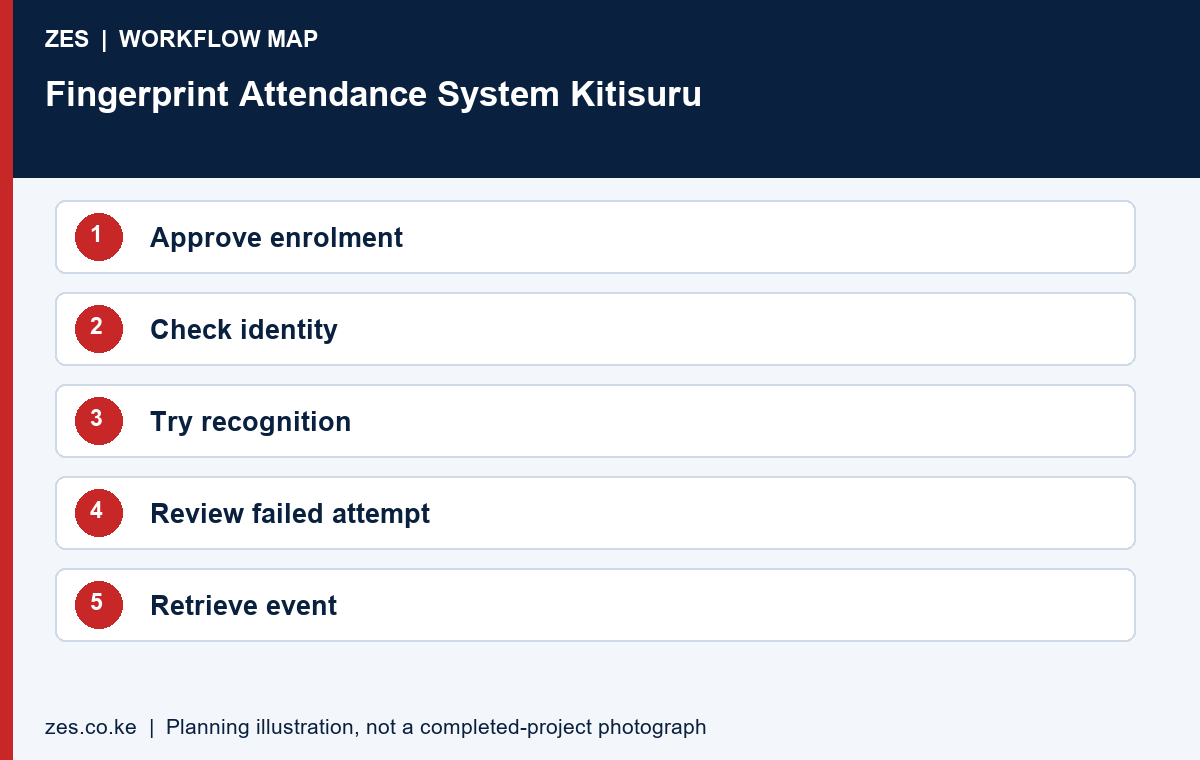
Follow a sample clocking through the terminal and reporting application. Confirm the employee identifier and time, and then retrieve the event. Recognition, transfer and attendance calculation are different stages. A missing report might be caused by a schedule or network problem even when the sensor recognises the user. Ask the intended administrator to perform routine retrieval and explain what they will do when a record fails to appear.
Review exceptions and staff changes regularly
Document how missed events and failed recognition are reported and approved. Retain appropriate accountability for corrections. Review profiles when staff leave, return or change role, according to the organisation’s requirements. Follow the selected equipment’s care guidance and keep support responsibilities visible. ZES can review a Kitisuru brief and confirm the proposed installation and training scope. A fingerprint purchase should include the process for maintaining trustworthy records, not only the initial capture of profiles.
A fingerprint enrolment and fallback test
Use a supervised trial to check whether the proposed reader is practical for the actual workforce and environment. Observe enrolment and recognition with representative users, without treating a marketing capacity figure as evidence of reliable daily operation. Ask what the operator does after repeated failed attempts and which alternative credential the approved design supports. Review accessibility and the practical handling of people who cannot reliably use the selected method.
Check that a recognition event is assigned to the correct sample employee and arrives in the intended report. Then test a duplicate-profile scenario and the approved process for a leaver. Specify who can enrol or delete a profile and how those actions are reviewed. Follow the selected model documentation for cleaning and maintenance. Never assume that every fingerprint device stores information in the same format or offers the same security controls.
Fingerprint Attendance System Kitisuru: supporting guidance
For privacy planning, consult the ODPC guidance notes, including its biometric data guidance. Check equipment and software behaviour against the documentation for the exact proposed version. ZKTeco publishes a ZKBio CVAccess user manual as one product-specific reference; it is not evidence that every device or platform has the same functions. Confirm the model and supported features in your quotation.
A worked example: recognition for a smaller workforce
Consider an illustrative employer with a small workforce investigating fingerprint attendance. A compact requirement can still involve different user needs, working patterns and administration responsibilities. Begin by identifying the record the employer needs and the person who will review it. The purchase should follow that brief rather than start with a device’s maximum capacity or an assumption that the most complex platform is always preferable.
Use sample identities to compare the proposed fingerprint attendance process with the existing method. Include a normal day and an approved exception. Ask the intended administrator to retrieve the results and explain the steps required. A manageable trial can reveal whether the technology solves the actual record problem or merely replaces one difficult routine with another.
Make enrolment an administered process
Identify who approves and creates a fingerprint attendance profile. Ask that operator to demonstrate enrolment and check the resulting identifier. Record how a poor enrolment is recognised and what the operator does next. The employer should understand the process before enrolling the workforce, rather than rely on the installer to carry out every future change without documented instructions.
Check for duplicate employee identifiers and test a sample correction. Ask what happens if a person changes role or uses another premises. Fingerprint attendance records should remain attributable to the intended person across the approved arrangement. A successful recognition message does not resolve an incorrect profile association, so identity checks need their own place in the acceptance process.
Review practical use and an alternative method
Observe how representative users approach the proposed fingerprint attendance point. Follow the selected manufacturer’s operating instructions and record practical difficulties during the trial. Ask whether the proposed position is suitable for ordinary use and whether staff can obtain help after an unsuccessful attempt. Avoid claiming a universal recognition rate from a small demonstration.
Agree an appropriate alternative for people who cannot use the selected method reliably or appropriately. The responsible organisation should approve the approach with suitable advice. Demonstrate how the alternative is issued, used and withdrawn in the selected fingerprint attendance arrangement. A shared workaround may make events difficult to attribute, so the process should remain understandable to both the operator and reviewer.
Keep visitor entry separate from employment attendance
At premises used by several groups, distinguish employee fingerprint attendance from visitors and occasional service providers. Not everyone entering the property needs an employment attendance profile. Identify the approved purpose and the responsible organisation before adding user categories. This keeps the project boundary clearer and helps avoid an installer being asked to design an undefined record system for every person who arrives.
If the customer also needs a controlled doorway or visitor process, describe it separately in the brief. Confirm the technical and operational interfaces before combining functions. A fingerprint attendance reader may support different features, but that does not establish that the selected model, software and property arrangement provide every requested function without additional components or review.
Fingerprint attendance: define enrolment quality
Fingerprint attendance begins with an enrolment process that the organisation can administer consistently. Ask the proposer to demonstrate the actual device and application workflow with representative test users. Observe whether the operator can identify a poor enrolment and explain the next step. A marketing statement about maximum template capacity does not demonstrate practical recognition for the intended workforce. Document the selected model and the supported credential methods rather than assuming that every fingerprint reader behaves identically.
Separate fingerprint attendance enrolment permissions from routine report access where the selected application allows it. Identify who approves a new employee profile, who checks the identifier and who reviews duplicates. Use a small sample to demonstrate that a recognised credential is associated with the correct employee record. The organisation should understand the supported correction process before enrolling the full workforce. Incorrect identity association is a different problem from a missed clocking event.
Recognition trials and an appropriate alternative
A fingerprint attendance trial should observe ordinary working conditions. Consider the device position, the way users approach it and the practical conditions of the work. Ask users to follow the supported operating method and record repeat failures without making assumptions about their cause. The aim is to discover whether the proposed method is workable for the actual users. Avoid turning a demonstration into a promise that any person will be recognised under every condition.
Agree how fingerprint attendance exceptions will be handled where a person cannot use the selected method reliably or appropriately. The available alternative depends on the equipment and the employer’s approved approach. Demonstrate its administration, approval and effect on reports. An alternative should remain attributable and reviewable; a shared credential can undermine those aims. Appropriate privacy and employment decisions belong to the responsible organisation with suitable advice, rather than being dictated by the reader’s default configuration.
Trace a fingerprint attendance event into the report
Test fingerprint attendance as an event chain. Enrol a sample identity, record a known event and retrieve it in the intended application. Compare the identifier, time, terminal and reporting date. Repeat the check for a second sample identity and confirm that the records remain separate. If the application applies schedules or exceptions, show those settings and their effect on the summary. This provides a stronger acceptance test than observing the reader display a successful recognition message.
Ask how fingerprint attendance data moves between the terminal and application. Confirm the supported connection method and what happens when it is unavailable. During an agreed trial, compare known sample events before and after recovery. Record any supported limits that affect event retrieval or storage. Do not infer device behaviour from another model’s specification sheet. The proposed product documentation and witnessed test should support the particular operating arrangement being purchased.
Daily administration and profile removal
Fingerprint attendance administration should include a clear leaver process. Identify who authorises removal, where the profile must be removed and how completion is checked. Ask the supplier to demonstrate the selected system’s actual behaviour using a sample profile. Distinguish removal of a credential from handling historical employment records under the organisation’s approved requirements. Avoid vague claims that deleting a name from one screen automatically removes every associated record from every component.
Provide a short fingerprint attendance operating guide for the designated administrator. Include a failed attempt, a missed event, a duplicate profile and a support request. Keep equipment identification and the manufacturer’s maintenance instructions available. Review recurring software charges and report access before purchase. A useful handover leaves the employer able to manage ordinary tasks and recognise when technical assistance is needed, without relying on undocumented steps known only to the original installer.
Trace sample events and review a missing clocking
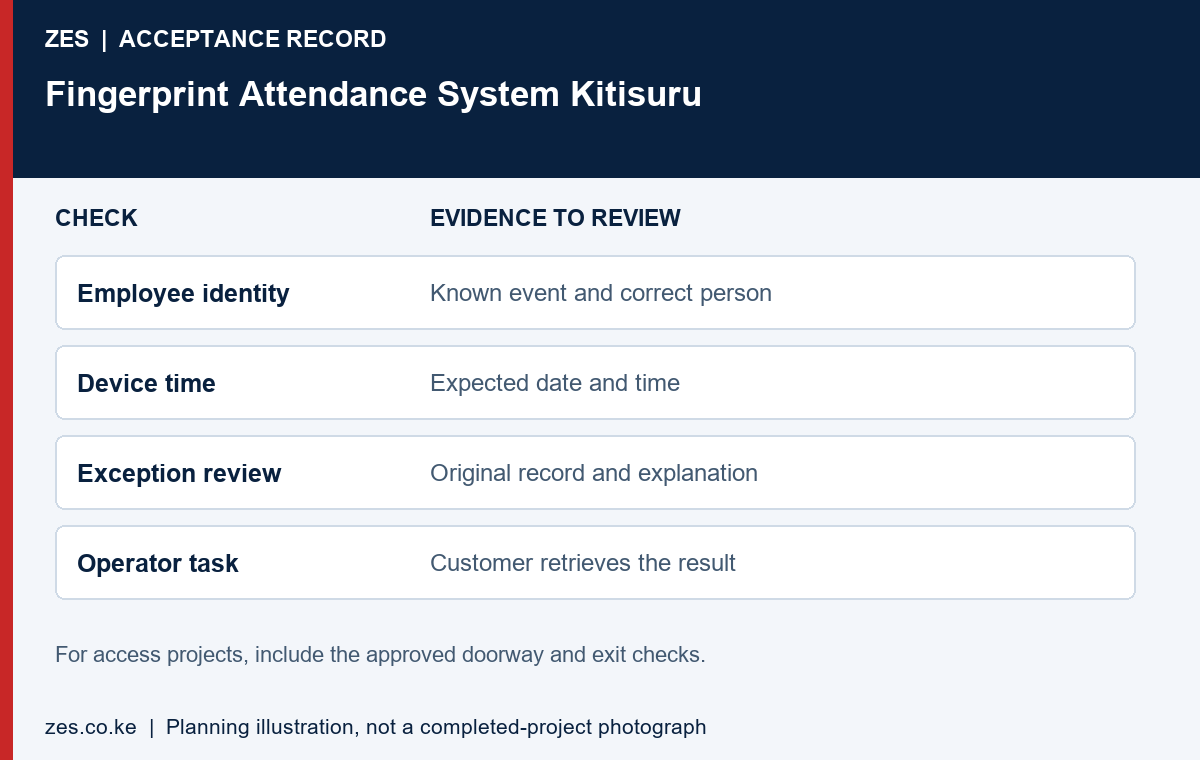
Create a known fingerprint attendance event and retrieve it through the intended application. Compare identity, device time and reporting date. Repeat the check for a second sample user and confirm that the records remain separate. Ask the administrator to retrieve the required summary, rather than assess the installation only from the terminal display.
Demonstrate a missed event through the employer’s approved review process. Keep the original record distinguishable from the explanation and correction wherever the application supports it. Identify who approves the result. Fingerprint attendance equipment provides event information; it does not independently decide whether every gap was a technical problem, an authorised duty or an unexplained absence.
Confirm hosting, report access and recurring tasks
Ask where the fingerprint attendance application will operate and who maintains it. Identify licences, recurring charges and any supporting connectivity. Have the intended administrator retrieve an export using sample identities. The employer should understand how to obtain its own reports and the practical work required each reporting period before depending on the installation.
Keep an authorised backup contact where the organisation needs cover for leave or staff changes. Provide short operating instructions covering enrolment, missed events, routine retrieval and support requests. A smaller workforce may have limited administration time, so the fingerprint attendance process should be proportionate to the requirement and usable by the people expected to maintain it.
Plan profile withdrawal and ongoing review
Use a sample profile to demonstrate the approved leaver process. Identify where the credential must be removed and how the authorised operator checks completion. Distinguish credential withdrawal from the organisation’s approved handling of historical employment records. Do not assume that deleting a visible name from one fingerprint attendance screen automatically removes every associated item from every connected component.
Review the first period of live operation. List recognition difficulties, unresolved event questions and tasks requiring technical assistance. Identify whether each issue concerns the device, configuration, training or the employer’s process. Keep the review practical. The objective is a fingerprint attendance arrangement that remains usable and accountable after the original installation demonstration has finished.
Prepare a Kitisuru fingerprint attendance enquiry
Provide ZES with the intended workforce, existing process, proposed clocking location and required report. Explain known difficulties with existing equipment or the need for a trial. Share anonymised examples rather than biometric records or confidential employee files. Identify the person who will administer the installation so usability and training can be included in the assessment.
Ask the written scope to identify the selected equipment, application, alternatives, installation responsibilities and acceptance checks. Confirm logistics and timing directly. This planning guide does not claim a completed Kitisuru customer installation, a guaranteed fingerprint recognition rate or a manufacturer relationship that has not been verified.
A private and usable project handover
Keep a private implementation file alongside the public buying guide. It should identify the supplied equipment, application arrangement, account owner, support contact and agreed acceptance results. Separate public marketing material from operational configuration and employee records. For an initial enquiry, anonymised examples are usually more useful than a large collection of personal records because they show the required output without exposing information unrelated to the purchase decision.
Ask the responsible organisation to review the purpose, necessity and handling of biometric information with appropriate advisers before live enrolment. The selected product documentation should explain its actual supported functions, but a technical specification does not by itself establish that every proposed use is appropriate. Confirm responsibilities for administration, access to reports, profile withdrawal and the organisation’s approved retention arrangements. Keep those decisions connected to the intended workflow rather than relying on a generic claim that a device is compliant.
Use a short readiness and acceptance record. Before work, confirm the site contact, approved position, enabling tasks and application access. During testing, record the expected result, observed result and unresolved item. At handover, identify who owns the next action and how it will be reviewed. This gives the customer a practical basis for accepting the actual scope, while avoiding a vague completion statement that cannot be compared with the original requirement.
The proposal should also explain how later changes are managed. A new premises, additional users, changed working patterns or another reporting application can create a different requirement. Keep equipment references and the approved scope available for that review. Ask for revised terms and tests where necessary instead of assuming that the original purchase includes every future alteration. Clear documentation is useful to both the customer and the supplier when the people involved in the original project change.
Information to include in your enquiry
Share the site location, organisation type, staff numbers, clocking points or controlled doors, existing devices and software, and the required outcome. Include available layouts and sample reports with personal information removed. Identify the person who approves building access and the person who will administer the system. Ask the quotation to identify assumptions, exclusions, recurring charges, testing and handover responsibilities.
Frequently asked questions
Can a small employer skip employee identifiers?
Stable identifiers help keep device and software records aligned, especially when staff return or records are transferred.
Should a failed recognition be treated as absence?
No. Review the circumstances, technical condition and authorised exception process before drawing conclusions.
Related Kitisuru biometric guides
- Biometric Access Control Kitisuru: Separate Property Entry, Staff Access and Restricted Areas
- Biometric Machine Suppliers Kitisuru: Purchase the Required Outcome, Not Only a Terminal
Discuss your requirement with ZES
ZES is based in Kamakis, Ruiru and reviews Kitisuru enquiries before confirming the appropriate assessment and delivery arrangements. Travel, installation timing, equipment availability and support commitments are agreed directly for the actual scope.
Biometric attendance services · Access-control services · Request a quotation · Request a site assessment