

Biometric Access Control Kitisuru: Biometric access control in Kitisuru should distinguish property entry, staff permissions and access to particular restricted areas. These decisions may belong to different responsible parties. A system that recognises a person still needs an approved rule about where and when that person may enter. This guide focuses on the permission plan and its interfaces. ZES can assess the intended access scope, with doorway hardware and safe-operation responsibilities reviewed separately by competent parties.

Biometric Access Control Kitisuru: Map the controlled boundary
Identify the opening or area actually included in the project. If property management controls a common entrance while an employer controls an office door, record both responsibilities. Visitor handling and employee access are not automatically the same scope. Name the person who approves permissions. A clear boundary prevents an installer being asked to configure restrictions without knowing whether the customer has authority over the particular gate, doorway or shared area.
Define staff, contractors and visitors separately
List user groups and their approved access needs. Temporary personnel may require a different arrangement from permanent employees. Establish who grants, changes and withdraws permission. Ask the selected system to demonstrate the required limits and make any limitations visible. Do not enrol every visitor as an employee simply because that is the easiest screen to use. The organisation should review the purpose and handling of biometric information before adding new categories of users.
Plan an alternative and exception route
Recognition may fail or a device may be unavailable. Agree how an authorised person resolves access difficulties without creating an uncontrolled workaround. Keep the method compatible with the property and reviewed safety requirements. Do not assume that a spare credential or shared administrator account is an acceptable universal answer. Document who can approve the exception, how it is recorded and how the temporary arrangement ends.
Connect permission policy to hardware assessment
Provide information about the door or gate, existing equipment and intended operation. Competent parties should assess locking, release, power-loss behaviour and any safety-sensitive responsibilities for the actual installation. A permission matrix does not establish that a particular lock is suitable. Record component compatibility and contractor interfaces in the proposal. Any connection to attendance, intercom or surveillance needs a separate check of accessible interfaces and the requested function.
Test user removal and handover
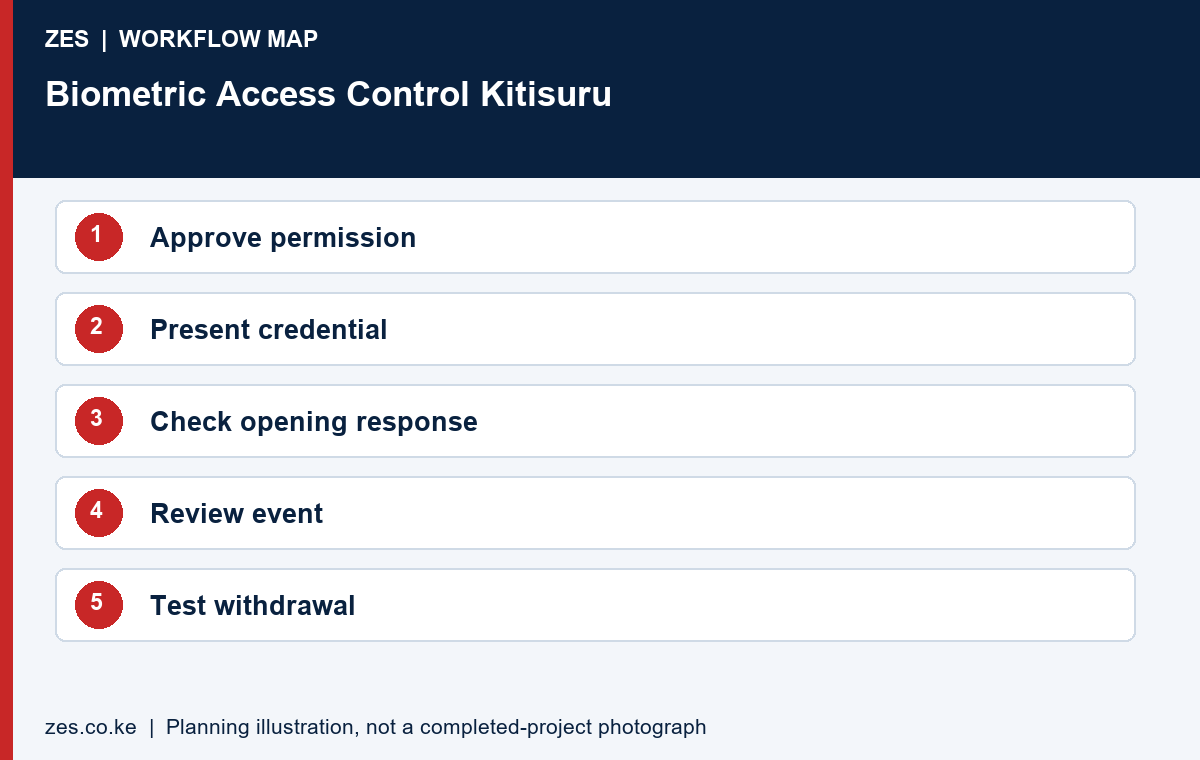
Demonstrate authorised entry, denied access, an approved permission change and removal of a sample user. Check which event information is available to the responsible manager. Hand over configuration ownership, equipment details and support procedures. ZES can review the Kitisuru brief and confirm assessment and deployment arrangements directly. The result should remain administrable when the person who approved the original installation changes, with clear authority for future permission updates.
An access-control acceptance checklist
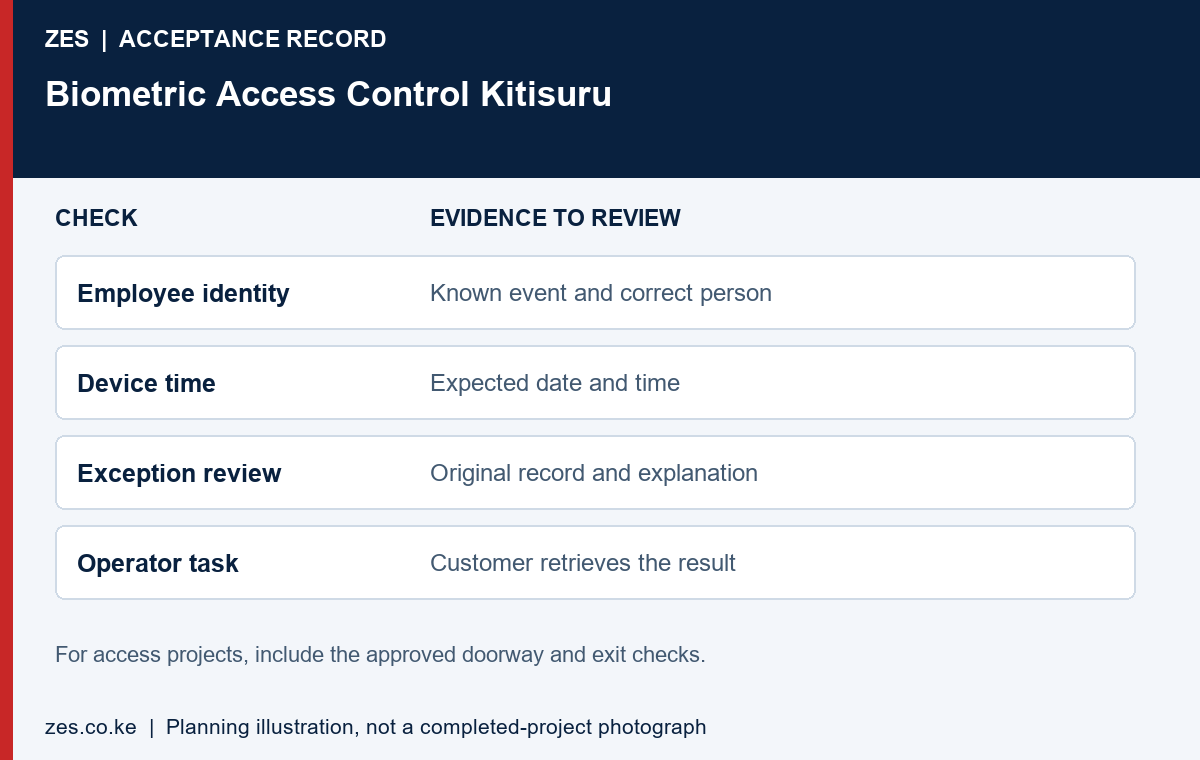
Test an authorised credential, a rejected credential and a credential outside its approved access schedule. Confirm that the response matches the agreed doorway policy and that an administrator can retrieve the relevant event. Test the approved exit arrangements with the responsible site team. A demonstration of entry alone is incomplete: door hardware, emergency egress, power behaviour and operational responsibilities must be addressed in the actual design.
Separate permissions for entering premises from permissions for opening a restricted room. Record who approves changes and who removes access when a person leaves. Establish how visitors and contractors are managed without silently creating permanent staff permissions. Ask for a documented review of the power-loss and connection-loss behaviour of the selected equipment. Site-specific safety decisions should be confirmed by the appropriate competent people before commissioning.
Biometric Access Control Kitisuru: supporting guidance
For privacy planning, consult the ODPC guidance notes, including its biometric data guidance. Check equipment and software behaviour against the documentation for the exact proposed version. ZKTeco publishes a ZKBio CVAccess user manual as one product-specific reference; it is not evidence that every device or platform has the same functions. Confirm the model and supported features in your quotation.
A worked example: separate property entry and a private office
Consider an illustrative premises where one party controls property entry and an employer separately controls a private office. The access control requirement must identify those boundaries and the authority to change them. A credential recognised at the entrance should not automatically imply permission for every internal area, nor should a tenant’s equipment proposal silently take responsibility for a boundary it does not control.
Prepare a permission map showing the included openings and the approving party for each. Mark existing equipment and proposed interfaces. If a boundary is excluded, state that clearly. This gives the access control assessment a useful starting point and prevents the project being described as one complete property system when only a specific doorway is actually included in the approved scope.
Define the users and the intended level of access
List employees, temporary workers, contractors and visitors separately. Identify which area each group needs and how permission is approved or withdrawn. Ask the proposed access control application to demonstrate the required distinctions using sample identities. Record any limitation that must be managed through a procedure rather than an automated setting.
Avoid creating permanent employee permissions for every visitor simply because a demonstration screen makes that easy. Establish a practical temporary-access process and the person responsible for it. The access control arrangement should remain understandable when the usual administrator is absent, with an approved route for unusual requests rather than reliance on an informal shared credential.
Assess the opening and its operating conditions
Provide the actual door or gate details to the appropriate competent parties. Assess the proposed locking, release, exit arrangements and supporting power for that opening. Identify any interface with existing equipment. A biometric reader’s recognition function does not establish that a particular lock is appropriate or that an existing opening can be altered without further review.
Record the approved access control behaviour during power or connection loss. Agree how that behaviour will be witnessed without disrupting unrelated premises operations. Keep safety and operational responsibilities explicit. These decisions should follow the actual site and competent design assessment, rather than a universal reader setting applied to every property.
Plan a controlled exception route
Describe what an authorised user does after a failed recognition attempt or device outage. Identify the person who can approve the response and how a temporary arrangement ends. The access control process should provide a workable exception without silently creating unrestricted permanent access. Demonstrate the method under the approved design and operating procedure.
Check that the relevant staff understand the exception route at handover. If another organisation manages the common boundary, agree the interface with that party. Avoid asking the installer to improvise permissions for a part of the premises outside the customer’s authority. A clear access control boundary is useful both during ordinary use and when an unusual situation requires prompt review.
Access control: define a permission matrix
An access control brief should identify people, areas, schedules and approval authority. List the actual controlled openings and user groups rather than describing the whole premises as one unrestricted zone. Distinguish employees, contractors and visitors. For each group, identify the person who approves access and the circumstances in which it changes. This matrix gives the supplier something measurable to configure and helps the customer recognise requirements that may need additional hardware or software.
Keep access control permissions separate from general attendance reporting unless the organisation has explicitly assessed the intended connection. A person may enter a building for an authorised meeting without following a normal staff schedule. Conversely, a staff member may perform approved duties away from the building. Explain which events will be used for which purpose. The technology should support the agreed operating rules rather than silently turning every access event into a payroll or performance decision.
Doorway design and operating responsibilities
Access control equipment must be considered with the actual door, gate or barrier. Ask appropriate competent parties to assess locking, release, exit arrangements, supporting power and interaction with other systems. Record the proposed components and how compatibility will be established. A reader’s recognition capability does not prove that any lock can be fitted to any opening. Avoid making commissioning decisions from a photograph or a generic product description alone.
Agree access control behaviour during power loss, connection loss and an operational incident. Demonstrate the approved arrangement under a planned test with the responsible site team. Document who has authority to operate any manual procedure and when normal operation is restored. The required safety and security balance depends on the premises and its competent design review. It should not be selected casually by changing a reader setting without considering the opening and the people using it.
Test access control permissions and removal
Test access control with an authorised user, a rejected credential, a user outside the permitted schedule and a removed sample profile. Compare the expected response with the observed opening behaviour and available event record. Where several openings are included, test the agreed permission differences. Record limitations clearly. A successful entry test at one door does not establish that every scheduled permission and withdrawal function works across the whole installation.
Make access control changes reviewable. Identify who requests a change, who approves it and who applies it. Ask the selected software to show the available administration history and account permissions. Agree a practical process if some controls depend on written procedures rather than built-in restrictions. Include temporary access expiry and a leaver example in the handover. The customer should be able to explain how permissions are kept current after the original project team has moved on.
Access control handover and ongoing review
The access control handover should identify controlled openings, equipment, account ownership, approved settings and support arrangements. Give the responsible manager an accessible copy of the permission plan and a procedure for raising faults. Transfer sensitive configuration information through an appropriate private channel. Do not place passwords, internal network details or unrestricted access instructions in public project material. Public marketing photographs and private commissioning evidence serve different purposes.
Review access control when the premises, occupancy or staffing changes. A newly partitioned office, a changed visitor route or a revised contractor arrangement can alter the original requirement. Assess whether the existing design remains appropriate before extending it. Keep maintenance aligned with the selected products and the approved operating plan. Any ongoing service promise should identify its actual coverage and response arrangements rather than relying on a broad claim that all possible faults are automatically included.
Test permissions, changes and user removal
Use invented identities to demonstrate permitted entry, denied access, an approved permission change and withdrawal of a profile. Retrieve the available event and administration records. Where the access control project covers several openings, test the agreed differences between them. A successful result at the property entrance does not prove that a restricted internal area follows its intended rule.
Include a sample temporary user and show how permission ends. Ask the intended administrator to perform the routine task under supervision. Record any unsupported requirement or manual step. The acceptance record should identify the actual application and configuration demonstrated, without suggesting that every feature advertised for the product family was included in the project.
Keep administration ownership clear
Identify who owns access control accounts, configuration records and licences. Ask the selected application to demonstrate the available permission restrictions and history. Keep sensitive details in the private handover file. Public-facing project material should not expose passwords, internal addresses or instructions that undermine the customer’s approved security arrangement.
Nominate an authorised administrator and appropriate cover. Give them a usable operating guide and a clear support contact. Record which changes require approval from another responsible party. An access control installation should remain administrable when a manager changes or a different support provider is engaged, rather than depending on undocumented knowledge held only by the original installer.
Review the installation when the premises change
Reassess access control when occupancy, staffing, internal partitions or visitor routes change. The original permission map may no longer represent the actual premises. Review the affected openings and operating responsibilities before extending the system. Keep the approved design and handover information current so the customer can understand which requirements are covered by the existing installation.
For ongoing support, identify the actual tasks and response arrangements included in the agreement. Distinguish routine administration from hardware maintenance and a new project requirement. Avoid assuming that every later alteration is automatically covered by the original quotation. A documented access control scope makes future decisions easier for both the customer and the supplier.
Prepare the Kitisuru access control requirement
Send ZES the included openings, user groups, existing equipment and intended permissions. Explain which party controls the property boundary and which controls the internal area. Include suitable layouts or photographs with confidential material removed. Identify the people who approve access to the work area and the parties responsible for the actual opening and safe operation.
Ask the proposal to identify equipment, component interfaces, configuration, testing and handover responsibilities. Confirm site assessment and attendance arrangements directly. This guide uses illustrative permission-planning examples and does not claim a local office, a completed installation at a named property or a universal guarantee about any proposed access control component.
A private and usable project handover
Keep a private implementation file alongside the public buying guide. It should identify the supplied equipment, application arrangement, account owner, support contact and agreed acceptance results. Separate public marketing material from operational configuration and employee records. For an initial enquiry, anonymised examples are usually more useful than a large collection of personal records because they show the required output without exposing information unrelated to the purchase decision.
Ask the responsible organisation to review the purpose, necessity and handling of biometric information with appropriate advisers before live enrolment. The selected product documentation should explain its actual supported functions, but a technical specification does not by itself establish that every proposed use is appropriate. Confirm responsibilities for administration, access to reports, profile withdrawal and the organisation’s approved retention arrangements. Keep those decisions connected to the intended workflow rather than relying on a generic claim that a device is compliant.
Use a short readiness and acceptance record. Before work, confirm the site contact, approved position, enabling tasks and application access. During testing, record the expected result, observed result and unresolved item. At handover, identify who owns the next action and how it will be reviewed. This gives the customer a practical basis for accepting the actual scope, while avoiding a vague completion statement that cannot be compared with the original requirement.
The proposal should also explain how later changes are managed. A new premises, additional users, changed working patterns or another reporting application can create a different requirement. Keep equipment references and the approved scope available for that review. Ask for revised terms and tests where necessary instead of assuming that the original purchase includes every future alteration. Clear documentation is useful to both the customer and the supplier when the people involved in the original project change.
Information to include in your enquiry
Share the site location, organisation type, staff numbers, clocking points or controlled doors, existing devices and software, and the required outcome. Include available layouts and sample reports with personal information removed. Identify the person who approves building access and the person who will administer the system. Ask the quotation to identify assumptions, exclusions, recurring charges, testing and handover responsibilities.
Frequently asked questions
Can common property entry and office access be managed together?
Only where authority, technical compatibility and responsibilities are explicitly agreed. They are not automatically one system.
Does access control prove staff attendance?
Not by itself. Assess the event meaning and a separately approved attendance workflow before using access data for that purpose.
Related Kitisuru biometric guides
- Employee Attendance System Kitisuru: Reviewable Records for Changing Staff Duties
- Biometric Attendance System Kitisuru: Plan Records for a Small or Distributed Employer
Discuss your requirement with ZES
ZES is based in Kamakis, Ruiru and reviews Kitisuru enquiries before confirming the appropriate assessment and delivery arrangements. Travel, installation timing, equipment availability and support commitments are agreed directly for the actual scope.
Biometric attendance services · Access-control services · Request a quotation · Request a site assessment