

Biometric Attendance System Kitisuru: A biometric attendance system in Kitisuru should be sized around a real employment and reporting requirement. A small office, an institution and an organisation with staff moving between premises can need very different arrangements. This guide focuses on deciding what to record and how to avoid buying a system that adds more administration than it resolves. ZES accepts Kitisuru enquiries and confirms suitable assessment, installation and support arrangements for the actual site.

Biometric Attendance System Kitisuru: Identify the employer and the included workforce
State which organisation employs the users and who owns their attendance records. If several employers or contractors operate on the property, do not combine their records without an agreed purpose and proper responsibilities. Distinguish permanent staff, visiting service providers and occasional contractors. Not everyone who enters a site necessarily needs an employee attendance profile. Starting with this boundary helps define the report, permissions and administrative effort before deciding how many terminals to purchase.
Check whether attendance is the actual problem
Describe the present difficulty: retrieving records, reviewing missed entries, producing a summary or coordinating staff at separate premises. A device will not clarify uncertain schedules or establish who approves work performed elsewhere. Compare the intended process with the current one and identify the improvement that can be demonstrated. Keep the system proportionate to that outcome. More functions are not automatically useful if nobody has responsibility or time to operate them after installation.
Plan around movement between premises
If staff attend more than one location, decide where an event should be recorded and how the approved working day is reviewed. Stable identifiers help prevent duplicate staff records. Ask how the selected software handles several clocking points and what connectivity it requires. Do not equate a record at one entrance with proof of every duty performed that day. The employer should define the treatment of authorised travel, changed locations and other exceptions before configuration.
Use a small acceptance trial
Demonstrate a normal day, an authorised off-site duty, a missed event and an approved correction using sample records. Have the intended operator retrieve the report. Observe whether the proposed process is genuinely manageable for the organisation. Test the agreed connection-loss behaviour and identify the software licence and hosting basis. A pilot should produce evidence for the purchase decision rather than become an unexplained collection of operational biometric data.
Assign a practical owner for the installation
Name the person who manages enrolment, leavers, corrections and support requests. Review staff communication and data handling through the responsible organisation. Confirm recurring charges, equipment ownership and access to exports. Ask the written scope to identify installation, training and handover separately. ZES can assess the Kitisuru requirement and confirm what is suitable; site visits and travel are arranged directly rather than promised solely because the enquiry names a nearby location.
A practical attendance acceptance test
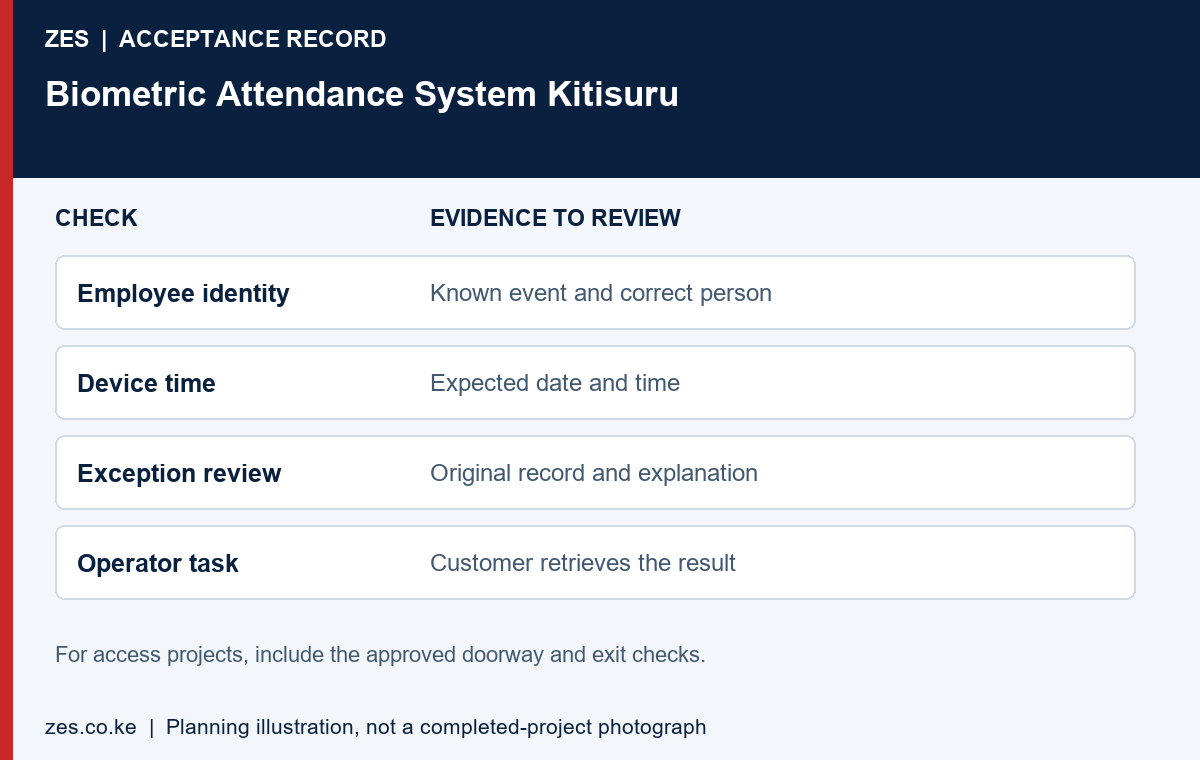
Create a sample staff record and a short, approved schedule before testing. Record an arrival and departure, then retrieve the events in the intended application. Confirm that the employee identifier, date, device time and reporting period agree. Have the designated attendance administrator review a missed event and record an approved correction. Keep the original event and the explanation distinguishable. A clocking event is an input to review, rather than an automatic decision about pay or performance.
Ask the supplier to demonstrate the agreed behaviour when the connection is interrupted. After restoration, compare device events with the application and check for duplication or missing events. Record who will investigate discrepancies, how a backup is retrieved and where the employer keeps its handover documents. The final test should be performed by the person who will operate the system, using sample data wherever practical.
Biometric Attendance System Kitisuru: supporting guidance
For privacy planning, consult the ODPC guidance notes, including its biometric data guidance. Check equipment and software behaviour against the documentation for the exact proposed version. ZKTeco publishes a ZKBio CVAccess user manual as one product-specific reference; it is not evidence that every device or platform has the same functions. Confirm the model and supported features in your quotation.
A worked example: a small employer with separate work locations
Consider an illustrative organisation with a small administrative team and staff who perform approved duties at more than one premises. Its attendance system requirement may be a clear period summary rather than a complicated central platform. Begin by identifying the actual employer, the included workforce and the reviewer. Keep contractor visits and general property entry outside the employee attendance scope unless a separate purpose has been approved.
Prepare a simple statement of the required result. For example, the reviewer needs to retrieve known clocking events and distinguish them from approved duties performed elsewhere. Ask how the proposed attendance system supports that task and what manual review remains necessary. A small workforce does not automatically make every requirement simple, but it provides a useful reason to question unnecessary complexity before purchase.
Keep employee identity consistent across the premises
If an employee uses more than one clocking point, decide how the attendance system identifies that person across the proposed arrangement. Ask the supplier to demonstrate a sample identity at the relevant points and retrieve the intended summary. Check whether the selected software and licence support the required view. Avoid creating separate profiles without understanding how the records will later be reviewed together.
Record who maintains the employee list and who approves changes. Where several organisations use the same property, do not combine their staff records merely because one terminal could technically recognise all of them. The attendance system needs an agreed record owner and operating purpose. A clear boundary makes administration, reporting and support responsibilities easier to explain to the people using the installation.
Decide whether a simpler process will meet the requirement
Compare the proposed attendance system with the actual problem. If the employer cannot explain what report it needs or who will review it, resolve those questions before selecting advanced functions. Ask whether an agreed basic export is sufficient or whether the organisation needs a supported reporting platform. The most appropriate proposal is the one that delivers the approved workflow at a manageable operating effort.
Ask the intended administrator to perform a sample task rather than assess usability only from a presentation. Can the person retrieve a period, identify an exception and follow the approved correction process? Note where training or technical assistance is required. An attendance system should reduce confusion about records; it should not introduce a recurring set of undocumented tasks that a small employer has no capacity to maintain.
Design the trial around real working patterns
Use invented records to represent a normal working day, an approved change of location and a missed clocking. Ask the attendance system reviewer to explain each case from the available events and approved supporting information. Keep the employer’s interpretation distinct from what the device actually recorded. A trial should expose those boundaries before staff rely on the output for an operational reporting cycle.
Include a period when the proposed connection is unavailable, using an agreed test that does not affect unrelated systems. Ask the supplier to demonstrate the selected product’s supported recovery method. Compare the known events afterward and record limitations. Do not assume that every attendance system stores or synchronises events in the same way simply because it is described as networked or cloud connected.
How the attendance system turns an event into a report
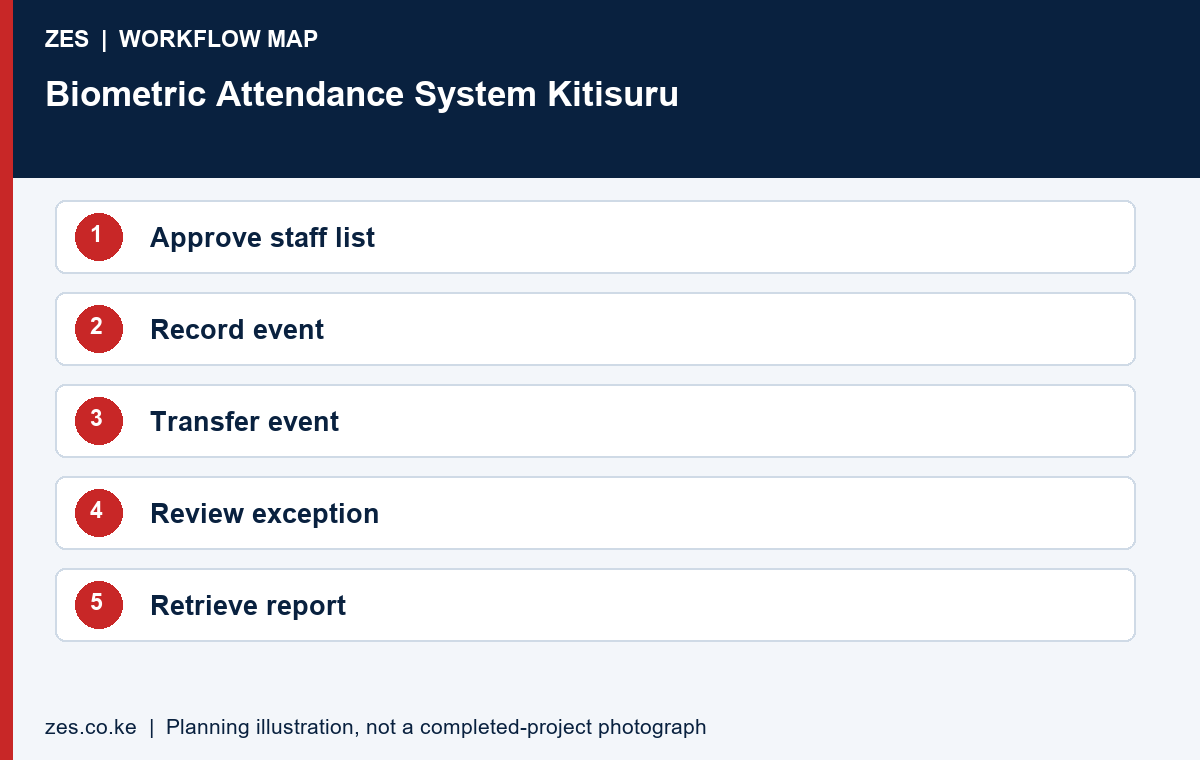
Treat the attendance system as a chain of responsibilities. A recognition event is first associated with an employee identifier and a device time. The application then receives the event and presents it under a reporting period. Approved schedules and exception rules influence the eventual attendance summary. Buying a terminal therefore answers only part of the requirement. Ask the proposer to draw this chain and identify which product performs each step, which connections it needs and who reviews the result.
Test the attendance system with an invented employee record before using operational data. Make a small event sheet containing an expected arrival, departure, authorised absence and missed clocking. Retrieve the corresponding application report and compare it with that sheet. A successful demonstration shows traceable records and understandable exceptions. It should also show what the report cannot establish: a clocking record does not independently explain a person’s duties, whereabouts throughout the day or entitlement to payment.
Attendance system ownership, permissions and exports
Decide which attendance system tasks belong to HR, a supervisor, IT and the supplier. The person maintaining network connectivity may not need permission to review employee records. The person approving a correction may not need permission to change application settings. Ask the proposed software to demonstrate the required separation using test accounts. Record any limitations, including functions that can be restricted only through an operating procedure rather than a software permission.
Request an attendance system export in the format the receiving team actually needs. Check employee identifiers, date boundaries, blank fields, department labels and the treatment of changed records. If a payroll application is involved, obtain its interface requirements before promising automatic integration. Have the receiving team inspect a sample and document the result. A file opening successfully is a useful first check, but it does not demonstrate that every field has the agreed business meaning.
A controlled first reporting period
Introduce the attendance system with a defined review period. Explain the clocking locations, approved hours, contact for a failed attempt and procedure for reporting a missed event. Give the responsible reviewer time to compare sample records with authorised schedules. Keep a list of operational questions and agree who can resolve each one. This is more useful than assuming that a single training session eliminates every exception the organisation will encounter.
At the end of the first reporting period, review the attendance system against the original brief. Can the administrator retrieve the required summary without recreating it manually? Are unexplained gaps investigated? Are authorised corrections distinguishable from original device events? Are reports available to the intended recipients and no wider audience? Record changes that need further testing. The purpose is a manageable attendance process, rather than simply a terminal that accepts a fingerprint.
Continuity checks for the attendance system
Ask how the selected attendance system behaves when a terminal loses its connection to the application. Supported behaviour depends on the actual device, configuration and software version. Demonstrate interruption and recovery under an agreed test rather than relying on a generic promise that every machine works offline. Compare the known test events after recovery and investigate any duplicates or gaps before signing off the arrangement.
Document attendance system recovery responsibilities. Identify who checks the device clock, who restores connectivity and who authorises any temporary recording method. Keep the equipment details and support route with the handover record. Agree how the organisation will retrieve its own reports if a supplier relationship changes. A continuity plan should describe the specific installation and its supported recovery process; it should not assume that a cloud label alone provides backup, retention or disaster recovery.
Choose a practical administration and hosting arrangement
Identify who will maintain the attendance system application and where the authorised administrator will access it. Consider the organisation’s actual IT capacity and the support offered in the quotation. Ask which tasks remain with the customer and which are included with the service. A hosted arrangement and a local application involve different responsibilities that should be explained rather than reduced to a marketing label.
Confirm the licence basis, recurring charges and access to the organisation’s own reports. Keep administrative ownership clear if a supplier assists with configuration. Name a suitable backup contact for routine tasks. The customer should understand how the attendance system will remain usable during staff leave, a change of administrator or a future decision to obtain technical support from another provider.
Budget for the premises and supporting routes
A small attendance system can still require site-specific enabling work. The survey should identify the proposed position, mounting surface, power and communication routes. Ask who approves any work around finished surfaces or shared infrastructure. Do not infer installation cost solely from staff numbers or the terminal price. The actual route and customer-supplied dependencies may be important parts of the installed scope.
Ask for enabling works, equipment, software, configuration and training to be identifiable in the quotation. Record which assumptions require confirmation and how changes will be approved. If more than one premises is involved, specify attendance and logistics for each. A written comparison helps the employer understand what it is buying without relying on a general promise that any small installation will be inexpensive or immediately available.
Use the first report to check the whole arrangement
Review one complete attendance system reporting period with the intended administrator. Compare known events, approved explanations and the final summary. Check whether the chosen process is manageable and whether staff know how to raise questions. Record unresolved issues with an owner and an agreed next step. This is a practical opportunity to improve operation before adding more users or clocking points.
Keep a short handover and review record. Identify the equipment, application, licence arrangement, report location and support route. Include a worked missed-event example and the approved leaver procedure. The aim is an attendance system the organisation can continue operating after the initial demonstration, with clear responsibilities rather than an unexplained collection of device events.
Prepare a Kitisuru attendance system enquiry
Provide ZES with the employer type, approximate workforce, premises involved and required report. Explain staff movement, existing equipment and the person who will administer the system. Share anonymised examples where useful. State whether the main problem is retrieving events, reviewing exceptions or preparing a summary, so the proposal can address the intended outcome before selecting equipment.
ZES can review the requirement and confirm assessment, installation and support arrangements directly. The written scope should identify the selected application and operating responsibilities. This page uses illustrative situations and does not claim a Kitisuru office, a completed local customer project or a guaranteed attendance system outcome before the actual requirement has been assessed.
A private and usable project handover
Keep a private implementation file alongside the public buying guide. It should identify the supplied equipment, application arrangement, account owner, support contact and agreed acceptance results. Separate public marketing material from operational configuration and employee records. For an initial enquiry, anonymised examples are usually more useful than a large collection of personal records because they show the required output without exposing information unrelated to the purchase decision.
Ask the responsible organisation to review the purpose, necessity and handling of biometric information with appropriate advisers before live enrolment. The selected product documentation should explain its actual supported functions, but a technical specification does not by itself establish that every proposed use is appropriate. Confirm responsibilities for administration, access to reports, profile withdrawal and the organisation’s approved retention arrangements. Keep those decisions connected to the intended workflow rather than relying on a generic claim that a device is compliant.
Use a short readiness and acceptance record. Before work, confirm the site contact, approved position, enabling tasks and application access. During testing, record the expected result, observed result and unresolved item. At handover, identify who owns the next action and how it will be reviewed. This gives the customer a practical basis for accepting the actual scope, while avoiding a vague completion statement that cannot be compared with the original requirement.
The proposal should also explain how later changes are managed. A new premises, additional users, changed working patterns or another reporting application can create a different requirement. Keep equipment references and the approved scope available for that review. Ask for revised terms and tests where necessary instead of assuming that the original purchase includes every future alteration. Clear documentation is useful to both the customer and the supplier when the people involved in the original project change.
Information to include in your enquiry
Share the site location, organisation type, staff numbers, clocking points or controlled doors, existing devices and software, and the required outcome. Include available layouts and sample reports with personal information removed. Identify the person who approves building access and the person who will administer the system. Ask the quotation to identify assumptions, exclusions, recurring charges, testing and handover responsibilities.
Frequently asked questions
Does everyone visiting the premises need an attendance profile?
No. Define employee attendance, contractor administration and visitor handling as separate purposes before choosing the scope.
Is a biometric system necessary for every small employer?
Assess the actual record problem, administration and proportionality with responsible advisers. A purchase should follow a defined requirement.
Related Kitisuru biometric guides
- Biometric Installation Kitisuru: Retrofit Planning Without Losing Service Access
- Biometric Access Control Kitisuru: Separate Property Entry, Staff Access and Restricted Areas
Discuss your requirement with ZES
ZES is based in Kamakis, Ruiru and reviews Kitisuru enquiries before confirming the appropriate assessment and delivery arrangements. Travel, installation timing, equipment availability and support commitments are agreed directly for the actual scope.
Biometric attendance services · Access-control services · Request a quotation · Request a site assessment