
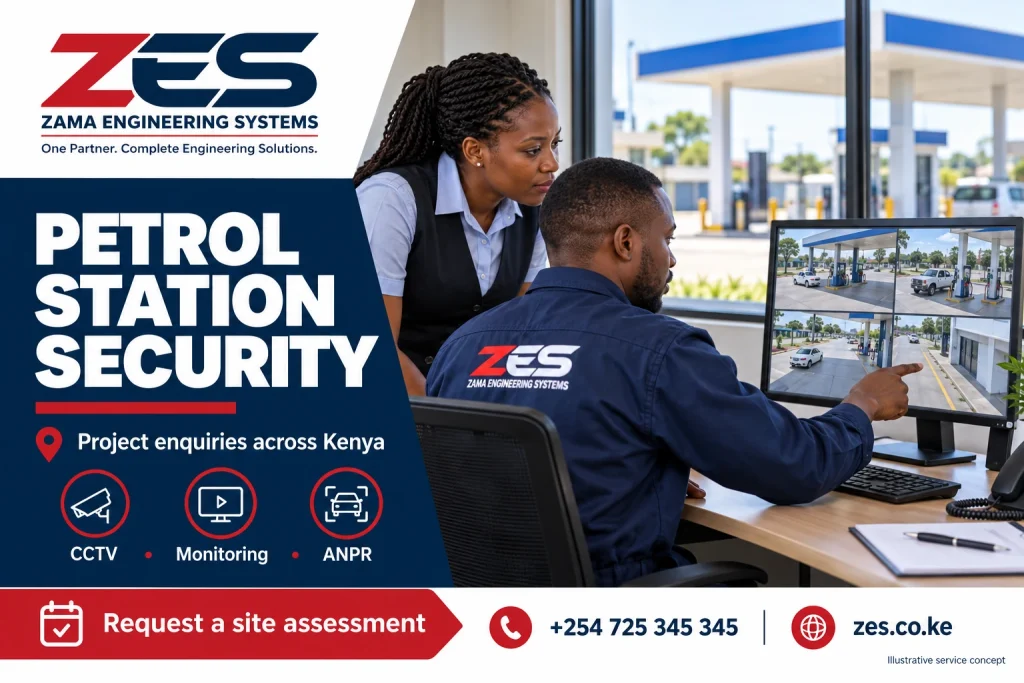
Fuel Station Security Monitoring Kenya enquiries need a clear response process as well as suitable cameras. Someone must know what is being monitored, what triggers attention and what the authorised response should be. This guide focuses on monitoring responsibilities, escalation and evidence handover. ZES can review the technology requirement and confirm the supplied scope; a monitoring arrangement should not be assumed to include guarding, emergency attendance or a guaranteed response time unless those services are expressly contracted.
1. Separate observation from response
Identify whether the requirement is local viewing, remote observation, event notification or a staffed monitoring service. These are different operating arrangements. Name the party responsible for reviewing an event and the party authorised to respond. A camera or mobile application does not independently establish that somebody will act at a particular time or attend the premises.
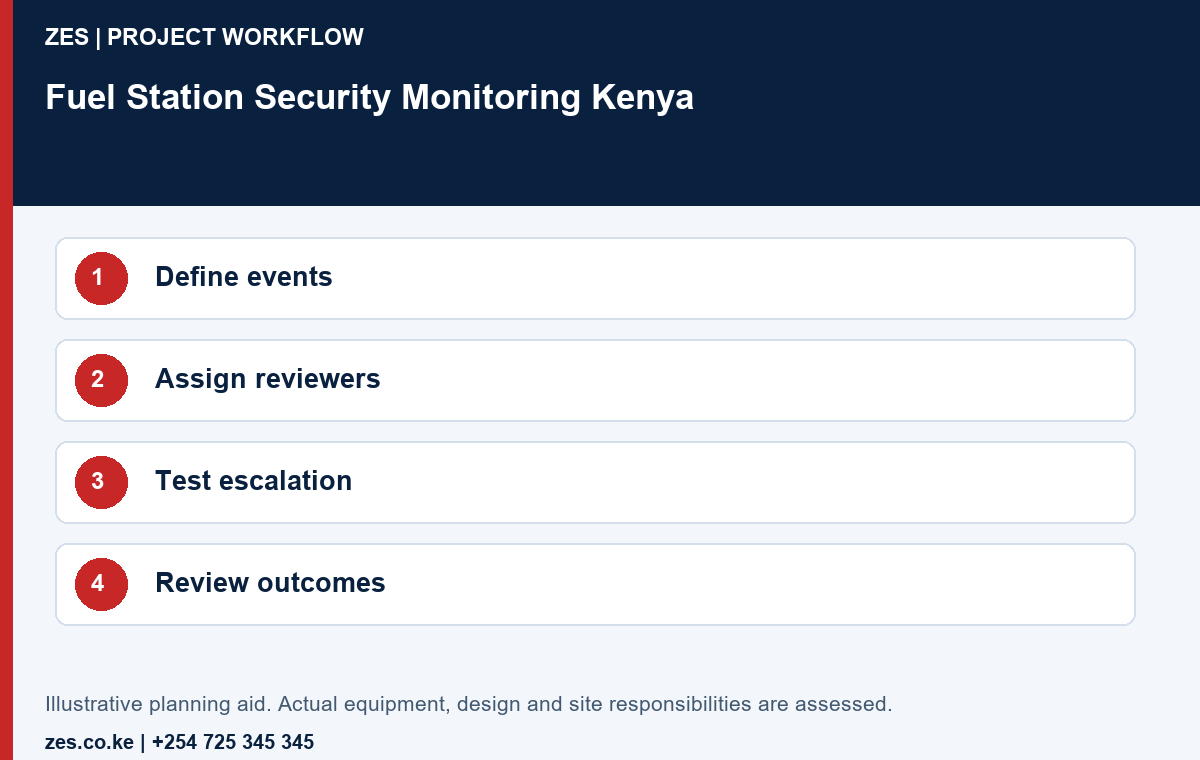
2. Define actionable events
Write a short list of the situations requiring review and the information the reviewer needs. Avoid enabling every available alert without considering how the station will handle it. An excessive stream of poorly defined notifications can make real issues harder to recognise. Ask the proposed monitoring setup to demonstrate an ordinary event and a non-event using a controlled test.
3. Check coverage and supporting connections
Review the intended camera views, application access and communication dependency at the actual site. Ask what the selected arrangement does when a connection is interrupted and how the operator becomes aware of the interruption. Confirm equipment suitability and installation responsibilities with the relevant site professionals. Do not infer fuel-site suitability from a general security installation elsewhere.
4. Agree an escalation matrix
Record who receives the first notification, who provides cover and when the matter moves to another authorised contact. Distinguish an acknowledgement target from attendance or resolution. Confirm service hours and any separate security-provider responsibilities. Use the station’s approved emergency arrangements for actual incidents; a technology demonstration should not invent an alternative emergency procedure.
5. Limit and review access
Give monitoring access to the roles that need it and agree how permission changes are handled. Identify who can export recordings or change alert settings. Keep a record of customer account ownership and supplier support access. The organisation should review privacy requirements with its responsible team and use the relevant ODPC guidance when defining the purpose and handling of recordings.
6. Demonstrate the handover of an event
Create a harmless agreed test and follow it from notification to review, escalation and the available event record. Check whether contacts can retrieve the relevant footage and explain the next action. Record limits clearly. A successful test supports the demonstrated configuration; it should not be turned into a blanket promise that every incident will be detected or prevented.
7. Review the arrangement during operation
Schedule a practical review of unwanted alerts, missed tests, contact changes and technical faults. Assign an owner to unresolved findings. Confirm how changes to camera views or operating hours are approved. Monitoring should remain connected to the station’s actual response capacity, rather than becoming an unattended application that everybody assumes another person is watching.
Fuel Station Security Monitoring Kenya: demonstration and review workbook
Imagine a station that records images locally but wants a defined after-hours notification and review process. The enquiry is about who notices a specified event, what information they receive and what happens next. It is not automatically a request for continuous human observation or an emergency response monitoring service. Before selecting technology, the operator should explain the monitoring hours, authorised contacts and desired escalation. Compare proposals against this same operational story so that a notification feature is not mistaken for a staffed monitoring contract.
The following cases help the buyer specify and compare the actual project. Agree which apply to the proposed monitoring scope and record any exclusions before acceptance. They are hypothetical review prompts, not evidence of a completed ZES client project. The responsible site team and relevant competent parties approve any physical tests or changes to live operations.
Monitoring boundary
List the sites, scenes and operating hours included in security monitoring. Identify whether the requirement involves automatic notifications, a staffed review function or a combination explicitly offered.
Defined trigger
Describe an example event in ordinary language. Ask the proposed arrangement to demonstrate its supported trigger and state conditions that can prevent or complicate notification.
Notification route
Trace an approved test notification to the intended recipient. Record the supported channel and dependencies, including the relevant equipment, connection and account arrangements.
Acknowledgement
Identify who acknowledges a notification and where that acknowledgement is recorded. Distinguish an electronic delivery indication from proof that an authorised person has reviewed the incident.
Escalation
Agree what happens if the first contact is unavailable. Use named roles with current contact arrangements, rather than assuming that the installer always provides an operational response.
Visual review
Show what information the reviewer can access to assess the example. Explain whether it is a live view, stored clip or another supported record and what remains uncertain.
Routine exceptions
Discuss ordinary movements or planned work that can resemble the specified event. Confirm who can authorise temporary changes and how the normal monitoring arrangement is restored.
Connection loss
Ask how the selected system indicates a relevant communication failure. Agree the customer’s next action and avoid equating absence of notifications with absence of incidents.
Review record
Retain the event reference, notification, reviewer decision and assigned action where the approved process requires them. Keep operational detail and personal information in controlled records.
Service ownership
Separate equipment support, notification delivery, human monitoring and physical response in the contract. Record which of those functions is actually supplied and which belongs to another party.
Detailed buyer questions
Is monitoring the same as continuous guarding?
No. The proposal must explicitly identify any staffed observation or physical response. A camera application or alert feature does not establish that a person watches every scene throughout the day.
Can every notification be treated as a confirmed incident?
No. The responsible reviewer needs context and an approved assessment process. Agree how uncertain or incomplete information is handled without presenting automated output as an infallible decision.
What should be reviewed after commissioning?
Review notification delivery, contact accuracy, acknowledgement, escalation and unresolved limitations. Use a permitted exercise and the actual monitoring service terms to check that the monitoring workflow remains usable.
Separate image capture, review and incident response
A security enquiry often combines several different tasks under the word CCTV. The station may want images recorded, an operator to review them, a notification when a defined event occurs or someone to respond. Specify each function separately. Identify where it operates and who owns the next action. A functioning recorder does not establish that someone is watching, and a notification does not prove that an incident has been understood or resolved.
Prepare a scene and purpose register. A wide forecourt view can provide context, while another view may be intended to support a cashier investigation or a vehicle enquiry. State the intended use of each proposed scene without publishing the detailed security layout. Ask the supplier to demonstrate representative footage from the actual arrangement. Image resolution alone does not show whether the needed detail will remain usable under the site’s lighting, movement and viewing conditions.
Specify retrieval as part of the purchase. A responsible operator should locate a known event, understand the displayed time, export an appropriate sample and replay it independently. Confirm what viewing tools are required and how the organisation controls release of footage. A screen full of live pictures is not sufficient evidence that a later investigation will be straightforward. Use a sample event with permission, and protect real people and transaction details during demonstrations.
Define security responsibilities through a realistic exercise
Choose a hypothetical incident such as a disputed visit or an unexplained reporting gap. Write down what the station knows at the start, who receives the request and which records can legitimately be consulted. Follow the enquiry to its conclusion. Record where the exercise depends on CCTV, a transaction system, a manager’s decision or an external response. This exposes gaps that are easy to miss when evaluating cameras individually.
Agree how the organisation learns that part of the arrangement is unavailable. The selected equipment may provide supported health indications, but somebody must be responsible for checking and acting on them. Ask how an unavailable camera, incomplete recording period or failed connection is reported and investigated. Do not assume that a visible live image proves that every required historical record has been stored correctly.
Review remote access and administration as separate design decisions. Identify authorised roles, account ownership, supported update arrangements and the withdrawal process for former users. A shared login can make responsibilities difficult to trace. Ask the selected product to demonstrate the controls being offered rather than relying on a general security label. Remote features depend on the actual equipment, connectivity and commercial arrangements included in the proposal.
Footage, vehicle identifiers and staff information need appropriate handling. The organisation should assess its purpose, access arrangements, retention decisions and disclosure process with its responsible advisers and relevant ODPC guidance. The buying guide does not establish a lawful basis or prescribe a universal retention period. Put the organisation’s decisions into the operating procedure, train the people who receive requests and review those decisions when the intended use changes.
Build a proposal that can be compared and accepted
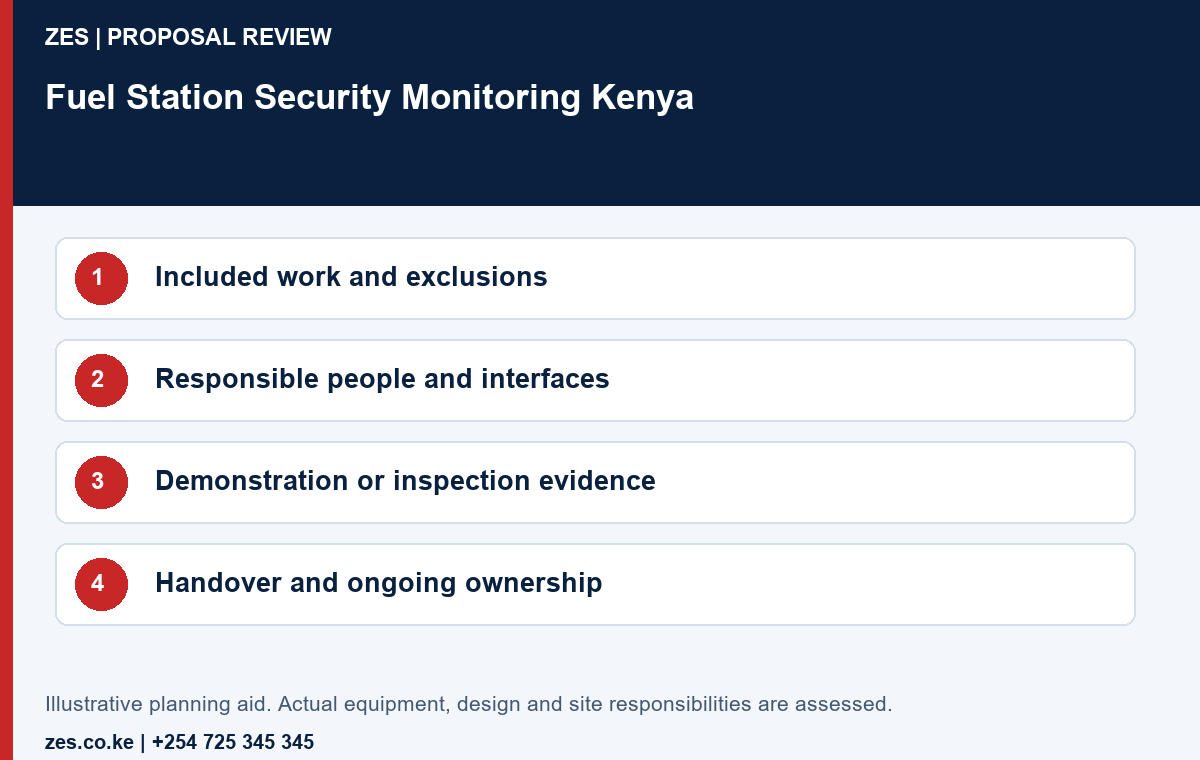
A useful specification separates the result the station wants from the product a supplier proposes. Start with a short statement of the operational problem, the people affected and the evidence that would show improvement. Give each requested deliverable a reference. A supplier can then identify the equipment, labour, configuration, documentation and customer dependencies against that reference. This makes it easier to compare offers without assuming that similar item names describe the same complete monitoring service.
Keep a simple comparison register with columns for requirement, included work, excluded work, customer action, acceptance evidence and price basis. An item marked included should have enough detail to distinguish supply alone from installation, configuration or commissioning. An exclusion is not necessarily a poor offer; it becomes a problem when the station discovers it only after work starts. Clarify unanswered questions in writing and attach the clarification to the agreed proposal.
The station should nominate one commercial contact and the operational or technical people who can approve their respective parts. A cashier may explain a daily workflow without having authority to approve a system change. A premises manager may approve access while another party owns an interface or structure. Record these boundaries early. Give the supplier a coordinated response instead of several conflicting instructions from people who assume somebody else has approved the change.
Use a dependency list before agreeing an implementation date. Examples include approved access, available records, enabling works, an authorised test window and attendance by another supplier. For each dependency, identify who provides it and how readiness will be confirmed. Separate the proposed working duration from the full calendar programme. A short installation task can still depend on an assessment, procurement or approval that has not yet been completed.
Use an evidence register rather than a completion claim
Create one acceptance entry for each important requirement. Record the agreed condition, the expected result, the observed result, the person witnessing it and any remaining action. Use the selected product documentation and approved design to decide what is appropriate to test. The examples in this guide are purchasing questions, not permission to carry out hazardous operations or alter live station equipment. Tests must be planned and performed by the responsible people under the site’s arrangements.
An entry should be specific enough for another manager to understand later. An observation such as tested successfully does not explain what was tested. A clearer entry identifies the relevant asset or sample record, the conditions checked and the evidence retained. Do not publish sensitive configuration, employee information or security layouts in a public project gallery. Keep the operational evidence in the customer’s controlled handover file, with access appropriate to its contents.
Distinguish a defect from an agreed exclusion, a customer dependency and a later improvement request. Each needs a different decision. Assign an owner and review date to unresolved matters. If an issue affects the safe or intended use of the delivered work, the responsible parties must decide the appropriate restriction and resolution before treating the affected monitoring scope as accepted. A signature should record an informed decision rather than conceal an incomplete requirement.
Customer acceptance and a supplier invoice serve different purposes. An invoice identifies a commercial charge; it does not replace the technical evidence agreed for the project. Similarly, a photograph can show a visible installation without establishing its configuration, structural adequacy or reporting behaviour. Retain the relevant inspection, demonstration or test record alongside the commercial documents so that future reviews do not depend on recollection.
Plan ownership, changes and the next review
Ask for a handover index before completion. Depending on the monitoring scope, it may list equipment references, approved drawings, configured functions, maintenance information, licences, acceptance records and support contacts. Mark documents as supplied, not applicable or outstanding. Keep passwords and sensitive access arrangements separate from general manuals. The customer should know who controls each account and how authorised access will be transferred when an employee or contractor changes.
The person expected to use or maintain the result should demonstrate the ordinary task during handover. A presentation to the purchasing team is useful, but it is not the same as the nominated operator retrieving a report, identifying an asset or following the approved support route. Arrange cover for that role. Record the limits of the training and the subjects that still require a competent specialist rather than encouraging staff to improvise repairs.
Compare ongoing obligations as carefully as the initial price. Identify recurring licences, replacement consumables, support arrangements, inspection responsibilities and customer-provided services where relevant. Ask what happens if a renewal is not made, an account changes or an additional site is added. Do not assume that a one-time purchase includes every later configuration change, site visit or third-party monitoring service. Request current written commercial terms for the actual monitoring scope.
Schedule a review after a representative operating period. Compare the original requirement with actual use, note unresolved findings and decide whether the proposed improvement achieved its purpose. If the station changes layout, staffing, operating hours or another connected system, review the affected assumptions. Keep the approved baseline and later changes together. This gives future suppliers a reliable starting point and reduces the risk of replacing working equipment simply because its documentation has been lost.
A practical enquiry example
A useful monitoring brief states the included hours, the event requiring attention and the authorised contact chain. Ask who supplies notification delivery, who performs monitoring review and who owns a response decision. Keep those monitoring responsibilities explicit when comparing price. If staffed monitoring is required, obtain a specific service commitment rather than infer it from the availability of remote pictures or an alert application.
Prepare a clear enquiry for ZES
Share the station location, the problem or intended outcome, relevant quantities and the existing equipment or application references. Include available approved plans or anonymised examples where useful. Identify the person who can authorise site access and the contacts responsible for operations and technical interfaces. Keep credentials, employee biometric records and confidential transaction information out of a general enquiry.
Ask the written proposal to identify the supplied work, exclusions, customer dependencies, current commercial terms and the evidence used for acceptance. Confirm specialist responsibilities and relevant credentials for the actual scope. ZES can review the brief and confirm the appropriate assessment and proposal arrangements. Site attendance, timing, product availability and support commitments are agreed directly rather than promised solely because a project names a particular county or town.
Compare the same complete scope
- Equipment or materials: identify the actual model, specification and documentation.
- Supporting tasks: record enabling work, site access and customer-supplied dependencies.
- Configuration or fabrication: state the work and the responsible approving party.
- Acceptance: agree the demonstration, inspection or verification evidence required.
- Ownership: confirm accounts, records, recurring charges and the future support route.
Frequently asked questions
Does remote viewing include a staffed monitoring service?
No. Staffing, operating hours, escalation and response must be separately stated in the agreement.
Can monitoring prevent every incident?
No. Define the supported observations, limitations and response arrangements without promising universal detection or prevention.
Reference information: ODPC guidance.
Related ZES service · Petrol-station engineering enquiries · Request a scoped quotation · Request a site assessment · Call +254 725 345 345