
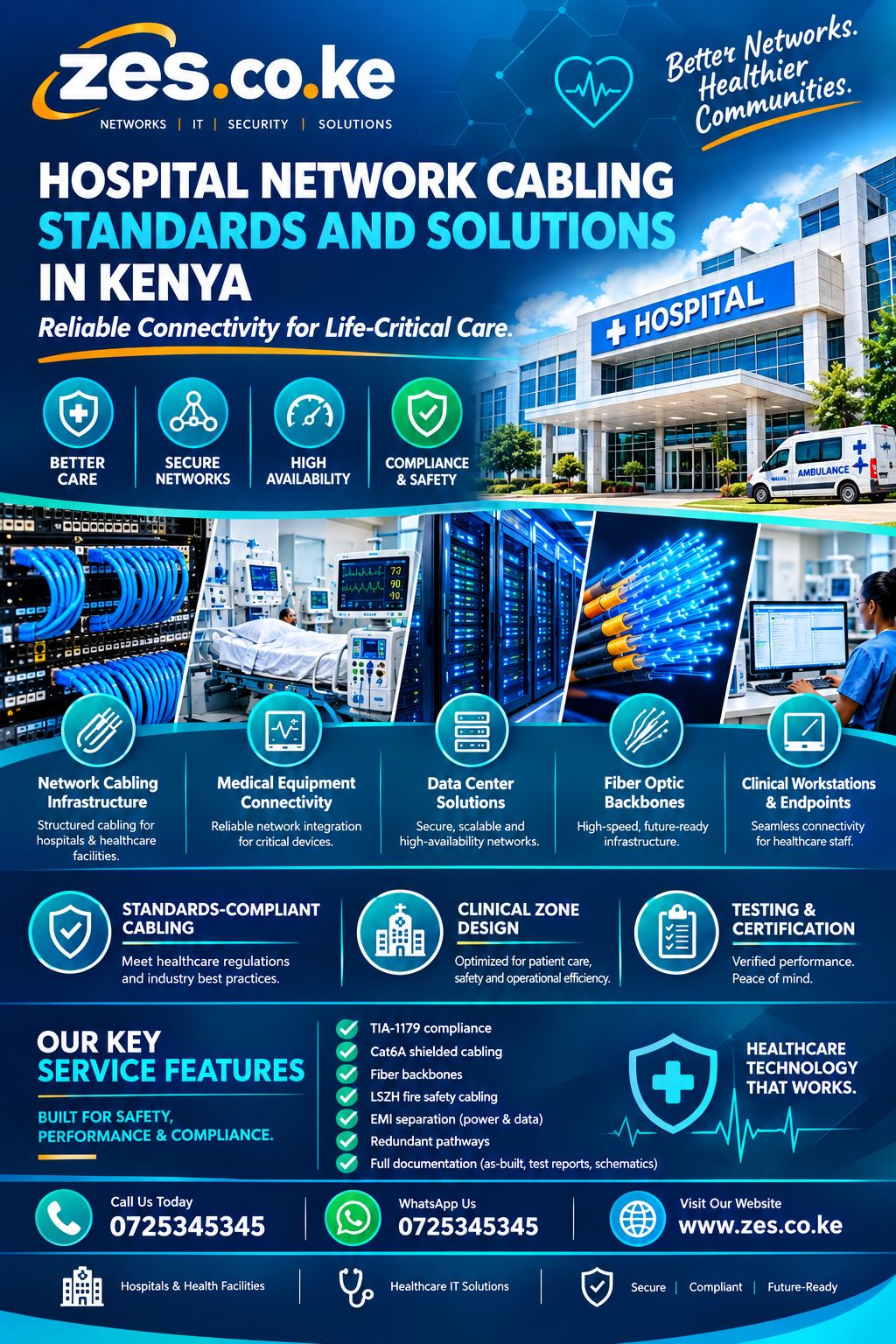
Hospital network cabling standards and solutions in Kenya have become a critical priority for healthcare facilities seeking to support digital health systems, electronic medical records, and life-critical medical devices, and at zes.co.ke, we understand that cabling in a hospital is not the same as cabling in an office. Whether you are equipping a private hospital in Nairobi’s Parklands, upgrading a mission hospital in Kisumu, or building a new medical facility in Mombasa, implementing professional hospital network cabling standards and solutions in Kenya is the foundation for patient safety, clinical efficiency, and regulatory compliance.
With the Ministry of Health’s Digital Health Strategy driving adoption of EMR systems, telemedicine, and connected medical devices, more healthcare facilities are recognizing that reliable cabling infrastructure is no longer a support function but a clinical necessity, and zes.co.ke is at the forefront of providing comprehensive healthcare cabling solutions.
The healthcare technology landscape in Kenya has evolved dramatically, with hospitals seeking cabling solutions that meet stringent standards for reliability, safety, and performance. When researching hospital network cabling standards and solutions in Kenya, you will discover that healthcare cabling must comply with international standards such as TIA-1179 for healthcare facilities, ISO/IEC 11801, and the IEC 60364 series for electrical installations in medical locations. These standards address critical requirements including separation of clinical and non-clinical traffic, redundancy for life-critical systems, electromagnetic compatibility, and fire safety. At zes.co.ke, we offer comprehensive solutions tailored to healthcare environments.
At zes.co.ke, we specialize in providing hospital network cabling standards and solutions in Kenya that address the unique challenges of medical facilities. Our solutions are designed to handle everything from small clinics to large referral hospitals with multiple buildings, all while maintaining the highest standards of reliability and regulatory compliance. We understand that every healthcare facility has different requirements, which is why we offer customizable solutions that fit your specific clinical needs, patient volume, and technology roadmap.
For healthcare administrators looking to build reliable digital infrastructure, hospital network cabling standards and solutions in Kenya represents a strategic investment in patient care and operational efficiency. A properly designed hospital network supports electronic medical records, picture archiving and communication systems (PACS), nurse call systems, patient monitoring, telemedicine, and administrative applications simultaneously. A single cable failure in a hospital can disrupt patient monitoring or delay critical test results, making professional installation and testing non-negotiable. zes.co.ke offers systems that integrate seamlessly with existing clinical and administrative systems.
The importance of professional installation cannot be overstated when considering hospital network cabling standards and solutions in Kenya. Proper installation ensures that your cabling system functions optimally and provides the reliability, safety, and performance that clinical operations demand. At zes.co.ke, our certified technicians understand the nuances of Kenyan healthcare environments—from the infection control requirements of operating theatres to the shielding needs of imaging departments—and can recommend the most appropriate solutions for your specific facility. From initial site assessment to final testing and documentation, we manage every aspect of the implementation process.
When evaluating hospital network cabling standards and solutions in Kenya, it’s essential to consider factors such as zone classification, cable pathways, redundancy requirements, and separation from medical equipment. Healthcare cabling must comply with TIA-1179 specifications that define cabling topology, distances, testing, and separation from electromagnetic interference (EMI) sources. For hospitals, Cat6 and Cat6A copper cabling remain the practical standard for horizontal runs, while fiber optic cabling is essential for backbone connections between buildings and floors. zes.co.ke provides expert guidance on these technical requirements.
The value of hospital network cabling standards and solutions in Kenya extends to specialized applications including operating theatres, intensive care units (ICUs), radiology departments, and laboratories. In these areas, cabling must be shielded against EMI from MRI machines and X-ray equipment, and isolated from other building systems. Medical-grade network infrastructure typically features redundant pathways, isolated circuits, and rigorous testing protocols to ensure reliability. At zes.co.ke, we offer advanced solutions tailored to the most demanding clinical environments.
For facilities requiring comprehensive network infrastructure, hospital network cabling standards and solutions in Kenya provides the foundation for integrated healthcare operations. Hospitals typically require dedicated VLANs for clinical systems, guest networks for patients, administrative networks, and medical device networks, all separated for security and performance. Our solutions support these requirements from the cabling layer up. At zes.co.ke, we prioritize practical, compliant solutions.
The user experience is crucial when selecting hospital network cabling standards and solutions in Kenya. Professional installations ensure that clinicians can access patient records, communicate with colleagues, and monitor patients without disruption. Cabling must also support round-the-clock operation with minimal downtime for maintenance, making clean installation and comprehensive documentation essential. At zes.co.ke, we prioritize clinician satisfaction and patient safety.
When exploring hospital network cabling standards and solutions in Kenya, modern solutions offer advanced approaches including structured cabling to every ward, clinic, and diagnostic room; fiber backbones between buildings; and PoE support for IP phones, wireless access points, and IP cameras. Healthcare systems increasingly rely on Power over Ethernet to simplify deployment of clinical and administrative devices. At zes.co.ke, we stay at the forefront of healthcare IT infrastructure.
The flexibility provided by hospital network cabling standards and solutions in Kenya extends to various cable types suitable for different hospital zones. Standard commercial-grade cabling is inappropriate for clinical spaces where patient safety, infection control, and electromagnetic compatibility matter. Cat6A shielded cabling (F/UTP) is recommended for areas with high EMI, while low-smoke zero-halogen (LSZH) jackets are required in oxygen-enriched environments. At zes.co.ke, we help you specify the right cabling for each zone.
The integration capabilities of hospital network cabling standards and solutions in Kenya extend to comprehensive clinical systems including EMR, PACS, laboratory information systems, nurse call, and security systems. Network segmentation through VLANs ensures that clinical traffic is never compromised by administrative or guest traffic. At zes.co.ke, we provide comprehensive integration solutions.
When considering hospital network cabling standards and solutions in Kenya, it’s important to work with providers who understand both the technical and clinical requirements of healthcare facilities. Professional providers assess each zone of your hospital—from reception and wards to operating theatres and mortuaries—and design cabling that meets the specific requirements of each area. At zes.co.ke, we ensure complete project management and clinical awareness.
For organizations requiring specialized healthcare cabling solutions, hospital network cabling standards and solutions in Kenya offers expertise in clinical zone cabling, EMI mitigation, and regulatory compliance. Hospitals must also consider fire safety requirements, with LSZH cabling used in high-risk areas and fire-rated barriers protecting cable penetrations through compartment walls. At zes.co.ke, we offer comprehensive healthcare cabling solutions.
Looking for cutting-edge technology in hospital network cabling standards and solutions in Kenya? Modern healthcare cabling includes high-density fiber solutions, intelligent patching for automated documentation, and structured cabling that supports future telemedicine and smart-hospital deployments. At zes.co.ke, we offer these innovative solutions for forward-thinking healthcare providers.
For advanced healthcare deployments, hospital network cabling standards and solutions in Kenya includes integrated monitoring and management of physical layer infrastructure, enabling predictive maintenance and reducing the risk of unplanned outages in critical clinical areas.
Core Standards for Hospital Network Cabling in Kenya
TIA-1179 Healthcare Facility Cabling Standard
TIA-1179 is the primary standard for healthcare facility cabling, defining requirements for cabling topology, distance, performance, and testing. It recognizes different healthcare areas—clinical, administrative, and support—and recommends appropriate cabling and separation for each. TIA-1179 specifies categories of cabling (Cat6 minimum, Cat6A recommended), recommends redundant pathways for life-critical systems, and requires proper separation from EMI sources. At zes.co.ke, we design all healthcare installations to meet or exceed TIA-1179 requirements.
ISO/IEC 11801 and IEC 60364 Standards
ISO/IEC 11801 provides the international framework for generic cabling in commercial premises, and healthcare facilities are covered through specific design guidance. IEC 60364-7-710 specifically addresses electrical installations in medical locations, requiring isolation, separation, and monitoring of circuits serving patient areas. At zes.co.ke, we ensure compatibility with these international standards.
Kenya Bureau of Standards and Local Requirements
Hospital cabling installations in Kenya must also comply with Kenya Bureau of Standards requirements for cabling materials, fire safety, and electrical installations. The Kenya Building Code and county fire regulations set requirements for cable fire performance and penetration sealing. At zes.co.ke, we ensure all installations align with KEBS and local regulatory requirements.
Fire Safety and LSZH Requirements
Hospitals require low-smoke zero-halogen (LSZH) cabling in areas where smoke emissions could endanger patients and staff, particularly in oxygen-enriched areas, operating theatres, and evacuation routes. Fire-rated barriers protect cable penetrations through compartment walls, and fire-stopping is required whenever cables breach a fire compartment. At zes.co.ke, we prioritize fire safety in all healthcare cabling.
Healthcare Zones and Cabling Design
Clinical Areas
Clinical areas include patient wards, examination rooms, treatment areas, and consulting rooms. Cabling in clinical areas must support EMR terminals, nurse call systems, patient monitoring, and Wi-Fi access. At least two outlets should be provided per clinical location, and cabling must be properly separated from medical equipment circuits. At zes.co.ke, we design clinical cabling for reliability and accessibility.
Critical Care Areas
Critical care areas include ICUs, HDU, neonatal units, and operating theatres. These areas have the highest requirements for reliability, redundancy, and EMI protection. Cabling must support life-critical monitoring, ventilators, anaesthesia machines, and imaging systems. Redundant pathways and UPS-backed circuits are essential. At zes.co.ke, we design critical care cabling to the highest standards.
Diagnostic Imaging Areas
Diagnostic imaging areas include radiology, CT, MRI, and ultrasound departments. MRI rooms require special shielding and cabling considerations, with fiber optic connections used to isolate equipment from EMI. X-ray and CT suites need high-bandwidth connections for PACS. At zes.co.ke, we provide specialized imaging department cabling.
Support and Administrative Areas
Support areas include administration, records, pharmacy, and laboratories. Cabling in these areas can be designed to commercial standards with healthcare-specific requirements for fire safety and separation. At zes.co.ke, we design support area cabling to balance performance with cost.
Public and Patient Areas
Public areas include reception, waiting rooms, and patient access zones. Cabling in these areas supports guest Wi-Fi, queue management systems, and wayfinding. Appropriate physical protection and separation are required. At zes.co.ke, we design public area cabling for durability and security.
Cable Types and Selection
Cat6A Shielded Cabling (F/UTP)
Cat6A shielded cabling is recommended for healthcare environments with high EMI, such as imaging departments and areas near heavy electrical equipment. The shielding protects signal integrity against electromagnetic interference, ensuring reliable data transmission. At zes.co.ke, we supply and install Cat6A shielded cabling where required.
Cat6 UTP Cabling
Cat6 UTP cabling is suitable for most clinical and administrative areas where EMI is not a concern. It supports 1 Gbps reliably and 10 Gbps over shorter distances. At zes.co.ke, we use Cat6 UTP for standard clinical and administrative deployments.
Fiber Optic Backbone Cabling
Fiber optic cabling provides the high-bandwidth backbone between floors and buildings. It is immune to EMI and supports distances beyond copper limitations, making it essential for connecting main distribution frames, building distribution frames, and floor distribution frames. At zes.co.ke, we design fiber backbones for campus-wide healthcare connectivity.
LSZH-Jacketed Cabling
LSZH-jacketed cabling is required in oxygen-enriched areas, operating theatres, and evacuation routes. It emits minimal smoke and no halogens during a fire, protecting patients and staff during evacuation. At zes.co.ke, we specify LSZH cabling for all healthcare installations.
Cabling Design Considerations for Hospitals
Separation from Medical Equipment
Proper separation between data cabling and electrical circuits serving medical equipment is essential to prevent EMI. TIA-1179 specifies minimum separation distances based on circuit voltage and type. At zes.co.ke, we prioritize separation in every design.
Redundancy and Diversity
Life-critical systems require redundant cabling pathways that are physically and electrically diverse, ensuring that a single failure does not disable critical systems. Redundancy applies to horizontal cabling, backbone cabling, and pathway diversity. At zes.co.ke, we design redundancy into every critical care area.
Pathways and Spaces
Healthcare cabling requires dedicated pathways (conduits, trays, and risers) and spaces (telecommunications rooms and equipment rooms) that are separated from other building systems. Pathways should be sized with 40-50% spare capacity for future expansion. At zes.co.ke, we design sufficient pathways and spaces for growth.
Testing and Certification
All cabling must be tested and certified to the applicable standard. Testing includes wire map, length, insertion loss, NEXT, return loss, and other parameters. Documentation includes test reports, as-built drawings, and cable schedules. At zes.co.ke, we provide comprehensive testing and documentation.
Labelling and Documentation
Clear labelling and comprehensive documentation are essential for healthcare facilities where maintenance must be performed quickly and accurately. Every cable, outlet, and patch panel port should be labelled, with documentation matching physical installation. At zes.co.ke, we deliver complete labelling and documentation.
Infection Control
Cable installation in clinical areas must respect infection control requirements. Disruption during installation should be minimized, dust and debris contained, and surfaces cleaned after work. At zes.co.ke, we plan every installation with infection control in mind.
The Installation Process at zes.co.ke
Initial Consultation and Site Assessment
The first step in hospital network cabling standards and solutions in Kenya is a comprehensive consultation. At zes.co.ke, we assess each hospital zone, review clinical requirements, and evaluate existing infrastructure. We identify EMI sources, review fire compartments, and plan cable pathways.
System Design and Equipment Specification
Based on the assessment, our experts design a cabling solution that meets TIA-1179 and applicable standards for each zone. We specify cable types, quantities, pathways, redundancy, and documentation requirements.
Professional Installation
Our certified technicians execute the installation with minimal disruption to hospital operations. We follow infection control protocols, work around clinical schedules, and maintain safety in all areas including operating theatres and ICUs.
Testing and Certification
After installation, every cabling link is tested to the applicable standard, with reports provided for compliance and ongoing management. We verify performance, labelling, and documentation.
Documentation and Handover
We deliver comprehensive documentation including as-built drawings, test reports, cable schedules, and labelling records. We provide training for hospital IT teams on system management and maintenance.
Ongoing Support
At zes.co.ke, we provide ongoing support including scheduled maintenance, fault finding, and additions or changes. We help hospitals keep their cabling infrastructure in peak condition throughout its lifecycle.
Common Hospital Cabling Challenges in Kenya
EMI from Medical Equipment
Radiology and imaging departments generate significant EMI that can disrupt standard cabling. Shielding and separation are required, along with proper grounding. At zes.co.ke, we mitigate EMI through proper design and materials.
Infection Control During Installation
Installing cabling in operating theatres and ICUs requires stringent infection control measures. We plan work to minimize dust, contain debris, and clean thoroughly after installation. At zes.co.ke, we prioritize infection control.
Continuity of Clinical Operations
Hospitals cannot shut down for cabling work. We schedule installation in phases, work after hours where required, and coordinate closely with hospital management. At zes.co.ke, we prioritize clinical continuity.
Regulatory Compliance
Compliance with TIA-1179, IEC 60364-7-710, and KEBS requirements is essential. We provide documentation to support regulatory submissions and inspections. At zes.co.ke, we ensure regulatory compliance.
Future-Proofing
Healthcare technology evolves rapidly. We design cabling infrastructure with spare capacity and high-performance components to support future clinical applications. At zes.co.ke, we design future-ready solutions.
Benefits of Professional Hospital Cabling
Patient Safety
Reliable cabling supports life-critical systems including monitoring, nurse call, and medication administration. At zes.co.ke, we prioritize patient safety.
Clinical Efficiency
Clinicians can access records, images, and communications without delays. At zes.co.ke, we deliver efficient connectivity.
Regulatory Compliance
Professional installations meet TIA-1179, IEC 60364-7-710, and KEBS requirements. At zes.co.ke, we ensure regulatory adherence.
Reduced Downtime
Redundant pathways and quality components reduce unplanned outages. At zes.co.ke, we minimize downtime.
Future-Proof Infrastructure
Scalable cabling supports evolving healthcare technology. At zes.co.ke, we design for growth.
Investing in professional hospital network cabling standards and solutions in Kenya is a strategic decision that protects patients, supports clinical operations, and ensures regulatory compliance. At zes.co.ke, we are committed to providing expert design, quality materials, and professional installation for all your healthcare cabling needs. Whether you require a single department upgrade or a full hospital deployment, our experienced team delivers reliable cabling solutions.
Hospital network cabling standards and solutions in Kenya represent a valuable investment in your healthcare facility’s digital infrastructure and patient safety. By choosing a professional provider like zes.co.ke, you ensure your cabling system is properly designed, installed, tested, and documented for optimal performance. Our commitment to quality and customer satisfaction ensures you receive a solution that meets your specific clinical needs.
For more information about hospital network cabling standards and solutions in Kenya and to schedule a site assessment, contact zes.co.ke today. Our friendly team is ready to answer your questions and provide expert guidance for your healthcare cabling project.
- Hospital network cabling standards and solutions in Kenya
- Hospital network cabling standards and solutions in Kenya
- Hospital network cabling standards and solutions in Kenya
- Hospital network cabling standards and solutions in Kenya
- Hospital network cabling standards and solutions in Kenya
- Hospital network cabling standards and solutions in Kenya
- Hospital network cabling standards and solutions in Kenya