
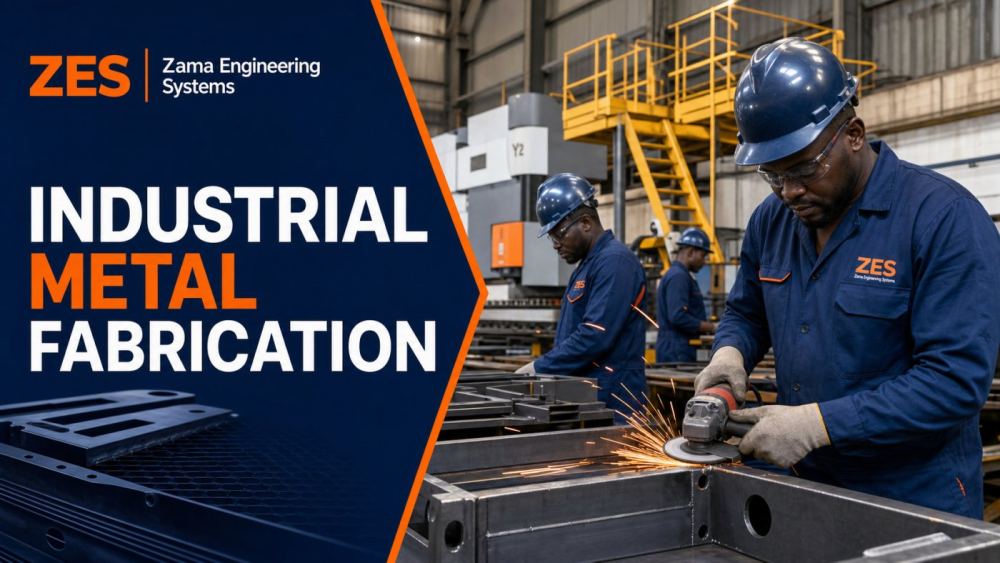
Industrial metal fabrication in Kenya should improve an operating asset without introducing difficult access, contamination traps or an unmaintainable one-off solution. ZES develops site-specific fabrication scopes for factories, processors, workshops, water facilities, farms and warehouses. Typical work can include guards, platforms, frames, supports, trolleys, access steelwork and repairs, subject to the approved technical information and site controls.
Start with the duty, not a copied shape
An industrial component is exposed to loads, vibration, temperature, washdown, chemicals, impact, dust or repeated maintenance. The brief should state what the item carries or protects, its operating cycle, interfaces, cleaning regime and consequence of failure. Measurements taken while equipment is stopped may not show thermal movement or operating clearances.
Machine guards need safe access and interlock coordination where applicable. Platforms and ladders require defined loading and safe geometry. Pipe or cable supports should not obstruct valves or inspection. Frames and bases must consider alignment and vibration. Any modification to original equipment should be reviewed with the relevant technical owner and manufacturer information where available.
Plan fabrication around production
Agree isolations, shutdown duration, permit requirements, hygiene controls and return-to-service authority. Measure and prefabricate as much as reasonably possible before a planned outage. Templates or a trial assembly can reduce site fitting. If site welding is necessary, the method should address fire risk, nearby product, cables, combustible dust, coatings and protected equipment.
A staged scope may separate urgent risk controls from a permanent engineered solution. Temporary reinforcement should be clearly identified, time-limited and inspected. It must not become the undocumented final condition because production resumed.
Industrial fabrication deliverables
- Problem statement, boundaries and operating assumptions.
- Verified dimensions and interface points.
- Approved sketches or drawings with material and finish.
- Access, isolation and installation sequence.
- Inspection points and functional acceptance criteria.
- Records of modifications to the agreed information.
- Maintenance access and replacement considerations.
For repeated components, approve a first article before batch production. A jig can control consistency, but the sample still needs to be checked against the real equipment and user workflow. Where hygiene matters, review joints, hollow sections, crevices and coating compatibility with cleaning practices.
Choosing between repair and replacement
Visible cracking can be the symptom of overload, vibration, stress concentration, misalignment or corrosion loss. Welding over the crack without finding the cause often transfers the problem or delays failure. Inspect the parent material, surrounding geometry and operating history. A competent technical person should decide whether to repair, reinforce, redesign or replace.
For failure assessment and urgent callouts, use the welding repair and maintenance guide. A portfolio of recurring defects may be better managed through a documented preventive maintenance programme rather than repeated emergency work.
Pricing industrial metal fabrication
Budget drivers include engineering information, material grade and section, quantity, complexity, machining or forming, finish, quality records, shutdown access, lifting, hygiene controls, travel and testing. Production downtime can be a larger commercial cost than the fabricated item, so compare proposed methods and outage duration—not only the fabrication price.
A site survey allows ZES to identify information gaps and quote the defined part of the work. The proposal should state exclusions such as civil bases, electrical interlocks, OEM approval, specialist inspection or structural design.
Industrial design inputs
Capture equipment make and model where relevant, process description, loads, speed, temperature, vibration, chemicals, cleaning, hygiene zone, utilities and maintenance tasks. Mark no-go areas, guarding boundaries and emergency access. Obtain original drawings or manuals when available and record where information is unknown.
For a platform or support, define imposed loads, equipment loads and movement. For a guard, define the hazard and access needed for inspection or clearing jams. For a trolley or frame, define payload, centre of gravity, floor condition and handling method. Design input must reflect abnormal but foreseeable use, not only ideal operation.
Materials and fabrication detail
Material choice considers strength, stiffness, wear, corrosion, contamination, weldability, availability and repair. Thin hollow section may reduce weight but can dent or corrode internally. Plate thickness, bend radius, edge treatment and reinforcement affect both performance and cleanability. Stainless work requires suitable handling to avoid contamination and damage to its finish.
Detail joints to avoid inaccessible product or water traps where hygiene or corrosion matters. Removable guards and covers need robust, repeatable fasteners. Label pieces that must return to a specific machine position. If the component interfaces with machined surfaces, protect them during welding and coating.
Management of change
Industrial sites should not treat fabricated modifications as informal maintenance. Record the reason, affected equipment, technical approval, drawing change, risk assessment and training or procedure impact. A new platform may alter access; a guard may affect visibility; a support may transmit vibration; a heavier gate may affect an automated drive.
Before return to service, the responsible operations and maintenance personnel should inspect the change and accept any updated method. Keep the as-built sketch or drawing with the asset file. Temporary bypasses or removed guards must be tracked and restored.
Industrial HSE and permit controls
Confirm isolation of electrical, mechanical, hydraulic, pneumatic, thermal, gravitational and process energy. Empty-looking equipment may retain pressure, chemical residue or combustible vapour. The site owner’s permit system and competent process advice govern preparation. Welding near tanks, lines or confined spaces needs specialist controls beyond a normal workshop method.
Manage lifting, restricted access, dropped objects and work at height. Protect adjacent instrumentation, cables and bearings from heat, dust and spatter. Establish housekeeping and tool accountability, particularly in food or product-contact areas. Test gas or ventilation where the site assessment requires it.
QA, inspection and commissioning
Use inspection points that relate to the component: critical dimensions, fit, alignment, guard openings, weld condition, coating, fasteners, wheel operation, removable access and load or function tests defined by the responsible technical person. A fabricated item should be trial-fitted before final coating where interfaces are uncertain.
Commission under controlled conditions. Run equipment slowly or unloaded first where appropriate, observe vibration and clearances, then progress according to the approved test. Record who authorised return to service, what was tested and when follow-up inspection is due.
Handover and spares
Provide drawings or sketches, material and coating information required by the contract, inspection record, functional test, spare or wear-part details and maintenance instructions. Identify special tools and safe removal sequence. If the component has a rated capacity or usage limit, mark and document it appropriately.
For repeat components, give the client the approved part identifier and revision. This helps future replacement match the right machine instead of relying on an old damaged sample.
Industrial buyer checklist
- Define the operating duty and consequence of failure.
- Provide equipment and process information.
- Assign design and modification approval.
- Agree isolation, shutdown and permit responsibilities.
- Approve a sample or trial fit where useful.
- Set inspection and commissioning criteria.
- Capture the change in the asset record.
- Plan spares, wear parts and follow-up inspection.
Industrial examples that require different briefs
A machine guard prioritises separation from a hazard while preserving authorised maintenance. A pipe support controls loads and movement without blocking valves. A washdown trolley needs drainage, cleanable joints and suitable wheels. A maintenance platform needs approved loads, safe access, guarding and clearance from operations. Naming the asset alone does not communicate these functional differences.
Use an operational acceptance test that reflects the brief. A trolley should manoeuvre with its intended load; a removable guard should return to the same secure position; a platform should be inspected under the approved test plan; a support should be checked during the relevant operating condition.
Questions for an industrial fabricator
- Which operating and maintenance information is missing?
- How will work interface with isolations and production permits?
- Which dimensions require a shutdown to verify?
- How will heat, distortion and contamination be controlled?
- What trial fit, first article or commissioning is proposed?
- How are drawing changes added to the asset record?
- Which spares or wear parts should be supplied?
Build-versus-buy decision
Before commissioning a custom industrial item, check whether a compliant, maintainable standard product exists. A bought item may bring tested capacity, documentation and spares. Custom fabrication is appropriate when the requirement or interface is genuinely site-specific and the buyer can define and approve the necessary design and test evidence.
Post-installation review
Inspect the fabricated item after an agreed period of production. Look for looseness, vibration marks, coating wear, difficult access, trapped product, deformation and operator workarounds. A review under real duty can reveal issues that commissioning at low speed or without product could not. Record improvements through management of change before altering the component.
Frequently asked questions
Can ZES fabricate from an existing component?
Possibly, but the old component should not be assumed correct. Its duty, failure history, dimensions, material and interfaces need review before it becomes the pattern.
Can work be completed during a shutdown?
Yes where the agreed scope, isolations, materials, people, permits and access are ready. Prefabrication and a clear return-to-service test reduce outage risk.
Do you repair factory machinery?
ZES can assess welding and fabricated-metal repairs within its scope. OEM, mechanical, electrical or engineered approval requirements are identified before work proceeds.