

Petrol Station Canopy Refurbishment Nairobi projects should begin with an assessment of what has deteriorated and why. A cosmetic finish, a roof leak and a structural concern need different decisions. This guide adds a refurbishment brief to ZES’s existing canopy-repair page. ZES can review the reported condition and confirm the appropriate assessment and proposal arrangements; replacement, strengthening and site-work decisions require the responsible competent parties.

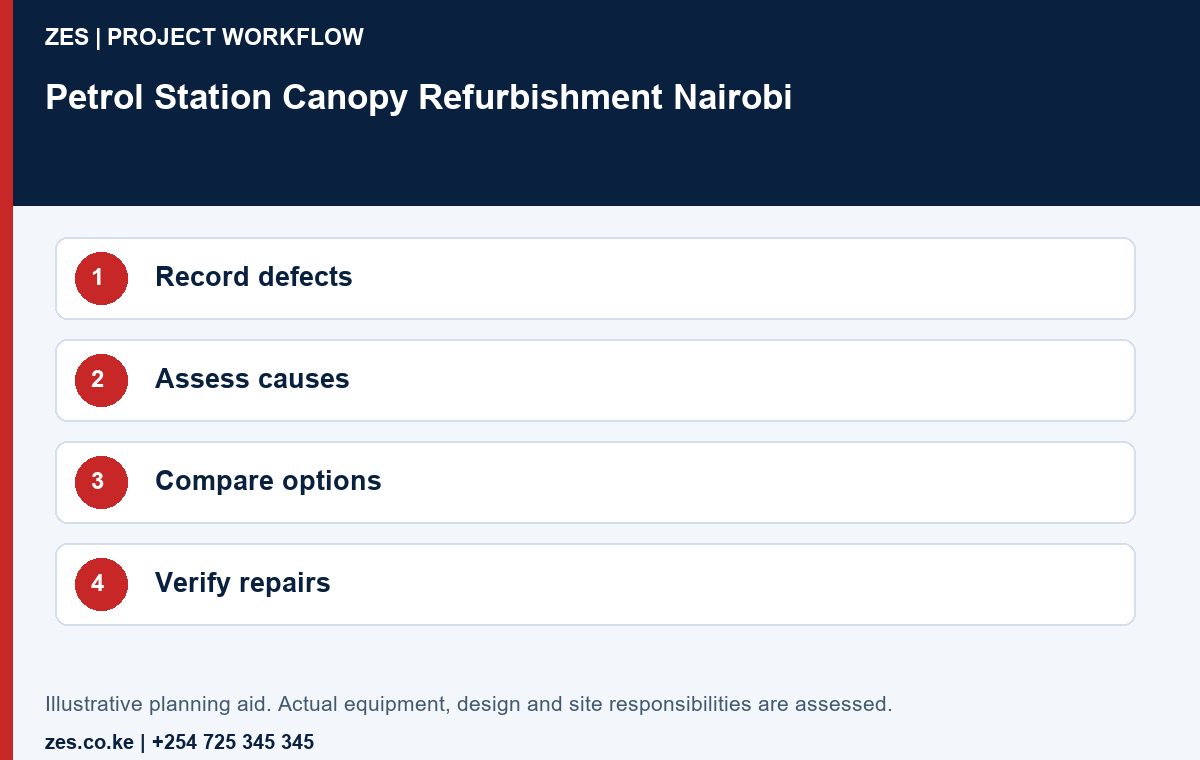
1. Record condition by location
Prepare dated photographs and a location schedule of reported defects, taken only from safe authorised positions. Explain when the problem was noticed and whether it has changed. Distinguish visible symptoms from conclusions about their cause. A quotation should identify what has been assessed and what remains uncertain, rather than assume that a fresh coating resolves every concern.
2. Separate finish, roof and structural questions
Ask the assessor to distinguish coating deterioration, roofing or drainage defects and concerns requiring structural review. Assign each question to the appropriate competent party. Avoid accepting a general refurbishment description as evidence that load capacity or concealed condition has been verified. The required assessment should determine which options can reasonably be compared.
3. Review leak paths and interfaces
If water entry is reported, investigate the relevant roofing, junction and drainage interfaces through an appropriate assessment. Record the proposed remedial scope and how its result will be checked. A visible interior stain does not by itself identify the cause. Keep responsibility clear where roofing, steelwork, signage or electrical components belong to different contractors.
4. Compare retain, repair and replacement options
Ask the proposal to explain which elements can remain, which need repair and which require further assessment or replacement. Record the basis and limitations of that recommendation. Do not compare only a repainting price with a more extensive remedial scope. The customer needs to understand the different outcomes and unresolved risks each option addresses.
5. Agree site-work responsibilities
Plan access and controlled work areas with the station operator and competent contractors. Identify effects on ordinary operations and any specialist authorisation required by the proposed method. Work at height, lifting and potential hot work need their own assessed arrangements. This buyer guide is not a method for carrying out canopy repairs beside fuel operations.
6. Make variations and finishes explicit
Specify preparation, coating or replacement requirements and how concealed deterioration changes the agreed scope. Record approval of variations before additional work proceeds. Include interfaces, reinstatement and cleanup responsibilities. The proposal should explain the actual finish and inspection requirements without promising a universal maintenance-free life.
7. Verify the result and retain records
Use the agreed inspection and acceptance plan to review completed work. Record outstanding items, photographs of accessible completed areas and relevant updated information. Confirm future maintenance access and support arrangements. A useful handover explains what was repaired and what was excluded, helping the operator review later condition changes without relying on memory of the refurbishment discussion.
Petrol Station Canopy Refurbishment Nairobi: demonstration and review workbook
A canopy looks weathered and the operator requests refurbishment. The buying decision should separate visible finish deterioration from the condition of the underlying elements and connections. A cosmetic refresh may be a defined refurbishment scope, but it cannot establish structural adequacy or explain every source of water entry. Use a condition register to agree the investigation, repair decisions and finishes before refurbishment work. This hypothetical example helps the buyer avoid accepting a freshly painted appearance as proof that every reported canopy problem has been resolved.
The following cases help the buyer specify and compare the actual refurbishment project. Agree which apply to the proposed refurbishment scope and record any exclusions before acceptance. They are hypothetical review prompts, not evidence of a completed ZES client refurbishment project. The responsible site team and relevant competent parties approve any physical tests or changes to live operations.
Reported condition
Record the operator’s observations, their locations and relevant history. Distinguish an identified defect from a suspected cause that still requires competent investigation before repair selection.
Survey boundary
State which canopy elements are assessed and what remains inaccessible. A report should not imply that concealed components were checked when access or refurbishment scope did not allow it.
Repair decisions
Ask the responsible competent parties to classify the required intervention. Surface preparation, component repair, replacement and structural alteration are different scopes with different supporting evidence.
Existing supports
Identify any findings that affect the existing structural arrangement. Refurbishment should not bypass required assessment merely because the original request was described as painting or general repair.
Water-related findings
Where water entry is reported, identify the investigation and verification refurbishment scope. Do not promise that coating an unrelated surface will resolve an unconfirmed drainage or envelope problem.
Interface protection
Agree responsibility for adjacent lighting, signs and other affected services. The site plan should identify who authorises and handles the relevant interfaces during the permitted refurbishment work.
Approved materials
Record the selected repair and finish specifications through the appropriate refurbishment project documents. A similar colour or generic product category does not establish equivalent suitability.
Hidden refurbishment work evidence
Identify the checks and records required before repaired areas become concealed. Keep any approved changes distinguishable from the original proposal and attach the supporting information.
Operating coordination
Agree access, station operating boundaries and the responsible refurbishment work method. The programme must follow readiness and approvals rather than assume that site refurbishment is ordinary unrestricted workshop refurbishment work.
Review after refurbishment work
Compare the supplied refurbishment against the original findings and agreed evidence. Keep unresolved items visible and identify any continuing maintenance or later assessment requirement.
Detailed buyer questions
Does refurbishment guarantee a structurally sound canopy?
Not by its name alone. The proposal and competent assessment must identify what was checked and what evidence supports the actual repair or structural refurbishment scope.
Should every weathered component be replaced?
The appropriate intervention follows the assessment and approved design or repair requirements. Ask for the basis of the proposed treatment, including limitations and any further investigation needed.
What is a useful acceptance record?
Link each original finding to the authorised treatment and appropriate verification evidence. Retain relevant photographs, inspection records, materials references and outstanding actions in the customer’s controlled file.
Prepare a clear enquiry for ZES
Share the station location, the problem or intended outcome, relevant quantities and the existing equipment or application references. Include available approved plans or anonymised examples where useful. Identify the person who can authorise site access and the contacts responsible for operations and technical interfaces. Keep credentials, employee biometric records and confidential transaction information out of a general enquiry.
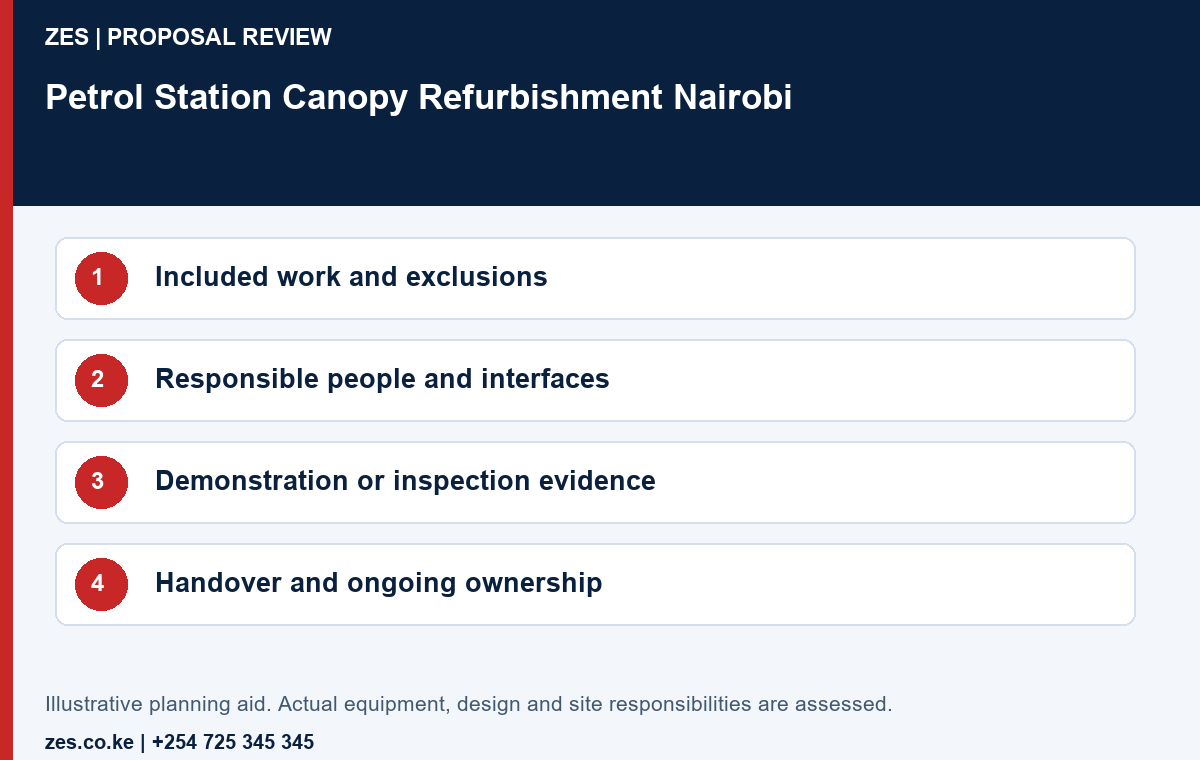
Ask the written proposal to identify the supplied work, exclusions, customer dependencies, current commercial terms and the evidence used for acceptance. Confirm specialist responsibilities and relevant credentials for the actual scope. ZES can review the brief and confirm the appropriate assessment and proposal arrangements. Site attendance, timing, product availability and support commitments are agreed directly rather than promised solely because a project names a particular county or town.
Compare the same complete scope
- Equipment or materials: identify the actual model, specification and documentation.
- Supporting tasks: record enabling work, site access and customer-supplied dependencies.
- Configuration or fabrication: state the work and the responsible approving party.
- Acceptance: agree the demonstration, inspection or verification evidence required.
- Ownership: confirm accounts, records, recurring charges and the future support route.
Frequently asked questions
Is repainting sufficient for every canopy defect?
No. Assess the cause and distinguish finish work from roofing, drainage and structural questions.
Can a refurbishment proceed while the station trades?
That requires a site-specific operating and work plan agreed by the responsible parties; it should not be assumed.
Reference information: NCA contractor information · EPRA petroleum application guidance.
Related ZES service · Petrol-station engineering enquiries · Request a scoped quotation · Request a site assessment · Call +254 725 345 345
Further guidance on the existing service

Petrol station canopy repair in Kenya starts with understanding why the canopy has deteriorated. A dripping roof, loose fascia and corroded column are different problems. They should not receive the same quotation or the same repair method. For a station owner, the useful outcome is a defined repair scope that addresses the defect, protects people and equipment, and explains how the repaired area will be inspected before handover.
ZES can assess enquiries for canopy repairs alongside the wider station maintenance requirement. Share your location, the age of the structure if known, photographs taken from a safe position and a description of when the problem appears. The initial information helps establish which specialists and access arrangements the assessment may require. It does not replace a site inspection or structural judgement.
Identify what has changed
Record observations without climbing onto the canopy or entering an unsafe area. Useful observations include water dripping at a particular joint, stains around a downpipe, panels moving during windy weather, a vehicle impact or rust developing around a connection. Note whether the issue began suddenly or became worse over several months. Keep the description factual: “water appears above dispenser two during heavy rain” is more helpful than assuming the entire roof needs replacement.
An immediate concern such as a visibly displaced member, hanging panel or recent vehicle impact needs the operator’s incident response and assessment by the appropriate competent people. Staff should use the station’s established procedures to manage access and operation. A marketing article cannot determine whether an affected bay or station is safe to keep open.
Separate roofing defects from structural defects
A canopy comprises several connected systems. Roofing and flashings manage rainwater; gutters and downpipes discharge it; fascia and branding form the visible perimeter; structural members and foundations carry loads. Lighting, cabling and other equipment may also be attached. Repairing one component can affect another, particularly where access requires removal of cladding or equipment.
A roof leak does not automatically mean a structural member is defective. Conversely, repainting a corroded column does not demonstrate that it retains the required capacity. Where corrosion, distortion, cracking or movement raises structural concerns, the assessment should involve a responsible structural professional. Ask the quotation to distinguish cosmetic treatment, component replacement and any investigation or engineered strengthening.
Investigate the path of water
Water can travel along a sheet or member before appearing at a visible drip point. The survey should consider joints, penetrations, edge details, drainage and the condition of the surrounding material. Repeatedly sealing the location of the drip may conceal the symptom without correcting the entry point. Provide previous repair records so the assessor can see whether the same area has been treated before.
Drainage deserves its own scope. A damaged gutter, obstructed outlet or failed connection can create overflow that looks like a roof failure. The contractor should state what will be inspected and what evidence will demonstrate improvement. Any proposed water testing must be planned around electrical equipment, vehicles and station operation; the owner should not improvise a test at height.
Agree how corrosion will be assessed
Paint bubbling and surface rust should prompt inspection of the affected area and its environment. Water traps, damaged coatings and dissimilar materials can influence deterioration. The assessment should explain whether local surface preparation is sufficient or whether material condition requires further investigation. Do not accept a blanket claim that a fresh finish restores structural strength.
For coating work, the proposal should identify the surfaces included, preparation standard or method, coating system and access limitations. It should also identify areas that cannot be inspected until cladding is removed. This makes provisional costs understandable and gives the owner a fair basis for approving additional work after concealed conditions are exposed.
Plan access around a working forecourt
The access method is a major part of the repair, not an incidental cost. Work at height may require appropriate platforms, exclusion areas and a plan for moving equipment into position. The station team needs to know how delivery routes, customer circulation, tanker movements and pedestrian access will be affected. Agree who coordinates the work with the operator and who can authorise changes to the work area.
Fuel environments require specific controls. Welding, cutting, electrical work and other potentially hazardous activities must be assessed and managed by competent personnel under the applicable site procedures. Do not assume that working during a quiet period makes an activity safe. The quotation should include the relevant planning responsibilities without presenting generic promises as evidence of site suitability.
Compare repair and replacement options
Local repair may suit an isolated defect where the surrounding system remains serviceable. Replacement of a wider section may be more sensible where materials are extensively deteriorated, previous patches repeatedly fail or compatible components are unavailable. The decision should consider condition, access costs, expected maintenance needs and the consequence of another disruption.
Ask for options that describe the same underlying defect. An inexpensive patch and a complete roof renewal cannot be compared by price alone. Each option should explain the included area, assumptions, exclusions and remaining issues. Where a recommendation depends on investigation, obtain the investigation result before treating the final repair price as settled.
What belongs in the quotation
A useful quotation identifies the affected canopy or bay, measured quantities, materials, removal and disposal arrangements, access equipment and the proposed inspection process. It separates roofing, drainage, structural, electrical and branding work where different responsibilities apply. Drawings or annotated photographs can prevent confusion about the boundaries of the work.
Commercial details also matter. Ask how variations will be authorised, whether replacement branding is included, who reinstates disconnected equipment and what conditions apply to any workmanship warranty. Confirm taxes, transport and working-hour assumptions. A clear list of exclusions is useful when it prevents an owner from assuming that a roof repair also includes lighting repairs or a structural assessment.
Review the programme before mobilisation
The programme should show assessment, procurement, site preparation, repair, inspection and handover. Weather can affect roofing and coating activities, while custom-made components can affect procurement. Request a realistic sequence instead of an unsupported promise that all repairs will finish in a single visit. Where operations continue, agree the handover between work stages and the conditions for releasing each area.
Keep one named station contact and one contractor contact for operational decisions. Record changes in writing, especially when concealed deterioration alters the approved scope. Photographs should be organised by location and date so that a later reviewer can understand which defect was repaired and which item remains outstanding.
Inspect the finished work and keep records
Handover should connect each original defect to the corresponding completed work. Request before-and-after photographs, the materials or components used, inspection findings and any outstanding recommendations. For repaired drainage, define the agreed evidence of satisfactory flow. For structural work, obtain the relevant professional documentation rather than relying solely on a general completion note.
The station maintenance register should record the repair date, affected area and recommended follow-up inspections. New leaks, impact damage or movement should be reported through the operator’s normal procedures. A canopy repair is easier to manage over time when the records show both what was repaired and what was deliberately left outside the scope.
Common questions from station owners
Can a leaking canopy remain in operation during repairs? That depends on the defect, work method and site assessment. The operator and responsible specialists should decide the operational arrangement. Do not base the decision solely on whether the canopy looks sound from ground level.
Can a repair quotation be prepared from photographs? Photographs can support an initial discussion, but access, concealed conditions and measurements may change the scope. Treat any remote estimate as conditional until the necessary assessment has taken place.
Should branding be replaced at the same time? Coordinating work can reduce repeated access costs, but branding changes should not obscure defects awaiting inspection. Agree the sequence so the structure, roof and service interfaces are assessed before finishes are closed.
To begin a ZES enquiry, describe the visible defect, affected bays and any previous repairs. Include the site’s operational constraints and the outcome you need. That information supports a more useful assessment and a quotation tied to the actual canopy condition.
Discuss your project with ZES
Share the site location, photographs taken from a safe position, available drawings, quantities and intended outcome. ZES can confirm the assessment needed and provide a scoped proposal with responsibilities and exclusions.
Request a project quotation | Explore the related ZES service | Call +254 725 345 345
For current petroleum permit and licence application information, consult EPRA application guidance. Project-specific regulatory advice should come from the responsible professionals and authorities.