

Petrol Station Steel Bollards Nairobi enquiries should explain the intended function before comparing a diameter or appearance. A visual marker, a traffic-guidance element and a designed vehicle-protection system are different requirements. This guide helps operators prepare a fabrication and installation brief. ZES can review the steelwork requirement and confirm its supplied scope; protective performance, foundations and suitable placement require appropriate professional assessment for the actual site.

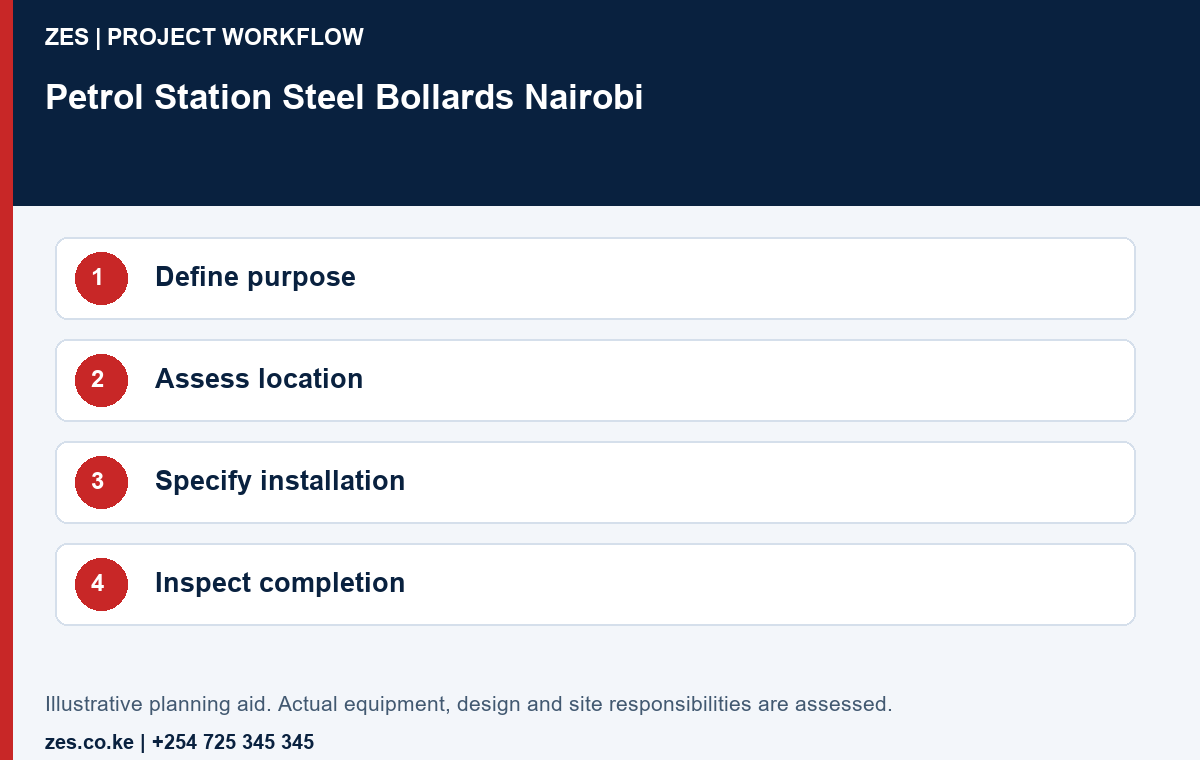
1. State the required function
Describe what the bollard is intended to do and identify the asset or route concerned. Avoid treating every steel post as an impact-rated protective barrier. If a defined protective performance is needed, obtain the appropriate design and evidence requirements from the responsible professional. Appearance or material thickness alone does not establish that performance.
2. Review placement and movement
Assess the proposed locations against vehicle and pedestrian movement, accessible routes and the station’s operating layout. Identify which responsible party approves placement. The fabrication brief should use actual site information rather than a standard spacing copied from another project. Keep any required protective-system design separate from a simple supply-only steelwork quotation.
3. Check foundations and underground interfaces
Before installation is planned, assign appropriate review of the support and fixing arrangement and relevant underground information. Do not assume that any available slab or unverified drilling position is suitable. The contractor and operator need a site-specific approved method. A general buyer guide should not be used as an excavation or drilling instruction for a fuel site.
4. Specify materials and finishes
Request the approved dimensions, material requirements, connection details and finish specification. Identify inspection and site touch-up responsibilities where relevant. Decorative visibility and corrosion protection should be described clearly. A coating colour or heavy-duty label is not a substitute for the structural or protective requirements the customer has actually specified.
5. Decide whether elements are fixed or removable
If access occasionally needs to change, describe the operational requirement and ask the responsible designer to assess a suitable arrangement. Confirm who can authorise any change and how the intended function is maintained. Do not assume that a removable component provides the same performance as a separately assessed fixed design.
6. Compare complete quotations
Separate fabrication, delivery, approved supporting works, installation, finishes and reinstatement. Identify what the customer must provide and which site assumptions need confirmation. Ask for evidence of any claimed product or system performance. This makes it easier to compare the same requirement without mistaking a simple fabricated marker for a tested protective system.
7. Keep an installation and inspection record
At handover, compare the work with the approved layout and specification. Record the supplied components, inspected work and any outstanding item. Agree how damage or a changed site layout will be referred for assessment. A bollard should not be assumed serviceable after an incident solely because it still appears upright.
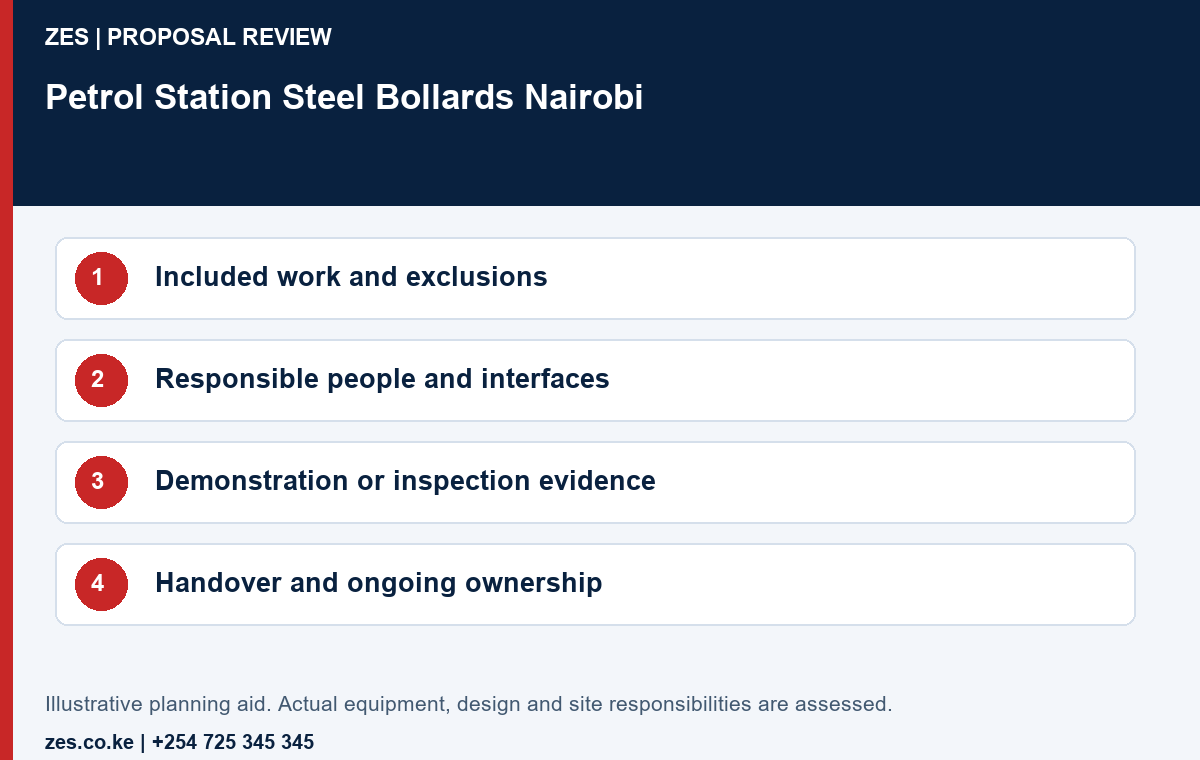
Petrol Station Steel Bollards Nairobi: demonstration and review workbook
A buyer asks for steel bollards near a vulnerable station asset. First decide whether the intended duty is visual guidance, access management or a specified protective function. These duties are not interchangeable, and appearance alone cannot establish impact performance. The responsible designer must assess location, traffic, relevant clearances, supporting conditions and the intended specification. This hypothetical procurement case helps the operator request a defined bollard installation without inventing a universal diameter, spacing or foundation detail for an unassessed fuel site.
The following cases help the buyer specify and compare the actual project. Agree which apply to the proposed bollard scope and record any exclusions before acceptance. They are hypothetical review prompts, not evidence of a completed ZES client project. The responsible site team and relevant competent parties approve any physical tests or changes to live operations.
Required function
Describe the intended duty of the bollards in plain language. If a specified protective performance is required, identify the responsible design and evidence rather than relying on appearance.
Asset boundary
Identify the asset or area concerned and the parties authorised to approve work nearby. Do not assume that a steel barrier can be placed wherever there is visible space.
Traffic review
Ask the responsible reviewer to consider actual vehicle and pedestrian movements. The proposed arrangement must be assessed for its intended use and relevant operational interfaces.
Site information
Identify dimensions, available drawings and the process for assessing relevant concealed services or supporting conditions. The quotation should state which investigation and enabling work are included.
Bollard specification
Compare the proposed steel bollards with the approved specification. Record the actual construction and documentation rather than an unsupported claim that any thick pipe is a protective system.
Fixing responsibility
Assign design and assessment of the supporting or anchoring arrangement to the responsible competent parties. This article does not provide installation dimensions or a universal fixing method.
Finish and visibility
Agree the finish and visibility requirements relevant to the approved use. Keep those requirements distinguishable from any structural or protective performance claimed for the bollard arrangement.
Installation boundary
Record the included supply, enabling work, installation, reinstatement and inspection tasks. A delivered bollard component does not demonstrate that the complete bollard installation has been supplied.
Acceptance evidence
Ask for checks against the approved layout and specification, with the documentation appropriate to the actual duty. A photograph alone cannot verify an untested performance rating.
Later damage
Agree how a struck, moved or visibly damaged bollard is reported and assessed. Avoid assuming that a bollard component remains suitable simply because it is still standing.
Detailed buyer questions
Are all steel bollards designed to stop vehicles?
No. Duties and performance differ. Require the intended function, specification and relevant evidence to be defined for the actual project instead of assuming protection from material or appearance.
Can bollards be installed without a site assessment?
A location needs the appropriate review of operations, supporting conditions and interfaces. Ask the proposal to identify the assessment and approval responsibilities before finalising the installation bollard scope.
What should a price comparison include?
Compare the same specified components, supporting works, finish, installation, reinstatement and acceptance evidence. A unit supply price should not be mistaken for the complete installed project cost.
Turn a metalwork enquiry into an approved physical bollard scope
Describe the required function, not only a desired appearance. A canopy member carries a different responsibility from a non-structural sign frame, and a protective bollard has a different purpose from a queue marker. Identify the location and the interfaces affected. The responsible designer or competent reviewer must establish the appropriate design and specification for the actual duty. A photograph is useful context but does not determine dimensions, load capacity or material selection.
Record what already exists before agreeing alterations. Available approved drawings, condition observations and measured site information help identify assumptions. The bollard scope should say who verifies existing supports, concealed conditions and connections to other work. Where information is missing, make the assessment task explicit. Do not allow a quotation based on a visible surface to become an unqualified promise about the structure or services behind it.
Specify material and finish through the approved project documents. Relevant details can include the member or sheet specification, connection arrangement, fabrication requirements and the intended protection system. Ask how the supplied work will be identified and checked. A general label such as heavy duty or stainless does not establish suitability for every application. Changes after approval need review because a visually similar substitute may perform differently.
Coordinate fabrication, installation and operations
The site team should distinguish workshop work from site work and identify who approves each stage. A bollard component completed in a workshop may still require site preparation, supporting construction, specialist lifting or coordination with live operations. The proposal should identify those interfaces and the responsible parties. Do not treat a delivered piece of metalwork as evidence that all associated installation and commissioning tasks have been included.
Fuel-site works require an approved approach to site access, operating boundaries and the hazards associated with the actual task. The responsible parties must assess and control the work; this guide does not provide a hot-work method or permission to weld at an operating station. Where an alteration affects another system, involve its responsible owner before agreeing the programme. A convenient time slot is not a substitute for readiness.
Agree inspection and dimensional checks against the approved design. Identify what is checked before delivery, before concealed work becomes inaccessible and before customer acceptance. Ask which specialist inspection or documentation the actual bollard scope requires. Keep deviations and approved changes visible in the record. A coat of paint or a completed appearance should not conceal an unresolved question about dimensions, connections or the condition of an existing support.
Plan the operating handover as well as fabrication completion. The customer may need final drawings, material or finish references, inspection information and maintenance requirements relevant to the supplied bollard scope. Record any limitations and the conditions that would trigger another review. Later signs, accessories or equipment can change how a frame or support is used, so additional loads and alterations should be assessed rather than added on the assumption that unused space means spare capacity.
Build a proposal that can be compared and accepted
A useful specification separates the result the station wants from the product a supplier proposes. Start with a short statement of the operational problem, the people affected and the evidence that would show improvement. Give each requested deliverable a reference. A supplier can then identify the equipment, labour, configuration, documentation and customer dependencies against that reference. This makes it easier to compare offers without assuming that similar item names describe the same complete service.
Keep a simple comparison register with columns for requirement, included work, excluded work, customer action, acceptance evidence and price basis. An item marked included should have enough detail to distinguish supply alone from installation, configuration or commissioning. An exclusion is not necessarily a poor offer; it becomes a problem when the station discovers it only after work starts. Clarify unanswered questions in writing and attach the clarification to the agreed proposal.
The station should nominate one commercial contact and the operational or technical people who can approve their respective parts. A cashier may explain a daily workflow without having authority to approve a system change. A premises manager may approve access while another party owns an interface or structure. Record these boundaries early. Give the supplier a coordinated response instead of several conflicting instructions from people who assume somebody else has approved the change.
Use a dependency list before agreeing an implementation date. Examples include approved access, available records, enabling works, an authorised test window and attendance by another supplier. For each dependency, identify who provides it and how readiness will be confirmed. Separate the proposed working duration from the full calendar programme. A short installation task can still depend on an assessment, procurement or approval that has not yet been completed.
Use an evidence register rather than a completion claim
Create one acceptance entry for each important requirement. Record the agreed condition, the expected result, the observed result, the person witnessing it and any remaining action. Use the selected product documentation and approved design to decide what is appropriate to test. The examples in this guide are purchasing questions, not permission to carry out hazardous operations or alter live station equipment. Tests must be planned and performed by the responsible people under the site’s arrangements.
An entry should be specific enough for another manager to understand later. An observation such as tested successfully does not explain what was tested. A clearer entry identifies the relevant asset or sample record, the conditions checked and the evidence retained. Do not publish sensitive configuration, employee information or security layouts in a public project gallery. Keep the operational evidence in the customer’s controlled handover file, with access appropriate to its contents.
Distinguish a defect from an agreed exclusion, a customer dependency and a later improvement request. Each needs a different decision. Assign an owner and review date to unresolved matters. If an issue affects the safe or intended use of the delivered work, the responsible parties must decide the appropriate restriction and resolution before treating the affected bollard scope as accepted. A signature should record an informed decision rather than conceal an incomplete requirement.
Customer acceptance and a supplier invoice serve different purposes. An invoice identifies a commercial charge; it does not replace the technical evidence agreed for the project. Similarly, a photograph can show a visible installation without establishing its configuration, structural adequacy or reporting behaviour. Retain the relevant inspection, demonstration or test record alongside the commercial documents so that future reviews do not depend on recollection.
Plan ownership, changes and the next review
Ask for a handover index before completion. Depending on the bollard scope, it may list equipment references, approved drawings, configured functions, maintenance information, licences, acceptance records and support contacts. Mark documents as supplied, not applicable or outstanding. Keep passwords and sensitive access arrangements separate from general manuals. The customer should know who controls each account and how authorised access will be transferred when an employee or contractor changes.
The person expected to use or maintain the result should demonstrate the ordinary task during handover. A presentation to the purchasing team is useful, but it is not the same as the nominated operator retrieving a report, identifying an asset or following the approved support route. Arrange cover for that role. Record the limits of the training and the subjects that still require a competent specialist rather than encouraging staff to improvise repairs.
Compare ongoing obligations as carefully as the initial price. Identify recurring licences, replacement consumables, support arrangements, inspection responsibilities and customer-provided services where relevant. Ask what happens if a renewal is not made, an account changes or an additional site is added. Do not assume that a one-time purchase includes every later configuration change, site visit or third-party service. Request current written commercial terms for the actual bollard scope.
Schedule a review after a representative operating period. Compare the original requirement with actual use, note unresolved findings and decide whether the proposed improvement achieved its purpose. If the station changes layout, staffing, operating hours or another connected system, review the affected assumptions. Keep the approved baseline and later changes together. This gives future suppliers a reliable starting point and reduces the risk of replacing working equipment simply because its documentation has been lost.
Prepare a clear enquiry for ZES
Share the station location, the problem or intended outcome, relevant quantities and the existing equipment or application references. Include available approved plans or anonymised examples where useful. Identify the person who can authorise site access and the contacts responsible for operations and technical interfaces. Keep credentials, employee biometric records and confidential transaction information out of a general enquiry.
Ask the written proposal to identify the supplied work, exclusions, customer dependencies, current commercial terms and the evidence used for acceptance. Confirm specialist responsibilities and relevant credentials for the actual scope. ZES can review the brief and confirm the appropriate assessment and proposal arrangements. Site attendance, timing, product availability and support commitments are agreed directly rather than promised solely because a project names a particular county or town.
Compare the same complete scope
- Equipment or materials: identify the actual model, specification and documentation.
- Supporting tasks: record enabling work, site access and customer-supplied dependencies.
- Configuration or fabrication: state the work and the responsible approving party.
- Acceptance: agree the demonstration, inspection or verification evidence required.
- Ownership: confirm accounts, records, recurring charges and the future support route.
Frequently asked questions
Are all fabricated steel bollards impact rated?
No. Any claimed protective performance needs the appropriate design and supporting evidence.
Can bollards be installed anywhere on the forecourt?
No. Assess layout, support, underground interfaces and the approved site-work method first.
Reference information: NCA contractor information · EPRA petroleum application guidance.
Related ZES service · Petrol-station engineering enquiries · Request a scoped quotation · Request a site assessment · Call +254 725 345 345