
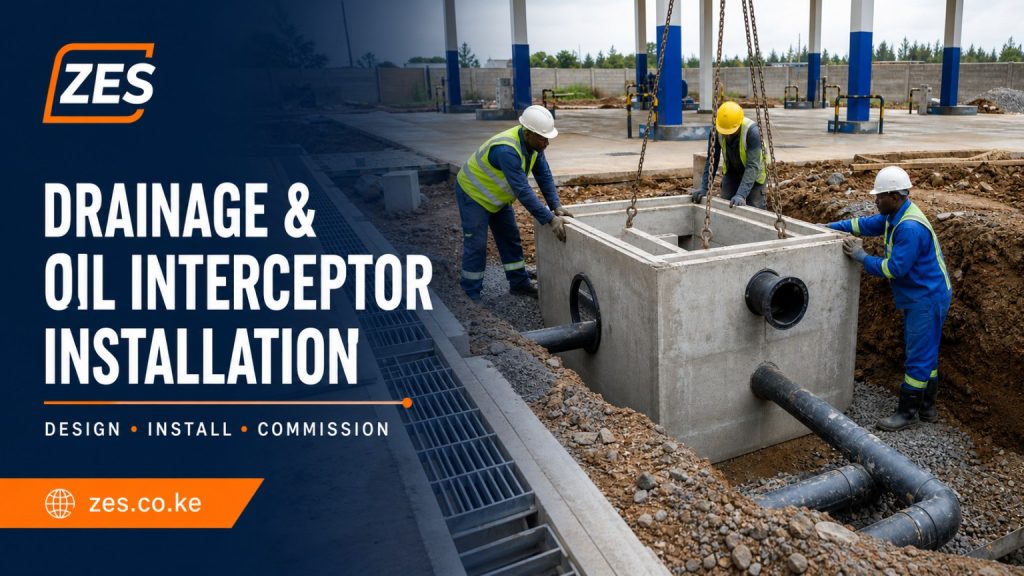
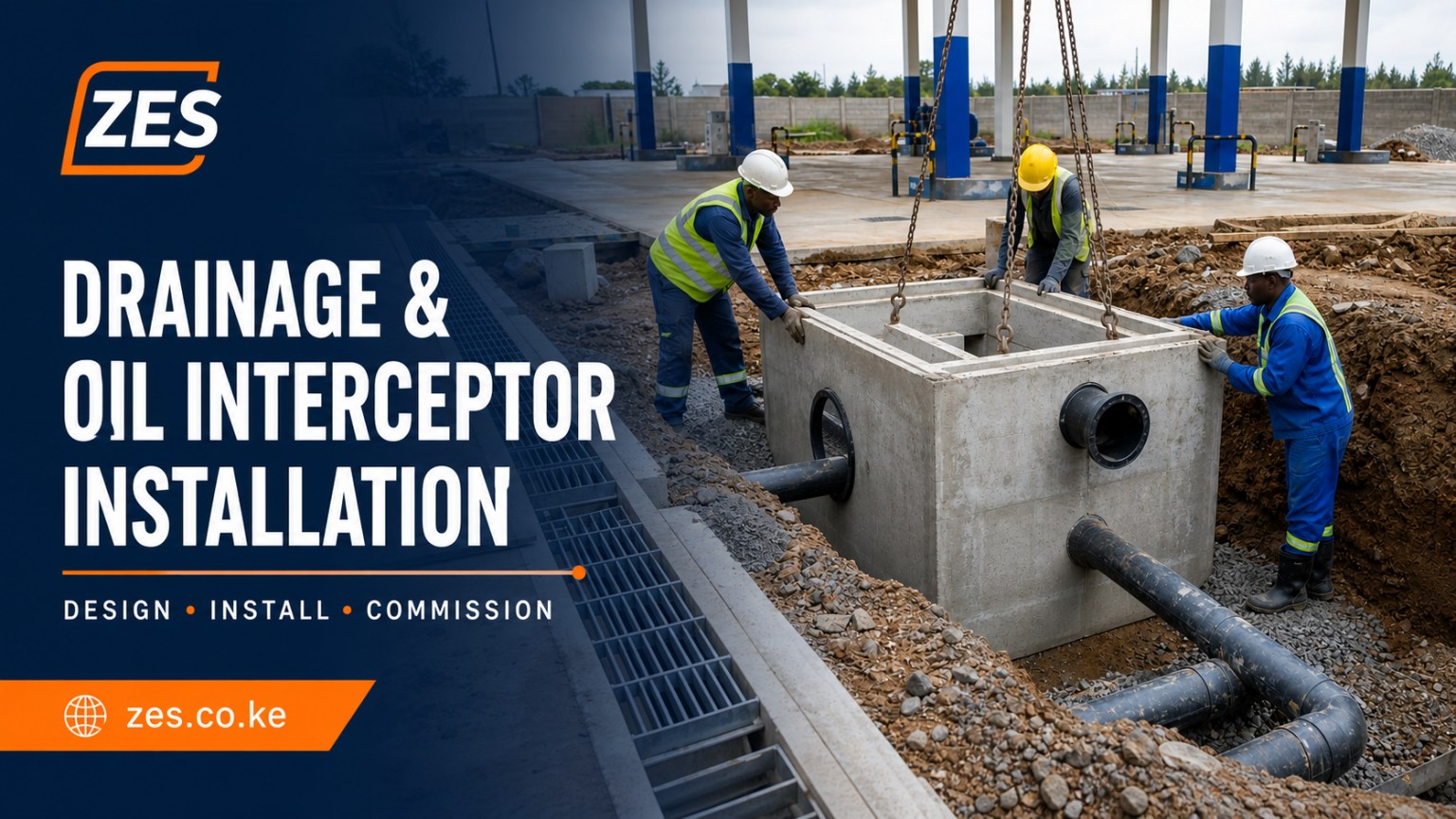
For owners searching for petrol station drainage and oil interceptor installation Kenya, the project should begin with a site-specific hydraulic and environmental design, not with the purchase of a separator tank from a catalogue. The system must collect runoff from the right areas, keep avoidable clean water out of the contaminated-water route, control silt, provide accessible treatment and inspection points, and discharge only through an approved destination and arrangement. If the pavement falls, inlet levels, pipe routes or outlet conditions are wrong, even a well-made interceptor cannot rescue the whole system.
For a station developer or operator, drainage is both an asset-protection decision and an operating discipline. Water standing on the forecourt disrupts traffic and accelerates defects; uncontrolled oily runoff creates environmental risk; and an inaccessible interceptor is unlikely to receive the maintenance it needs. This guide sets out the package a serious buyer should request, the pricing information contractors need, and the records that should exist before handover.
The buyer’s decision in one sentence
Appoint a team that can coordinate professional civil design, petroleum-system interfaces, construction, testing and maintainable handover under one documented scope. Do not assess bidders only by interceptor capacity, pipe diameter or a lump-sum installation price. Those figures are meaningful only when tied to the approved catchment plan, design flow, contamination risk, outlet and authority conditions.
Zama Engineering Systems can integrate drainage with petrol station construction services, forecourt civil works, tank chambers, piping and dispenser areas. That coordination reduces the risk of the drainage contractor arriving after levels and underground routes have already been fixed.
What a petrol station drainage system needs to do
A complete system is more than channels and buried pipes. It begins with catchment zoning: identifying which surfaces may receive fuel or oil contamination, which surfaces normally carry clean stormwater, where tanker unloading takes place, how spills are contained and where water is permitted to go. The approved arrangement may then use falls, kerbs, channels, catchpits, silt traps, an oil-water separator or interceptor, inspection and sampling points, valves or containment features, and a defined outlet.
Separate water streams deliberately
Routing roof water or a large clean parking catchment through an oil interceptor can create excessive hydraulic loading, especially during intense rainfall. Conversely, allowing potentially contaminated forecourt runoff to bypass treatment defeats the purpose of the system. The designer should classify catchments and show them clearly on the drainage plan. Downpipes from a petrol station canopy also need a deliberate destination so they do not discharge onto the dispensing area or overwhelm the contaminated-water route.
Control silt before it occupies treatment volume
Sand, dust, litter and pavement debris settle in channels and chambers. If there is no suitable silt-management stage, solids can reduce the working volume of the interceptor, block pipework and make cleaning harder. The design should provide accessible points for routine removal and should avoid chamber geometries that maintenance teams cannot safely reach with their normal equipment.
Provide a verified outlet
A drawing that ends at “outfall” without confirming the receiving system is incomplete. The team must establish whether the approved destination is a public sewer, another authorised drainage system, a treatment or reuse arrangement, or an environmental discharge subject to licensing and conditions. Ownership, invert level, capacity, backflow risk, sampling needs and written consent can all affect design. The correct route is a project decision made with the relevant professional and authority—not a generic promise in a contractor’s proposal.
Current Kenyan regulatory context
The Petroleum (Retail Dispensing Site Construction and Licensing) (No. 2) Regulations, Legal Notice 188 of 2025 are the current retail-dispensing-site construction regulations. The construction-permit schedule specifically calls for civil engineer’s drawings showing general drainage and oil-water-separator layouts or designs, alongside the forecourt layout and surface design. It also lists a valid NEMA environmental impact assessment licence for the development, relevant engineer practising certificates, a priced bill of quantities and other project documents.
For water quality, use the latest consolidated Environmental Management and Co-ordination (Water Quality) Regulations, 2024, incorporating the 2025 amendments shown by Kenya Law. Among other provisions, the Regulations prohibit discharge of pollutants contrary to the prescribed standards and set licensing and monitoring requirements for applicable effluent discharge into the environment. NEMA’s official Water Quality Regulations guidance page explains the roles of NEMA and sewerage service providers and links to effluent-discharge guidance and forms.
These sources do not turn an oil interceptor into a universal permission to discharge. The applicable standard, licence, consent, sampling regime and outlet conditions depend on the project and receiving environment. EPRA also publishes current petroleum licence and permit application guides that buyers should review with their professional team.
Project-specific design and approval govern: This article is a buyer’s guide, not a hydraulic design, environmental licence or compliance certificate. Follow the approved drawings, NEMA licence and conditions, EPRA permit, county or sewerage-provider requirements, applicable Kenya Standards, professional engineer’s instructions and written outlet approvals for the actual site. Performance and regulatory acceptance cannot be guaranteed by installing a generic interceptor.
Information the designer needs before sizing the system
Interceptor selection is downstream of site investigation. A competent brief should assemble the following information before equipment is ordered:
- Topographic survey: existing and proposed levels, low points, boundaries, road tie-ins and confirmed outlet inverts.
- Catchment areas: forecourt, tanker unloading zone, parking, access roads, roof areas, wash areas and landscaped zones.
- Rainfall design basis: the intensity, duration, return criteria and climate allowance selected by the professional designer for the project.
- Operating activities: dispensing, deliveries, vehicle service, washing, generator or tank areas and the likely types of contamination.
- Fuel infrastructure: fill points, vents, dispenser islands, tank chambers, product pipes and leak-detection components.
- Ground and groundwater: soil condition, bearing, excavation stability, groundwater level, buoyancy risk and infiltration constraints.
- Existing utilities: electrical ducts, water, sewer, communications and structures that constrain routes.
- Receiving system: ownership, consent, hydraulic capacity, discharge criteria, sampling location and backflow conditions.
- Maintenance capability: safe access, vehicle reach, lifting needs, waste removal route and intended inspection frequency.
At sites with new underground fuel tanks, the drainage design must be coordinated with excavation support, tank anchorage or backfill, chamber levels and pipe trenches. At an existing station, utility detection and careful opening-up may be necessary before final routes are confirmed.
Components that may appear in the approved scope
Surface falls, kerbs and channels
The pavement is the first hydraulic component. Falls should convey water without sending it across customer paths, into buildings or toward sensitive equipment. Channels and gratings must suit the traffic path and designed loads. A correctly sized buried pipe cannot compensate for a forecourt that ponds because its surface levels missed the inlet.
Catchpits and silt management
Catchpits collect local flows and provide inspection or level-change points. Silt traps allow solids to settle before they enter downstream treatment. Their volume, baffles, access covers and cleaning arrangements should be shown on drawings. “Provide silt trap” is too vague for a fixed price.
Oil-water interceptor or separator
An interceptor uses differences in density and, in some products, additional coalescing media or control features to help separate free hydrocarbons from water. Selection depends on design flow, likely contamination, required discharge quality, silt load, available head, maintenance and the manufacturer’s certified performance data where applicable. Some installations may require alarms, closure devices or other project-specific features. The engineer should specify them; the bidder should identify manufacturer, model, duty and included accessories.
An oil-water separator is not a magic treatment plant. Emulsified hydrocarbons, detergents, unusual chemicals or high solids may require different controls or treatment. Operational practices should minimise contamination at source rather than relying on the interceptor to accept every liquid used on the site.
Inspection, sampling and isolation
The design may require accessible inspection chambers before and after treatment, a sampling point, or an isolation arrangement for incidents. These features help operators observe performance and implement the environmental management plan. Their positions must be safe to access without exposing staff to moving traffic or confined-space hazards.
Pipework and backflow protection
Pipe material, diameter, gradient, bedding, jointing and cover should follow the design. Where an external drain or sewer can surcharge, backflow risk should be assessed. A flap valve or other device is not automatically the answer; it can itself require maintenance and affect hydraulic capacity. The engineer should resolve the condition based on outlet data.
A complete installation scope to request
Issue a scope and bill of quantities that allow all bidders to price the same outcome. Depending on design, it may include:
- Survey, setting out, service detection and verification of outlet level and consent.
- Permits to work, traffic management, barricading, temporary drainage and environmental controls.
- Saw-cutting, pavement removal, excavation support, groundwater control and lawful disposal.
- Channels, kerbs, sumps, catchpits, silt traps and inspection chambers.
- Specified pipes, fittings, bedding, surround, warning measures and tested connections.
- Interceptor supply, delivery inspection, lifting, foundation, anchorage where designed, installation and connections.
- Alarms, probes, control panels, power and communications where specified.
- Sampling, isolation and approved outlet works.
- Selected backfill, layer compaction and pavement reinstatement.
- Leak, level, flow, functional and electrical tests required by the specification.
- Cleaning, initial commissioning, operator training and a planned-maintenance demonstration.
- As-built survey, test pack, product documentation, warranties and operations-and-maintenance manual.
Assign responsibility for interfaces. If one contractor supplies the interceptor, another lays pipes and a third constructs the forecourt, state who checks levels, accepts the equipment, seals connections, supplies power, commissions alarms and corrects defects. A single missing owner can delay opening.
Petrol station drainage and interceptor cost in Kenya
When reviewing petrol station drainage and oil interceptor installation Kenya prices, remember that a credible cost cannot be calculated from interceptor capacity alone. Two sites with the same paved area may have different rainfall catchments, outlet depths, ground conditions, traffic staging and environmental conditions. Ask for an elemental price tied to drawings and stated quantities instead of relying on an unqualified “supply and install” figure.
What drives the budget
- Survey and professional design: catchment analysis, calculations, drawings, specifications, approvals and construction review.
- Interceptor duty and features: flow capacity, construction material, coalescing components, alarms, closure features and access requirements.
- Drainage length and depth: deeper excavations need more support, lifting, dewatering and reinstatement.
- Groundwater and buoyancy: high groundwater may change foundation, anchorage, installation sequence and temporary works.
- Chambers and gratings: loading class, dimensions, silt volume and the number of level changes affect cost.
- Outlet work: a long connection, pumping requirement, backflow measure or sewer-provider condition can materially alter scope.
- Live-station phasing: night work, temporary customer routes, hand excavation near services and short work zones reduce productivity.
- Pavement reinstatement: cutting and restoring an engineered forecourt can cost more than pipe installation.
- Testing and documentation: survey, laboratory analysis where required, alarms, commissioning and handover records should be visible items.
- Maintenance access: safe covers, lifting aids and cleaning-vehicle reach may add capital cost but reduce future operating difficulty.
For tender evaluation, compare equipment make and duty, measured civil quantities, provisional sums, exclusions, taxes, programme, payment milestones, warranty, servicing offer and waste-disposal assumptions. Have the design professional review deviations before commercial scoring. The cheapest bidder may simply have priced a smaller catchment or omitted the outlet.
Recommended construction and commissioning sequence
- Approve submittals: confirm drawings, calculations, method statements, materials and selected interceptor before procurement.
- Set out and expose: locate utilities, prove tie-in points and confirm invert levels before bulk excavation.
- Manage temporary water: prevent stormwater from flooding excavations or carrying silt and contaminants off site.
- Construct upstream works: form channels, pits and pipe runs to controlled lines and levels with inspection at hold points.
- Install the interceptor: inspect delivery condition, prepare the designed base, lift correctly, orient connections and apply designed anchorage or protection.
- Connect and test: verify pipe joints, levels, chambers, alarms and the outlet before concealment and reinstatement.
- Backfill in controlled layers: use approved material and compaction procedures without damaging the vessel or pipework.
- Restore surfaces: reinstate the engineered pavement and seal interfaces to the approved details.
- Commission with clean water where appropriate: demonstrate flow path, absence of unintended bypass, alarm functions and access, following the manufacturer and engineer’s plan.
- Handover: provide as-builts, test results, serial information, manuals, cleaning plan and operator training.
Commissioning should not deliberately release fuel or contaminated water. The project engineer and environmental team should define safe test media, acceptance criteria and disposal of test water.
Quality checks before trenches disappear
The inspection and test plan should identify which work cannot proceed until it has been checked. Useful records may include:
- Surveyed coordinates and inverts for channels, pipes, chambers, interceptor and outlet.
- Photographs and approval of bedding, foundations, anchorage and connections before backfill.
- Product delivery inspection, manufacturer certificates and serial details.
- Pipe-joint, leak or pressure-test evidence appropriate to the specified system.
- Backfill material approvals and layer-compaction results.
- Grating, cover and chamber load-rating documentation where specified.
- Electrical test and alarm simulation records for powered devices.
- Controlled flow observations at all inlets, treatment stages and the approved outlet.
- Non-conformance reports, approved remedies and closed snag lists.
- Final as-built drawing showing every access and sampling point.
Acceptance criteria and test methods must come from the contract documents, equipment requirements and professional instructions. Water appearing at the outlet does not by itself prove the system meets its hydraulic or treatment duty.
Maintenance determines real-world performance
An interceptor begins accumulating oil and silt as soon as the station operates. Its effective volume and separation performance can deteriorate if those materials are not removed. The handover plan should identify inspection frequency, alarm response, oil and silt removal triggers, authorised waste handling, cleaning method, record forms and the person accountable on each shift or maintenance cycle.
After heavy rain or a spill, operators may need additional inspections under the site plan. Covers, channels and silt traps should be kept clear. Maintenance should be performed with safe isolation, traffic control and appropriate confined-space precautions; staff should not enter chambers casually. Removed oily waste and sludge must be characterised and handled through the approved waste route, with records retained where required.
Changes in station use also matter. Adding a wash bay, enlarging the paved catchment, redirecting roof water or altering the outlet may invalidate the original design basis. Have the engineer assess modifications before connecting them to the system.
Questions to ask drainage and interceptor contractors
- Who prepared the hydraulic design and who will certify or oversee work within their professional remit?
- Which catchments and design flows does your proposal include?
- What outlet have you assumed, and what evidence confirms its level and approval?
- What interceptor make, model, duty and accessories are priced?
- How does the proposed equipment match the specified contamination and maintenance conditions?
- What silt-control volume and cleaning access are included?
- How will groundwater, excavation stability and vessel buoyancy be managed?
- How will you locate and protect product pipes, tank chambers, electrical ducts and other live services?
- Which tests, surveys and independent inspections are included?
- Who supplies power, wiring, alarms, commissioning and operator training?
- What pavement reinstatement and traffic phasing have you allowed?
- What consumables, cleaning and servicing will the owner need during the first year?
- What defects response and equipment warranty do you offer?
- Can we inspect a comparable operating installation and speak with its facilities team?
Pre-award checklist for owners and consultants
- The latest survey and utility information are available.
- Catchments are classified and shown on the approved or tender design.
- Clean and potentially contaminated water routes are deliberately coordinated.
- The outlet, invert, ownership and written conditions are confirmed.
- Drainage aligns with forecourt levels, tank chambers, dispensers and canopy downpipes.
- Interceptor selection is supported by project design data and product documentation.
- Silt management, inspection, sampling and maintenance access are included.
- Groundwater and buoyancy risk have been assessed.
- All bidders priced the same bill of quantities, tests and reinstatement.
- Approvals and environmental-licence conditions have been reviewed by the project team.
- Construction hold points and handover records are specified.
- An operational inspection and waste-removal plan has an accountable owner.
Common mistakes and their commercial consequences
Buying the interceptor before design: the vessel may not match flow, available depth, outlet or maintenance space. Redesign and return costs then erase the apparent saving.
Sending every drop through one route: unnecessary clean-water inflow can overload the treatment path and increase maintenance. Catchment zoning should be designed, not improvised.
Ignoring silt: solids fill chambers and separator volume, leading to blockage, difficult cleaning and poor performance.
Assuming a public drain can receive the outlet: physical proximity is not approval. Confirm ownership, consent, conditions and receiving capacity in writing.
Burying inaccessible equipment: a low initial cost becomes high lifetime cost when covers cannot be safely opened or a cleaning vehicle cannot reach the chamber.
Omitting as-builts: later maintenance teams cannot locate chambers and routes, while future contractors risk damaging buried services.
Frequently asked questions
Is an oil interceptor mandatory at every petrol station in Kenya?
Legal Notice 188 of 2025 requires the construction-permit submission to include civil engineer’s drawings covering general drainage and oil-water-separator layouts or designs. The exact equipment, duty, arrangement and approval conditions remain project-specific. Obtain professional design and follow the issued permit and environmental conditions.
How is an oil interceptor sized?
The designer considers the contributing catchment, design rainfall or process flow, contamination risk, silt, discharge objective, available hydraulic head, equipment performance and maintenance. A simple paved-area rule or the size used at another station is not enough.
Can canopy rainwater bypass the interceptor?
Clean roof water is often considered separately so it does not unnecessarily load the contaminated-water system, but its route must be deliberately designed and approved. Downpipes must not create hazards or reconnect downstream in a way that defeats the drainage plan.
Can treated water discharge to a public sewer or storm drain?
Only through the applicable approved arrangement and conditions. Sewerage providers regulate discharges to their systems, while NEMA regulates applicable discharge into the environment. Confirm the destination, consent, standards, licence and monitoring obligations for the actual project.
How often should an interceptor be cleaned?
Frequency depends on its design, silt and oil accumulation, rainfall, site activity, alarm information, manufacturer guidance and environmental plan. Set inspection and removal triggers at handover, keep logs and increase checks after abnormal events.
Can an existing station add an interceptor without changing other drainage?
Sometimes upstream and downstream works are still necessary. The engineer must verify catchments, levels, pipe condition, treatment duty, outlet and pavement reinstatement. Because Legal Notice 188 regulates construction and modification, the project team should confirm required approvals before starting.
Should drainage connect to fuel tank leak detection?
They serve different functions and should not be casually interconnected. Drainage manages designed water flows, while a fuel tank leak detection system monitors specified tank or containment conditions. The petroleum and civil designers should coordinate both without creating an unintended discharge route.
Request a site-specific ZES drainage proposal
To obtain a useful initial review, share the site location, survey or layout, greenfield or operating status, paved and roof areas, known outlet, tank and dispenser arrangement, groundwater concerns, environmental documents and desired programme. ZES can then identify the investigation and engineering steps required before confirming equipment and construction scope.
Request a petrol station drainage and oil interceptor quotation or contact Zama Engineering Systems. The final solution will be based on project-specific professional design, authority approvals, site conditions and agreed contract documents.
Petrol station drainage installation must control levels and separate runoff according to the approved site design. Clean roof water, general stormwater and water from areas exposed to fuel or oil should not be routed by convenience to the same point. An Oil interceptor installation Kenya project also needs safe inspection, emptying and maintenance access; a buried unit that cannot be serviced will not protect the site reliably.
Procure the drainage path, not only the interceptor
The tender should include surveyed levels, catchment areas, channels and gullies, pipe sizes and slopes, silt control, separator or interceptor duty, sampling or inspection points, outfall, covers, vehicle loads and maintenance access. Coordinate tank and dispenser areas with the petrol station engineering layout. Manufacturer information should show capacity assumptions, internal arrangement, installation requirements and service procedure.
Bidders need to state excavation, bedding, concrete or structural work, waterproofing, connections, covers, reinstatement, testing, waste handling, authority interfaces and excluded downstream works. The owner should define who removes captured oil and sludge and how records are retained. Ongoing inspection belongs in the station maintenance schedule.
Accept levels, flow and maintainability
Before covers are closed, inspect invert levels, pipe falls, seals, chamber condition and correspondence with drawings. Controlled water tests can demonstrate flow direction, ponding, leakage and accessible inspection points without introducing contaminants. Verify that covers suit the traffic duty and that staff can reach service points safely.
Handover should include as-built levels and routes, product data, inspection and test records, photographs, cleaning procedure, service frequency and responsible waste contractor arrangements. The design must follow current environmental and authority requirements for the site. Request a ZES drainage assessment with the survey and proposed forecourt layout.
Maintenance-access checkpoint
Before approving the drainage layout, walk the proposed route with the person expected to inspect and clean it. Confirm that chamber covers can be opened safely, a service vehicle can reach the interceptor, accumulated material can be removed and maintenance will not require uncontrolled excavation. Identify where staff observe silt, oil or blocked flow and how an issue is escalated. Record the cleaning frequency as an initial plan to be adjusted from actual site conditions and applicable requirements. This checkpoint prevents a technically specified separator from becoming an inaccessible buried asset whose condition is unknown until flooding or contamination occurs.