

Petrol Station Inventory Reconciliation Software should make stock assumptions, source records and unexplained differences visible to authorised reviewers. It does not remove the need for reliable measurements or establish that every variance has the same cause. This guide focuses on the software’s inputs, review workflow and acceptance examples. ZES can assess a reconciliation requirement and confirm available product and interface options within a written scope.

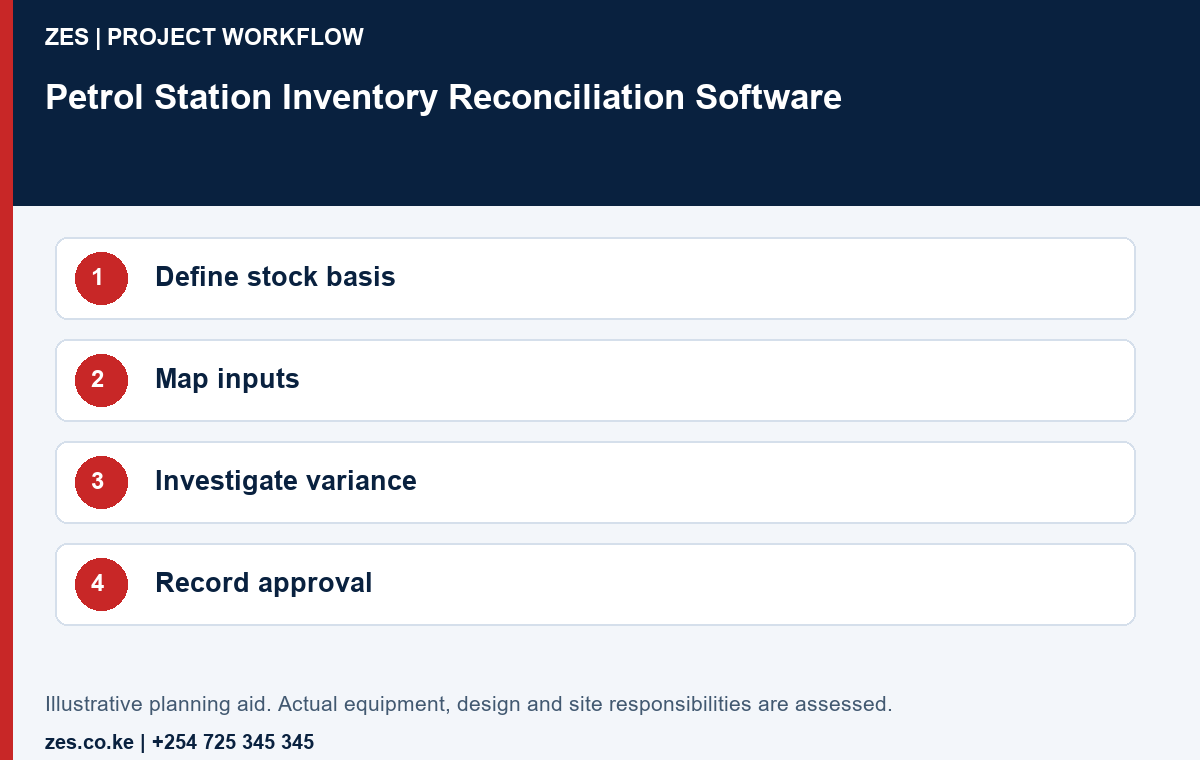
1. Define the reconciliation model
Ask the responsible operations and finance teams to specify the record basis, units, reporting boundary and approved adjustments. Identify each input and its source. The proposed application should make these assumptions visible. Avoid using a generic calculation without checking whether the compared records use compatible periods and measurement bases.
2. Explain the difference with an illustrative example
A simplified sample could show opening stock of 20,000 units, receipts of 10,000 and closing stock of 8,000, giving a movement of 22,000 before other approved adjustments. If a separately defined activity record shows 21,900 on a comparable basis, the difference needs review. These invented figures demonstrate software traceability; they are not operating limits, a measurement procedure or evidence of a particular cause.
3. Verify measurements and source interfaces
List the actual equipment and records supplying the proposed reconciliation inputs. Confirm model references, accessible interfaces and responsibility for measurement quality with the appropriate specialists. The software supplier should not assume that every tank-monitoring or dispensing system provides the same fields. Keep any specialist calibration, metrology and regulatory responsibilities separate from the reporting application’s configuration.
4. Test incomplete and late information
Include a missing receipt, a late input and a corrected sample record in the demonstration. Ask how the report distinguishes incomplete information from an approved period result. Identify who can reopen or adjust a period under the organisation’s process. The application should expose uncertainty rather than present an apparently precise variance from inputs that have not been reviewed.
5. Record investigation and approval
Define who reviews a difference, what supporting information is needed and who approves an adjustment or conclusion. Ask the software to demonstrate the available history and attachments or references. A variance should not automatically be labelled theft, leakage or equipment failure. Those possibilities require appropriate investigation and evidence outside a simple comparison of totals.
6. Compare branch and period reports consistently
If several sites are included, agree common definitions and identify justified local differences. Check that site identifiers, units and period boundaries remain visible. Use sample data to test the combined report and the ability to return to a particular station’s records. A group total can be misleading if it combines results prepared on different assumptions without making the differences clear.
7. Accept the full review workflow
Follow a sample period from input through variance review, approved adjustment and final export. Let the intended customer reviewer perform the task. Keep the calculation basis, equipment interfaces, limitations and support route in the handover. Confirm hosting, licences and future changes in writing rather than assume that a generic software description includes every reconciliation function.
Petrol Station Inventory Reconciliation Software: demonstration and review workbook
Use an invented reconciliation: opening quantity 20,000, receipts 10,000 and recorded sales 8,000 give an expected closing quantity of 22,000 on a consistent agreed basis. A comparable measured figure of 21,900 creates a difference of 100 for review. It does not establish theft, leakage or the person responsible. Inventory reconciliation software should preserve the inputs, assumptions and review outcome. Ask the supplier to process this small example before demonstrating a large dashboard whose numbers the buyer cannot trace.
The following cases help the buyer specify and compare the actual project. Agree which apply to the proposed reconciliation scope and record any exclusions before acceptance. They are hypothetical review prompts, not evidence of a completed ZES client project. The responsible site team and relevant competent parties approve any physical tests or changes to live operations.
Stock boundary
Identify the product, storage or reporting unit covered by reconciliation. Prevent records for different products or physical boundaries from being combined without an explicitly approved interpretation.
Opening record
Show the source and approved reporting time of the opening quantity. A reconciliation requires a meaningful starting point rather than an unexplained number copied between spreadsheets.
Receipts
Enter an invented receipt with its source reference and timing. Demonstrate how corrections and late information are identified without silently replacing the original supporting record.
Sales quantity
Identify the source of the quantity deducted for sales. Keep that measure distinguishable from sales value or payment received so that unlike business measures are not subtracted.
Comparable measurement
Ask the responsible business and technical people to define the comparison basis. Units, timing and relevant measurement assumptions must be understood before interpreting a displayed difference.
Calculation trace
Reproduce the expected closing quantity from the sample inputs. An authorised reviewer should be able to explain the calculation without treating the reconciliation software output as unexplained authority.
Variance workflow
Record an invented difference and its investigation status. Distinguish an observation requiring review from an approved conclusion, and identify who can close the enquiry.
Adjusted input
Apply a permitted correction to one source input. Demonstrate whether the reconciliation software preserves the original reconciliation, revised result and the available reason or approval record.
Reporting periods
Show how the next period begins after an adjustment. Avoid an unexplained carry-forward that makes a later difference appear to arise from a different shift or product.
Interface limits
If measurement or transaction data will be imported, confirm the actual supported interface and validation. The existence of a sensor or sales application does not prove compatibility.
Detailed buyer questions
Does a variance automatically identify a fuel loss?
No. Review source completeness, timing, units, measurement assumptions and approved adjustments with the responsible people. A calculated difference is an investigation input, not a complete diagnosis.
Can existing spreadsheets help specify the reconciliation software?
Yes, if their intended measures and rules are explained. Use anonymised or invented samples to show the required workflow, then distinguish existing practices from the approved future requirement.
What evidence should support acceptance?
Trace a small agreed dataset from sources through calculation, correction and review. Include reporting boundaries and the actual import method where one is supplied, rather than accepting only a populated screen.
Specify decisions and records before reconciliation software features
Write the business decision that each report or screen must support. A branch manager may need a shift exception, an accountant may need an approved period total and a group office may need a consolidated view. These are different deliverables. Identify the data source, timing, calculation and authorised reviewer for each. A dashboard can be attractive while still leaving the customer unable to explain where a figure came from.
Create a small demonstration dataset using invented records. Include an ordinary transaction, an allowed correction, a late record and a period boundary. Where the enquiry concerns inventory, keep quantity bases and measurement assumptions explicit. Where it concerns sales, distinguish sales records from receipts and settlement. Ask the proposed product or development reconciliation scope to show the actual required behaviour instead of treating a generic demonstration as acceptance.
Confirm which functions already exist, which require configuration and which would need development or another service. List the relevant product version, deployment arrangement, licence and interface dependencies. ZES can assess a reconciliation software brief and propose a defined reconciliation scope; this guide does not promise that every listed requirement is available in a ready-made package. Obtain a demonstration or a written delivery and acceptance commitment for the selected solution.
Control imports, changes and reporting boundaries
Give each imported record an identifiable source and agree how repeated imports are handled. Review how a correction is distinguished from a new transaction. Ask what happens when a branch is temporarily offline or a source delivers a record late. A successful file transfer establishes only that information moved; it does not establish that the receiving system interpreted every identifier, date, unit or business rule correctly.
Assign approval and administration roles separately. A person who enters information need not automatically be able to approve it, alter configuration or remove the change history. Demonstrate the selected application’s supported controls with sample users. Record any requirement that depends on an operating procedure. Do not describe separation of duties as delivered merely because a proposal contains several role names.
Define the reporting boundary for each period. Explain how reopened shifts, late adjustments and branch transfers affect a previously approved view. Keep the original and revised outputs distinguishable where the agreed workflow requires it. Test the customer’s actual review process with the demonstration data. Differences between reports can reflect timing or reconciliation scope; they should be investigated before anyone concludes that a particular member of staff or system caused a loss.
Plan exit and continuity from the beginning. Identify customer account ownership, accessible exports, backup responsibilities and the supported restoration or migration arrangements. Specify the evidence expected for those functions. Do not assume that an exported spreadsheet contains everything required to restore a complete application. If another supplier owns a pump, payment or accounting interface, obtain its documented requirements and confirm who resolves interface faults and future version changes.
Build a proposal that can be compared and accepted
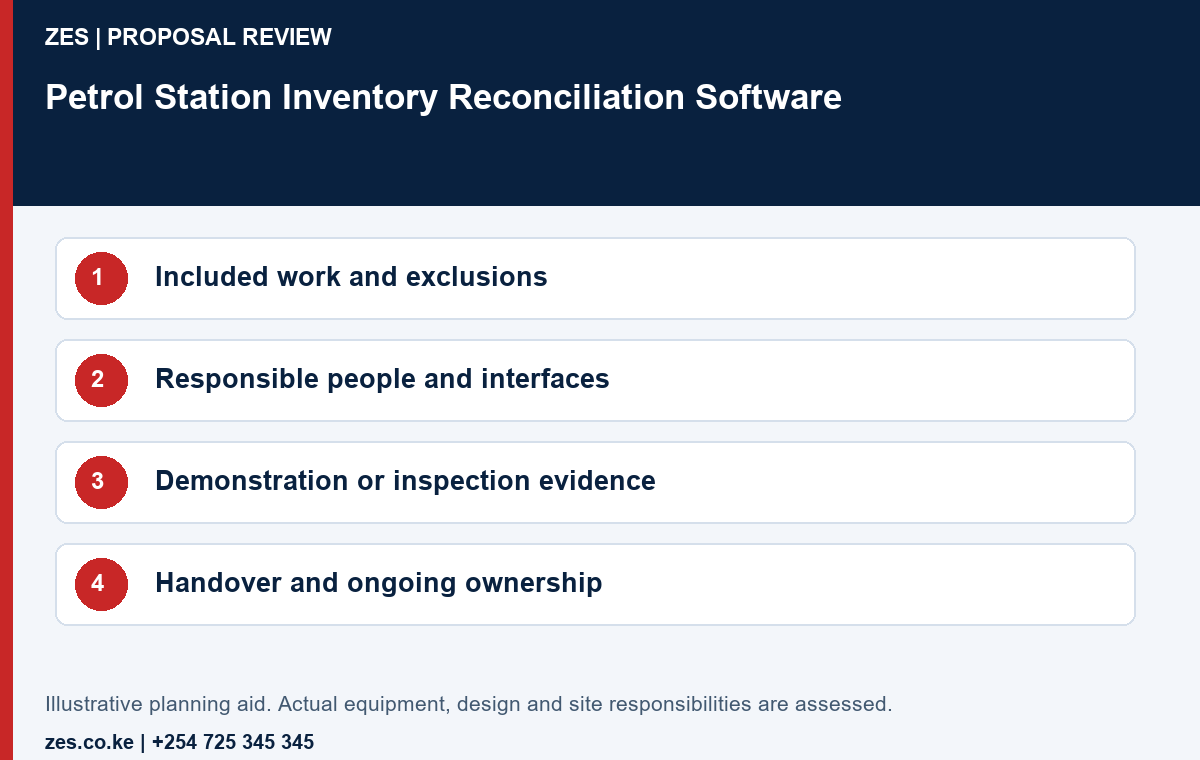
A useful specification separates the result the station wants from the product a supplier proposes. Start with a short statement of the operational problem, the people affected and the evidence that would show improvement. Give each requested deliverable a reference. A supplier can then identify the equipment, labour, configuration, documentation and customer dependencies against that reference. This makes it easier to compare offers without assuming that similar item names describe the same complete service.
Keep a simple comparison register with columns for requirement, included work, excluded work, customer action, acceptance evidence and price basis. An item marked included should have enough detail to distinguish supply alone from installation, configuration or commissioning. An exclusion is not necessarily a poor offer; it becomes a problem when the station discovers it only after work starts. Clarify unanswered questions in writing and attach the clarification to the agreed proposal.
The station should nominate one commercial contact and the operational or technical people who can approve their respective parts. A cashier may explain a daily workflow without having authority to approve a system change. A premises manager may approve access while another party owns an interface or structure. Record these boundaries early. Give the supplier a coordinated response instead of several conflicting instructions from people who assume somebody else has approved the change.
Use a dependency list before agreeing an implementation date. Examples include approved access, available records, enabling works, an authorised test window and attendance by another supplier. For each dependency, identify who provides it and how readiness will be confirmed. Separate the proposed working duration from the full calendar programme. A short installation task can still depend on an assessment, procurement or approval that has not yet been completed.
Use an evidence register rather than a completion claim
Create one acceptance entry for each important requirement. Record the agreed condition, the expected result, the observed result, the person witnessing it and any remaining action. Use the selected product documentation and approved design to decide what is appropriate to test. The examples in this guide are purchasing questions, not permission to carry out hazardous operations or alter live station equipment. Tests must be planned and performed by the responsible people under the site’s arrangements.
An entry should be specific enough for another manager to understand later. An observation such as tested successfully does not explain what was tested. A clearer entry identifies the relevant asset or sample record, the conditions checked and the evidence retained. Do not publish sensitive configuration, employee information or security layouts in a public project gallery. Keep the operational evidence in the customer’s controlled handover file, with access appropriate to its contents.
Distinguish a defect from an agreed exclusion, a customer dependency and a later improvement request. Each needs a different decision. Assign an owner and review date to unresolved matters. If an issue affects the safe or intended use of the delivered work, the responsible parties must decide the appropriate restriction and resolution before treating the affected reconciliation scope as accepted. A signature should record an informed decision rather than conceal an incomplete requirement.
Customer acceptance and a supplier invoice serve different purposes. An invoice identifies a commercial charge; it does not replace the technical evidence agreed for the project. Similarly, a photograph can show a visible installation without establishing its configuration, structural adequacy or reporting behaviour. Retain the relevant inspection, demonstration or test record alongside the commercial documents so that future reviews do not depend on recollection.
Plan ownership, changes and the next review
Ask for a handover index before completion. Depending on the reconciliation scope, it may list equipment references, approved drawings, configured functions, maintenance information, licences, acceptance records and support contacts. Mark documents as supplied, not applicable or outstanding. Keep passwords and sensitive access arrangements separate from general manuals. The customer should know who controls each account and how authorised access will be transferred when an employee or contractor changes.
The person expected to use or maintain the result should demonstrate the ordinary task during handover. A presentation to the purchasing team is useful, but it is not the same as the nominated operator retrieving a report, identifying an asset or following the approved support route. Arrange cover for that role. Record the limits of the training and the subjects that still require a competent specialist rather than encouraging staff to improvise repairs.
Compare ongoing obligations as carefully as the initial price. Identify recurring licences, replacement consumables, support arrangements, inspection responsibilities and customer-provided services where relevant. Ask what happens if a renewal is not made, an account changes or an additional site is added. Do not assume that a one-time purchase includes every later configuration change, site visit or third-party service. Request current written commercial terms for the actual reconciliation scope.
Schedule a review after a representative operating period. Compare the original requirement with actual use, note unresolved findings and decide whether the proposed improvement achieved its purpose. If the station changes layout, staffing, operating hours or another connected system, review the affected assumptions. Keep the approved baseline and later changes together. This gives future suppliers a reliable starting point and reduces the risk of replacing working equipment simply because its documentation has been lost.
Prepare a clear enquiry for ZES
Share the station location, the problem or intended outcome, relevant quantities and the existing equipment or application references. Include available approved plans or anonymised examples where useful. Identify the person who can authorise site access and the contacts responsible for operations and technical interfaces. Keep credentials, employee biometric records and confidential transaction information out of a general enquiry.
Ask the written proposal to identify the supplied work, exclusions, customer dependencies, current commercial terms and the evidence used for acceptance. Confirm specialist responsibilities and relevant credentials for the actual scope. ZES can review the brief and confirm the appropriate assessment and proposal arrangements. Site attendance, timing, product availability and support commitments are agreed directly rather than promised solely because a project names a particular county or town.
Compare the same complete scope
- Equipment or materials: identify the actual model, specification and documentation.
- Supporting tasks: record enabling work, site access and customer-supplied dependencies.
- Configuration or fabrication: state the work and the responsible approving party.
- Acceptance: agree the demonstration, inspection or verification evidence required.
- Ownership: confirm accounts, records, recurring charges and the future support route.
Frequently asked questions
Does a variance prove a loss or misconduct?
No. First check the source information, basis, period and supporting evidence through an authorised investigation.
Does software replace reliable measurement?
No. The actual measurement and source-system responsibilities remain part of the assessed operating arrangement.
Reference information: ODPC guidance.
Related ZES service · Petrol-station engineering enquiries · Request a scoped quotation · Request a site assessment · Call +254 725 345 345