
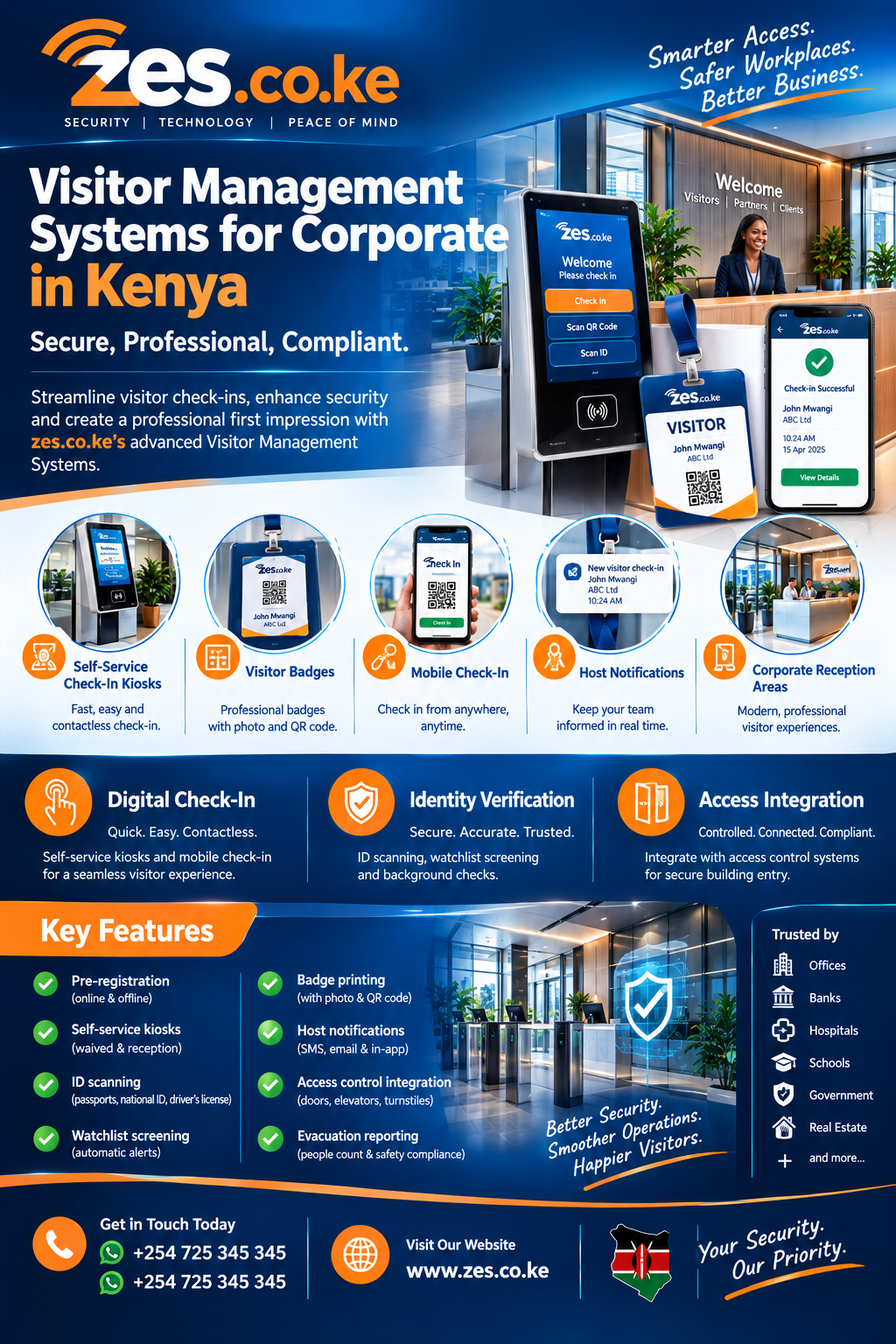
Visitor management systems for corporate in Kenya have moved from a nice-to-have to a core requirement for organizations that host clients, contractors, regulators, and job applicants on a daily basis. At zes.co.ke, we understand that visitor management systems for corporate in Kenya solve problems that paper logbooks cannot: they verify identity, enforce access policies, protect employees, and produce records that stand up to audit. Whether you operate a bank headquarters in Nairobi, a law firm in Upper Hill, or a corporate campus in Westlands, professional visitor management systems for corporate in Kenya are the foundation for a secure, professional, and compliant front desk.
The corporate security landscape in Kenya has shifted considerably. High-profile incidents, regulatory scrutiny under the Data Protection Act, and rising expectations from multinational clients have pushed front desk security up the agenda. Paper registers that anyone can read, forge, or photograph are no longer acceptable. Modern visitor management systems for corporate in Kenya replace them with digital check-in, badge printing, watchlist screening, and real-time visibility of who is on site.
At zes.co.ke, we specialize in helping corporate clients evaluate visitor management systems for corporate in Kenya against their specific reception layouts, entry volumes, and integration requirements. A financial institution with multiple entrances and strict regulatory obligations needs a different configuration from a tech company with a single lobby and a high volume of interview candidates. Our approach starts with understanding how your premises are actually used.
Why Corporate Organizations in Kenya Need Digital Visitor Management
The limitations of paper-based visitor management systems for corporate in Kenya become obvious under scrutiny. A paper register tells you who signed in, but not whether the signature is genuine, whether the visitor was expected, or whether they actually left. It cannot screen against a watchlist, cannot alert a host automatically, and cannot produce reliable evacuation lists during an emergency.
Digital visitor management systems for corporate in Kenya address each of these gaps. Identity verification confirms that visitors are who they claim to be. Pre-registration allows hosts to approve visitors in advance, so reception staff know who to expect. Automatic notifications alert hosts when their visitors arrive, reducing waiting times and improving the visitor experience.
The evacuation dimension is often overlooked until an emergency occurs. When a fire alarm sounds, security teams need to know who is in the building. Visitor management systems for corporate in Kenya that maintain live occupancy records provide this information instantly. Paper registers left at reception are useless in that moment.
For organizations subject to audit—banks, insurers, law firms, healthcare corporates—visitor management systems for corporate in Kenya provide the documented trail that auditors expect. Records of who entered, when, why, and who authorized the visit can be retrieved in seconds rather than days.
Core Features of Visitor Management Systems for Corporate in Kenya
Not every visitor management systems for corporate in Kenya deployment needs every feature, but understanding the full range of capabilities helps buyers make informed decisions.
Pre-registration allows hosts to enter visitor details before arrival. The visitor receives a confirmation with directions and any access instructions. On arrival, check-in is fast because details are already in the system. Pre-registration is particularly valuable for scheduled meetings, interviews, and contractor visits.
Self-service check-in kiosks allow visitors to register themselves without occupying reception staff. The visitor enters their name, company, and host, and the system notifies the host automatically. Self-service reduces queues during peak arrival times and frees reception staff for higher-value tasks.
Identity verification confirms that visitors match the identity they present. This may involve scanning a national ID, passport, or driving licence. Some systems capture photographs for comparison. For high-security corporate environments, identity verification is a baseline expectation.
Watchlist screening checks visitor names against lists of banned individuals, terminated employees, or persons of interest. This feature protects against social engineering and repeat offenders. Visitor management systems for corporate in Kenya used in financial services and critical infrastructure often include this capability.
Badge printing issues temporary visitor badges with the visitor’s name, photograph, host, and validity period. Badges make visitors identifiable on site and make it obvious when someone is not wearing one. Expiring badges ensure that visitors cannot reuse credentials from previous visits.
Host notifications alert employees when their visitors arrive. Notifications may be sent by email, SMS, or messaging platforms. This reduces the time visitors wait in reception and improves the overall experience.
Access control integration allows visitor badges to work with door readers, granting access only to authorized areas. This integration is valuable in corporate environments where visitors need access to meeting rooms but not to operational areas.
Evacuation reporting provides real-time lists of visitors on site. In an emergency, this information supports roll calls and search operations. Visitor management systems for corporate in Kenya that integrate with fire alarm systems can trigger automatic reports when alarms activate.
At zes.co.ke, we help clients prioritize features based on their specific risk profile and operational needs.
Integration with Access Control and CCTV
Visitor management systems for corporate in Kenya deliver maximum value when integrated with other security systems. Integration with access control allows visitor credentials to work with door readers. A visitor badge might open the main entrance and meeting room doors but not server rooms or executive floors. This ensures that visitors move only where they are authorized.
Integration with CCTV allows camera views to be linked to visitor events. When a visitor checks in, the reception camera captures their image. If an incident occurs later, video can be correlated with visitor records. This integration is valuable for investigations and for verifying that the person who checked in is the person who entered.
Integration with intercom systems allows reception staff to communicate with visitors at remote entrances. When a visitor arrives at a gate or side entrance, the intercom connects them to reception, where staff can verify their details in the visitor management system before granting access.
At zes.co.ke, we design integrations that connect visitor management systems for corporate in Kenya with the access control, CCTV, and intercom systems our clients already use. This creates a unified security ecosystem rather than isolated systems.
Data Protection and Privacy Compliance
Visitor management systems for corporate in Kenya collect personal data: names, identification numbers, photographs, vehicle registrations, and visit histories. This data is subject to Kenya’s Data Protection Act, and organizations must handle it lawfully.
Key compliance requirements include informing visitors about what data is collected and why, obtaining consent where required, storing data securely, retaining it only as long as necessary, and providing access when visitors request their records.
Data retention policies must be defined. How long are visitor records kept? Common practice is to retain records for a defined period—often 6 to 12 months—after which they are deleted. Retention periods should reflect legitimate business needs and regulatory requirements.
Access to visitor data must be controlled. Not every employee should be able to view visitor records. Role-based access ensures that only authorized staff can retrieve visitor information. Audit trails record who accessed what and when.
For multinational corporations, visitor management systems for corporate in Kenya may also need to satisfy parent company policies or international standards. At zes.co.ke, we advise clients on data protection and privacy considerations, helping them deploy systems that comply with Kenyan law and corporate standards.
Applications Across Corporate Sectors
Visitor management systems for corporate in Kenya serve diverse sectors, each with distinct requirements.
Banking and financial services use visitor management systems for corporate in Kenya to control access to headquarters, branches, and data centres. Regulatory requirements demand detailed records and identity verification. Watchlist screening is common. Integration with access control ensures visitors reach only authorized areas.
Law firms use visitor management systems for corporate in Kenya to protect client confidentiality and manage the flow of clients, witnesses, and court officials. Discreet check-in and host notification maintain the professional atmosphere expected in legal settings.
Insurance companies use visitor management systems for corporate in Kenya for claims processing visits, agent meetings, and regulatory inspections. Detailed records support audit requirements.
Corporate headquarters use visitor management systems for corporate in Kenya for client meetings, interviews, vendor visits, and delivery management. Self-service kiosks handle high volumes while maintaining security standards.
Technology companies use visitor management systems for corporate in Kenya for candidate interviews, client demonstrations, and partner meetings. Integration with calendar systems streamlines the process.
Healthcare corporates use visitor management systems for corporate in Kenya for patient visitors, pharmaceutical representatives, and equipment suppliers. Privacy considerations are particularly important in healthcare settings.
Manufacturing corporates use visitor management systems for corporate in Kenya for contractor management, safety briefings, and regulatory inspections. Integration with safety systems ensures visitors receive required inductions.
At zes.co.ke, we tailor visitor management systems for corporate in Kenya to the specific needs of each sector.
Cloud-Based vs On-Premise Visitor Management
Organizations evaluating visitor management systems for corporate in Kenya face a choice between cloud-based and on-premise deployment.
Cloud-based systems offer several advantages. They require no on-site servers, reducing IT infrastructure requirements. They are accessible from anywhere, supporting multi-site and remote management. They receive automatic updates and security patches. They scale easily as organizations grow.
On-premise systems keep data within the organization’s infrastructure. This may be preferred where data sovereignty is a concern or where internet connectivity is unreliable. On-premise systems require IT resources for maintenance and updates.
Many organizations adopt hybrid approaches, using cloud platforms with local components for resilience. If internet connectivity fails, local check-in continues and synchronizes when connectivity returns.
At zes.co.ke, we help clients evaluate these options for visitor management systems for corporate in Kenya based on their connectivity, IT resources, and data governance requirements.
Multi-Site Visitor Management
Corporate organizations with multiple locations need visitor management systems for corporate in Kenya that work across all sites. A consistent visitor experience and consistent security standards are essential.
Centralized platforms allow visitor policies to be defined once and applied everywhere. Visitor records can be searched across sites. Watchlists are shared, so a banned individual cannot enter one site after being refused at another.
Local flexibility allows sites to adapt to their specific circumstances. A headquarters with high visitor volume may need self-service kiosks, while a small branch office may need only a tablet-based check-in app.
Multi-site visitor management systems for corporate in Kenya also support reporting across the organization. Trends in visitor volumes, peak arrival times, and common visit purposes can inform staffing and resource allocation.
At zes.co.ke, we design multi-site visitor management systems for corporate in Kenya that balance central control with local needs.
Selection Criteria for Visitor Management Systems for Corporate in Kenya
Choosing the right visitor management systems for corporate in Kenya requires careful evaluation.
Ease of use matters for both visitors and staff. If check-in is slow or confusing, queues form and the visitor experience suffers. Systems should be intuitive, with clear prompts and fast processing.
Identity verification capability determines how confident you can be that visitors are who they claim to be. Options range from manual ID inspection to automated scanning and facial comparison.
Watchlist screening protects against known risks. The system should allow lists to be maintained and updated, and should screen automatically on check-in.
Badge printing produces professional credentials that identify visitors clearly. Badge design should include photographs, names, hosts, and validity periods.
Integration capabilities determine how well the system works with existing access control, CCTV, and other security systems. Open protocols and documented APIs simplify integration.
Compliance features support data protection obligations. The system should enable consent capture, retention management, and access control for visitor data.
Reporting provides the visibility needed for security and compliance. Reports on visitor volumes, durations, and purposes inform decisions.
Support and maintenance ensure the system continues to perform. Local support presence reduces response times when issues arise.
At zes.co.ke, we help clients evaluate visitor management systems for corporate in Kenya against these criteria.
The Deployment Process
Deploying visitor management systems for corporate in Kenya follows a structured process.
Assessment begins with understanding the reception environment, entry volumes, host notification requirements, and integration needs. We observe peak arrival times, interview reception staff, and review existing processes.
Design specifies the kiosk or tablet configuration, software platform, badge printing solution, and integrations. The design is documented and reviewed with stakeholders.
Installation places kiosks or tablets, configures software, and integrates with existing systems. Testing verifies that check-in, host notification, badge printing, and reporting all function as expected.
Training ensures that reception staff can operate the system confidently and can assist visitors when needed. Training also covers data protection obligations and emergency procedures.
Support provides ongoing maintenance, updates, and troubleshooting. Visitor management systems for corporate in Kenya need periodic review as organizational needs evolve.
Common Mistakes to Avoid
Organizations often make avoidable mistakes when deploying visitor management systems for corporate in Kenya.
Ignoring the visitor experience leads to queues and frustration. Systems should be fast and intuitive.
Under-investing in integration leaves the system isolated. Integration with access control and CCTV multiplies value.
Neglecting data protection exposes the organization to regulatory risk. Compliance must be designed in from the start.
Failing to plan for emergencies leaves the organization unable to account for visitors during evacuations. Evacuation reporting is a critical feature.
Skipping staff training means systems are underused or misused. Training is essential for effective operation.
Choosing on price alone risks selecting a system that fails to meet requirements. Total cost of ownership and capability matter more.
At zes.co.ke, we help clients avoid these mistakes by guiding them through a structured evaluation and deployment process.
{{VIDEO_EMBED: Insert a 2-minute video here showing a visitor checking in at a self-service kiosk, a host receiving a notification, and a badge being printed, with commentary on each step.}}
Measuring Success
How do you know if your visitor management systems for corporate in Kenya are working? Several metrics indicate success.
Check-in time measures how long visitors wait to complete check-in. Shorter times indicate efficient processing.
Host wait time measures how long visitors wait for their hosts after check-in. Shorter times indicate effective notifications.
Compliance rate measures the percentage of visitors who follow check-in procedures. High compliance indicates that the system is easy to use and consistently enforced.
Incident reduction measures whether unauthorized access attempts or security incidents decline after deployment. Fewer incidents indicate effective security.
Audit readiness measures how quickly visitor records can be produced when required. Faster retrieval indicates good system design and data management.
At zes.co.ke, we help clients define metrics and review performance over time, ensuring that their investment in visitor management systems for corporate in Kenya delivers ongoing value.
Future Trends in Visitor Management
Visitor management systems for corporate in Kenya continue to evolve. Mobile check-in allows visitors to complete registration on their phones before arrival. Facial recognition speeds check-in for frequent visitors. Integration with calendar systems automates pre-registration based on meeting invitations.
Health screening features, introduced during the pandemic, remain relevant for some organizations. Temperature checks, health declarations, and vaccination status verification can be integrated into check-in workflows.
AI-powered analytics can identify patterns in visitor traffic, flag unusual behaviour, and provide insights for security and operations. These capabilities are becoming more accessible as technology matures.
At zes.co.ke, we stay current with developments in visitor management systems for corporate in Kenya, ensuring that our recommendations reflect the best available options.
Frequently Asked Questions
Q: How long does visitor management system deployment take?
A: Simple deployments can be completed in days. Complex multi-site deployments with integrations may take several weeks.
Q: Can visitors pre-register themselves?
A: Yes. Most systems support pre-registration via web links or mobile apps, with host approval workflows.
Q: Does the system work during internet outages?
A: On-premise components or local caching allow check-in to continue. Data synchronizes when connectivity returns.
Q: How does visitor management integrate with access control?
A: Visitor badges can be programmed to work with door readers, granting access only to authorized areas.
Q: What data protection requirements apply?
A: Kenya’s Data Protection Act applies. Consent, secure storage, retention limits, and access controls are required.
Q: Can the system produce evacuation lists?
A: Yes. Live occupancy reports show who is on site at any moment, supporting emergency roll calls.
Q: Is badge printing necessary?
A: Not always, but badges make visitors identifiable and support access control integration.
Q: How do we handle repeat visitors?
A: Most systems store visitor records, allowing fast check-in for returning visitors while maintaining security checks.
At zes.co.ke, we help clients understand these considerations for visitor management systems for corporate in Kenya.
Investing in visitor management systems for corporate in Kenya is a strategic decision that enhances security, improves the visitor experience, and supports compliance. At zes.co.ke, we provide expert guidance, quality equipment, and professional deployment for visitor management systems for corporate in Kenya. Whether you need basic guidance or a complete multi-site rollout, our team delivers reliable solutions.
Visitor management systems for corporate in Kenya represent a critical component of modern corporate security. By choosing a professional partner like zes.co.ke, you ensure your deployment is properly designed, installed, and supported. Our commitment to quality ensures you receive a system that meets your specific needs.
For more information about visitor management systems for corporate in Kenya and to schedule a free consultation, contact zes.co.ke today. Our team is ready to answer your questions.