
Updated 3 November 2026 · Zama Engineering Systems buyer guide
Warehouse Safety Railing Fabrication should start with the purpose of the proposed barrier or guard and the people or equipment using the area. Different protective assemblies have different duties. This section expands the existing ZES warehouse metalwork guide with a clearer railing brief and acceptance framework, without assigning unverified impact or load ratings.
Identify the function before choosing a profile
Explain whether the item manages pedestrian movement, guards an edge or serves another assessed protective purpose. Do not assume a low barrier and an elevated-edge balustrade are interchangeable. Share the site layout and relevant operations. The responsible safety and design parties should establish the required performance and arrangement. A strong-looking section does not prove suitability for the proposed duty.
Warehouse Safety Railing Fabrication: coordinate the layout
Describe traffic, handling equipment, doors and the working areas around the proposed installation. Identify relevant floor or structural information and buried services. The competent project team should establish positions, supporting requirements and interfaces. A railing should support the assessed site arrangement rather than create a new obstruction. Keep design and approval responsibilities explicit before fabrication is ordered.
Specify the supplied assembly and site work
List materials, components, finish, installation and any required markings against approved information. Ask which existing items are retained and how alternatives are reviewed. Work-area controls and occupied-site phasing need appropriate planning. A workshop price may exclude supports, fixing work and making good. The common comparison schedule should explain the complete proposed protective assembly rather than only the steel length.
Keep acceptance and damage reporting clear
Agree the inspection and supporting evidence appropriate to the actual requirement. Record completed work, limitations and outstanding items. Provide care and damage-reporting information. An impact or later layout change should prompt the relevant review rather than an informal straightening or additional weld. The warehouse should retain the specification and records so maintenance does not depend on assumptions about the original duty.
Compare the supplied scope
| Decision | Information to confirm | Useful result |
|---|---|---|
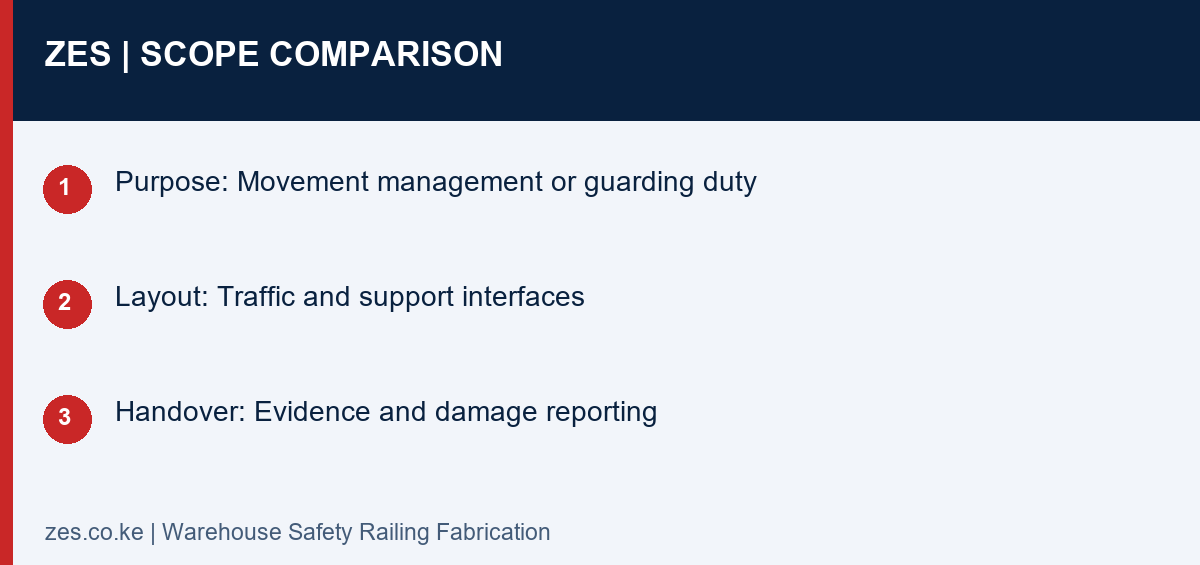
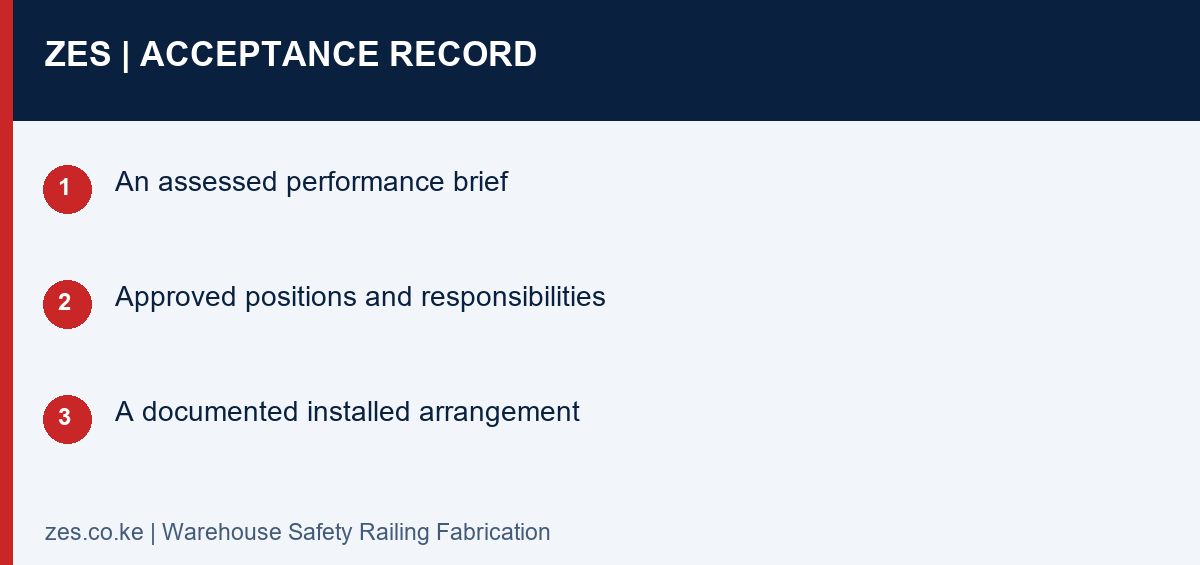
| Purpose | Movement management or guarding duty | An assessed performance brief |
| Layout | Traffic and support interfaces | Approved positions and responsibilities |
| Handover | Evidence and damage reporting | A documented installed arrangement |
A practical planning example
A warehouse wants to separate a walking route from handling activity. The responsible assessment should establish the required arrangement and performance rather than select a barrier solely from its appearance. This is an illustrative scope question.
Warehouse Safety Railing Fabrication: enquiry checklist
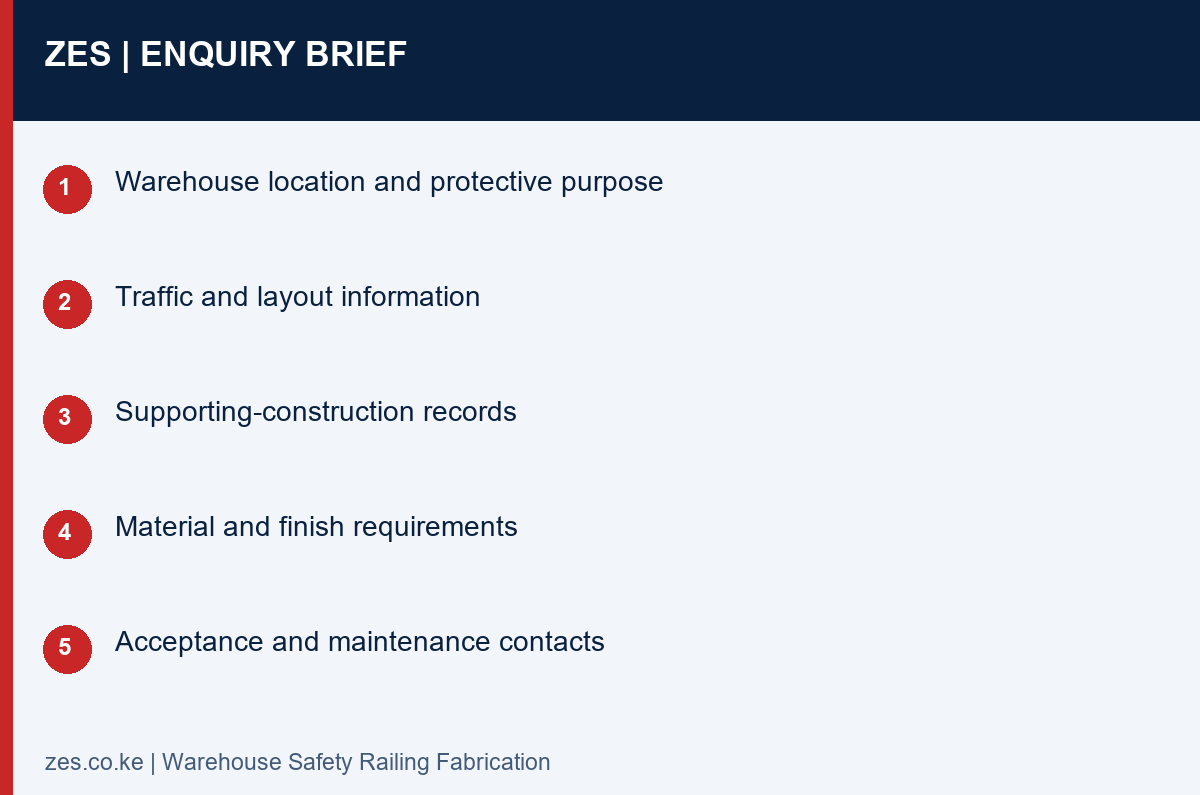
- Warehouse location and protective purpose
- Traffic and layout information
- Supporting-construction records
- Material and finish requirements
- Acceptance and maintenance contacts
Questions before arranging work
Does a fabricated steel barrier have an automatic impact rating?
No. Any claimed performance needs relevant support for the actual assembly and installation.
Can a damaged rail simply be rewelded?
Condition, duty and the cause of damage need appropriate assessment before a repair is selected.
Discuss the metalwork requirement with ZES
Read the related ZES fabrication planning guide and explore welding and metal fabrication services. Share the location, equipment information and intended outcome. ZES confirms the appropriate assessment, availability, proposed delivery responsibilities and commercial terms for the actual enquiry.
Request a scoped quotation · Request a site assessment · Call +254 725 345 345
Technical background: NCA contractor information. Confirm the actual project requirements with the responsible advisers and relevant product information.
More detailed project planning
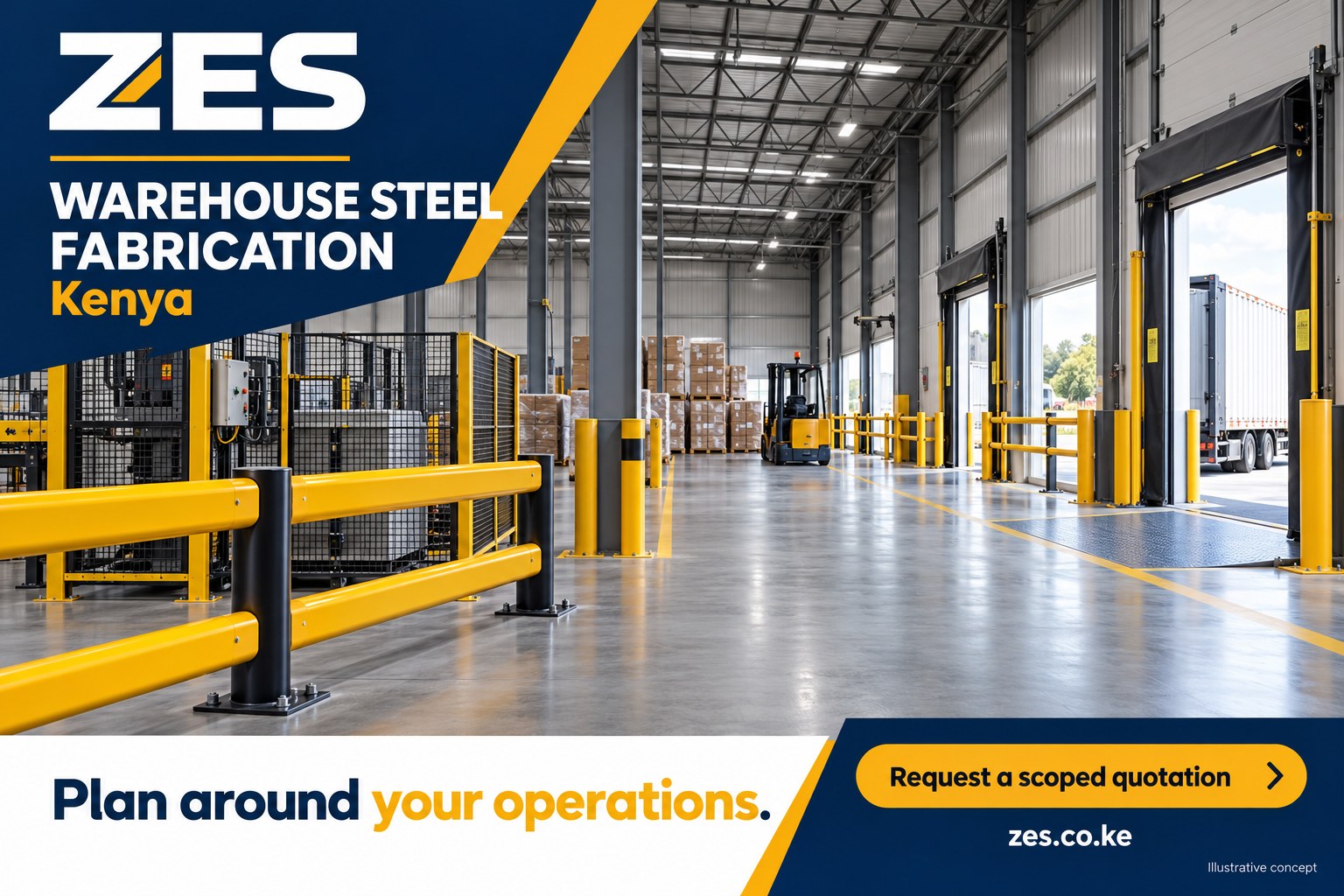
Warehouse steel fabrication Kenya operators need should be planned around the movement of goods, vehicles and people. The work may involve protective barriers, equipment guards, gates, enclosures, stands or replacement metalwork. Each item should solve a defined operating problem without obstructing another important activity in the building.
ZES can review warehouse metalwork requirements and scope fabrication or repairs around site conditions and agreed drawings. Start with the problem: repeated impact at a corner, an exposed machine, an insecure storage area or a damaged loading-area component. That brief is more useful than requesting a general quantity of steel without identifying its purpose.
Map the operating area before measuring the item
Record the routes used by forklifts, pallet equipment, delivery vehicles and pedestrians. Identify doors, emergency routes, fire equipment, service panels and areas that need regular access. A guard or barrier should not be positioned simply because there is space to bolt it down. Its location needs to work with the activities and clearances around it.
Consult the people who use the area during different shifts. A location that looks empty during a survey may become a temporary staging area when deliveries arrive. A barrier that prevents one type of contact can create another obstruction if the movement pattern is not understood. Mark the proposed arrangement on a plan and review the effect before fabrication.
Separate protective metalwork from structural alterations
Do not treat a mezzanine, building extension, rack alteration or load-bearing platform as ordinary accessory fabrication. These items require an appropriate design basis and professional review. Warehouse racking also has its own system requirements; welding or modifying a rack without the responsible supplier or designer's assessment can invalidate its intended performance.
For equipment guards and enclosures, discuss what access must remain possible and who will inspect the finished arrangement. Fabrication should support the machine's safe operation and maintenance requirements. A cover that must be removed for every routine task may be used differently from what the designer intended. Resolve that interface before finalising the metalwork.
Plan installation around warehouse activity
Agree work zones, delivery routes, stock protection and any shutdown periods. The project may be easier to manage in sections, with each section inspected before the next area is released. State who moves stock or machinery and who reinstates the area. These responsibilities can materially affect both programme and cost.
Where drilling or fixing is proposed, the substrate and concealed services need consideration. A floor slab should not be assumed suitable for every anchor or load. The appropriate fixing detail should follow the item, the base and the design requirements. The quotation should make any investigation or remedial work visible rather than leave it to an installer to resolve on the day.
Use the asset history to reduce repeat repairs
Record the location and cause of damaged metalwork where known. Frequent impact at the same point may indicate a layout, visibility or handling issue. Replacing the same barrier repeatedly without reviewing traffic movement can leave the underlying problem unchanged. A useful repair report distinguishes the physical damage from the operational condition that contributed to it.
Ask for a schedule identifying the fabricated items, their locations, finishes and relevant inspection records. Avoid unsupported load ratings or claims that a barrier will stop every vehicle impact. Send ZES the warehouse location, a layout or sketch, photographs, the operating problem and the permitted work windows. The following repair guidance adds detail for assessing existing warehouse metalwork before deciding what should be retained or replaced.
Further project planning guidance
Welding repairs for warehouses Kenya operators arrange can affect loading bays, gates, doors, barriers, stairs, railings, canopies, cages and equipment frames. The first priority is to protect people, stock and vehicle routes while the defect is assessed. A quick weld is not a substitute for unloading, isolation, approved repair design or replacement where damage is extensive.
This guide is for warehouse managers, landlords, logistics teams, facilities contractors and procurement staff. It supports ZES welding and metal fabrication services. Proprietary pallet racking and load-bearing storage systems need special care: do not weld, straighten or modify them without written direction from the manufacturer or an appropriately qualified responsible professional.
Make the damaged area safe and identify the asset
Assign the item an asset or location reference and record the defect before altering it. Note impact marks, corrosion, cracks, loose fixings, distortion and any change in operation. Photograph surrounding columns, floor, wall and connected components. Forklift impact can affect more than the point that looks bent, while water entry may cause hidden corrosion at bases and joints.
The warehouse’s authorised team should decide interim controls. These can include unloading an affected structure, closing a bay, isolating a door, redirecting forklifts or installing an approved temporary barrier. The repair contractor should be told who can release the work area and who can return it to use.
Separate ordinary fabricated metalwork from proprietary systems. Racking uprights, beams, connectors and protective devices may be governed by a manufacturer’s repair policy. Welding can alter material properties or geometry and may invalidate the approved system arrangement. Obtain a documented assessment before any modification.
Choose repair or replacement using the defect cause
Determine why the item failed. Common contributors can include vehicle impact, overloaded or misused components, worn hinges and rollers, foundation movement, poor drainage, coating breakdown and repeated forced operation. Repairing a cracked joint while leaving a misaligned door or unprotected column can lead to recurrence.
The approved repair detail should state material, removed areas, replacement sections, connections, dimensions and finish. Severe section loss, multiple previous repairs, unknown steel or distorted geometry can make replacement the better option. Load-bearing stairs, platforms, canopies and structural frames require professional review of capacity and supports.
Where a loading-bay door, gate or dock item is involved, coordinate movement, springs, counterweights, motors, sensors and stored energy with the appropriate equipment specialist. Metal fabrication does not automatically include electrical, mechanical or access-control commissioning.
Plan work around people, stock and logistics
A warehouse repair plan should map forklift lanes, pedestrian routes, loading schedules, fire equipment, exits, combustible stock and working-at-height risks. Agree whether work takes place during a shutdown, within a segregated bay or after stock is relocated. Barriers and signs must protect both the repair zone and alternative routes.
Hot work follows the facility’s permit, isolation, fire-prevention, ventilation and post-work monitoring arrangements. Sparks and grinding debris can travel into packaging, stored goods and cavities. A controlled cold connection or workshop-fabricated replacement may reduce site hot work where the approved design permits it.
Plan delivery and lifting before the repair window. Long beams, gate leaves and canopy components need clear routes and safe handling. If opening-up reveals concealed damage or unsuitable supports, stop and obtain approval rather than expanding the repair informally.
Build a quotation and handover record
Provide asset identity, defect photographs, dimensions, original drawings where available, repair approval, stock or traffic constraints, site induction, work window and inspection needs. State whether the scope includes dismantling, temporary barriers, access equipment, workshop fabrication, finishing, delivery, installation and disposal.
- Confirm the item is unloaded, isolated or otherwise made safe.
- Identify proprietary equipment and obtain its authorised repair route.
- Describe forklift, pedestrian and public exclusion arrangements.
- List material, finish and approved dimensional requirements.
- Assign functional testing for doors, gates or moving equipment.
- Record variations and outstanding risks before reopening the area.
Handover may include before-and-after photographs, approved drawings or repair details, finish records, inspections and a snag list. The warehouse should update its asset and impact history, then monitor repaired areas for recurring damage.
Multi-site operators can standardise asset references and evidence fields while allowing each warehouse to document its own traffic, stock, access and permit conditions.
Frequently asked questions
Can a bent pallet-rack upright be welded straight?
Do not assume so. Unload and isolate the affected bay as directed, then follow the rack manufacturer’s or appointed competent professional’s written assessment and repair policy.
Can a damaged loading-bay gate be repaired in place?
Possibly, after stored energy, drive systems, alignment, support condition and access are controlled. Some components are better removed or replaced.
How can hot work disruption be reduced?
Complete cutting and welding in the workshop where practical, prepare exact dimensions and replacement parts, then use approved site connections and a planned work zone.
Who controls forklift traffic during repairs?
The warehouse operator should establish and enforce traffic management, isolation and alternative routes in coordination with the contractor.
What causes repeat warehouse metalwork damage?
Unresolved vehicle paths, missing protection, misalignment, drainage, worn hardware or unsuitable design can contribute. Review the cause rather than repeatedly repairing the same point.
For a warehouse repair assessment, request a ZES quotation with the asset location, defect evidence, loading status, authorised repair detail and operating constraints.
Discuss your project with ZES
Share the site location, photographs taken from a safe position, available drawings, quantities and intended outcome. ZES can confirm the assessment needed and provide a scoped proposal with responsibilities and exclusions.
Request a project quotation | Explore the related ZES service | Call +254 725 345 345