
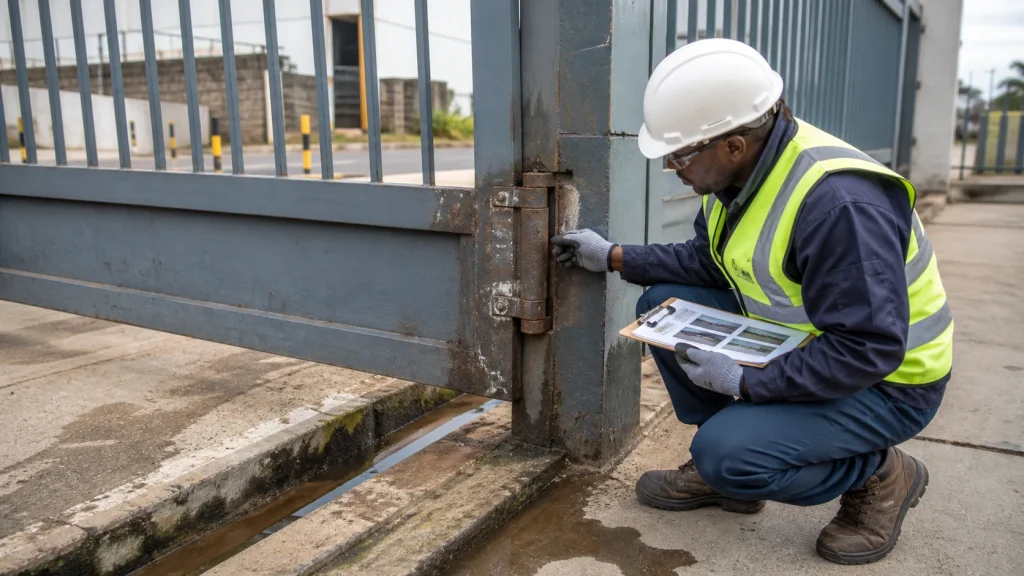
A responsible welding repair company Kenya facilities teams consult should assess why metalwork failed before covering the visible defect. A cracked hinge plate, corroded stair stringer, loose rail or distorted frame may be repairable, but it may also signal loss of sound base material, repeated impact, poor drainage, overload or movement elsewhere. A documented repair-or-replace decision protects the buyer from treating the same symptom repeatedly.
This guide gives facilities managers, estates, schools, warehouses and commercial properties a practical assessment framework. It complements the main ZES welding repair service, where individual conditions can be reviewed.
Secure the area and record the condition
The site’s responsible person should first control use and access based on the actual risk. Do not keep operating a sagging gate, loose handrail or damaged platform simply to see whether it worsens. Do not grind, repaint or dismantle the area before recording it unless an immediate safety procedure requires action.
Take close photographs of the defect and wide photographs showing the whole assembly, its supports and nearby environment. Record when the problem was noticed, whether it followed an impact or unusual event, how the item is normally used and any temporary action already taken. Previous repair dates and photographs can reveal a recurring pattern.
Label each location if several items are involved. “Repair three rails” is less useful than a numbered condition schedule showing Rail A with a loose base plate, Rail B with corrosion at the lower post and Rail C with impact distortion.
Look beyond the visible crack or broken joint
A defect often appears where stress concentrates, but the cause may lie elsewhere. A gate hinge can crack because the post moved or the gate drags. A bracket can fail because equipment vibrates or a load path changed. A rail base can corrode because water collects around the fixing.
The assessment should examine surrounding material, alignment, connections, support condition, exposure and evidence of repeated contact. Cleaning may be necessary to reveal sound material, but the extent and method should be controlled. If the item is structural, safety-critical, machine-related or otherwise outside a routine metalwork decision, involve the appropriate project or equipment professionals.
A repair should address an identified cause where feasible. Adding more weld metal without correcting misalignment, drainage or ongoing impact may only move the next failure to another location.
Compare repair, reinforcement and replacement
Local repair may be appropriate when sound material remains, access allows proper preparation and the original function can be restored through an approved detail. The scope should identify removal of damaged material, preparation, fit-up, finishing and follow-up checks.
Reinforcement may be considered when an authorised detail addresses the underlying condition and transfers forces appropriately. It should not be an improvised plate covering unknown deterioration. Record who approved the detail and how interfaces will be finished and inspected.
Replacement may be more practical when deterioration is widespread, geometry is badly distorted, multiple past repairs exist, access for sound repair is poor or the repaired item would still be difficult to maintain. Replacement can be local to a component or cover the complete assembly, depending on assessed condition and approved information.
Ask for the reasoning, not just the recommendation. A concise condition note should state observations, constraints, proposed action, assumptions and exclusions.
Consider access, disruption and temporary conditions
Repair method depends on where the metalwork sits. An occupied entrance, active loading bay, stair route or equipment area may need temporary access arrangements. State operating hours, alternative routes, surrounding finishes and any period when the item can be removed.
Decide what can be prepared in a workshop. A replacement hinge bracket or rail section may be measured on site, fabricated elsewhere and installed during a shorter closure. Larger assemblies may require temporary support or staged work designed and controlled by the appropriate parties.
If the work must occur at the installed location, the ZES on-site and mobile welding service is a related route for access and mobilisation planning.
Document the temporary state. If a gate remains out of service, an opening is barricaded or a coating stage is incomplete, assign who controls the area and when the next review occurs. Temporary measures should not become undocumented permanent arrangements.
Define completion and recurrence checks
Agree how the completed work will be reviewed: alignment, operation, joint condition, surrounding material, fasteners, drainage, finish touch-up and housekeeping may all be relevant. Any load, structural or equipment test must follow the approved project requirements and responsible specialists.
Record before-and-after photographs and the final repair or replacement detail. Note the suspected cause and any action taken to reduce recurrence. If the cause remains uncertain, state that limitation and recommend an appropriate observation or further-assessment interval without inventing a universal schedule.
Facilities teams can add repaired assets to their maintenance register. Revisit areas exposed to impact, moisture, vibration or frequent operation according to site conditions. A record makes it easier to distinguish a stable repair from a returning pattern.
Build a comparable repair quotation
Ask bidders to price the same numbered locations and identify preparation, removal, replacement material, fabrication, site fitting, finish restoration and disposal. If full condition cannot be known until cleaning or dismantling, request a clear assumption and an approval route for added work.
Separate immediate containment, permanent work and optional wider maintenance. This prevents an urgent condition from turning into an undefined package. It also lets the buyer plan similar low-priority defects without delaying the critical repair.
A good quotation should be specific about what will be restored, but cautious about conditions that have not yet been exposed. That honesty is more useful than a confident claim based only on a photograph.
Frequently asked questions
Can rusted steel always be welded?
No. The remaining sound material, extent of corrosion, role of the component and ability to prepare it must be assessed. Widespread loss may make replacement more appropriate.
Why do cracks return after repair?
Possible reasons include recurring overload, impact, vibration, poor alignment, unsuitable detailing or an unaddressed support problem. The surrounding condition and failure cause should be reviewed.
Is reinforcement always better than replacement?
No. Reinforcement needs an appropriate, approved basis and sound material to connect to. It can add weight or shift forces without resolving deterioration if used casually.
What should a repair record include?
Include the location, observed condition, selected action, approved detail where applicable, photographs, accepted changes, completion check and any follow-up recommendation.
For an initial repair-or-replace discussion, send ZES clear photographs, location details and repair history. The team can indicate whether further site assessment and approved technical input are needed.