
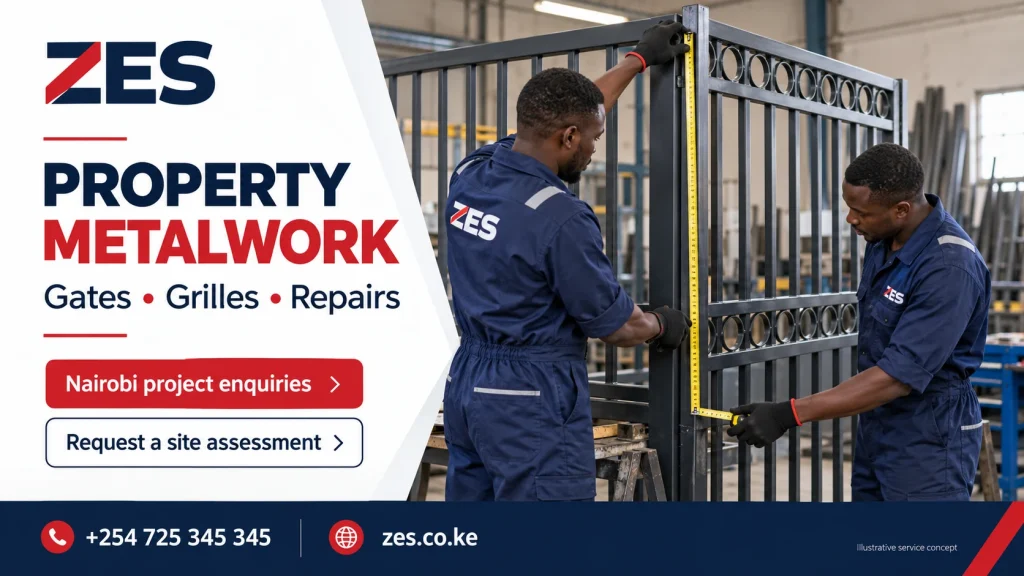
Welding Services Embakasi West buyers often need to decide whether work should happen at the property or in a workshop. The right choice follows the actual item, design, condition, access and approved site arrangements. A mobile service is not automatically the most suitable route, and workshop fabrication still needs a defined installation plan. This guide helps a customer compare the complete options. ZES can assess Embakasi West enquiries and confirm the relevant workshop, site and supporting responsibilities before a quotation is finalised.
1. Describe the complete item
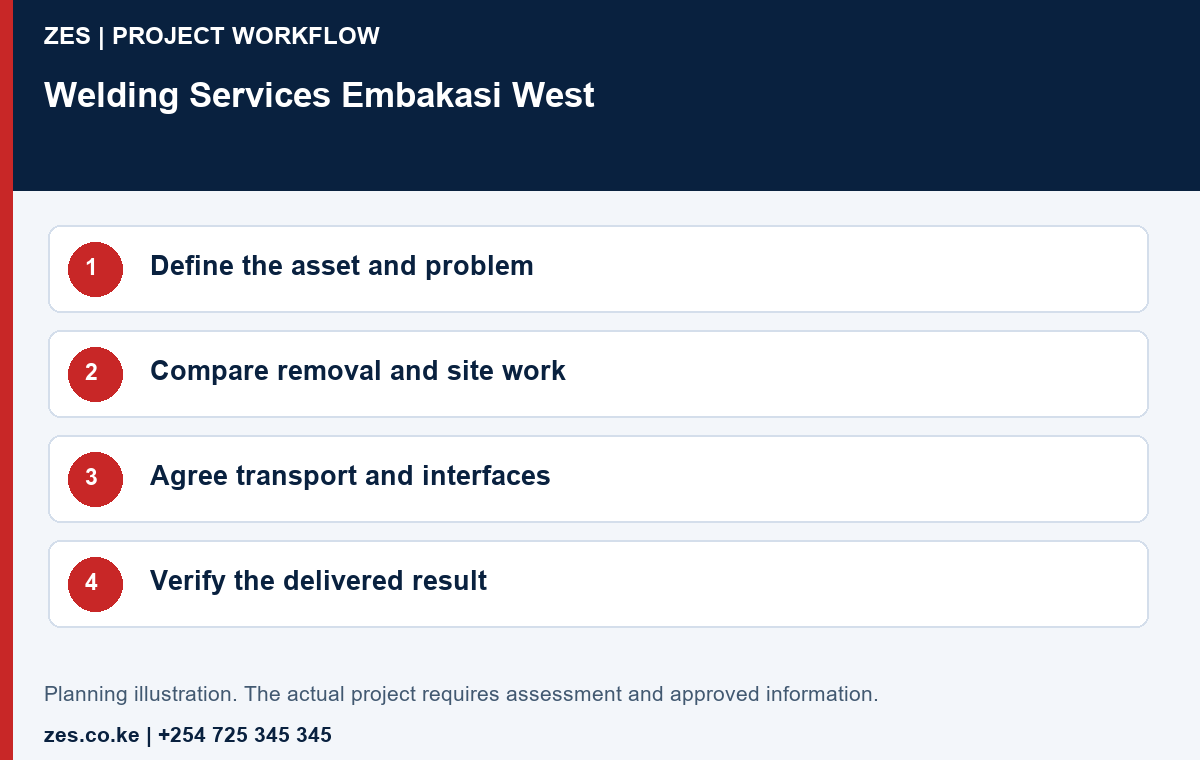
State whether the enquiry concerns a removable component, an installed assembly or a new fabricated item. Include intended use, dimensions needing verification and available drawings. A close photograph may not show the connections or supporting elements that determine the work boundary. Workshop fabrication and site work should both begin with the same agreed requirement so the alternatives can be compared fairly.
2. Ask who assesses removal and reinstatement
If an existing part might be removed, identify the responsible assessment and the work needed around it. Removal may involve other suppliers, supporting construction or operational dependencies. Do not treat a part as freely removable merely because it appears attached by a small connection. Welding services Embakasi West should state which removal and reinstatement tasks are supplied and which remain with the customer or another competent party.
3. Compare the complete workshop route
A workshop-fabrication option should identify assessment, approved information, production, finish, transport and installation where included. Confirm whether completed components can reach their intended position and who provides relevant handling. A workshop supply price can be appropriate for a defined customer arrangement, but it should not be described as a full installed solution if essential tasks remain excluded.
4. Compare the actual site route
The site option needs an appropriate assessment of access, operating boundaries, relevant controls and responsibilities. The responsible people must approve the work method and readiness. This guide does not provide a procedure for carrying out welding beside occupied areas or live equipment. A convenient attendance time does not establish that the site and other dependencies are ready for the proposed intervention.
5. Identify dimensional and design hold points
Ask when dimensions become final and which information must be approved before production or modification. Workshop fabrication based on unresolved assumptions can create avoidable changes at installation. Site work should not become an excuse to alter an approved design informally. If a measured condition differs from the reference, raise it with the responsible party and record the authorised technical and commercial decision.
6. Include the effect on ordinary use
Describe how the customer expects to manage the affected asset while work is underway. The responsible site team should assess and approve any temporary arrangement. Compare interruption, access and other dependencies in the programme, without converting a short welding task into a guaranteed completion duration. State the decision process if an expected part, approval or supporting supplier is unavailable.
7. Accept against the same outcome
Whichever route is selected, retain the agreed scope, final references and appropriate verification evidence. Workshop fabrication should be checked as supplied; installation should be checked against its approved arrangement. Record remaining actions rather than accepting a photograph as the whole handover. Later welding services Embakasi West enquiries can then reference the original work and any changes since it was accepted.
Illustrative project brief for Embakasi West
An invented customer needs an existing metal frame altered to suit a changed use. One proposal assumes removal to a workshop, while another assumes assessed site work. A fair comparison identifies the design decision, removal responsibility, supporting conditions, transport, protection, installation and acceptance evidence for each route. If either option excludes a necessary interface, the customer can arrange it explicitly before appointment. This is a buying example, not a promise that every frame can be altered or that ZES has carried out the described local work.
Prepare a clear enquiry for ZES
Send the site location, intended use, quantity, photographs, available drawings and approximate dimensions. Mark measurements that still need verification. Identify the person authorised to approve the work and the relevant technical or property contacts. Explain the preferred programme and which activities must continue. Avoid sending private tenant information, security credentials or unrelated personal records when a simple project description will explain the requirement.
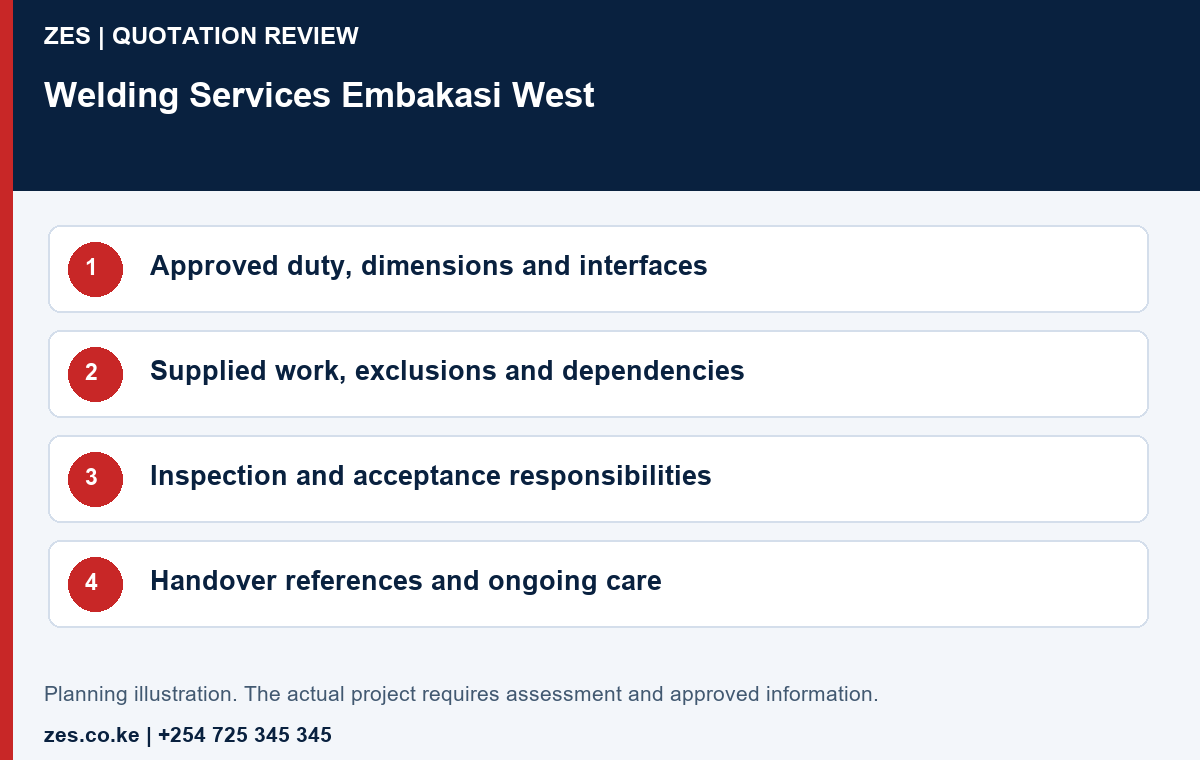
A written proposal should identify supplied work, exclusions, customer dependencies, approved references and acceptance evidence. Confirm current commercial terms and any assessment, travel, delivery or installation arrangements directly. Relevant design, approvals and specialist verification remain with the appropriately qualified responsible parties where required. This guide provides buying questions; it is not a site-specific welding method, structural design or certification of an existing installation.
- Required result: identify the item, duty and quantity.
- Information: distinguish approved details from assumptions.
- Interfaces: name customer and third-party responsibilities.
- Commercial scope: compare equivalent supplied outcomes.
- Acceptance: agree evidence, outstanding actions and handover references.
Frequently asked questions
Is site welding always faster than workshop fabrication?
Not necessarily. The appropriate programme depends on readiness, approved method, access, information, materials and supporting tasks. Compare the complete delivery route rather than only the time spent welding.
Can ZES quote both options?
Describe the requirement and ask which alternatives can reasonably be assessed. The proposal should confirm feasibility, dependencies and commercial terms for the actual item.
Does workshop supply include installation?
Only where the written scope includes it. Ask for transport, handling, enabling work, installation, relevant verification and reinstatement to be identified separately.
Related specialist ZES guide · Welding and metal fabrication services · Request a welding quotation · Request a site assessment · Call +254 725 345 345.
Reference: NCA contractor information. Confirm requirements applicable to the actual scope with the responsible advisers.