
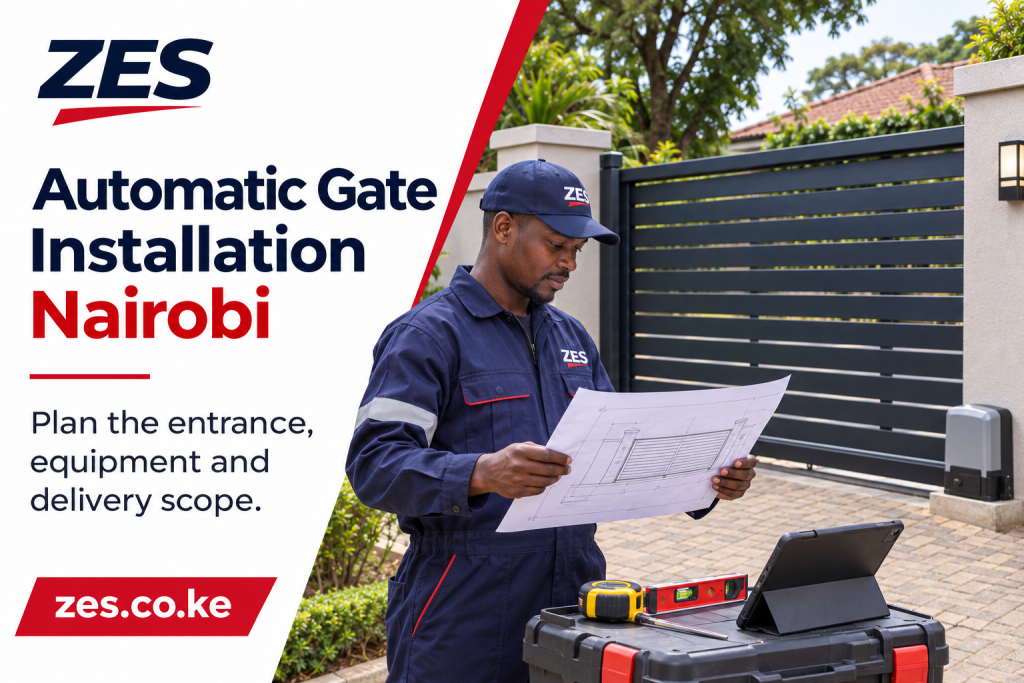
Updated 3 November 2026 · Zama Engineering Systems buyer guide
Automatic Gate Installation Nairobi projects should connect the physical gate, user needs, power and relevant safety arrangements. Selecting an operator is only part of a completed installation. This section extends the established ZES gate installation and repair page with a practical commissioning-focused brief for Nairobi properties, while preserving its existing address and detailed service information.
Describe the actual entrance and users
Share the location, gate type, available drawings and expected use. Identify pedestrian, resident, visitor and delivery needs. A suitable assessment should consider the physical opening and the way people approach it, not only the appearance of the gate. Explain whether it is a new installation or a retrofit. Safely taken photographs can support the enquiry but do not replace relevant site information.
Automatic Gate Installation Nairobi: resolve suitability
The competent parties should review the gate condition, geometry, duty, supports and proposed automation. An operator should not be selected to disguise poor movement or an unresolved support issue. Product-specific requirements and relevant safety arrangements belong in the assessment. Ask which information and enabling works are required before installation. A quoted model name alone does not establish suitability for the entrance.
Define the complete work package
The proposal should identify equipment, controls, power work, mechanical interfaces, relevant devices, testing and user instruction. List which items are supplied by others and how compatibility is confirmed. Visitor communication and software functions need an actual supported scope. Ask about transport, access, making good and any recurring costs. Compare complete installed offers rather than a motor-only price.
Plan commissioning and customer ownership
The responsible parties should establish and demonstrate relevant checks for the installed arrangement and ordinary user controls. Obtain equipment references, user instructions, support terms and the agreed outage or authorised release information. Customer accounts should have an accountable owner where applicable. Record outstanding work and any limitations so the installation is understandable after the project team leaves.

Compare the supplied scope
| Decision | Information to confirm | Useful result |
|---|---|---|
| Entrance brief | Gate, users and operating pattern | A site-specific assessment |
| Installed scope | Equipment and enabling interfaces | Named delivery responsibilities |
| Commissioning | Relevant checks and user instruction | A documented completed arrangement |
A practical planning example
A residential entrance may need both vehicle automation and a clear visitor procedure. Defining those needs before equipment selection helps the proposal address the complete use of the site. This is an illustrative planning example.
Automatic Gate Installation Nairobi: enquiry checklist
- Nairobi site and gate information
- New-build or retrofit requirement
- Users and control preferences
- Power and supporting-work information
- Installation and handover responsibilities
Questions before arranging work
Does a motor quotation include the complete installation?
Not necessarily. Confirm enabling works, controls, relevant devices, commissioning and handover in the actual scope.
Can any existing gate be automated?
Suitability requires appropriate assessment of the actual gate, entrance and intended operation.
Discuss the gate requirement with ZES
Read the related ZES gate project guide and explore the service categories. Share the location, equipment information and intended outcome. ZES confirms the appropriate assessment, availability, proposed delivery responsibilities and commercial terms for the actual enquiry.
Request a scoped quotation · Request a site assessment · Call +254 725 345 345
Technical background: HSE powered-gate technical background (UK). This background does not establish Kenyan legal requirements for a particular project. Use the actual product instructions and appropriate project-specific advice.
More detailed project planning
A gate is the first security layer any visitor meets. When it opens smoothly at the touch of a button, it feels effortless. When it jams, reverses unpredictably or leaves the driveway exposed, it becomes a daily frustration and a security risk. The difference is almost always the quality of the automatic gate installation and the system chosen for the entrance.
Automatic gate installation in Kenya covers a lot more than mounting a motor. It involves assessing the entrance, selecting the right gate type and motor, designing safety and access control, installing power and control wiring, commissioning the system and supporting it afterwards. Get it right and the gate lasts for years. Get it wrong and you inherit recurring faults, unsafe operation and expensive repairs.
This guide explains how automatic gate installation works in Kenya, the gate types and motors available, the safety and access-control considerations, the installation process, what affects cost, and how to choose gate automation contractors who will deliver a reliable system.
It is written for homeowners, estate managers, property developers, business owners, facility managers and procurement teams.
Why Automatic Gates Are in Demand in Kenya
Automatic gates have moved from luxury to practical necessity.
Security. Gates control vehicle and pedestrian access, deter opportunists and support estate security.
Convenience. Drivers do not need to leave the car to open the gate, which is safer and faster.
Property value. A well-installed automatic gate improves the appearance and perceived value of a property.
Access control. Gates can integrate with intercoms, CCTV, biometrics and remote controls.
Traffic management. Commercial and industrial sites use automation to manage vehicle flow.
Staff efficiency. Guards can focus on verification rather than manual gate operation.
Weather protection. Automation means nobody has to stand in the rain to open a gate.
Demand is strongest in Nairobi, its estates and satellite towns, but automatic gates are now common across Kenya.
Gate Automation Services
Gate automation services typically include:
Site survey and assessment. Checking the entrance, gate, ground conditions and power.
Gate and motor selection. Matching the gate type, weight and usage to the right motor.
Installation. Mounting the motor, running wiring, fitting controls and safety devices.
Access control integration. Remote controls, keypads, intercoms, biometrics and vehicle tags.
Safety systems. Obstruction detection, warning lights, emergency release and safe-stop.
Commissioning. Testing travel, force limits, limits switches and safety functions.
Training. Showing the client how to operate and maintain the system.
Maintenance and repair. Servicing, adjustments and fault response.
A complete provider handles the whole scope, not just the motor.
Gate Types for Automation
Different gates suit different entrances.
Sliding Gates
The gate slides along a track or cantilever system. Sliding gates are popular in Kenya because they need less clearance than swinging gates and can be automated reliably. They suit wide driveways and commercial entrances.
Swing Gates
One or two leaves swing open. Swing gates suit smaller driveways and traditional entrances. They need clearance for the leaves to swing and careful safety planning.
Bi-fold and Telescopic Gates
These fold or telescope to fit tight spaces where a full sliding gate cannot run.
Barrier Gates
Used for high-traffic commercial and industrial entrances, often with ticketing or access control.
Cantilever Sliding Gates
The gate is supported by the structure rather than a ground track, which suits uneven ground and heavy use.
The gate type must match the space, the traffic and the motor.
Motor Types
Motor selection is critical.
Sliding gate motors. Rack-and-pinion systems that move the gate along its track.
Swing gate motors. Articulated arms or underground operators that swing the leaves.
Barrier motors. Boom barriers for vehicle control.
Solar-powered motors. Suitable where mains power is unreliable or unavailable.
Heavy-duty motors. For commercial and industrial gates with high usage.
Residential motors. Lighter duty for homes and estates.
Motor quality. Cheap motors may work initially but fail under frequent use or harsh conditions.
The motor must be rated for the gate weight, length and frequency of use.
Power and Electrical Considerations
Automatic gates need reliable power.
Mains power. Available at most urban sites, but voltage fluctuations can affect motors.
Solar power. Useful in remote or unstable grid areas, with batteries and charge controllers.
Backup. Batteries or manual release ensure operation during outages.
Earthing. Proper earthing protects equipment and users.
Cable routes. Power and control cables must be protected and correctly sized.
Isolation. A means to isolate power for maintenance.
Surge protection. Protects control boards from spikes.
Compliance. Electrical work should be safe and compliant.
Power quality and protection are often overlooked and cause early failures.
Safety Systems
Safety is the most important part of gate automation.
Obstruction detection. The gate should stop or reverse when it meets an obstacle.
Force limits. Motors should be set so they do not exert dangerous force.
Safety edges. Rubber or optical sensors on the gate leaf.
Photocells and sensors. Detect vehicles or people in the path.
Warning lights. Flash before and during movement.
Emergency release. Manual release for power failure or emergencies.
Safe-stop. The gate should stop safely rather than crush or trap.
Signage. Warning signs on automated gates.
Testing. Safety functions should be tested at commissioning and maintained.
A gate that moves is not necessarily a gate that is safe.
Access Control and Smart Operation
Modern gates integrate with access control.
Remote controls. Handheld transmitters for residents and staff.
Keypads. Code entry for visitors and staff.
Intercoms. Audio or video intercoms for visitor verification.
Biometrics. Fingerprint or face recognition for high-security sites.
Vehicle tags. Long-range tags for frequent users.
Mobile access. Smartphone apps for opening and monitoring.
Integration with CCTV. Cameras at the gate for verification.
Visitor management. Logging and temporary access.
Smart automation. Scheduling, remote monitoring and notifications.
Access control should be designed with the gate, not added as an afterthought.
The Installation Process
Professional installation follows a clear sequence.
1. Site survey. Assess the entrance, gate, ground, power and access.
2. Design. Select the gate and motor, plan wiring, safety and access control.
3. Quotation. Provide an itemised quotation with scope and assumptions.
4. Preparation. Prepare foundations, track or mounting points as required.
5. Wiring. Run power and control cables safely.
6. Motor installation. Mount the motor and connect the gate.
7. Control installation. Fit the control panel, receivers and safety devices.
8. Commissioning. Set limits, force, speed and safety functions; test thoroughly.
9. Training. Show the client how to operate, release and maintain the gate.
10. Handover. Provide documentation and support arrangements.
Skipping commissioning and safety testing is a common cause of problems.
What to Expect from Gate Automation Contractors
A good contractor is more than an installer.
Assessment. They check the gate, ground and power before quoting.
Honest advice. They recommend the right system, not the most expensive one.
Quality equipment. They use motors and controls suited to the usage.
Safe installation. They prioritise safety devices and testing.
Clear quotation. They itemise equipment, labour, wiring and commissioning.
Warranty. They stand behind the installation.
Support. They offer maintenance and respond to faults.
Documentation. They provide manuals and warranty information.
References. They can show comparable installations.
Communication. They explain the system and its limitations.
Choosing a contractor on price alone often leads to recurring problems.
What Affects Automatic Gate Installation Cost
Cost depends on the site and the system.
Gate type and size. Sliding, swing, bi-fold and barrier gates differ in cost.
Gate weight. Heavier gates need stronger motors and structure.
Motor quality and rating. Residential versus heavy-duty commercial motors.
Power availability. Solar or backup systems add cost.
Wiring distance. Long cable runs increase labour and materials.
Safety devices. Photocells, safety edges and warning lights add cost.
Access control. Remote controls, intercoms, keypads and biometrics add cost.
Ground conditions. Uneven ground or a new track adds cost.
Installation complexity. Access and site conditions affect labour.
Maintenance. Ongoing servicing should be budgeted.
A good quotation itemises these elements so you can compare fairly.
Common Installation Mistakes
Undersized motors. The motor cannot handle the gate weight or usage.
Poor foundations or track. The gate binds and the motor strains.
No safety devices. A serious safety risk.
Incorrect force settings. The gate may crush or fail to reverse.
Poor wiring. Intermittent faults and safety issues.
No surge protection. Control boards fail after power spikes.
No manual release. The gate cannot be operated in an outage.
Skipping commissioning. Limits and safety functions are not set correctly.
No maintenance. The gate degrades and fails.
Choosing on price alone. Cheap installations cost more over time.
Maintenance and Repair
Automatic gates need regular care.
Servicing. Check the motor, track, rollers, hinges and controls.
Lubrication. Moving parts need appropriate lubrication.
Safety testing. Test obstruction detection and emergency release.
Battery checks. For backup and solar systems.
Control settings. Verify force, speed and limits.
Cleaning. Keep the track and moving parts clear.
Repairs. Address faults promptly to avoid bigger failures.
Records. Track maintenance and repairs.
Response. Choose a contractor with reliable support.
Regular maintenance extends life and protects safety.
Solar-Powered Automatic Gates
Solar power is increasingly common in Kenya.
When to choose solar. Remote sites, unstable grid power or areas without mains supply.
System components. Solar panels, charge controller, battery and inverter or DC motor.
Battery capacity. Sized for cloudy days and usage.
Motor compatibility. Some motors are better suited to solar systems.
Backup. Manual release remains essential.
Maintenance. Panels need cleaning and batteries need replacement over time.
Cost. Higher upfront, but avoids grid connection and outages.
Solar gates are practical when designed correctly.
Gate Automation Near Me: Choosing a Local Contractor
Local service matters for gates.
Response time. Faults need fast attention.
Familiarity. Local contractors know the area, power conditions and typical gates.
References. Nearby installations are easy to verify.
Support. Local contractors can attend quickly.
Warranty. Local support makes warranties practical.
Site visits. Easy access for surveys and maintenance.
When searching for gate automation near you, check reviews, ask for references and confirm the contractor handles maintenance.
Understanding Gate Mechanics
Gate automation works by applying controlled force to move a gate along a defined path.
Sliding gate mechanics. The gate runs on rollers along a track or is suspended as a cantilever. The motor drives a pinion against a rack fixed to the gate.
Swing gate mechanics. The gate rotates on hinges. The motor pushes or pulls the leaf through an arm or an underground operator.
Bi-fold mechanics. The gate folds as it opens, reducing the space needed.
Barrier mechanics. A boom raises and lowers to control vehicles.
Limits. Limit switches or encoders tell the controller when the gate is fully open or closed.
Force. The controller monitors force and reverses if an obstacle is detected.
Speed. Opening and closing speed affects convenience and safety.
Duty cycle. The motor's rated usage affects reliability.
Understanding the mechanics helps buyers ask the right questions.
Ground Tracks and Cantilever Systems
The support method affects reliability.
Ground tracks. The gate runs on a track fixed to the ground. Tracks need to be level, clear and well maintained. Debris can cause binding.
Cantilever gates. The gate is supported by a structure and does not need a ground track. This suits uneven ground, slopes and areas where a track would be impractical.
Foundation. Both systems need proper foundations for the posts and motor.
Drainage. Water should not pool around the track or foundation.
Maintenance. Tracks need cleaning; cantilever systems need structural checks.
Cost. Cantilever systems often cost more but avoid track problems.
The ground conditions should determine the support method.
Gate Weight and Duty Cycle
Motor selection depends on weight and usage.
Gate weight. The motor must be rated for the gate's weight plus fittings.
Gate length. Longer gates place more load on the motor and structure.
Frequency of use. A home gate opens a few times a day; a commercial gate may open hundreds of times.
Duty cycle. The motor's rated duty cycle should match the usage.
Environment. Dust, rain and heat affect motor life.
Safety margin. Choosing a motor slightly above the requirement improves reliability.
Heavy-duty components. Commercial gates need stronger motors, rollers and controls.
Under-specifying the motor is the most common cause of early failure.
Wiring and Control Panel Basics
The control system is the brain of the gate.
Power supply. Correct voltage and protection.
Control panel. Manages motor operation, limits, force and safety inputs.
Receivers. For remote controls and wireless devices.
Safety inputs. For photocells, safety edges and sensors.
Loop detectors. For vehicle detection at commercial entrances.
Intercom integration. For visitor verification.
Battery backup. For operation during outages.
Surge protection. Protects the panel from spikes.
Labelling. Clear labelling of cables and terminals.
Documentation. Manuals and wiring diagrams.
A well-installed control system makes maintenance and troubleshooting far easier.
Testing and Commissioning a Gate
Commissioning confirms the gate is safe and reliable.
Travel limits. Confirm the gate stops correctly at open and closed positions.
Force settings. Set so the gate reverses on obstruction without excessive force.
Speed. Set for safe and convenient operation.
Safety devices. Test photocells, safety edges and warning lights.
Manual release. Confirm it works and the client knows how to use it.
Remote controls. Test range and operation.
Access control. Test intercoms, keypads and tags.
Power failure. Test battery backup and manual release.
Cycle test. Operate the gate repeatedly to check reliability.
Handover. Train the client and provide documentation.
A gate that is not commissioned properly is not complete.
Estate and Multi-User Gate Systems
Estates and shared entrances have specific needs.
Multiple users. Residents, staff, visitors and service providers.
Access control. Tags, remote controls, keypads, intercoms and visitor management.
Logging. Records of who entered and when.
Traffic management. Managing peak flows without queues.
Safety. Protecting pedestrians and vehicles in shared spaces.
Power backup. Essential for security and access.
Maintenance. Shared responsibility and budgeting.
Management. Rules for issuing and revoking access.
Estate gates need systems that scale with the number of users.
Choosing Between Automation Brands
Brand matters less than suitability and support.
Motor quality. Reputable brands with proven reliability in Kenyan conditions.
Spare parts. Availability of parts and consumables locally.
Service support. Local technicians trained on the system.
Warranty. Clear terms and a local process for claims.
Compatibility. With access control and safety devices.
Weather resistance. Suited to dust, rain and heat.
Duty rating. Matched to usage.
Documentation. Manuals and wiring diagrams.
A well-supported mid-range system often outperforms an unsupported premium brand.
Gate Security and Forced Entry
Automation must not weaken security.
Gate strength. The gate itself must resist forcing.
Locking. Motors and mechanical locks secure the gate when closed.
Anti-lift devices. Prevent the gate being lifted off its track.
Control security. Remote controls and codes should be managed.
Access control. Restrict who can open the gate.
CCTV and monitoring. Visibility at the entrance.
Lighting. Deters intruders and improves camera images.
Integration. Gate, intercom, CCTV and alarms working together.
A weak gate with an expensive motor is still a weak gate.
Warranty, Support and Spare Parts
Support determines long-term satisfaction.
Warranty period. Understand what is covered and for how long.
Installation warranty. Workmanship should be covered.
Response time. How quickly faults are attended.
Spare parts. Availability of motors, boards, remotes and safety devices.
Service plans. Preventive maintenance options.
Documentation. Manuals and contact details.
Training. Ensure the client can operate and release the gate.
Records. Keep installation and service records.
Good support makes a mid-range system reliable.
Cost Planning and Budgeting
Plan the whole cost, not just the motor.
Equipment. Gate, motor, controls, safety devices and access control.
Installation. Labour, wiring, foundations and commissioning.
Power. Mains connection, solar or backup.
Maintenance. Annual servicing and repairs.
Replacement. Motors and batteries have a limited life.
Contingency. For unforeseen site work.
Comparison. Compare on scope and quality, not price alone.
Whole-life cost. Cheap systems may cost more over time.
Budgeting for maintenance avoids surprises.
Frequently Asked Questions
How much does automatic gate installation cost in Kenya?
Cost depends on the gate type, weight, motor, power, wiring, safety devices, access control and site conditions. Request an itemised quotation after a site survey.
Which is better, a sliding or swing gate?
Sliding gates need less clearance and are popular for wide driveways. Swing gates suit smaller entrances with space to swing. The right choice depends on your site and usage.
Can I automate an existing gate?
Often yes, if the gate is in good condition and suitable for automation. The gate and structure should be assessed first.
Do automatic gates work during power outages?
With battery backup or a manual release, yes. A manual release is essential for safety and access.
Are automatic gates safe for children and pets?
They can be, when fitted with obstruction detection, safety edges, photocells and correct force settings. Safety devices are not optional.
Can I open the gate from my phone?
Yes, with smart controllers and mobile access. This should be configured securely.
Can automatic gates integrate with CCTV and access control?
Yes. Gates can integrate with intercoms, CCTV, biometrics, keypads and vehicle tags.
How often should an automatic gate be serviced?
At least annually, and more often for heavy-use commercial gates. Safety functions should be tested regularly.
Can you install solar-powered gates?
Yes. Solar systems suit remote or unstable-power sites, with battery backup and manual release.
Do you work outside Nairobi?
Yes. Installation and support can be arranged across Kenya.
A Final Pre-Purchase Checklist
Before choosing a gate automation contractor, confirm the following. Make sure a site survey has been done. Check the gate type, motor rating and safety devices. Confirm the quotation itemises equipment, wiring, controls, commissioning and access control. Ask about power, backup and surge protection. Confirm safety testing and manual release. Ask about warranty and maintenance. Check references and response times. Finally, compare quotations against the same specification.
A contractor who explains these points clearly is usually the one worth trusting with your entrance.
Conclusion
Automatic gate installation in Kenya is a security and engineering decision. The difference between a gate that works reliably for years and one that causes constant problems is the assessment, the gate and motor selection, the safety design, the installation quality and the support.
If you are planning a gate, start with the entrance, the traffic and the power. Then insist on a site survey, the right motor, safety devices, proper commissioning and a maintenance plan.
ZES designs, installs, integrates and maintains automatic gates for homes, estates, businesses and industrial sites across Kenya. If you would like a practical assessment and a clear, itemised quotation, start with a site survey.
Request an automatic gate site survey and quotation from ZES
Automatic Gate Repair Services
Automation does not remove the need for repair. Gates and motors fail for predictable reasons: worn hinges, damaged tracks, failed welds, controller faults, battery failure and impact damage. A complete provider handles both installation and repair.
- Gate repair. Hinges, frames, tracks, rollers and alignment.
- Motor repair. Controllers, receivers, batteries and drive components.
- Safety repairs. Photocells, safety edges and warning lights.
- Access control repair. Remotes, keypads, intercoms and readers.
- Emergency response. For gates stuck open, closed or unsafe.
For detailed repair guidance, see automatic gate repair and gate motor repair.
Related Gate Automation Services
Explore our full gate and access-control capability:
- Electric gate motor installation and repair
- Sliding and swing gate automation
- Sliding gate motors
- Automatic swing gates
- Gate access control systems
- Automatic driveway gates
- Commercial automatic gate systems
- Solar powered automatic gates
- Automatic gate maintenance
- Automatic gate repair and gate motor repair
Automatic gate maintenance and repair enquiries
For an existing swing or sliding gate, describe the observed fault, equipment references, operating requirement and available service history. ZES can review a maintenance or repair enquiry and confirm the assessment and supplied intervention. The complete arrangement may involve gate condition, supports, motor, controls, power and relevant safety devices; a visible symptom should not be treated as a settled diagnosis.
The appropriate responsible parties should determine the safe operating response and any technical work needed. A repair quotation must identify what is retained, repaired or replaced, the supporting interfaces and the evidence required before acceptance. Current availability, visit arrangements and commercial terms are confirmed directly rather than promised as universal same-day response. See the existing automatic gate maintenance guide for a more detailed buying checklist.