
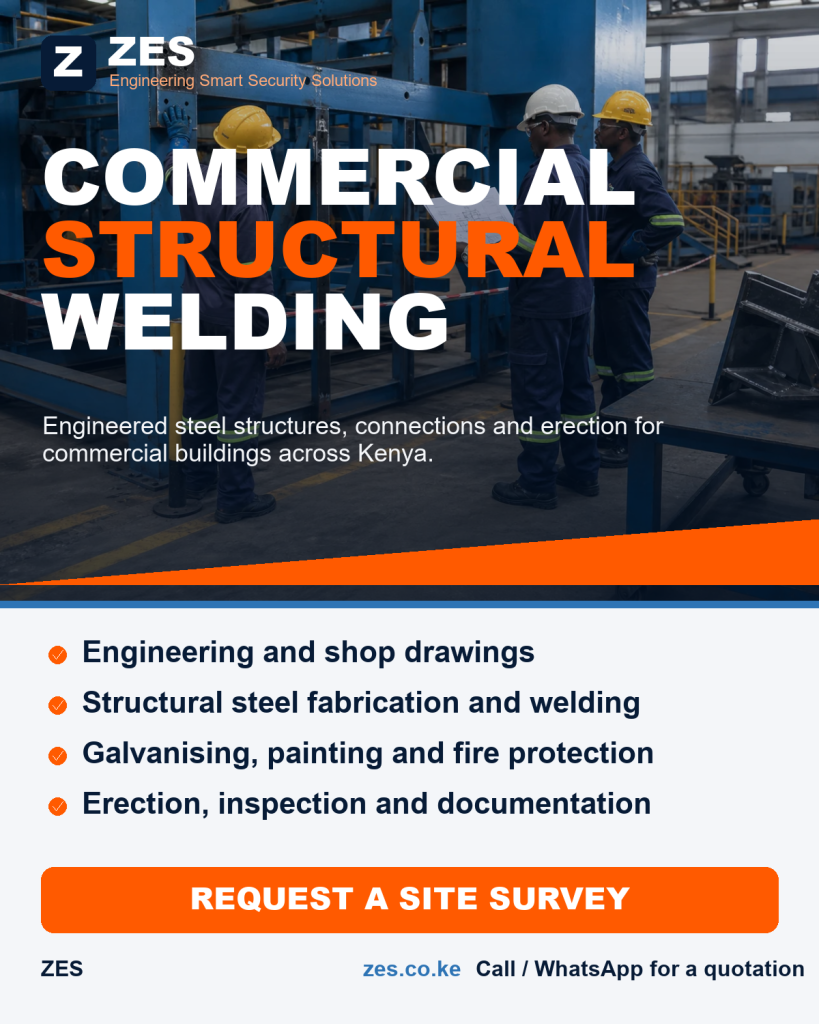
Commercial buildings depend on steel. Warehouses, malls, offices, schools, hospitals, canopies, mezzanines, staircases and platforms all use structural steel to carry loads safely and create space. The welding that holds that steel together is not a cosmetic detail — it is a structural and safety-critical activity.
Prepare a commercial steelwork enquiry
For a ZES quotation, share engineer-approved drawings, connection details, material schedules, lifting access, installation sequence and inspection requirements. The team can then confirm the assessment, fabrication, site work and supporting specialists required for your project.
Ask the written proposal to identify materials, quantities, preparation, finishing, installation, inspection, exclusions and handover records. Any required welder qualifications, specialist tests or compliance documents must be confirmed for the actual scope before appointment.
Commercial structural welding in Kenya is the discipline of fabricating and installing load-bearing steel structures to an engineering design, with qualified welders, inspected joints and documented quality. When it is done properly, structures perform for decades. When it is done poorly, the consequences can include failed inspections, costly remediation, structural movement and, in the worst cases, collapse.
This guide explains what commercial structural welding involves, how engineering and design shape the work, the materials and connections used, how welding quality is controlled, how structures are protected and installed, what affects cost, and how to choose a contractor for commercial structural work.
It is written for developers, architects, main contractors, project managers, engineers and business owners.
What Commercial Structural Welding Is
Structural welding joins steel members that carry loads. It is different from general fabrication because the consequences of failure are severe and the quality requirements are higher.
Structural welding work includes:
Building frames. Columns, beams, bracing and connections for commercial buildings.
Warehouses and godowns. Portal frames, trusses, purlins and supports.
Mezzanine floors. Structural mezzanines and access platforms.
Canopies. Entrance canopies, walkway roofs and petrol station canopies.
Staircases and balustrades. Structural stairs, fire escapes and handrails.
Platforms and walkways. Access platforms and elevated walkways.
Equipment supports. Structural supports for heavy equipment and services.
Modifications and strengthening. Altering or reinforcing existing structures.
Each of these requires engineering, fabrication and installation to a defined standard.
Applications in Commercial Construction
Structural steel is used across commercial sectors.
Retail and malls. Large-span roofs, mezzanines and feature structures.
Offices. Frames, canopies, staircases and rooftop structures.
Warehouses and logistics. Portal frames, racking supports and mezzanines.
Schools and universities. Halls, canopies, covered walkways and laboratory structures.
Hospitals. Plant supports, canopies and specialised structures.
Hotels. Feature structures, canopies and rooftop plant supports.
Petrol stations. Canopies, walkways and structural supports.
Factories. Platforms, supports and structural modifications.
Mixed-use developments. Frames, canopies and architectural steel.
Each application has specific loading and durability requirements.
Engineering and Design
Structural welding begins with engineering.
Load analysis. Dead loads, live loads, wind loads and, where relevant, seismic loads.
Structural design. Member sizing, connections and bracing.
Drawings. General arrangement drawings and shop drawings.
Calculations. Prepared and checked by a qualified engineer.
Approvals. Building approvals and, where required, structural audits.
Coordination. Interface with civil, architectural and services designs.
Tolerances. Specified for fabrication and erection.
Connections. Designed for the loads and erection method.
Engineering is not optional for load-bearing work. A fabricator who welds without design input is taking unacceptable risks.
Materials for Structural Steel
Material selection affects strength, weldability and durability.
Structural steel grades. Common grades have specified yield and tensile strengths. The engineer specifies the grade for each application.
Sections. Universal beams, columns, channels, angles, hollow sections and plates.
Thickness. Determines strength and weldability.
Certificates. Mill certificates confirm grade and properties.
Weldability. Higher-strength steels may require preheat and specific procedures.
Corrosion protection. Galvanising, painting or fire protection as required.
Availability. Local availability affects cost and programme.
The fabricator should confirm material grades against the design.
Bolted versus Welded Connections
Steel structures use both bolted and welded connections.
Bolted connections are common on site because they are faster, more controllable and easier to inspect. They require accurate hole positions and proper tightening.
Welded connections provide continuity and stiffness. They require qualified welders, proper procedures and inspection.
Hybrid connections combine both, with shop welding and site bolting.
Erection considerations. Site welding is slower and more affected by weather; bolting is often preferred for site joints.
Inspection. Bolted connections require torque checks; welded connections require weld inspection.
The connection design determines the fabrication and erection approach.
Welding Processes and Quality
Structural welding requires qualified procedures and welders.
Welding procedure specifications. Define the process, consumables, parameters and technique.
Welder qualification. Confirms the welder can achieve the required standard.
Process selection. MIG, stick, flux-cored or other processes, depending on the material and position.
Preheat. Required for some steels and thicknesses to prevent cracking.
Joint preparation. Clean, accurate fit-up.
Heat input control. Affects toughness and distortion.
Post-weld treatment. Stress relief where required.
Inspection. Visual and non-destructive testing.
Quality is verified, not assumed.
Fabrication and Shop Drawings
Shop fabrication offers control and quality.
Shop drawings. Detailed drawings for fabrication, including dimensions, connections and weld symbols.
Cutting. Accurate cutting for fit and tolerance.
Drilling and punching. Accurate hole positions for bolted connections.
Fit-up and jigging. Components assembled accurately.
Welding. Performed to the procedure.
Trial assembly. Checks fit before delivery.
Surface preparation. Before protective coating.
Marking. Components marked for site assembly.
Documentation. Records of fabrication and inspection.
Good shop fabrication reduces site problems.
Corrosion Protection
Steel must be protected from corrosion.
Surface preparation. Cleaning and blast cleaning before coating.
Priming. Applied soon after preparation.
Painting. Number of coats and paint system depend on the environment.
Galvanising. Hot-dip galvanising offers excellent protection for exposed steel.
Fire protection. Intumescent coatings or other systems may be required for fire resistance.
Site touch-up. Damaged coatings repaired after erection.
Inspection. Coating thickness and adhesion checks.
Maintenance. Periodic inspection and repainting.
Corrosion protection is part of the structural system, not an optional extra.
Site Installation and Erection
Erection turns fabricated components into a structure.
Site preparation. Foundations, anchor bolts and setting out.
Delivery and storage. Components delivered and stored safely.
Lifting. Cranes and rigging planned for the loads and reach.
Alignment. Columns plumbed and beams aligned.
Bolting. Connections tightened to specification.
Welding. Site welds performed to procedure and inspected.
Bracing. Temporary bracing until the structure is stable.
Safety. Working at height, lifting and site coordination.
Inspection. Dimensional and weld inspection during erection.
Handover. As-built records and certificates.
Erection is a high-risk activity that requires planning and supervision.
Inspection and Non-Destructive Testing
Inspection confirms structural integrity.
Visual inspection. Weld appearance and dimensional checks.
Dye penetrant. Surface-breaking defects.
Magnetic particle. Surface and near-surface defects.
Ultrasonic. Internal defects in thicker sections.
Radiographic. Internal weld quality where required.
Bolt torque checks. Confirms connections are tightened.
Dimensional checks. Confirms geometry and alignment.
Documentation. Inspection reports and certificates.
The inspection regime should be agreed before fabrication begins.
Safety in Structural Welding
Structural work carries serious hazards.
Working at height. Scaffolding, harnesses and safe access.
Lifting operations. Cranes, rigging and exclusion zones.
Hot work. Permits, fire watch and clearance of combustibles.
Welding fumes. Ventilation and respiratory protection.
Falling objects. Tool tethering and exclusion zones.
Site traffic. Coordination with other trades and equipment.
Weather. Wind and rain affect lifting and welding.
Emergency response. Clear procedures and first aid.
Training. Competent workers and supervisors.
Safety planning is integral to structural projects.
Compliance and Approvals
Commercial structural work is regulated.
Building approvals. Structural work may require approval.
Engineering certification. Designs and calculations may need certification.
Contractor registration. Relevant registration and compliance may be required.
Inspections. Authorities may inspect structural work.
Fire safety. Structural fire protection may be required.
Workplace safety. Compliance with safety regulations.
Documentation. Records support approvals and audits.
Compliance protects the developer, the contractor and the public.
What Affects Commercial Structural Welding Cost
Cost depends on design, materials and site conditions.
Steel weight. The primary driver of material cost.
Complexity. Complex connections and geometry cost more.
Welding and inspection. Higher standards and NDT add cost.
Corrosion protection. Galvanising and painting add cost.
Fire protection. Intumescent coatings add cost.
Erection. Crane, access and labour costs.
Site conditions. Restricted sites and difficult access increase cost.
Programme. Urgent work may cost more.
Engineering. Design and certification add value.
A good quotation itemises material, fabrication, protection, delivery and erection.
How to Choose a Structural Welding Contractor
Use this checklist.
1. Do they work with engineers? Structural work requires design input.
2. Do they provide shop drawings? Essential for fabrication.
3. Do they have qualified welders and procedures? Quality assurance.
4. Do they inspect and test? Visual and NDT as required.
5. Do they handle protection? Galvanising, painting and fire protection.
6. Can they erect? Lifting, alignment and site welding.
7. Are they safe? Height, lifting and hot work.
8. Do they provide documentation? Drawings, certificates and reports.
9. Do they have relevant experience? Similar structures.
10. Do they show comparable work? References and examples.
Common Mistakes Buyers Make
No engineering. Welding without design is dangerous.
No shop drawings. Fabrication errors and rework.
Unqualified welders. Poor weld quality.
No inspection. Defects go unnoticed.
Inadequate corrosion protection. Premature rust and maintenance costs.
Poor erection planning. Delays and safety risks.
Ignoring fire protection. Compliance and safety issues.
Choosing only on price. Cheap work costs more over its life.
No documentation. Approvals and maintenance become difficult.
Structural Welding by Sector
Warehouses: portal frames, trusses and mezzanines.
Retail: large-span roofs and feature structures.
Offices: frames, canopies and staircases.
Schools: halls, canopies and covered walkways.
Hospitals: plant supports and canopies.
Hotels: feature structures and rooftop supports.
Petrol stations: canopies and structural steel.
Factories: platforms, supports and modifications.
Each sector has specific requirements, and a good contractor adapts.
Understanding Loads and Structural Behaviour
Structural safety depends on understanding loads.
Dead loads. The weight of the structure and permanent elements.
Live loads. People, equipment, vehicles and stored goods.
Wind loads. Significant in Kenya for roofs, canopies and tall structures.
Seismic loads. Usually modest in Kenya but considered for critical structures.
Dynamic loads. Machinery, vehicles and moving equipment.
Thermal movement. Expansion and contraction affect long structures.
Load paths. How loads travel from the roof to the foundations.
Bracing. Provides stability against lateral loads.
A structure that looks strong but lacks a clear load path is not safe.
Portal Frames and Warehouse Structures
Portal frames are common for warehouses and industrial buildings.
Frame design. Columns and rafters designed for span and loads.
Connections. Knee and apex connections transfer significant forces.
Purlins and bracing. Secondary members support roofing and provide stability.
Foundations. Base plates and anchor bolts transfer loads to the ground.
Erection. Frames erected and temporarily braced before final connections.
Roof and cladding. Coordinated with the frame design.
Fire protection. May be required for structural elements.
Maintenance. Inspection of connections and protection.
Portal frame fabrication requires accurate geometry and strong connections.
Mezzanines and Platforms
Mezzanines add floor space within a building.
Design loads. Storage, equipment or people, depending on use.
Supporting structure. Columns, beams and connections.
Floor decking. Designed for the loads and use.
Access. Stairs, ladders and guardrails.
Fire egress. Escape routes from the mezzanine.
Integration. With existing building structure.
Vibration. Considered for machinery or movement.
Protection. Corrosion and fire protection as required.
Mezzanines must be engineered, not improvised.
Staircases and Balustrades
Staircases are structural and safety-critical.
Design. Rise, going, width and loads.
Stringers. Structural members supporting the steps.
Connections. Welded or bolted to the structure.
Balustrades and handrails. Height, strength and spacing.
Slip resistance. Treads and landings.
Fire escape requirements. Width, enclosure and protection.
Erection. Lifting and alignment.
Inspection. Dimensional and weld checks.
Staircases must be safe under normal use and emergency conditions.
Canopies and Roof Structures
Canopies are exposed to wind and weather.
Design loads. Wind uplift is often critical.
Connections. Anchorage to the building or ground.
Drainage. Roof falls, gutters and downpipes.
Cladding. Roofing and soffit materials.
Movement. Thermal expansion and contraction.
Protection. Galvanising or painting for exposed steel.
Access. For cleaning and maintenance.
Approvals. May be required depending on size and location.
Canopies that ignore wind uplift can fail in storms.
Strengthening and Modifications
Existing structures often need strengthening.
Assessment. Understand the current structure and its capacity.
Design. Engineer the strengthening solution.
Methods. Added plates, additional members, bracing or connection upgrades.
Welding. Careful procedures to avoid overloading existing members.
Temporary support. Keep the structure stable during work.
Inspection. Verify the strengthening.
Documentation. Record changes and calculations.
Approvals. May be required for structural changes.
Strengthening without engineering can make a structure less safe.
Welding Procedure Qualification
Structural welding should follow qualified procedures.
Procedure specification. Defines materials, process, consumables and parameters.
Qualification. Procedures are tested to confirm they produce sound welds.
Welder qualification. Welders are tested for the material and position.
Consumables. Stored and handled to prevent moisture damage.
Preheat and interpass. Controlled for certain steels and thicknesses.
Records. Kept for inspection and traceability.
Review. Procedures reviewed when materials or designs change.
Qualified procedures are the foundation of structural weld quality.
Erection Planning and Temporary Works
Erection requires careful planning.
Method statement. Describes the sequence, equipment and safety measures.
Temporary bracing. Keeps the structure stable during erection.
Lifting plan. Crane selection, rigging and load calculations.
Exclusion zones. Keep people away from lifting operations.
Weather. Wind limits for lifting and welding.
Site access. Routes for delivery and crane movement.
Coordination. With other trades and site activities.
Inspection. Checks during and after erection.
Emergency plan. For incidents during erection.
Temporary works are part of the structural system until the permanent structure is complete.
Fire Protection for Structural Steel
Steel loses strength at high temperatures, so fire protection may be required.
Intumescent coatings. Expand when heated to insulate the steel.
Board protection. Fire-resistant boards around structural elements.
Spray-applied protection. Cementitious or fibre sprays.
Concrete encasement. Used in some structures.
Design requirements. Determined by the building's fire strategy.
Application. Must be applied to specification.
Inspection. Thickness and coverage checks.
Damage repair. Protection must be maintained.
Fire protection is a compliance and life-safety requirement.
Quality Records and Handover
Structural work must be documented.
Material certificates. Grade and properties.
Shop drawings. As-built records.
Welding procedures and qualifications. Evidence of quality.
Inspection reports. Visual, NDT and dimensional.
Protection records. Coating and fire protection.
Erection records. Alignment and connection checks.
As-built drawings. Final geometry and changes.
Handover certificate. Acceptance of the work.
Maintenance information. Inspection and maintenance guidance.
Documentation supports approvals, maintenance and future modifications.
Procurement for Structural Steel
Clear procurement reduces risk.
Design documents. Drawings and calculations.
Specification. Materials, welding, protection and inspection.
Bill of quantities. Steel weight and items.
Erection scope. Who is responsible for erection.
Programme. Fabrication and erection dates.
Quality requirements. Inspection and documentation.
Safety requirements. Method statements and permits.
Payment terms. Milestones linked to progress.
Warranty. Coverage and duration.
Good procurement protects the developer and the contractor.
Frequently Asked Questions
What is commercial structural welding?
It is the fabrication and installation of load-bearing steel structures for commercial buildings, using engineering design, qualified welders and inspected connections.
Do I need an engineer for structural work?
Yes, for load-bearing structures. Engineering design and calculations ensure safety and compliance.
What steel grades are used?
The engineer specifies the grade based on the design. Mill certificates confirm the material properties.
Do you provide shop drawings?
Yes. Shop drawings are essential for accurate fabrication and erection.
How is weld quality checked?
Through welding procedures, qualified welders, visual inspection and non-destructive testing where required.
Do you handle erection?
Yes. Lifting, alignment, bolting and site welding can be included, with proper safety planning.
How is steel protected from corrosion?
Through surface preparation, painting or galvanising, with site touch-up and maintenance.
Is fire protection required?
It depends on the building and the approval requirements. Intumescent coatings or other systems may be required.
How long does a structural project take?
It depends on size, complexity and approvals. Engineering and approvals often determine the programme.
Do you work outside Nairobi?
Yes. Projects can be delivered across Kenya, with logistics reflected in the quotation.
A Final Pre-Purchase Checklist
Before awarding structural welding work, confirm the following. Make sure the engineering and drawings are complete. Check that the quotation itemises material, fabrication, protection, delivery and erection. Confirm welding procedures, welder qualification and inspection. Ask about corrosion and fire protection. Confirm erection planning and safety. Ask for documentation and certificates. Confirm the programme and approvals. Finally, compare quotations against the same specification.
A contractor who explains these points clearly is usually the one worth trusting with structural work.
Conclusion
Commercial structural welding in Kenya is engineering and craft combined. The difference between a structure that performs and one that causes problems is the design, the materials, the welding, the inspection, the protection and the erection.
If you are planning structural work, start with the engineering. Then insist on shop drawings, qualified welders, inspection, protection and safe erection.
ZES provides commercial structural welding, fabrication, protection and erection for warehouses, commercial buildings and facilities across Kenya. If you would like a practical assessment and a clear, itemised quotation, start with a site visit.
Request a structural welding assessment and quotation from ZES
Related Welding Services
Explore the rest of our welding and fabrication capability: