
Updated 1 November 2026 · Zama Engineering Systems buyer guide
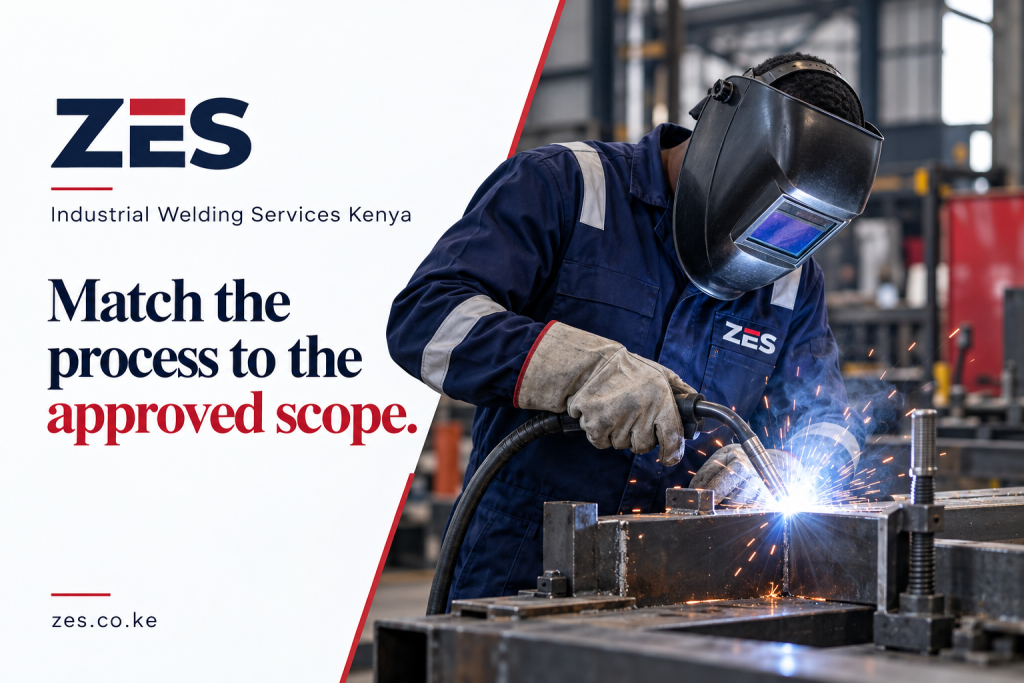
Industrial welding services Kenya should be specified around the material, component duty and actual project requirements. Repairing a machine guard, joining structural work and modifying a process component can require different responsibilities and evidence. This section extends the established industrial-contractor guide with a practical enquiry and acceptance framework. It does not claim universal process capability or unverified qualifications.
Identify the component and intended duty
Describe what the item does, the material information available and whether it is new fabrication or repair. Share drawings, equipment references and relevant service conditions through an appropriate project channel. A weld that looks neat does not by itself establish suitability for a component's duty. Keep missing material or design information visible so the responsible assessment can determine the next step.
Industrial welding services Kenya: allocate technical responsibility
Name the party who specifies the joint, approves any repair and establishes acceptance requirements. The applicable process, personnel and inspection arrangements should follow the actual work scope. Do not assume a contractor's general welding advertisement proves every qualification or procedure needed. Request current evidence relevant to the proposed task. A quotation should state technical assumptions and limits rather than quietly accept an undefined duty.
Choose workshop or site work deliberately
A workshop may provide controlled access, while site work may avoid moving an installed component. The decision depends on the item, access, surrounding operations and suitable work arrangements. Ask what the proposed package includes for preparation, handling and making good. Where equipment is involved, the customer and competent team should establish the relevant isolation and return-to-service responsibilities.
Plan records and inspection before welding
The order should identify the material, fabrication or repair information, hold points and inspection evidence required. Not every job needs the same testing, and a general article should not prescribe it. Ask who performs and accepts any specified checks. Record approved deviations and repairs. Evidence is more useful when it can be connected to the actual component and work performed.
Coordinate finishes and associated works
Coatings, linings, adjacent components and installed services may need attention before and after welding. Identify who assesses the effect of the proposed work and restores the agreed finish or condition. Do not infer compatibility from a photograph. Additional machining, electrical or specialist work should be identified as separate responsibilities where applicable. Compare complete proposals rather than a welding-only labour figure.
Define acceptance and ongoing support
Agree what completion means: dimensions, fit, specified inspection evidence, making good and any customer operational checks. Record unresolved items before return to normal use. Keep the repair or fabrication records with relevant equipment information. The written offer should explain support terms without promising that one intervention prevents every future fault. Changes in duty should prompt an appropriate review.
Compare the project scope
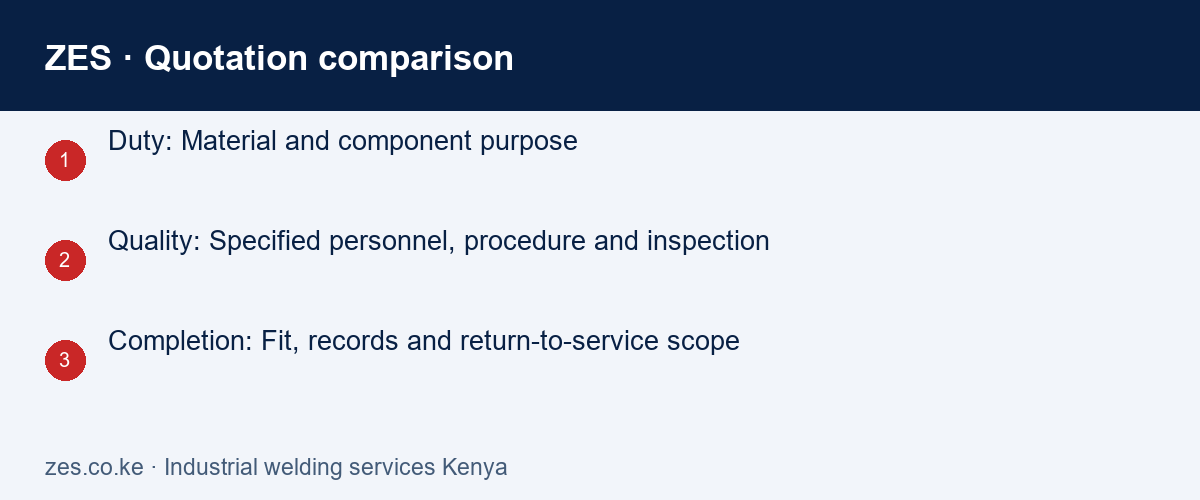
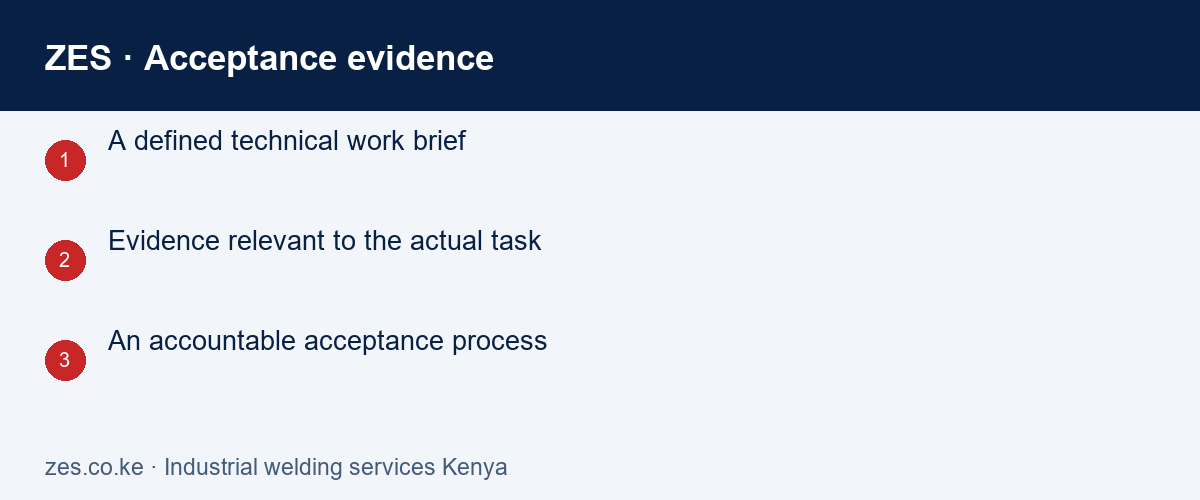
| Decision | Information to confirm | Useful acceptance evidence |
|---|---|---|
| Duty | Material and component purpose | A defined technical work brief |
| Quality | Specified personnel, procedure and inspection | Evidence relevant to the actual task |
| Completion | Fit, records and return-to-service scope | An accountable acceptance process |
A practical planning example
A factory guard repair and a pressure-containing component repair should not receive the same assumed scope merely because both involve welding. The relevant competent parties should establish the requirements for each. This is an illustrative scope distinction, not a repair instruction.
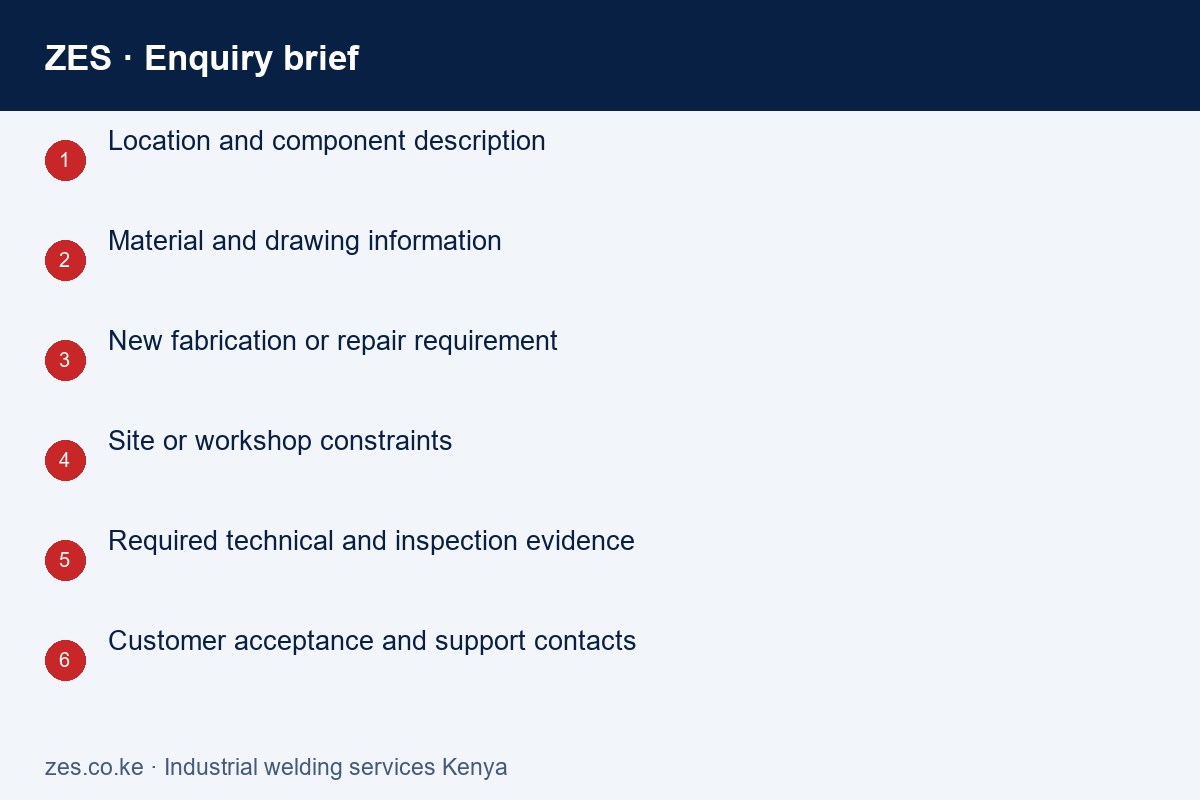
Industrial welding services Kenya: enquiry checklist
- Location and component description
- Material and drawing information
- New fabrication or repair requirement
- Site or workshop constraints
- Required technical and inspection evidence
- Customer acceptance and support contacts
Related enquiry: Industrial welding project services Kenya. Include the location and the intended outcome so the proposed scope can address the actual requirement.
Frequently asked questions
Does this page prove every welding certification?
No. Request and verify the specific evidence required for the actual work and proposed personnel.
Can ZES assess a site welding enquiry?
Share the component, location and constraints so the appropriate assessment and proposal arrangements can be confirmed.
Is visual appearance enough for acceptance?
Acceptance should follow the agreed project requirements and specified competent inspection, not appearance alone.
Industrial welding services Kenya: discuss the scope with ZES
Read the related ZES project planning guide and explore welding and metal fabrication services. Share the site, quantities, existing equipment and required outcome. Assessment, availability, delivery responsibilities and commercial terms are confirmed in the written proposal.
Request a scoped quotation · Request a site assessment · Call +254 725 345 345
Further reference: NCA contractor information. Product instructions and project-specific specialist advice remain important for the actual equipment and work.
More detailed project planning
Industrial facilities depend on steel. Structures, platforms, frames, tanks, guards, conveyors, pipework supports and machine bases all depend on welding and fabrication being done correctly. When an industrial welding contractor gets it right, plant runs safely and reliably. When they get it wrong, the consequences range from failed inspections to production stoppages and serious accidents.
Industrial welding project enquiries
For a ZES quotation, share the asset or component, material and thickness where known, drawings, quantity, site access and required inspection records. The team can then confirm the assessment, fabrication, site work and supporting specialists required for your project.
Ask the written proposal to identify materials, quantities, preparation, finishing, installation, inspection, exclusions and handover records. Any required welder qualifications, specialist tests or compliance documents must be confirmed for the actual scope before appointment.
Finding the right industrial welding contractor in Kenya is therefore a business-critical decision. The market includes everyone from individual welders to full fabrication and installation companies. The difference is not just price — it is engineering, quality control, safety, capacity and the ability to deliver a complete scope.
This guide explains what industrial welding contractors do, the sectors they serve, the capabilities to look for, how quality and safety are managed, how projects are delivered, what affects cost, and how to choose a contractor you can trust with industrial work.
It is written for plant managers, maintenance engineers, project managers, procurement officers, factory owners and operations directors.
What Industrial Welding Contractors Do
Industrial welding contractors provide welding and fabrication services for industrial and commercial facilities. Their work typically includes:
Structural steelwork. Frames, columns, beams, trusses, platforms, mezzanines, stairs and supports.
Plant fabrication. Tanks, hoppers, chutes, ducting, guards, skids and equipment bases.
Repair welding. Repairing cracked frames, worn components, damaged structures and failed welds.
Modifications. Adapting equipment and structures for new processes, products or capacity.
On-site welding. Working at the client's site where fabrication cannot be done in a workshop.
Installation. Positioning, aligning, bolting and welding components on site.
Maintenance support. Planned and emergency welding support for operating plants.
Documentation. Drawings, material records, inspection reports and certificates.
A capable contractor combines welding skill with engineering, planning, quality control and safety management.
Industries Served
Industrial welding contractors serve a wide range of sectors in Kenya.
Manufacturing. Factories need platforms, guards, frames, conveyors, ducting and equipment supports.
Food and beverage. Hygienic stainless fabrication, conveyors, tanks, tables and maintenance welding.
Petroleum and fuel. Canopies, tank supports, walkways, pipework supports and structural steel.
Construction. Structural steel, canopies, staircases, balustrades and site fabrication.
Warehousing and logistics. Racking, mezzanines, platforms and structural repairs.
Energy and utilities. Supports, frames, platforms and maintenance welding.
Mining and quarrying. Heavy-duty structures, chutes, guards and repairs.
Hospitals and institutions. Security structures, equipment supports and maintenance.
Agriculture and agro-processing. Silos, hoppers, conveyors and equipment supports.
Each sector has specific requirements, and a good contractor adapts to them.
Core Capabilities to Look For
Not every contractor can handle every job. The capabilities to assess include:
Welding Processes
A capable contractor should be competent in multiple processes — MIG/MAG, TIG, stick and others — and able to select the right process for the material and application.
Materials
Experience with mild steel, stainless steel, aluminium and galvanised steel. Each material requires different techniques and consumables.
Engineering and Drawings
The ability to interpret and produce shop drawings, and to work with structural engineers where required.
Workshop Capacity
Adequate space, equipment and lifting capacity to fabricate the required components safely.
On-Site Capability
The ability to work safely and effectively at the client's site, including permits, access and coordination.
Quality Control
Welding procedures, welder qualification, inspection and documentation.
Safety Management
Hot-work permits, PPE, working at height and site safety procedures.
Project Management
Planning, scheduling, coordination and communication.
A contractor who is strong in welding but weak in engineering, quality or safety is a risk on industrial work.
Quality Assurance in Industrial Welding
Quality is not luck. It is a system.
Welding procedure specifications. Define how joints should be welded for each material and thickness.
Welder qualification. Confirms that welders can achieve the required standard.
Material certificates. Confirm the grade and properties of steel supplied.
Joint preparation. Clean, properly fitted joints before welding.
Heat control. Prevents distortion and preserves material properties.
Weld inspection. Visual inspection and, where required, non-destructive testing.
Dimensional inspection. Confirms components match drawings and tolerances.
Documentation. Records of materials, inspections and tests.
For structural, pressure, lifting or safety-critical work, inspection is essential. Ask what will be inspected and who will do it.
Non-Destructive Testing
Some welds cannot be verified by looking. Non-destructive testing (NDT) detects internal defects.
Visual inspection. The first and most common check.
Dye penetrant testing. Detects surface-breaking defects.
Magnetic particle testing. Detects surface and near-surface defects in ferromagnetic materials.
Ultrasonic testing. Detects internal defects in thicker sections.
Radiographic testing. Uses X-rays or gamma rays to inspect welds.
Hardness testing. Checks material properties after welding.
The appropriate testing depends on the criticality of the joint and the standard being applied. A good contractor will explain the options and provide results.
Safety on Industrial Sites
Industrial welding carries serious hazards.
Hot work. Permits, fire watch, shielding and clearance of combustibles.
Working at height. Scaffolding, harnesses, guardrails and safe access.
Confined spaces. Procedures, gas testing and rescue arrangements.
Lifting and handling. Cranes, hoists and safe manual handling.
Fumes and ventilation. Extraction and respiratory protection.
Electrical safety. Isolated and protected equipment.
Grinding and cutting. Guards and eye protection.
Site traffic. Coordination with vehicles and equipment.
Emergency response. Clear procedures and first aid.
A contractor with a genuine safety culture will have procedures, trained staff and a record to show.
Workshop versus On-Site Welding
Industrial work happens in two settings.
Workshop fabrication offers controlled conditions, better equipment, consistent quality and safer working. It suits structural components, tanks, guards and repeatable items.
On-site welding is used where components are too large to transport, where existing structures must be modified, or where site conditions require adjustment. It is more exposed to weather, access and safety constraints.
Site installation includes positioning, aligning, bolting, welding, grouting and finishing.
A good contractor plans the split deliberately, because it affects quality, cost and programme.
Project Delivery Process
Professional industrial welding projects follow a clear sequence.
1. Enquiry and site visit. Understand the requirement and inspect the site.
2. Design and drawings. Produce or review drawings and specifications.
3. Quotation. Provide an itemised quotation with scope and assumptions.
4. Planning. Confirm programme, resources, materials and safety arrangements.
5. Fabrication. Cut, form, weld and finish components.
6. Inspection. Check dimensions, welds and finish.
7. Delivery and installation. Transport, position, align and fix.
8. Commissioning. Test and confirm.
9. Handover. Documentation, training and acceptance.
10. Support. Maintenance and follow-up.
Clear project management is as important as welding skill.
What Affects Industrial Welding Cost in Kenya
Cost depends on scope, specification and conditions.
Material. Mild steel, stainless and aluminium vary widely in cost.
Weight and complexity. More steel and more complex joints cost more.
Welding process. TIG is slower than MIG; inspection adds cost.
Quality requirements. Higher standards and testing add cost.
Finishing. Painting, galvanising and powder coating add cost.
Site conditions. Access, height and confined spaces increase labour.
Downtime constraints. Working in a live plant adds complexity.
Transport. Remote sites increase logistics costs.
Documentation. Certificates and reports add value.
A good quotation itemises material, fabrication, finishing, delivery, installation and inspection.
How to Choose an Industrial Welding Contractor
Use this checklist.
1. Do they visit the site? Industrial work needs assessment.
2. Do they provide drawings? Or can they work from yours?
3. Do they explain quality control? WPS, welder qualification and inspection.
4. Do they have relevant experience? Similar industries and structures.
5. Are they safe? Permits, PPE and site procedures.
6. Do they have workshop capacity? Enough to deliver on time.
7. Can they work on site? With proper permits and coordination.
8. Do they provide documentation? Drawings, certificates and reports.
9. Can they support maintenance? Ongoing support matters.
10. Do they show comparable work? References and examples.
Common Mistakes Buyers Make
Choosing on price alone. Cheap welding often fails inspection or fails in service.
No drawings. Fabrication without drawings invites errors.
Under-specifying material. Thinner or lower-grade steel saves money and fails sooner.
Ignoring inspection. Weld defects may not be visible until failure.
No safety planning. Industrial sites are hazardous.
Poor site measurement. Components that do not fit cause expensive rework.
No maintenance plan. Structures and equipment degrade over time.
Unrealistic timelines. Rushed work compromises quality.
No documentation. Future maintenance and audits become harder.
Industrial Welding by Sector
Manufacturing: platforms, guards, frames and equipment supports.
Food and beverage: hygienic stainless fabrication and maintenance welding.
Petroleum: canopies, tank supports and structural steel.
Construction: structural steel, staircases and canopies.
Warehousing: racking, mezzanines and structural repairs.
Energy: supports, frames and platforms.
Mining: heavy-duty structures and repairs.
Institutions: security structures and equipment supports.
Each sector has specific requirements, and a good contractor adapts.
Capability Statement: What a Serious Contractor Provides
Industrial buyers often ask for a capability statement. A strong one covers:
Company profile. Experience, sectors served and years in operation.
Technical capability. Welding processes, materials and fabrication capacity.
Engineering. Drawing production, structural coordination and calculations.
Quality systems. Welding procedures, welder qualification, inspection and NDT.
Safety. Policies, training, permits and incident record.
Workshop. Size, equipment, lifting and capacity.
Site capability. On-site welding, installation and coordination.
Project experience. Comparable projects and references.
Compliance. Registration, insurance and statutory compliance.
Documentation. Examples of drawings, inspection reports and certificates.
A contractor who cannot provide a capability statement is unlikely to handle serious industrial work.
Structural versus Plant versus Repair Welding
Industrial welding covers several distinct types of work.
Structural welding creates or modifies load-bearing structures: frames, platforms, mezzanines, canopies and supports. It requires engineering, drawings, qualified welders and inspection.
Plant fabrication produces equipment and components: tanks, hoppers, chutes, ducting, guards and skids. It requires attention to function, material and hygiene where relevant.
Repair welding restores damaged components: cracked frames, worn parts, failed welds and corroded structures. It requires assessment, root-cause understanding and appropriate repair techniques.
Modification welding adapts existing structures and equipment for new processes or capacity.
Maintenance welding supports operating plants through planned and emergency work.
Each type has different risks and quality requirements. A contractor who treats all welding the same is not thinking carefully.
Welding Codes and Standards
Industrial welding is governed by standards that define quality expectations.
Welding procedure specifications. Define the process, consumables, parameters and technique for a joint.
Welder qualification. Confirms that a welder can achieve the required standard for the material and position.
Structural welding standards. Define requirements for structural steelwork.
Pressure and tank standards. Apply to vessels and tanks where relevant.
NDT standards. Define inspection methods and acceptance criteria.
Material standards. Define steel grades and properties.
Safety standards. Cover hot work, confined spaces and working at height.
Buyers do not need to memorise the standards, but they should ask which standards apply and how compliance will be demonstrated.
Managing Industrial Projects
Industrial projects succeed on coordination.
Clear scope. Drawings, specifications and responsibilities.
Programme. Realistic sequencing of fabrication, delivery and installation.
Coordination. Interface with civil, electrical, mechanical and process works.
Hold points. Inspection points during fabrication and installation.
Materials. Availability and lead times.
Site access. Delivery, lifting and storage.
Permits. Hot work, height, confined space and site access.
Communication. Regular updates and issue resolution.
Documentation. Records and as-built drawings.
Handover. Acceptance and close-out.
Poor coordination is one of the most common causes of delay and rework.
Procurement and Prequalification
Industrial clients often prequalify contractors.
Registration. Company registration and statutory compliance.
Insurance. Liability and workers' compensation.
Safety record. Incidents, training and procedures.
Technical capability. Processes, materials and equipment.
Quality systems. Procedures and documentation.
Experience. Comparable projects and references.
Financial stability. Ability to complete the work.
Capacity. Workshop and site resources.
Compliance. Relevant licences and certifications.
Prequalification protects the client and improves project outcomes.
Emergency and Breakdown Welding
Industrial plants sometimes need urgent welding support.
Fast response. Availability and mobilisation.
Assessment. Identify the failure and the safest temporary solution.
Temporary repairs. Secure the situation and restore safe operation.
Permanent repair. Plan and execute a durable fix.
Root cause. Understand why the failure occurred.
Documentation. Record the repair and recommendations.
Preparedness. Pre-agree arrangements before emergencies occur.
Emergency capability is valuable, but it should not replace planned maintenance.
Building a Long-Term Contractor Relationship
Industrial clients benefit from long-term relationships.
Familiarity. The contractor knows the plant, drawings and standards.
Response. Faster mobilisation in emergencies.
Consistency. Same quality expectations over time.
Planning. Better maintenance scheduling.
Documentation. A shared history of work.
Pricing. Agreed rates for common tasks.
Improvement. Continuous learning about the plant.
Trust. Confidence in safety and quality.
A reliable contractor becomes part of the plant's maintenance capability.
Welding Quality: What Buyers Should Inspect
Buyers do not need to be welders, but they can check the basics.
Weld appearance. Consistent width, smooth profile, no visible cracks or excessive spatter.
Undercut. Deep grooves along the weld edge weaken the joint.
Porosity. Small holes indicate gas or contamination problems.
Slag inclusion. Trapped slag weakens the weld.
Distortion. Excessive heat can warp components.
Fit-up. Gaps and misalignment indicate poor preparation.
Finish. Grinding should improve appearance, not hide defects.
Documentation. Inspection records should match the work.
For critical work, insist on qualified inspection and NDT.
Materials Handling and Traceability
Industrial work often requires material traceability.
Material certificates. Confirm grade and properties.
Identification. Mark and track materials through fabrication.
Storage. Protect steel from moisture and contamination.
Cutting. Accurate cutting reduces waste and improves fit.
Offcuts. Manage and identify offcuts for future use.
Consumables. Store welding consumables correctly to avoid moisture damage.
Records. Link materials to components and inspections.
Traceability. Important for structural, pressure and safety-critical work.
Traceability supports quality, safety and accountability.
Site Safety and Permit-to-Work
Industrial sites operate under strict safety systems.
Permit to work. Formal authorisation before work begins.
Hot-work permit. Specific approval for welding, cutting and grinding.
Isolation. Lock-out/tag-out for energy sources.
Gas testing. For confined spaces and areas where flammable gases may be present.
Fire watch. Trained personnel and equipment during and after hot work.
Access control. Restrict access to work areas.
PPE. Appropriate to the hazards.
Emergency response. Clear procedures and contacts.
Reporting. Incidents and near-misses recorded.
A contractor who respects permit systems is safer and easier to work with.
Cost Planning and Value Engineering
Industrial welding budgets benefit from planning.
Define the scope. Avoid vague requirements that lead to variations.
Standardise. Repeated components reduce cost.
Design for fabrication. Simple, weldable details cost less.
Plan inspection. Build inspection into the programme.
Consider finishes. Choose finishes suited to the environment.
Plan maintenance. Design for access and repair.
Compare whole-life cost. Cheap work may cost more later.
Value engineering. Optimise without compromising safety or quality.
Value engineering is about spending where it matters, not cutting corners.
Common Industrial Welding Failures
Most failures trace back to predictable causes.
Poor preparation. Dirt, rust, moisture and poor fit.
Wrong consumables. Mismatched filler or damaged electrodes.
Excess heat. Distortion and reduced properties.
Lack of fusion. Insufficient penetration or travel speed.
Corrosion. Wrong grade or missing protection.
Fatigue. Cyclic loading on poorly designed joints.
Impact damage. Forklifts, equipment and materials.
Lack of inspection. Defects go unnoticed.
No maintenance. Corrosion and cracks progress.
Understanding failures helps buyers demand the right controls.
Frequently Asked Questions
What do industrial welding contractors do?
They provide welding and fabrication for industrial facilities, including structural steel, plant fabrication, repair welding, modifications, on-site welding and installation.
How do I choose an industrial welding contractor?
Look for relevant experience, engineering capability, quality control, safety practices, workshop capacity, documentation and references.
Do you provide welding procedures and inspection?
Yes. Welding procedures, welder qualification, inspection and documentation can be provided for industrial work.
Can you work on site?
Yes. On-site welding and installation can be carried out with proper permits, safety arrangements and coordination.
Do you fabricate in a workshop?
Yes. Workshop fabrication offers controlled conditions and consistent quality for components that can be transported.
What materials do you weld?
Mild steel, stainless steel, aluminium and galvanised steel, with the appropriate processes and consumables.
Do you provide drawings?
Yes. Shop drawings can be produced or reviewed, and structural work can be coordinated with engineers.
How long does a project take?
It depends on scope, materials and site conditions. A clear brief and drawings allow a realistic programme.
Do you work outside Nairobi?
Yes. Projects can be delivered across Kenya, with logistics reflected in the quotation.
Do you offer maintenance?
Yes. Planned and emergency welding maintenance can be provided for industrial facilities.
A Final Pre-Purchase Checklist
Before awarding industrial welding work, confirm the following. Make sure the site has been assessed. Check that the quotation itemises material, fabrication, finishing, delivery, installation and inspection. Confirm drawings and specifications. Ask about welding procedures, welder qualification and NDT. Confirm safety arrangements. Ask for references and comparable work. Confirm the programme and payment terms. Ask about documentation and maintenance support. Finally, compare quotations against the same specification.
A contractor who explains these points clearly is usually the one worth trusting with industrial work.
Conclusion
Industrial welding contractors in Kenya are part of the infrastructure that keeps factories, warehouses, plants and facilities operating safely. The difference between a contractor who delivers and one who creates problems is the engineering, the quality control, the safety management, the capacity and the support.
If you are planning industrial welding or fabrication, start with the requirement and the site. Then insist on drawings, a proper quotation, inspection and documentation.
ZES provides industrial welding, fabrication, installation and maintenance for factories, plants and facilities across Kenya. If you would like a practical assessment and a clear, itemised quotation, start with a site visit.
Request an industrial welding assessment and quotation from ZES
Related Welding Services
Explore the rest of our welding and fabrication capability:
- Welding and Metal Fabrication Kenya
- Food processing plant welding services
- Stainless steel fabrication contractors
- Commercial structural welding
- Industrial equipment repair welding
- On-site welding contractors
- Food-grade stainless steel welding