
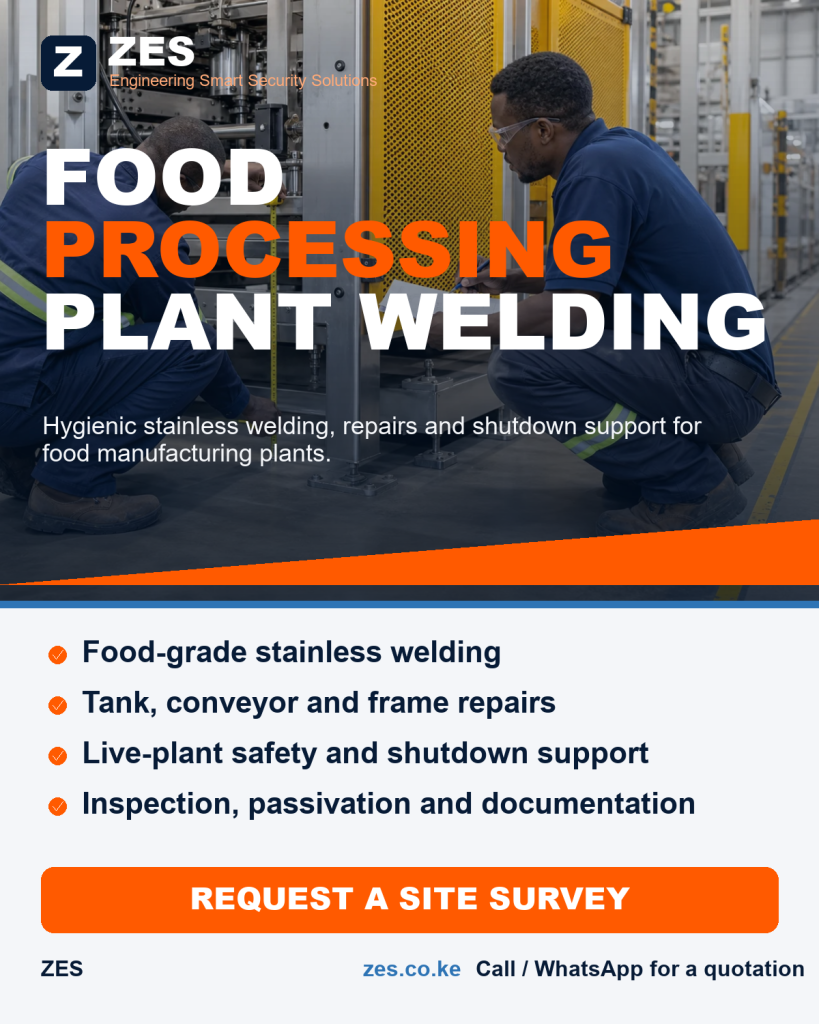
Food processing plants are unforgiving environments. Equipment runs for long shifts, is washed down with water and chemicals, and must meet hygiene standards that protect consumers and brands. When welding is needed — for a repair, a modification, a new line or an emergency — it has to be done in a way that protects food safety as well as structural integrity.
Plan welding around food production
For a ZES quotation, share the product-contact areas, cleaning chemicals, existing material records, shutdown window, isolation responsibilities and hygiene acceptance requirements. The team can then confirm the assessment, fabrication, site work and supporting specialists required for your project.
Ask the written proposal to identify materials, quantities, preparation, finishing, installation, inspection, exclusions and handover records. Any required welder qualifications, specialist tests or compliance documents must be confirmed for the actual scope before appointment.
Food processing plant welding services in Kenya cover the specialist welding work that food factories need: hygienic stainless steel welding, repairs to tanks, conveyors, tables and frames, modifications during shutdowns, and emergency response when production stops. It is not general welding. It requires the right materials, the right processes, careful finishing and a working understanding of food safety.
This guide explains what plant welding services involve, why food plants are different, the welding processes and materials used, how hygienic welds are achieved, how to work safely in a live plant, how shutdowns and emergencies are managed, and how to choose a contractor who understands food manufacturing.
It is written for plant managers, maintenance engineers, quality and food safety teams, production managers and factory owners.
What Plant Welding Services Cover
Food processing plants need welding support across a wide range of equipment and structures.
Tanks and vessels. Repairs, modifications, nozzles, supports and internal welds.
Conveyors and frames. Repairing frames, supports, guides and transfer points.
Tables and workstations. Repairs and modifications to stainless tables and frames.
Hoppers and chutes. Repairing wear points, replacing sections and modifying flow.
Ducting and extraction. Repairs and modifications to ventilation and dust extraction.
Equipment guards. Fabrication and repair of machine guards.
Platforms and access structures. Repairs and modifications to stairs, platforms and walkways.
Pipework supports. Repair and modification of supports and brackets.
Structural repairs. Repairing corroded or damaged structural steel.
Emergency repairs. Responding to failures that stop production.
The scope ranges from small repairs to complete fabrication packages.
Why Food Plants Are Different
Welding in a food plant is not the same as welding in a warehouse or workshop.
Hygiene. Welds in food-contact or splash zones must be smooth, cleanable and free of crevices that harbour bacteria.
Food safety. Repairs must not introduce contamination — metal particles, lubricants, paint or consumables.
Corrosion resistance. Stainless steel must retain its protective oxide layer; heat tint and contamination must be removed.
Washdown. Equipment is cleaned with water and chemicals; welds and finishes must withstand that.
Live production. Work often happens while the plant is operating, requiring isolation and protection.
Audits. Food safety audits examine welds, surfaces and documentation.
Downtime cost. Every hour of stoppage is expensive, so planning matters.
These factors make food plant welding a specialist service.
Materials Used in Food Plants
Material selection is central to food safety.
Grade 304 stainless steel is the standard food-grade material. It offers good corrosion resistance and weldability.
Grade 316 stainless steel contains molybdenum for improved resistance to chlorides and aggressive environments. It is common in dairy, meat, seafood, brine and chemical-cleaning applications.
Duplex and other alloys may be used in specific corrosive environments.
Mild steel may be used for non-contact structural elements, but it must be protected and kept out of splash zones where possible.
Food-grade plastics and elastomers are used for seals and guides, and must be suitable for food contact and cleaning.
Filler metals must match the base material and application.
Using the wrong grade or filler can cause corrosion and contamination.
Welding Processes for Food Plants
Different processes suit different situations.
TIG Welding
Tungsten inert gas welding offers precise control and clean welds. It is widely used for stainless steel in food plants, especially thin sections and hygienic welds.
Orbital Welding
Automated orbital welding is used for pipework in hygienic applications, providing consistent, repeatable welds.
MIG Welding
MIG can be used for thicker sections and frames, but requires care to avoid spatter and rough finish on food-contact areas.
Stick Welding
Stick welding is more common for structural mild steel and site repairs, but is less suitable for thin stainless and hygienic finishes.
Purging
For stainless pipework and tanks, purging the backside with inert gas prevents oxidation and produces clean internal welds.
The process should be selected for the material, position, access and hygiene requirement.
Achieving Hygienic Welds
Hygienic welding is about more than strength.
Joint design. Joints should be designed for full penetration and smooth finish where required.
Fit-up. Clean, accurate fit-up reduces gaps and defects.
Heat control. Controlled heat limits distortion and preserves corrosion resistance.
Shielding and purging. Proper gas shielding prevents oxidation.
Weld profile. Smooth, continuous welds without undercut or crevices.
Heat tint removal. Discolouration must be removed to restore corrosion resistance.
Passivation. Restores the protective oxide layer after welding.
Surface finish. Grinding and polishing to a cleanable finish.
Cleanliness. Remove swarf, spatter and consumables.
Poor hygienic welding is a common cause of corrosion and contamination in food plants.
Passivation and Pickling
Passivation and pickling are important finishing steps.
Pickling removes heat tint, scale and contamination from stainless steel using acid-based products.
Passivation restores the passive oxide layer that protects stainless from corrosion.
When required. After welding, after mechanical damage, and in corrosive environments.
Verification. Tests can confirm the passive layer is present.
Safety. Chemicals must be handled and disposed of safely.
Documentation. Record what was done.
Skipping passivation can lead to rapid corrosion at welds.
Working in a Live Plant
Many food plants cannot stop for welding work.
Permits. Hot-work permits and isolation procedures.
Lock-out/tag-out. Isolate energy sources before work.
Screens and protection. Protect product, equipment and surfaces.
Fume and dust control. Extract fumes and control grinding dust.
Fire safety. Clear combustibles, fire watch and extinguishers.
Hygiene. Clean and inspect before production resumes.
Access control. Restrict access to the work area.
Coordination. Work with production and quality teams.
Documentation. Record work, materials and sign-off.
Working in a live plant requires discipline and planning.
Shutdown Planning
Shutdowns are the best time for larger welding work.
Scope definition. List all work to be done.
Planning. Schedule work, resources and materials.
Preparation. Fabricate components in advance where possible.
Sequencing. Coordinate with other trades and inspections.
Permits. Arrange in advance.
Contractor mobilisation. Ensure the contractor is ready.
Inspection. Plan hold points and NDT.
Commissioning. Test before production resumes.
Documentation. Record work and results.
Contingency. Allow for unforeseen work.
Good shutdown planning avoids overruns and missed work.
Emergency Repairs
Breakdowns happen, and welding is often part of the response.
Fast assessment. Identify the failure and the safest temporary solution.
Temporary repairs. Secure the situation and restore safe operation.
Permanent repair. Plan and execute a durable fix.
Root cause. Understand why the failure occurred.
Communication. Keep production and quality informed.
Documentation. Record the repair and recommendations.
Preparedness. Pre-agree arrangements before emergencies occur.
Emergency capability is valuable, but planned maintenance is better.
Repair versus Replace
Not every failed component should be welded.
Repair is usually right when: the structure is sound, the failure is local, and the repair restores safe function at reasonable cost.
Replacement is usually right when: the item is extensively corroded, distorted, repeatedly failing or at the end of its life.
Food safety considerations should guide the decision. A repair that cannot be cleaned properly should not return to food contact.
Cost and downtime also matter; sometimes replacement is faster and cheaper than repair.
A good contractor will assess honestly.
Quality and Inspection
Inspection should cover fabrication and hygiene.
Visual inspection. Weld appearance and finish.
Dye penetrant testing. Surface-breaking defects.
Radiographic or ultrasonic testing. Internal defects where required.
Borescope inspection. Internal welds in tanks and pipework.
Passivation verification. Confirms corrosion resistance.
Dimensional checks. Fit and alignment.
Cleaning validation. Confirms equipment can be cleaned.
Documentation. Records of inspection and results.
Documented inspection supports food safety audits.
What Affects Plant Welding Cost
Cost depends on complexity and conditions.
Material. 316 and thicker sections cost more.
Access. Confined spaces, height and difficult locations increase labour.
Hygiene requirements. Hygienic finishing adds time.
Inspection. NDT and documentation add cost.
Downtime constraints. Working in a live plant adds complexity.
Urgency. Emergency work costs more.
Shutdown windows. Compressed schedules may require additional resources.
Transport. Remote sites increase logistics costs.
A good quotation itemises materials, labour, finishing, inspection and documentation.
How to Choose a Food Plant Welding Contractor
Use this checklist.
1. Do they understand food safety? Hygiene and cleanability.
2. Do they weld stainless properly? TIG, purging, heat control and passivation.
3. Do they work safely in a live plant? Permits, isolation and protection.
4. Do they provide inspection? Visual, NDT and documentation.
5. Do they plan shutdowns? Sequencing and coordination.
6. Can they respond to emergencies? Availability and mobilisation.
7. Do they provide material certificates? Traceability.
8. Can they fabricate components in advance? Reducing shutdown time.
9. Do they have relevant experience? Similar food processes.
10. Do they show comparable work? References in food plants.
Common Mistakes in Food Plant Welding
Using general welding standards. Hygiene and cleanability are overlooked.
Wrong grade or filler. Corrosion and contamination.
No purging. Oxidised internal welds.
No passivation. Welds corrode quickly.
Rough welds and crevices. Dirt traps.
Poor protection during work. Contamination of product and equipment.
No inspection. Defects go unnoticed.
Skipping cleaning. Contamination risk.
No documentation. Difficult to audit.
Choosing only on price. Cheap work costs more over time.
Plant Welding by Sector
Dairy: tanks, pipework, hygienic welds and passivation.
Meat and poultry: tables, conveyors, wash stations and repairs.
Bakery: frames, conveyors and oven supports.
Beverages: tanks, pipework and hygienic fabrication.
Grain and milling: hoppers, chutes, ducting and structures.
Fruit and vegetables: wash stations, conveyors and tables.
Confectionery: tables, frames and equipment.
Oils and fats: tanks, pipework and corrosion-resistant fabrication.
Each sector has specific requirements, and a good contractor adapts.
Hygienic Design of Welded Joints
Some joint designs are inherently more hygienic than others.
Full-penetration welds. Where possible, joints should be welded through to avoid gaps.
Butt welds. Often preferred for hygienic applications because they can be finished flush.
Lap joints. Can create crevices and are generally avoided in food-contact areas.
Fillet welds. Common in frames and supports, but must be smooth and cleanable if in food zones.
Removable joints. Where cleaning requires dismantling, joints should support that.
Radiused transitions. Smooth transitions reduce dirt traps.
Drainable designs. Joints should not create areas where liquid pools.
Access for finishing. The welder must be able to finish the weld properly.
Good joint design is cheaper than trying to clean a poor weld for years.
Tank and Vessel Welding
Tanks and vessels require particular care.
Internal welds. Must be smooth, cleanable and fully penetrated where required.
Purging. Internal purging prevents oxidation on stainless.
Nozzles and fittings. Welds around nozzles are common leak points and need careful preparation.
Supports. Must carry the weight safely and allow cleaning.
Covers and vents. Should prevent contamination while allowing access.
Drainage. Outlets and slopes should allow complete drainage.
Inspection. Borescope inspection may be needed for internal welds.
Testing. Leak testing and, where required, pressure testing.
Tank welding failures can cause leaks, contamination and production loss.
Conveyor and Frame Repair
Conveyors are constantly in motion and take wear.
Frame cracks. Often caused by fatigue or impact; repair must restore strength.
Belt tracking. Misalignment may be caused by frame distortion.
Guides and rails. Wear and damage affect product handling.
Legs and supports. Corrosion and impact damage.
Hygiene. Repairs must not create crevices or rough surfaces.
Alignment. After repair, conveyors must run true.
Testing. Run the conveyor and check tracking and function.
Conveyor repairs that ignore alignment cause recurring downtime.
Weld Cleaning and Contamination Control
Stainless welds need cleaning to perform.
Heat tint. Discolouration must be removed; it can become a corrosion site.
Weld spatter. Must be removed, especially on food-contact surfaces.
Grinding dust. Iron particles from grinding can cause surface rust; they must be removed.
Pickling. Removes scale and contamination.
Passivation. Restores the passive layer.
Rinsing. Removes chemical residues.
Verification. Tests can confirm cleanliness and passivation.
Documentation. Record cleaning and treatment.
Contamination control is essential in food plants.
Documentation and Audit Readiness
Food safety audits examine welding work.
Material certificates. Evidence of grade and traceability.
Weld procedures. Specification of the welding process.
Welder qualification. Evidence of competence.
Inspection reports. Visual and NDT results.
Cleaning and passivation records. Evidence of finishing.
Drawings. As-built records.
Repair records. What was done and why.
Maintenance history. Ongoing records.
Good documentation makes audits easier and protects the business.
Building a Welding Maintenance Programme
Rather than reacting to failures, plants can plan.
Asset register. List welded equipment and structures.
Inspection schedule. Regular checks for cracks, corrosion and damage.
Priority ranking. Critical equipment first.
Contractor arrangement. Pre-agree response and rates.
Spares and materials. Common materials available.
Shutdown plan. Schedule larger work.
Records. Track failures and repairs.
Review. Use records to plan replacements.
A programme reduces downtime and emergency costs.
Selecting Welders for Food Plant Work
Not every welder is suited to food plants.
Stainless experience. Thin sections, TIG and heat control.
Hygiene awareness. Understanding cleanability and contamination.
Attention to finish. Willingness to grind, polish and passivate.
Safety discipline. Permits, PPE and working in occupied plants.
Documentation habits. Records and traceability.
Problem-solving. Repair assessment and root cause.
Communication. Working with production and quality teams.
Experience in similar plants. Dairy, meat, beverage or bakery.
The welder's skill and discipline determine the quality of the work.
Common Stainless Welding Defects
Food plant welding has characteristic defects.
Heat tint. Discolouration that reduces corrosion resistance.
Lack of fusion. Insufficient bonding between weld and base metal.
Porosity. Gas trapped in the weld.
Undercut. Groove along the weld edge.
Cracks. Often from heat, restraint or contamination.
Distortion. Warping from excessive heat.
Rough finish. Surfaces that trap dirt.
Crevices. Gaps that harbour bacteria.
Spatter. Metal droplets on surfaces.
Understanding defects helps buyers inspect and demand correction.
Weld Testing Methods Explained
Different tests answer different questions.
Visual inspection. Detects surface defects and finish issues.
Dye penetrant. Detects surface-breaking defects in non-porous materials.
Magnetic particle. Detects surface and near-surface defects in ferromagnetic materials.
Ultrasonic. Detects internal defects in thicker sections.
Radiographic. Provides an image of internal weld quality.
Borescope. Inspects internal surfaces where access is limited.
Leak testing. Confirms tanks and pipework are leak-free.
Passivation testing. Confirms corrosion resistance.
The right test depends on the joint and the standard.
Managing Multiple Contractors on a Shutdown
Shutdowns often involve several contractors.
Coordination. A single point of control for the shutdown.
Sequencing. Work that must happen before or after others.
Permits. Coordinated hot-work and isolation permits.
Access. Shared site access and lifting.
Safety. Shared safety rules and inductions.
Welfare. Facilities for contractors.
Communication. Regular coordination meetings.
Inspection. Shared inspection and handover points.
Documentation. Consolidated records.
Poor coordination can delay the whole shutdown.
Example Plant Welding Scenarios
Scenario one: a leaking tank seam. Assessment, isolation, cleaning, cutting back to sound metal, rewelding, passivation and leak testing.
Scenario two: a cracked conveyor frame. Inspection, temporary support, repair or replacement of the damaged section, alignment and testing.
Scenario three: a new nozzle on a vessel. Design, preparation, purging, welding, inspection and pressure testing.
Scenario four: emergency repair of a failed support. Fast response, temporary support, permanent repair and root-cause review.
Scenario five: shutdown modification. Pre-fabrication, planned installation, inspection, commissioning and documentation.
These scenarios show why planning and quality control matter.
Frequently Asked Questions
What are food processing plant welding services?
They are specialist welding and repair services for food factories, including hygienic stainless welding, tank and conveyor repairs, modifications, shutdown work and emergency response.
Why is food plant welding different?
Because welds must be hygienic, cleanable and corrosion-resistant, and work often happens in a live production environment with food safety risks.
Which stainless steel is used in food plants?
Grade 304 is common, while 316 is used where higher corrosion resistance is required, such as dairy, meat and aggressive cleaning environments.
Do you passivate welds?
Yes, where required. Passivation restores corrosion resistance after welding, which is important in food environments.
Can you work during production?
Where required, work can be planned around production with isolation, screening and cleaning. Some work is better done during shutdowns.
Do you provide inspection and NDT?
Yes. Visual inspection and, where required, dye penetrant, radiographic or ultrasonic testing can be provided.
Can you fabricate components in advance?
Yes. Pre-fabricating components reduces shutdown time and disruption.
Do you respond to emergencies?
Emergency response can be arranged, subject to availability.
Do you provide material certificates?
Yes. Material certificates support traceability and audits.
Do you work outside Nairobi?
Yes. Services can be provided across Kenya, with logistics reflected in the quotation.
A Final Pre-Purchase Checklist
Before engaging a food plant welding contractor, confirm the following. Make sure they understand food safety and hygiene. Check their stainless welding and passivation approach. Confirm safety arrangements for live-plant work. Ask about inspection and documentation. Confirm shutdown planning and pre-fabrication. Ask about emergency response. Confirm material traceability. Ask for references in food plants. Finally, compare quotations against the same scope and hygiene requirements.
A contractor who explains these points clearly is usually the one worth trusting in a food plant.
Conclusion
Food processing plant welding services in Kenya are a specialist combination of welding skill, food safety knowledge and production awareness. The difference between work that passes audits and lasts, and work that causes corrosion, contamination and downtime, is the material, the process, the finishing, the inspection and the planning.
If you need welding in a food plant, start with the process, the cleaning regime and the production constraints. Then insist on hygienic welding, proper finishing, inspection and documentation.
ZES provides welding, stainless fabrication, shutdown support and maintenance for food processing plants across Kenya. If you would like a practical assessment and a clear, itemised quotation, start with a site visit.
Request a food plant welding assessment and quotation from ZES
Related Welding Services
Explore the rest of our welding and fabrication capability: