
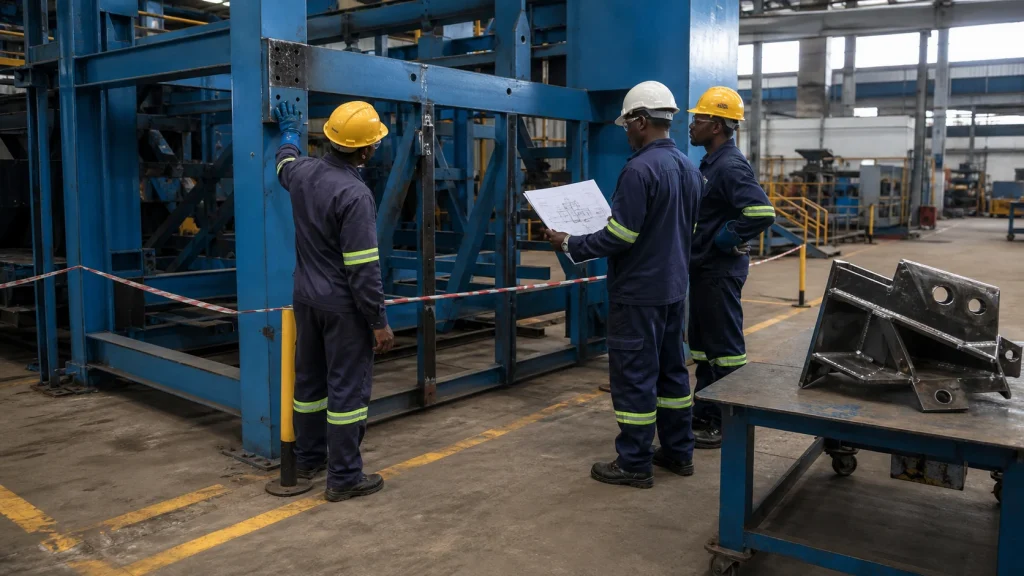
Booking industrial welding services Nairobi facilities can accommodate safely is largely a planning exercise. Welding beside operating equipment, stored materials or busy access routes is different from fabricating a component in a workshop. The buyer must define the operational window, site rules and acceptance process, while the work team confirms what can be prefabricated and what genuinely needs site fitting.
This guide is for facilities, production and maintenance teams preparing a controlled welding intervention. It supports the ZES industrial metal fabrication and welding service, which remains the commercial page for assessment requests.
Triage the operational problem before choosing a work method
Describe what has changed: a bracket is loose, a frame is cracked, a guard no longer aligns, or a new support is required. Record when the issue appears, what equipment is affected and whether use has already been restricted by the responsible facility team. Photographs help, but they do not reveal hidden corrosion, repeated loading or inaccessible base material.
Avoid assuming that welding is automatically the correct remedy. A failed part may require replacement, a revised detail or review of the underlying cause. Where the item affects structural stability, machine safeguarding or a pressurised or process system, route the decision to the appropriate specialists and approved documentation.
Classify the work as planned fabrication, planned repair or urgent condition assessment. This makes priorities clearer without promising an arbitrary attendance or completion time.
Gather information for the site review
Provide the exact facility location, access contact, affected equipment, approximate dimensions and clear images of the work and its surroundings. Add any known material information and previous repair history. State whether drawings, manuals or maintenance records are available.
Show the route from the gate to the work area. Door widths, stairs, lifts, floor loading restrictions, security procedures and vehicle access may determine which tools or prefabricated parts can be brought in. Identify available working space and whether temporary storage is permitted.
List adjacent activities and services: production lines, electrical cabling, gas lines, combustible storage, ventilation, drainage, offices or public routes. The site’s responsible team will need this context when establishing isolations, permits and controls suited to the facility.
Separate workshop work from site work
Site welding can be reduced when measurements and details allow components to be cut, drilled, assembled and finished in a workshop. This may limit disruption and improve access to all sides of a part. It can also simplify housekeeping at an operational facility.
However, existing equipment and irregular interfaces sometimes require site fit-up. Identify critical dimensions that must be verified and provide an approval stage before fabrication. Templates or trial fitting may be useful for repeated brackets or unusual geometry.
Create a task split showing workshop fabrication, delivery, removal of existing material, site preparation, final fitting, finishing and cleanup. The quotation can then reflect the actual site exposure rather than treating every hour as the same activity.
If the need is an isolated installed repair rather than a production component, the related ZES welding repair service provides a more focused commercial route.
Coordinate the production window and work area
Agree when the area can be released, who confirms isolation and who returns it to service. Production stoppage, cooling, cleaning, product removal or equipment access may need to happen before the welding team enters. Put these prerequisites in the work plan and assign owners.
Define the work boundary and nearby pedestrian or vehicle routes. Sparks, heat, fumes, noise, cables and equipment movement can affect areas beyond the immediate joint. The responsible site parties should establish the required permits, fire controls, ventilation, screening and monitoring for the actual conditions.
Plan delivery and removal. A repaired guard is not useful if it blocks a route during restart, and offcuts or used consumables should not remain near production. Include protection of nearby finishes and a housekeeping check in the scope.
Control decisions discovered during the job
Once a surface is cleaned or a component removed, the base material may be worse than photographs suggested. Agree who may stop the work, who assesses the new condition and how a revised action is approved. A predefined escalation path prevents the team from concealing uncertainty beneath a larger weld.
Record a short before-and-after description and any authorised change in dimensions, reinforcement or component replacement. If the discovery falls outside the agreed expertise or information, isolate the condition and obtain the appropriate review instead of improvising.
When several similar defects exist, consider sampling the broader asset population. One failed bracket may indicate impact, alignment or corrosion affecting others. That assessment can be planned separately from the immediate intervention.
Use a restart-focused completion check
Completion is not simply “welding finished.” Check the agreed dimensions, clearances, fasteners, moving parts, finish repair, guards, removed tools and housekeeping. Confirm that temporary items are removed or formally retained under the site’s process.
The facility’s responsible person should control return to service. Where the project requires a specific inspection or functional test, define it before work and record the result. A fabricator’s visual review does not replace process, machine or structural acceptance required by others.
Retain useful records with the asset: photographs, approved sketch, material or finish notes where requested, and follow-up observations. This creates a better starting point if the area is inspected again.
Frequently asked questions
Can an industrial welding job be quoted from photographs?
Photographs may support an initial discussion, but final scope often depends on base condition, access, measurements, material identification and operational controls that require verification.
How can site disruption be reduced?
Confirm dimensions early, prefabricate suitable components, prepare the area before the team arrives, coordinate a defined release window and agree the restart check in advance.
Who decides when equipment can return to service?
The facility should assign an authorised responsible person and follow its applicable procedures. The decision may depend on checks outside the welding scope.
What if more damage is found after cleaning?
Pause, document the condition and use the agreed escalation route. The revised repair or replacement decision should be reviewed and authorised before work continues.
For a planned Nairobi industrial welding enquiry, send ZES the site location, photographs, operating window and affected asset details. The team can identify the next assessment step and information required.